
You've decided to adopt in South Australia. Then you discovered that only zero to three infants are placed for local adoption each year, the Adoption Act 1988 is one of the oldest in the country, and the Department for Child Protection runs a four-stage process that the website describes in eight paragraphs of clinical prose -- with no explanation of what actually happens at each stage, what disqualifies you, or how much it really costs.
You've read the DCP website. You found the "Adopting an Australian-born child" booklet -- a document written from the department's perspective that lists administrative stages but never tells you how to prepare for the social worker's first home visit. You found the fee schedule showing $709 for the Expression of Interest, $935 for the application, $912 for the assessment, and $454 for placement -- but nothing about the GP appointments, specialist medical reports, home safety modifications, or Youth Court legal fees that push the real cost well past $5,000. You found Relationships Australia SA, which provides excellent post-adoption support but has nothing for families who haven't entered the system yet. And you found Reddit threads where people mix up Permanent Care Orders with adoption, cite timelines from 2015, and give advice based on the NSW or Victorian systems that work completely differently.
The information exists. It's scattered across the Adoption Act 1988, the Adoption Regulations 2022, DCP policy documents written for caseworkers, DHS screening guidelines, Legal Services Commission fact sheets, Youth Court practice directions, and archived forum threads from families who went through the process years ago under different rules. Piece it together yourself and you'll spend months reading documents that explain the rules in departmental language but never tell you what to do first, second, and third as a prospective parent in South Australia.
The DCP Assessment Decoder
This guide was built for the problem every South Australian family hits: a system controlled by a single department with no private agency alternative, governed by legislation written in 1988, screened by DHS, finalised by the Youth Court, and so restrictive that most families never see a placement. Every chapter, every checklist, every cost figure is grounded in the Adoption Act 1988 (SA), the Adoption Regulations 2022, current DCP policies, DHS screening requirements, and the real-world experience of families who have navigated this system.
What's inside
- The Adoption Act 1988 in plain English -- South Australia's adoption law is one of the oldest in the country and among the most prescriptive. The guide translates the Act's requirements into practical language: the "best interests of the child" principle, the open adoption framework, the consent and revocation process, and the 2016 adult adoption amendments. You'll understand what the law requires of you before you interact with DCP -- not after.
- The 5-year cohabitation rule decoded -- SA requires five years of continuous cohabitation in a qualifying relationship before you can apply. That's more than double what NSW and the Northern Territory require. The guide explains exactly what documentation DCP accepts as proof -- joint utility bills, lease agreements, statutory declarations -- and whether "special circumstances" arguments have ever succeeded in the Youth Court. This is the eligibility question that catches the most families off guard.
- DHS Screening survival guide -- Before DCP will assess you, the Department of Human Services runs a Working with Children Check and a comprehensive risk assessment. The guide walks you through what triggers a "care concern," how past interactions with government agencies are evaluated, what the Screening Organisation Portal requires, and what to do if your online identity verification fails. Screening delays of months are common when complications arise. The guide tells you how to avoid them.
- The four-stage DCP process mapped step by step -- Expression of Interest, education workshop, assessment, and registration. For each stage: exactly what happens, what DCP is looking for, what documents you need, how long it takes, what the unspoken criteria are, and where families most commonly stall. The DCP website gives you the sequence. This guide gives you the strategy.
- Complete cost breakdown with hidden expenses -- The DCP administrative fees total $3,010 across four stages. But the true cost includes GP appointments ($80-$150), specialist medical reports ($200-$500), home safety modifications ($100-$1,000), time off work for mandatory education workshops and home visits, and Youth Court legal representation ($2,000-$5,000). The guide itemises every cost by stage so there are no surprises.
- Youth Court preparation guide -- SA adoption orders are finalised in the Youth Court. The guide covers what documents the court requires, how hearings work, what the judge evaluates, and how to prepare evidence that supports your application. Most families don't learn about this step until they're already in it.
- The suitability self-audit -- A pre-application checklist that lets you assess your finances, health history, housing, relationship duration, and background against the criteria DCP social workers use during assessment. Identify potential issues before you pay the $709 EOI fee -- not after. This chapter alone can save you months of emotional investment if a disqualifying factor exists.
- Open adoption and the contact plan -- SA law requires ongoing contact between adoptive families and birth parents. The guide explains what goes into a contact plan, how to negotiate sustainable arrangements, what your legal obligations are, and how to protect your family's stability while honouring the birth parents' rights under the 1988 Act.
- Permanent Care and alternative pathways -- With only zero to three infant placements per year, the guide doesn't pretend local adoption is easy. It maps Permanent Care Orders, long-term guardianship, intercountry adoption through Hague Convention partners, step-parent adoption, and adult adoption -- comparing costs, timelines, eligibility, and legal outcomes so you choose the right pathway before investing years in the wrong one.
- Adult adoption guide -- Since the 2016 amendments and 2018 regulations, adults raised in foster or step-parent care can be legally adopted by their parental figures. The guide covers eligibility, the application process, court requirements, and what this means for inheritance, next-of-kin status, and birth certificates. An entire segment of the adoption market that most resources ignore.
- 90-day action plan -- Week-by-week steps from "seriously considering" to "formally in the system." When to start your DHS screening (allow months for processing), when to schedule medical exams, when to contact DCP, and when to submit your Expression of Interest with everything already in order.
Who this guide is for
- Post-IVF couples exploring adoption for the first time -- You've spent years in clinics. You've processed the grief of infertility enough to consider a new path, but the complexity of the SA system is creating a new kind of anxiety. The guide gives you the procedural clarity to match the emotional commitment you've already made -- so you don't waste months researching only to discover a disqualifying factor on page one of the DCP assessment.
- Families considering permanent care alongside adoption -- You want legal permanency for a child. In South Australia, that might mean adoption, or it might mean a Permanent Care Order. The guide compares both pathways honestly -- legal standing, parental rights, financial support, and long-term outcomes -- so you choose the one that serves your family and the child.
- Step-parents who need legal standing -- You've been parenting this child for years. You want the birth certificate, the medical authority, the inheritance rights. SA's step-parent adoption process has specific eligibility rules and court requirements. The guide walks you through from eligibility check to Youth Court order.
- Families considering intercountry adoption -- The overlap between SA state requirements, Commonwealth requirements, and partner country requirements is where most families get lost. The guide maps all three layers so you don't discover you're ineligible after investing years and tens of thousands of dollars.
- Single applicants navigating the system alone -- South Australia permits single-person adoption. In practice, the assessment may involve harder questions about support networks and parenting capacity. The guide covers what assessors are looking for and how to present your application when you don't have a co-applicant.
- Adults seeking to formalise a lifelong bond -- If you were raised by someone who isn't your legal parent -- a foster carer, a step-parent, a family member -- the 2016 adult adoption amendments may apply to you. The guide covers the process, the court requirements, and what changes legally when an adult adoption order is made.
Why the free resources aren't enough
The DCP website gives you a four-stage overview written in department language. It lists the fees but not the real costs. It describes the process but not the preparation. It doesn't tell you what the social worker is evaluating during your home visit, how to handle the DHS screening if complications arise, or what the Youth Court judge expects to see in your application. The "Adopting an Australian-born child" booklet prioritises state interests -- risk management and the best interests of the child -- over the navigational needs of the parent. It doesn't mention that the 5-year cohabitation rule is one of the strictest in Australia, or that Permanent Care might be a more realistic pathway for most families.
Relationships Australia SA provides specialist support through PASS and ICAFSS -- but these services focus on post-adoption counselling and adult adoptee reunification, not pre-adoption preparation. Adopt Change gives a strong national overview but can't tell you how DHS screening works in SA, what the Youth Court process involves, or how SA's 1988 Act compares to the more modern legislation in other states. Reddit and Facebook groups offer emotional support and anecdotal experience -- and also mix up SA's adoption process with Victoria's Permanent Care system, cite timelines from before the 2022 regulations, and give advice that doesn't account for how few placements actually happen in this state.
Printable standalone worksheets included
The guide comes with printable standalone PDFs designed for real-world use:
- Pathway Comparison Card -- Local adoption, permanent care, intercountry, step-parent, and adult adoption on one page. Costs, timelines, eligibility, and first steps for each route. Print it, sit down with your partner, and make the decision that shapes everything else.
- Document Checklist -- Every document DCP, DHS, and the Youth Court will request, organised by stage. DHS screening forms, medical reports, financial records, reference contacts, and home safety requirements. Nothing missing when the social worker arrives.
- Suitability Self-Audit Worksheet -- Assess your eligibility across the criteria DCP uses during assessment: relationship duration, health, housing, finances, and background. Complete this before you submit the $709 EOI -- not after.
- Post-Adoption Action Plan -- New birth certificate from SA Births, Deaths and Marriages, Medicare updates, Centrelink registration, passport application, and every administrative step after the Youth Court order, in sequence with contacts and processing times.
The free Quick-Start Checklist
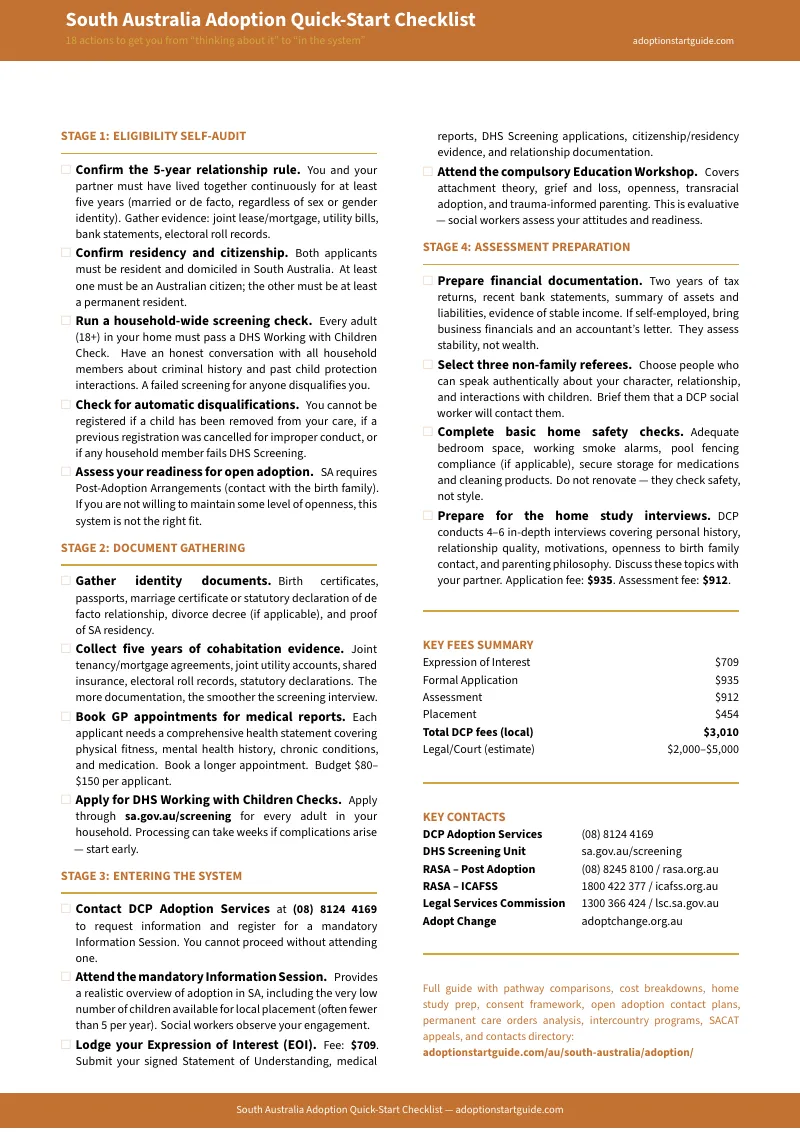
Download the South Australia Adoption Quick-Start Checklist for a one-page overview of the key steps from first enquiry through to Youth Court finalisation. Free, no commitment. If you want the full guide with the DCP Assessment Decoder, the suitability self-audit, the cost breakdown, the Youth Court preparation guide, and all the printable worksheets, click the button in the sidebar.
-- less than the GP appointment you'll need for your EOI health statement
A single GP visit in Adelaide costs $80 to $150. The DCP Expression of Interest fee is $709 -- non-refundable. Youth Court legal representation runs $2,000 to $5,000. The DCP Assessment Decoder doesn't replace your solicitor. It makes sure you don't pay your solicitor to teach you the basics of South Australian adoption law. And it makes sure you don't discover the 5-year cohabitation rule, the DHS screening complications, or the real cost of the process after you've already paid the EOI fee and invested months of emotional energy. If the guide doesn't deliver what you need, you're covered by a refund guarantee, no time limit -- no questions, no risk.