You want to foster a child in South Australia. The system expects you to navigate DCP policy manuals, choose between six competing NGOs, and survive a DHS screening process that nobody explains -- all before your first placement.
You went to the Department for Child Protection website. It told you that foster care provides "safe, stable and supportive" homes for children. It listed the steps to become a carer in broad strokes. It mentioned Lutheran Care, Uniting Communities, AnglicareSA, ac.care, Centacare, and Life Without Barriers as fostering agencies. It did not tell you what makes any of them different. It did not tell you that Lutheran Care runs a specialist therapeutic model while Uniting Communities operates the KEW program with a different support structure entirely. It told you to call one of them and "express your interest." You weren't sure which one to call. The website didn't help you decide.
While you waited, you searched "foster care Adelaide Reddit." You found a carer who described bonding with a toddler for fourteen months, attending every medical appointment, learning the child's bedtime routine -- then having the child returned to a birth parent they believed was still unsafe. The system's focus on reunification meant the carer had no standing to challenge the decision. You found another thread where someone described their DCP caseworker changing three times in a single year because of department turnover. You found a post from a regional carer near Port Augusta who said the "24/7 support line" was a phone call to Adelaide, two hours away. You closed the tab and sat with it for a few days.
Then you looked into the DHS screening. You knew you needed a Working with Children Check. You didn't know that every adult in your household needs one too -- your partner, your adult child still living at home, anyone who stays overnight regularly. You didn't know that the screening can take eight weeks or more, and that certain past medical history or minor police interactions might not disqualify you but will trigger a review that nobody at the DCP website explains. Your partner asked what happens if something shows up. You couldn't answer. Neither could the brochure.
Meanwhile, you heard about the "Shared Stories Shared Lives" training and "Building Connections" communication standards. The DCP site mentioned them. The NGO sites mentioned them. Nobody explained what they actually cover, how they connect to the assessment timeline, or what happens during the six to ten home visits where an assessor evaluates your relationship stability, your parenting philosophy, your capacity for grief, and your understanding of trauma. The training prepares you for the child's needs. Nothing prepares you for the assessment of you.
The SA Carer's Authority Map: Your Independent Guide to Foster Care in South Australia
This guide is built for how the South Australian foster care system actually works in 2026 -- the Department for Child Protection regulations, the NGO accreditation pipeline, the DHS Screening Unit process, the Shared Stories Shared Lives training curriculum, the Children and Young People (Safety) Act 2017 translated into carer rights, the payment structure that most free resources describe in vague terms, and the Adelaide-metro-vs-regional divide that affects everything from caseworker response times to cultural stewardship obligations. Every chapter reflects current SA law, the specific NGO landscape from Adelaide to the Eyre Peninsula, and the operational realities that DCP compliance pages and agency recruitment brochures systematically leave out. It is not a national fostering handbook with "South Australia" in the title. It is the operating manual for this state's system.
What's inside
- NGO Comparison Framework -- South Australia routes foster care through Non-Government Organisations, not a single department. Lutheran Care, Uniting Communities, AnglicareSA, ac.care, Centacare Catholic Country SA, and Life Without Barriers each operate with different models of care, geographical coverage, caseworker-to-carer ratios, and after-hours support capacity. Lutheran Care runs a specialist therapeutic model. Uniting Communities operates the KEW program. Centacare covers country SA from Port Augusta to the Far North. The guide compares what matters -- support structure, crisis response, respite availability, regional coverage, and specialisation -- so you choose an agency based on substance, not which one had the best information session.
- DHS Screening Survival Guide -- The Department of Human Services screening is the step that stalls more SA applications than any other. The guide explains the full Working with Children Check process for every adult in your household, the child protection history checks, the medical assessments, what triggers an extended review, typical processing times (and who to contact when it exceeds eight weeks), and how to have the screening conversation with reluctant household members -- because the awkwardness of asking your adult stepson to get checked is a real barrier that nobody at the DCP will help you navigate.
- Safety Act 2017 Carer Rights Decoder -- The Children and Young People (Safety) Act 2017 is the legislation that governs your role as a carer, but most prospective carers never read it. The guide translates the sections that matter into plain English: Section 79 (your right to receive all relevant information before a placement), Section 157 (your right to request an internal DCP review of decisions you disagree with), and the SACAT external review pathway. You have legal rights. The guide makes sure you know what they are before your first placement arrives.
- The "Who Pays for What" Worksheet -- South Australia's carer allowance structure includes the base rate (tiered by age), loading levels 1 through 4 for children with complex needs, respite payments, education grants, and start-up establishment costs. The guide provides current figures, explains what each payment tier covers, clarifies the difference between the base rate and the additional loadings you may be entitled to, and addresses the financial reality honestly -- because the 2021 "True Cost of Caring" research found that SA carers are systematically out of pocket, and the guide shows you how to document expenses and advocate for the loading level your child's needs require.
- Assessment and Home Visit Preparation -- The assessment involves six to ten home visits, deep interviews about your personal history, referee checks, and a written evaluation that becomes part of your permanent file. The guide decodes what assessors are actually evaluating at each stage: relationship stability, emotional regulation, capacity for grief when reunification happens, flexibility around placement preferences, and your understanding of trauma-informed care. It includes a preparation framework so you can be thorough without feeling like you've handed over your diary.
- Adelaide Metro vs. Regional and Remote SA -- Metropolitan Adelaide carers deal with higher agency density, more caseworker options, and closer access to specialist services at the Women's and Children's Hospital. Regional carers in Port Augusta, Whyalla, Mount Gambier, the Eyre Peninsula, and the Far North face service access barriers that Adelaide carers never encounter -- limited after-hours support, travel for family contact visits that consume entire days, and a cultural stewardship landscape involving Aboriginal communities that requires genuine engagement, not just a training tick-box. The guide addresses both realities with specific logistics for each.
- Building Connections Communication Decoder -- South Australia's Building Connections communication standard defines how professionals should interact with carers and families. The guide teaches you to use its five promises -- timely, clear, personalised, accessible, and transparent communication -- as a benchmark you can hold your DCP caseworker and NGO support worker to. This shifts you from being a passive subject of the system to an informed partner in the care of the child.
- Aboriginal and Torres Strait Islander Cultural Stewardship -- South Australia has a disproportionately high number of Aboriginal children in care. The Aboriginal and Torres Strait Islander Child Placement Principle governs placement decisions, and non-Aboriginal carers who receive a First Nations child need to understand cultural safety obligations, the role of Principal Aboriginal Consultants, cultural camps at sites like Iga Warta in the Flinders Ranges, and "Return to Country" logistics. The guide explains these requirements clearly so you can meet them with respect rather than anxiety.
Who this guide is for
- Adelaide families in the suburbs -- You have a spare room in Tea Tree Gully, Noarlunga, Salisbury, or Marion and you've been thinking about fostering for months. You've attended an AnglicareSA or Lutheran Care information session. You picked up the brochures. You need the independent comparison that tells you which NGO fits your suburb, your work schedule, and your family situation -- not the one that's spending the most on recruitment marketing.
- Regional and remote SA families -- You're in Port Augusta, Mount Gambier, Whyalla, the Eyre Peninsula, or the Flinders Ranges. Every training session and agency meeting requires planning around distance, work, and childcare. You need to know which NGOs operate in your region, what after-hours support actually looks like when you're two hours from Adelaide, and how to manage family contact visits when the birth parent lives in the city and you don't.
- Kinship carers who just received a placement -- DCP placed your grandchild, your niece, or a family connection with you. You have limited time to understand your rights under the Safety Act, the carer allowance you're entitled to, the training requirements, and the ongoing obligations. The guide covers the kinship pathway specifically -- because the process for relatives is different from the general foster care pipeline, and nobody hands you a manual at the door.
- People considering respite care as a first step -- You're not ready for a long-term placement, but you want to help. Respite care in SA provides short breaks for existing carers, and it's how many successful long-term carers started. The guide explains the respite pathway, the separate assessment requirements, the payment structure, and how respite experience feeds into a full carer application if you decide to continue.
- LGBTQ+ individuals and couples -- South Australia's equal opportunity protections are clear, and NGOs actively recruit diverse carers. The guide addresses how the assessment handles same-sex couples and single applicants, which agencies have specific support programs, and the practical realities of the process so you enter with confidence, not guesswork.
- Single applicants -- You don't need a partner to foster in SA. But the assessment process evaluates your support network differently when you're doing it alone. The guide addresses how single applicants demonstrate capacity, what assessors look for in your personal support structure, and how to prepare for questions about managing placement demands without a co-carer.
Why the free resources fall short
The DCP website publishes the statutory framework and lists the approved NGOs. It does not compare them. The NGO websites -- Lutheran Care, Uniting Communities, AnglicareSA, ac.care -- are recruitment tools. Their job is to get you to call, attend an information session, and sign up with them specifically. None of them will tell you that a different agency might be a better fit for your location, your work hours, or your care preferences. They're sales material dressed as information resources.
The SA.GOV.AU "Steps to Become a Foster Carer" page provides a clean overview that omits almost everything a prospective carer actually worries about: which NGO to choose, what the DHS screening really involves, how the assessment evaluates you personally, what happens when you disagree with a DCP decision, and whether the allowance covers the actual cost of care. Centacare's "Fostering Hope" booklet covers country SA in broad strokes. The DCP Manual of Practice is a 27-megabyte policy document designed for departmental staff, not prospective carers trying to figure out if they qualify.
Reddit and local Facebook groups provide raw, emotional accounts from current and former SA carers -- some from 2020, some from last week, some from interstate mislabelled as South Australian. The advice is real but unsorted, outdated, and impossible to verify against current regulations. Etsy sells foster care planners and binders that are designed for the American system -- different laws, different agencies, different payment structures. A binder built for a US "home study" won't tell you anything about the DHS Screening Unit, the Safety Act 2017, or the difference between Lutheran Care's specialist model and Uniting Communities' KEW program.
The free Quick-Start Checklist
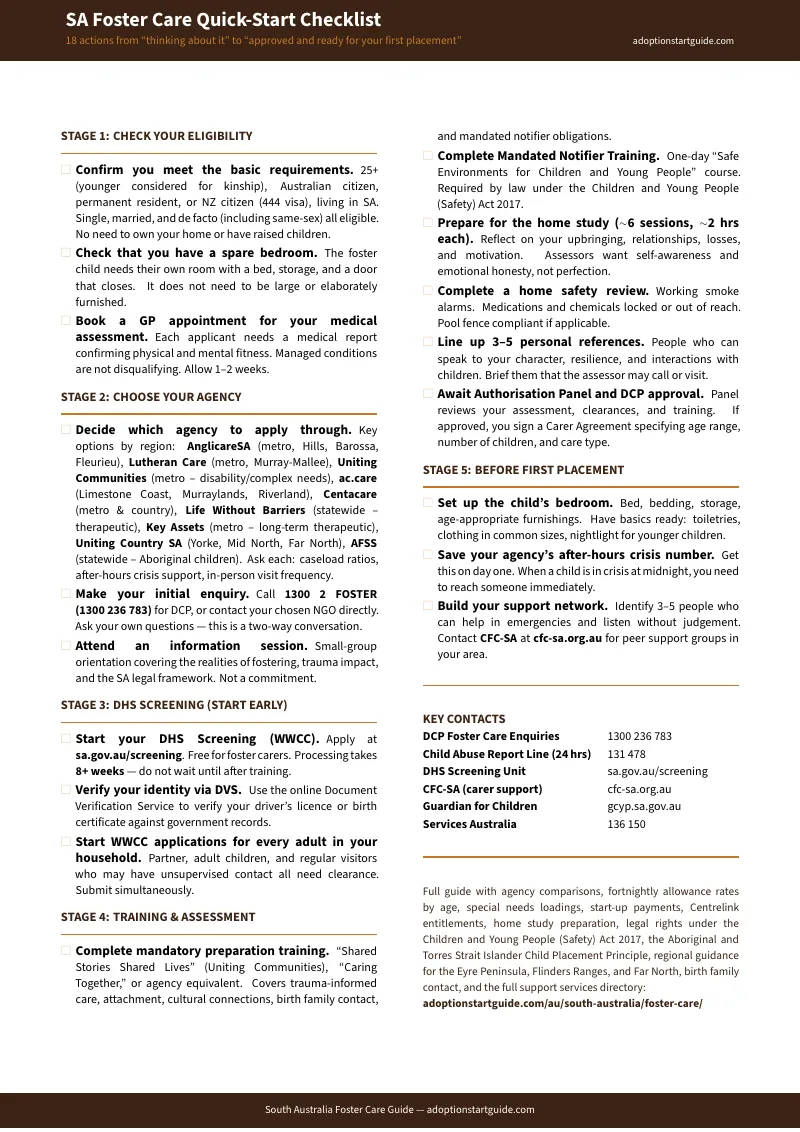
Download the South Australia Foster Care Quick-Start Checklist for the essential steps from first enquiry through NGO accreditation -- including the DHS screening requirements and home safety items that cause the most delays. Free, instant download, no commitment. If you want the full guide with the NGO comparison framework, the DHS Screening survival guide, the Safety Act carer rights decoder, the "Who Pays for What" worksheet, the assessment preparation framework, Adelaide-vs-regional logistics, the Building Connections decoder, and the cultural stewardship guidance, click the button in the sidebar.
-- less than the petrol for one round trip to an NGO information session you're not sure is right for you
One wrong agency choice means months invested in an organisation whose support model doesn't match your needs. One incomplete DHS screening application for a household member stalls your entire assessment for eight weeks or more. One misunderstanding about your rights under Section 79 -- not knowing you can demand placement information before saying yes -- sets you up for a first-night crisis that could have been prevented. This guide puts South Australia's complete foster care accreditation process in your hands for less than what most families spend on the parking and coffee for a single agency open day. Families who understand the system before they enter it ask the right questions at their first NGO meeting, pass the home assessment on the first visit, and walk into their first placement prepared.
If the guide doesn't deliver, reply to your download email at any time for a full refund. No forms. No justification required.