You've decided to adopt in Victoria. Then you discovered that two separate government departments, a 42-year-old Act of Parliament, and a brand-new law that just changed everything are each running a piece of the process -- and none of them will tell you how to start.
Victoria is the only Australian state where adoption sits in one department and child protection sits in another. In 2019, the Victorian Government transferred adoption services from the Department of Health and Human Services to the Department of Justice and Community Safety. That means Adoption Victoria now lives inside DJCS, while the Department of Families, Fairness and Housing still controls permanent care, foster care, and the child protection system. If you're a foster carer hoping to adopt the child in your home, you're about to discover that the department that knows your case is not the department that processes adoptions -- and neither website tells you how to cross the gap.
You've already done the research. You found the DFFH website, which scatters adoption-adjacent information across policy pages designed for social workers, not parents. You found Adoption Victoria's pages on vic.gov.au, which explain that you need an Expression of Interest but never map the five stages that follow it. You found Adopt Change, which provides an excellent national overview but can't tell you that Victoria finalises adoptions in the County Court's Adoptions, Surrogacy, and Name Changes List -- not the Children's Court, not the Supreme Court, and not the Family Court. And you found Facebook groups where well-meaning strangers mix up Victoria's Permanent Care Orders with New South Wales's Guardianship Orders and Queensland's Blue Card rules in the same thread.
The information exists. It's scattered across the Adoption Act 1984, the Children Youth and Families Act 2005, the brand-new 2026 Stability Act, DFFH permanent care fact sheets, DJCS adoption guidelines, Anglicare Victoria brochures, and County Court practice directions. Piece it together yourself and you'll burn weeks reading documents that explain the rules in department language but never tell you what to do first, second, and third as a prospective parent.
The Two-Department Decoder
This guide was built for the problem every Victorian family hits: a system split between two departments, governed by legislation that was deliberately designed to be difficult, and just reshaped by a 2026 reform that most families haven't heard about yet. Every chapter, every checklist, every cost figure is grounded in the Adoption Act 1984 (Vic), the 2026 Stability Act, current DJCS and DFFH policies, and the real-world experience of families who have adopted in this state.
What's inside
- The DFFH/DJCS split decoded -- Which department handles what, and why it matters. DFFH manages child protection, foster care, and Permanent Care Orders. DJCS houses Adoption Victoria, which runs both domestic and intercountry programs. If you're a foster carer pursuing adoption, your case crosses both departments. This chapter maps exactly who you contact, when, and for what -- so you stop being bounced between workers with different priorities.
- Five-pathway comparison table -- Local infant adoption (approximately 10-12 placements per year across all of Victoria), adoption from out-of-home care, known-child adoption for step-parents and relatives, adult adoption, and intercountry adoption through Hague Convention partners. Costs, timelines, eligibility, and realistic wait expectations mapped side by side so you choose the right pathway before investing months in the wrong one. Local adoption legal costs run $2,000 to $5,000 for the County Court process. Intercountry adoption totals $10,000 to $40,000 or more.
- The Adoption Act 1984 in plain English -- Section 8's "paramount consideration" principle, Part 2 eligibility (modernised in 2016 to include same-sex couples and single applicants), Part 3's strict consent requirements including the 30-day revocation period, and Part 4 governing adoption orders. The Act was written in response to Victoria's forced adoption history. This chapter explains what the legislation requires in practice so you work with it instead of being surprised by it.
- The 2026 Stability Act explained -- On 12 May 2026, the Children Youth and Families Amendment (Stability) Act commenced, replacing "permanency" with "stability" across Victoria's child protection framework. Adoption has been removed from the hierarchy. The system now prioritises relational, cultural, physical, and legal stability -- and Permanent Care Orders satisfy all four without severing birth family ties. This chapter explains what the reform means for your application and your pathway.
- Permanent Care versus Adoption -- the full comparison -- The single greatest source of confusion in the Victorian system. An Adoption Order permanently severs legal ties to birth parents, issues a new birth certificate, and lasts forever. A Permanent Care Order transfers parental responsibility until the child turns 18 but does not change the birth certificate and requires ongoing contact with birth family. The "18-Year Cliff" -- the fact that a PCO ends entirely when the child turns 18, with no ongoing legal parent-child relationship -- is the detail most families don't hear about until it's too late. This chapter gives you the side-by-side comparison on legal rights, identity implications, and long-term consequences so you understand what each order gives you before you accept one.
- The five-stage assessment process -- From your Expression of Interest through mandatory education seminars, the home study (four to six in-depth interviews in your own home), the Adoption Panel recommendation, and the supervised placement period. The home study is the most invasive phase -- social workers evaluate criminal checks, Working with Children Checks for every adult in your household, medical reports, financial stability, your childhood attachment history, and your relationship dynamics. This chapter explains what assessors look for and how to prepare.
- County Court process guide -- Victorian adoptions are finalised in the County Court's Adoptions, Surrogacy, and Name Changes List. The application requires the child's original birth certificate, evidence of consent or a dispensation order under Section 43, and the Guardian's Report. This chapter covers filing requirements, what happens in the courtroom, and how the order flows to BDM Victoria for a new birth certificate.
- Known-child and step-parent adoption guide -- Victoria's courts are famously cautious. Under Sections 11 and 12 of the Adoption Act, the court must be satisfied that a Parenting Order under the Family Law Act 1975 (Cth) would not be adequate. Step-parent adoption is typically only granted in exceptional circumstances. This chapter covers the consent requirements, the "Parenting Order first" threshold, and the full timeline to County Court finalisation.
- Intercountry adoption navigator -- Victoria works with five partner countries: Colombia, Chile, South Korea, Taiwan, and Thailand. Each has its own criteria layered on top of Victorian and Commonwealth requirements. The process takes three to five years from application to arrival. This chapter maps eligibility across all three layers so you know where you stand before you pay a dollar.
- Financial planning framework -- Current DJCS and DFFH fees for every pathway, County Court filing costs, legal representation estimates, intercountry travel and translation expenses, and the hidden costs that neither department's website itemises.
- Post-adoption support and records -- VANISH for search and reunion support, PCA Families for peer support, ICAFSS for free therapeutic support for intercountry adoptees, and Relationships Australia for family counselling. Plus the Adoption Information Register Victoria and integrated birth certificates.
- Aboriginal Child Placement Principle -- Aboriginal and Torres Strait Islander children in Victoria are subject to placement priorities that the 2026 Stability Act -- influenced by the Yoorrook Justice Commission -- has reinforced. Non-Aboriginal applicants must demonstrate commitment to cultural connection through a formal Cultural Plan. This chapter explains what it means for your application.
Who this guide is for
- Post-IVF couples exploring adoption for the first time -- You've been through years of treatment. You've made the decision -- and maybe you're still processing whether adoption feels like a "second choice." It isn't. But you need the procedural clarity to match the emotional commitment you've already made. The guide maps your pathway before you commit to the wrong one.
- Foster carers pursuing permanency -- The child in your home has had reunification ruled out. The 2026 Stability Act has changed the landscape, and you need to understand whether adoption or a Permanent Care Order is the right legal outcome. The guide explains the transition from carer to legal parent across both pathways.
- Step-parents who need legal standing -- You've been parenting this child every day. You want the birth certificate, the medical authority, the inheritance rights. Victoria's "Parenting Order first" threshold means adoption is granted only in exceptional circumstances -- the guide walks you through the legal test and the full County Court process.
- Families considering intercountry adoption -- The triple-layer eligibility system -- Victoria, Commonwealth, and partner country -- feels impenetrable. The guide maps all three layers so you don't discover you're ineligible after investing years and thousands of dollars.
- Kinship carers formalising long-term arrangements -- You're a grandparent, aunt, or uncle who has been caring for this child and you want legal recognition. The guide covers both the PCO pathway through DFFH and the adoption pathway through DJCS.
Why the free resources aren't enough
The DFFH website covers permanent care in practitioner language. Adoption Victoria's pages on vic.gov.au explain the EOI process but don't map the five stages in the order a family completes them, and don't explain how the DJCS adoption pathway connects to the DFFH child protection system when your child is already in care. Adopt Change provides a national overview but doesn't address the two-department split, the 2026 Stability Act, or the County Court filing process. The accredited agencies -- Anglicare Victoria, Uniting Vic/Tas, CatholicCare Victoria (now exiting adoption and permanent care services) -- train foster carers, not adoptive parents. When you call, you're often steered toward foster care and reunification when your goal is adoption.
Facebook groups and Reddit threads give you emotional support and anecdotal experience. They also mix Victoria's Permanent Care Orders with New South Wales's Guardianship Orders, recommend relocation to the ACT to "bypass red tape," and offer advice based on processes that predate the 2016 same-sex amendments, the 2019 departmental transfer, and the 2026 Stability Act. In a system where 10-12 local infant placements happen per year across the entire state, secondhand advice from the wrong jurisdiction or the wrong decade is worse than no advice at all.
Printable standalone worksheets included
The guide comes with printable standalone PDFs designed for real-world use:
- Pathway Comparison Card -- All five Victorian adoption pathways on one page. Local infant, out-of-home care, known-child, adult, and intercountry. Costs, timelines, eligibility, and the first steps for each route. Print it, sit down with your partner, and make the decision that shapes everything else.
- Permanent Care vs Adoption Decision Matrix -- Side-by-side legal comparison: birth certificate changes, contact obligations, the "18-Year Cliff," cultural plan requirements, and inheritance implications. The one-page reference for the biggest decision in the Victorian system.
- Home Study Document Checklist -- Every document the social worker will request during the five-stage assessment, organised by category. Criminal checks, Working with Children Checks, medical reports, financial records, reference contacts, and home safety requirements. Nothing missing when the assessor arrives.
- Post-Finalisation Action Plan -- New birth certificate from BDM Victoria, Medicare enrolment, Centrelink updates, tax offset filing, and every administrative step after the County Court order, in sequence with contacts and processing times.
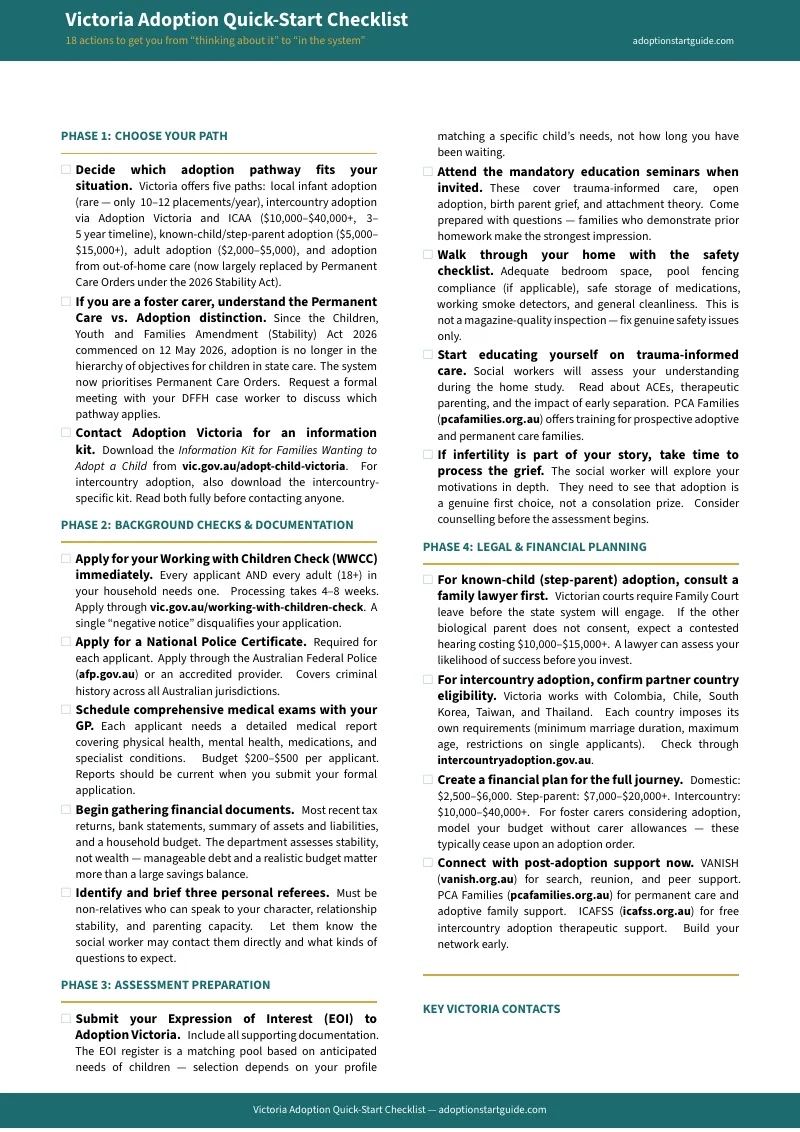
The free Quick-Start Checklist
Download the Victoria Adoption Quick-Start Checklist for a one-page overview of the key steps from first inquiry to County Court finalisation. Free, no commitment. If you want the full guide with the two-department decoder, the five-pathway comparison, the Permanent Care versus Adoption decision matrix, the 2026 Stability Act analysis, and all the printable worksheets, click the button in the sidebar.
-- less than a single hour of a Melbourne family lawyer's time
The average family lawyer in Melbourne charges $300 to $500 per hour. That's $600 to $1,000 of billable time before your lawyer addresses your actual case. The County Court process costs $2,000 to $5,000 in legal fees. The Two-Department Decoder doesn't replace your lawyer. It makes sure you don't pay your lawyer to teach you the basics of Victorian adoption law. And it makes sure you don't discover the DFFH/DJCS split, the 30-day revocation period, or the 2026 Stability Act the hard way. If the guide doesn't deliver what you need, you're covered by a refund guarantee, no time limit -- no questions, no risk.