
You're ready to adopt in Alberta. The system is not ready for you.
You started where everyone starts — Alberta.ca. You found a list of adoption types, a phone number for Children and Family Services, and a link to the "Adoption Self-Help Kit." You clicked the link. The PDF failed to open on your phone. You tried your laptop and got a fillable form designed for Adobe Reader 9. You went back to the webpage and found a bullet-point overview of the Child, Youth and Family Enhancement Act that answered the question "what is adoption?" when you needed the answer to "which pathway is fastest and cheapest for my situation?"
So you called an agency. Adoption Options in Edmonton or AMARIS in Calgary. The orientation was helpful — you learned about profile books and home studies and the general shape of the process. What they didn't explain is that their pathway — private domestic adoption — is one of four legal routes in Alberta, and it happens to be the most expensive one at $15,000 to $50,000. They didn't mention that public adoption through ACFS costs $0 to $2,000 and includes ongoing subsidies. They didn't mention it because that pathway doesn't involve an agency fee.
Then you joined the Facebook groups. A foster parent in Red Deer said she waited five years for a placement. A couple in Lethbridge said they were matched in six months. A kinship caregiver in Fort McMurray said you can adopt without an agency "if you're a relative," but she wasn't sure about the court paperwork. Someone posted a link to an American adoption checklist and called it "basically the same." It's not. Alberta's 10-day consent revocation window, the Permanent Guardianship Order system, and the Supports for Permanency income threshold are Alberta-specific rules with no US equivalent. And none of the Facebook commenters cited the CYFEA sections that actually govern these rules.
The gap you're experiencing is structural. Alberta.ca explains the rules but doesn't help you compare options. Agencies explain their option but not the alternatives. Social media provides lived experience without legal accuracy. And a single consultation with an adoption lawyer in Edmonton or Calgary runs $250 to $400 per hour — for a "general overview" of a process you haven't committed to yet.
The Alberta Adoption Navigator: Four Pathways, One Independent Comparison
This guide is built around the question that Alberta's system refuses to answer in one place: which adoption pathway is right for your situation, your budget, and your timeline? It covers all four routes — public adoption through Alberta Children and Family Services, private domestic adoption through a licensed agency, international adoption, and kinship or step-parent adoption through the Court of King's Bench — under a single roof, with side-by-side cost comparisons, realistic timelines, and the eligibility requirements that agencies keep separated by design.
What's inside
- The Four-Pathway Comparison Table — Public, private, international, and kinship adoption laid out side by side: what each costs ($0–$65,000+), how long each takes (6 months to 7 years), who selects the match (you, the birth parent, ACFS, or the foreign authority), and which ones require a licensed agency. No agency in Alberta publishes this comparison because they only benefit from one column. This guide shows you all four so you can choose based on your situation — not based on which agency's website you found first.
- The Home Study Preparation Bank — The home study in Alberta uses the Structured Analysis Family Evaluation (SAFE) model. It is not a house inspection. It is a multi-session psychological autobiography where a social worker asks detailed questions about your childhood, your relationship, your parenting philosophy, your discipline approach, and your finances. Most families walk in expecting a walkthrough of their kitchen. They leave shaken by how personal the questions were. This chapter covers the questions Alberta social workers actually ask, how to prepare your personal autobiography, and what triggers additional scrutiny versus what creates a bar to approval. The home study is an open-book test — if you have the right book.
- Supports for Permanency — The 2025 Financial Rules Decoded — The SFP program provides monthly maintenance payments, medical and dental coverage, respite care, and counseling for families who adopt children from government care. The 2025 rules introduced a $180,000 household income threshold for the basic maintenance rate — a change that pushed middle-income families toward the "Squeezed Middle" where they earn too much for full support but not enough to absorb private adoption costs. This chapter explains exactly what remains non-income-tested (therapeutic supports, respite), how to calculate your eligibility under the new rules, and why the $6,000 adoption expense grant exists even for families above the threshold.
- The Court of King's Bench Self-Help Kit — Decoded for Humans — If you are a step-parent, relative, or current guardian, you can finalize an adoption without an agency. The Court of King's Bench provides a Self-Help Kit with the required forms — an Application for Adoption Order, Affidavits of Personal Service, and notice requirements for the biological parents and the Minister. The kit is free but the forms are written for lawyers. This chapter translates each form into plain-language steps: who to serve, how to serve them, what to file, and what the hearing looks like. Most kinship adopters hire a lawyer at $300/hour because the forms feel too intimidating to file alone. This chapter puts the courthouse process in your hands for the cost of filing fees.
- The Consent and Revocation Timeline — In private adoption, a birth parent has 10 days after signing a consent to revoke it. During those 10 days, the placement is legally provisional — the child is in your home, you are caring for them, and the birth parent can change their mind. This chapter explains when the clock starts, what "revocation" actually looks like in practice, and when consent becomes irrevocable under the CYFEA. It also covers the separate consent process for public adoption (where the child is already a Crown ward) and kinship adoption (where biological parents must be served notice). Understanding these timelines before placement day is the difference between informed preparation and blindsided panic.
- The Alberta Adoption Tax Credit and Federal Deduction — Alberta offers a provincial adoption expense tax credit. Canada offers a federal adoption expenses deduction. Neither is automatic — you have to claim them, and many families don't because nobody told them to. This chapter shows you which expenses qualify (home study fees, legal fees, travel, court costs), how to claim both the provincial credit and the federal deduction in the same tax year, and the common mistake of missing the deadline because you assumed Revenue Canada would apply it automatically.
- The Decision Framework — Five Questions That Narrow Four Options to One — Are you already caring for the child? Is adopting a newborn your primary goal? Are you open to a child over age five? Do you have a connection to a specific country? What is your budget? This chapter walks you through each question with the legal and financial implications specific to Alberta, so you arrive at your pathway based on your own answers — not based on an agency's marketing funnel or a Facebook anecdote.
- Document Checklists and Planning Templates — Criminal Record Check with Vulnerable Sector verification, Child Intervention Record Check, medical reference forms, financial disclosure worksheets, reference letter preparation, and a background check tracking sheet with timelines. Every document you need, in the order you need it, with processing times so you can start the slow ones first. Budget 4 to 8 weeks for the CRC alone — families who don't start this early lose months before the home study even begins.
- 8 Standalone Printable PDFs — Every major tool in the guide is also available as a separate PDF you can print and bring to meetings, court, or your accountant: the pathway comparison card, decision framework, home study question bank, document checklist, SFP financial worksheet, Court of King's Bench Self-Help Kit companion, consent timeline, and adoption readiness self-assessment.
Who this guide is for
- Couples or individuals researching adoption for the first time — You've decided to explore adoption in Alberta but every search leads to an agency's marketing page, a government PDF that won't open, or a Reddit thread from 2019. You need the independent comparison of all four pathways — public, private, international, and kinship — with current costs, current timelines, and current subsidy rules, so you can make a decision based on data rather than whoever returns your call first.
- Foster parents whose child has received a Permanent Guardianship Order — The child you've been caring for is now legally free for adoption. The caseworker mentioned "Supports for Permanency" and the adoption process, but didn't explain the income threshold, the subsidy calculation, or the court filing steps. You need the transition roadmap from foster care to legal adoption, including how your existing home study transfers and which subsidies carry over.
- Step-parents and relatives already caring for a child — Your partner's child, your grandchild, your niece or nephew is already in your home. You've heard you can adopt without an agency using the Self-Help Kit, but the forms are intimidating and you're not sure if you need a lawyer. You need a plain-language walkthrough of the kinship and step-parent process — from serving the biological parents to the Court of King's Bench hearing — so you can decide whether to file yourself or hire representation knowing exactly what you're paying for.
- Families who have been quoted $15,000–$50,000 by a private agency — The agency fee feels enormous, especially after spending thousands on fertility treatments. Before you sign the contract, you want to understand whether public adoption, kinship adoption, or direct placement could achieve the same outcome at a fraction of the cost. This guide compares all four pathways so the agency's quote has context.
- Anyone who tried the Alberta.ca Self-Help Kit and gave up — The fillable PDF wouldn't open on your phone. The legal language felt impenetrable. The form asked you to "serve the Minister" and you didn't know what that meant. You need the same court process translated into plain English, accessible on any device, with step-by-step instructions that don't assume you went to law school.
Why the free resources aren't enough
Alberta Children and Family Services provides the rules. Their website lists the four adoption types, the eligibility requirements, and links to the relevant legislation. What it doesn't do is help you compare those options based on your situation. You cannot find a single page on Alberta.ca that shows the cost difference between public and private adoption, explains which home study transfers between pathways, or walks you through the Self-Help Kit forms in plain language. The information exists — it's siloed across dozens of pages, buried in PDFs that require desktop software, and written in the institutional language of the CYFEA.
Licensed agency websites — Adoption Options, AMARIS, Abide, Sunrise — provide polished orientation materials for their specific programs. They exist to recruit families into the private adoption pipeline. They won't explain that public adoption costs $0–$2,000 because that comparison doesn't generate agency revenue. They won't walk you through the kinship Self-Help Kit because self-represented families don't pay agency fees. The materials they provide are accurate about their pathway. They are silent about the alternatives.
Reddit and Facebook groups share real experiences from Alberta families. They also share outdated rules, province-wrong advice, and American procedures presented as Canadian law. When someone in r/Adoption says "consent is irrevocable at signing," they may be describing Ontario or Texas — not Alberta, where the 10-day revocation window applies. There is no accuracy filter in a comment thread, and the cost of acting on wrong information in an adoption proceeding is measured in years and thousands of dollars.
The free Quick-Start Checklist
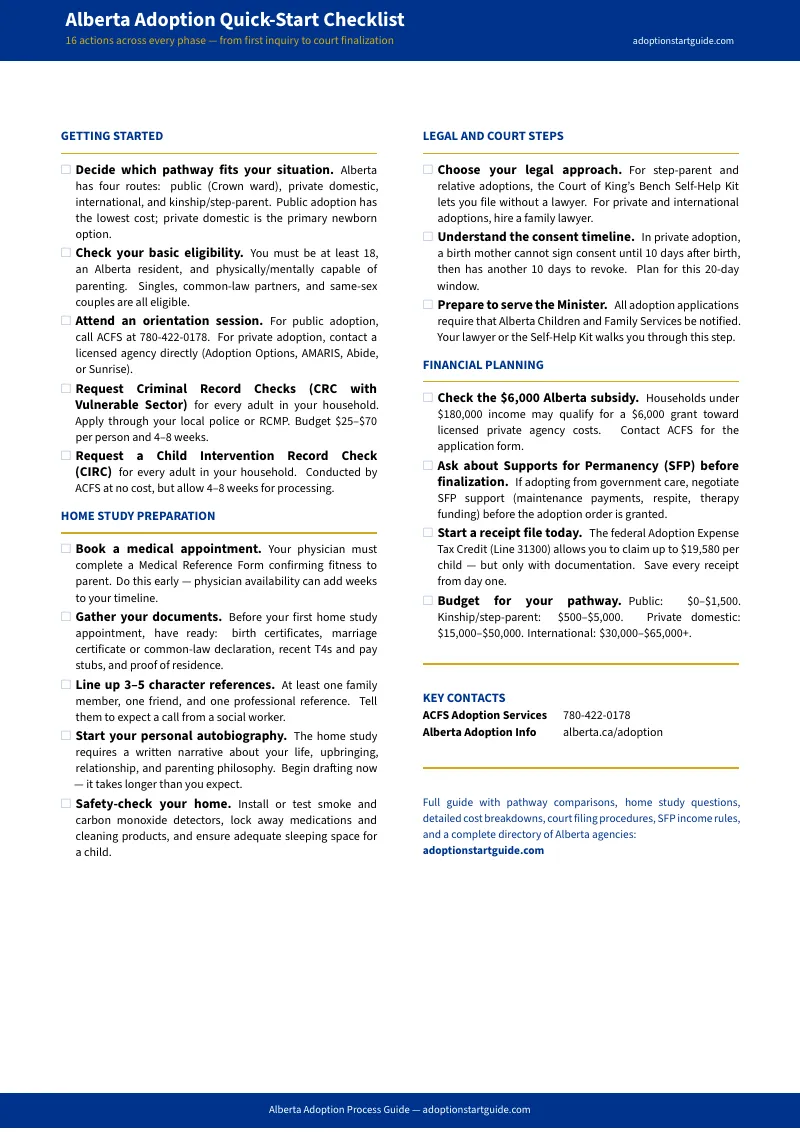
Download the Alberta Adoption Quick-Start Checklist for a one-page action plan covering every phase of the process — from your first inquiry to court finalization. It covers the key milestones, required documents, and the sequence the Alberta system expects. Free, no commitment. If you want the full guide with the four-pathway comparison, home study preparation bank, Supports for Permanency breakdown, Court of King's Bench filing steps, and document templates, click the button in the sidebar.
— Less Than Five Minutes With an Alberta Adoption Lawyer
Adoption lawyers in Edmonton and Calgary charge $250 to $400 per hour. A private agency application fee is $250 to $500 just to start. A missed tax credit, an unnecessary agency contract, or a wrong-pathway commitment can cost your family thousands of dollars and years of delay. This guide puts the pathway comparison, the financial rules, the court process, and the preparation checklists in your hands before you write the first cheque to anyone.
If the guide doesn't deliver, reply to your download email at any time for a full refund. No forms. No justification required.