You want to adopt in British Columbia. The MCFD website gives you four pathways. It doesn't tell you that private infant adoption costs $30,000, the SAFE home study asks about your childhood, or that a birth mother has 30 days to change her mind.
British Columbia's adoption system runs through the Ministry of Children and Family Development, which administers four fundamentally different pathways -- Crown Ward adoption through the public system, private domestic through a licensed agency, direct placement arranged between birth and adoptive parents, and relative or kinship adoption. Each pathway has its own costs, legal requirements, wait times, and emotional realities. The MCFD website describes all four on one page. It doesn't tell you that the Crown Ward path is nearly free but that 87% of available children are over five. It doesn't mention that private domestic through Sunrise or the Adoption Centre of BC starts at $15,000 and typically reaches $30,000 to $45,000 once you add the home study, birth parent legal fees, placement supervision, and court disbursements. And it certainly doesn't explain the 30-day revocation period -- the window after placement where a birth parent can withdraw consent and the child you've bonded with goes back.
Then there's the SAFE home study. The Structured Analysis Family Evaluation is a psychological deep dive conducted by an MCFD-approved practitioner who will interview every adult in your household, inspect your home room by room, and sit you down for Questionnaire 2 -- a private history interview covering your childhood, your parents' discipline style, your intimate relationships, your approach to conflict, and your understanding of trauma. No government website tells you what the assessor is actually evaluating, because the people who wrote those websites are the same people doing the assessing. Families walk into the most consequential interview of the adoption process with no preparation beyond a three-paragraph overview on gov.bc.ca.
Meanwhile, British Columbia's adoption landscape is being reshaped by Bill 38 and federal legislation recognizing Indigenous jurisdiction over child and family services. Twenty-four Delegated Aboriginal Agencies operate across the province. The Openness Agreement framework under Sections 59 and 60 of the Adoption Act confuses nearly every prospective parent -- most believe these agreements give birth parents enforceable access rights, when in reality they're good-faith arrangements that function very differently from court-ordered Access Orders. The Intercountry Adoption Act adds another layer for families considering international pathways. And none of this is explained in one place.
The Belonging Network offers community support and Adoption 101 orientation sessions. They're valuable once you're in the system. But as a non-profit partially funded by the government, they can only be so candid about the parts of the process that frustrate families -- the social worker turnover, the Adopt BC Kids portal that feels like a black box after your home study is approved, the months of silence during matching. Your adoption lawyer in Vancouver charges $300 to $500 per hour for a consultation that mostly covers the same basics you could learn on your own. Licensed agencies represent the child's best interests, which is not the same as coaching you through the process as an applicant. Nobody in the system is working against you. But nobody's job is to work for you either.
The Provincial Pathway System
This is a complete, BC-specific adoption guide written for the current legal framework -- the Adoption Act, the Child, Family and Community Service Act, the Intercountry Adoption Act, Bill 38, and the real-world realities of adopting in a province where housing costs alone consume most of a family's financial capacity before agency fees even enter the picture. Not a repurposed national overview that mentions "Children's Aid Society" offices BC doesn't have. Every chapter, every checklist, every cost figure is grounded in British Columbia's system and the experience of families who have navigated it.
What's inside
- Four-pathway comparison -- Crown Ward adoption through MCFD (nearly free, with Post-Adoption Assistance), private domestic through a licensed agency ($15,000 to $45,000), direct placement between birth and adoptive parents, and relative or kinship adoption compared side by side. Costs, timelines, eligibility, realistic wait times, and the trade-offs nobody tells you about. The public infant waitlist stretches years. The Adopt BC Kids portal has children waiting right now, but most are older, in sibling groups, or have complex needs. Private agencies focus on infants but the costs rival a down payment in the Fraser Valley. This chapter prevents you from spending months and thousands of dollars researching the wrong path.
- SAFE home study preparation -- What the assessor actually evaluates during the Structured Analysis Family Evaluation, the documents you need assembled before the first visit, and Questionnaire 2 decoded -- the questions about your childhood, your relationship history, your discipline philosophy, and your understanding of intergenerational trauma that catch families off guard. Walking into the SAFE interview unprepared is the single biggest source of adoption anxiety for BC families. The home study fee through a private practitioner runs $2,500 to $3,500. This chapter makes sure you don't need a second one.
- Complete cost breakdown by pathway -- Every expense mapped line by line. The agency registration fees. The home study. The birth parent's mandatory independent legal counsel, often paid by the adoptive family. Placement supervision fees. Court filing and legal disbursements. Crown Ward adoption at nearly $0 versus private domestic at $30,000+. International adoption through a Hague Convention country versus a non-Hague pathway. Every hidden cost in one place so you stop budgeting on scattered forum posts and outdated blog articles.
- The 30-day revocation period explained -- BC law allows a birth parent to withdraw consent within 30 days of the child's birth. For families coming from years of infertility treatment, this is the most terrifying provision in the Adoption Act. This chapter explains how the revocation window works in practice, the legal protections that exist for adoptive families during this period, and how to prepare emotionally and logistically for the placement phase without living in constant fear of a reversal.
- Openness agreements decoded -- Sections 59 and 60 of the Adoption Act create a framework for ongoing contact between adoptive families and birth families. Most prospective parents misunderstand these as enforceable contracts that give birth parents the right to show up at their home. They're not. This chapter explains the difference between good-faith Openness Agreements and court-ordered Access Orders, how to negotiate boundaries that serve the child's identity needs while protecting your family's stability, and what happens when an agreement isn't working.
- Adopt BC Kids portal navigation -- The online portal is the front door for Crown Ward adoption. It streamlines the application but not the matching. Families report feeling like their profile disappears into a black box once the home study is complete. This chapter explains what happens behind the portal -- how the matching process actually works, why sibling groups and older children are the highest need, what makes a family profile stand out to placement coordinators, and how to follow up with your social worker without being flagged as difficult.
- Indigenous considerations and Bill 38 -- When a significant proportion of children in BC's care system are Indigenous, understanding cultural safety isn't optional. Bill 38 recognizes the inherent right of Indigenous Nations to exercise jurisdiction over child and family services. Twenty-four Delegated Aboriginal Agencies operate across the province. This chapter explains how these frameworks affect matching, what custom adoption means, and how non-Indigenous families should approach cross-cultural placements with respect and cultural humility rather than anxiety.
- Financial assistance and tax benefits -- Post-Adoption Assistance payments for Crown Ward adoptions, the BC Adoption Tax Credit, the federal Adoption Expenses Tax Credit, and which receipts to save from day one. Most families discover PAA exists after finalization, when it's too late to negotiate the right support level. This chapter ensures you understand the financial framework before you commit to a pathway.
- Court finalization walkthrough -- What happens at the BC Supreme Court hearing, the documentation your lawyer needs, the six-month residency requirement, the post-adoption birth certificate process through Vital Statistics, and the Parents' Registry notification requirements. Written in plain language, not the legalese that makes the Adoption Act impenetrable to non-lawyers.
Printable standalone worksheets included
The guide comes with printable standalone PDFs designed for real-world use:
- Pathway Comparison Card -- Crown Ward, Private Domestic, Direct Placement, and Kinship adoption side by side on one page. Costs, timelines, and eligibility at a glance. Print it, sit down with your partner, and make the decision that shapes everything else.
- SAFE Document Checklist -- Every document your assessor needs, organized in the order they'll request them. Criminal record check, medical assessment, financial records, reference letters, and home safety items. Bring it to your first meeting so nothing is missing.
- BC Adoption Cost Map -- Every expense for every pathway in one printable sheet. Take it to your financial planning conversation.
- Court Readiness Worksheet -- The documents and requirements for your BC Supreme Court finalization hearing, with fill-in date fields for each milestone so you and your lawyer stay aligned.
Who this guide is for
- Couples moving from infertility to adoption -- You've spent years and tens of thousands of dollars on IVF and fertility treatments at clinics in Vancouver or Victoria. You're exhausted, financially stretched, and the last thing you need is to stumble into another process that drains your savings without a clear outcome. This guide shows you every pathway and its true cost so you can choose the one that fits your budget and your timeline, not the one an agency's sales page steers you toward.
- Families expanding through adoption -- You already have children and you want to provide a permanent home for a child in government care. You need to understand how the SAFE home study will assess your existing family dynamics, how a new addition changes the household assessment, and how the Adopt BC Kids matching system works for families with specific preferences about age, sibling groups, and needs.
- Single applicants in British Columbia -- The Adoption Act allows any adult aged 19 or older who has resided in BC for at least six months to adopt, regardless of marital status. No legal barrier. But the SAFE home study has specific questions for solo applicants about financial stability on a single income, backup care plans, and support networks. This guide addresses those directly so you walk into the assessment prepared, not blindsided.
- Foster parents pursuing permanency -- The child in your care has received a Continuing Custody Order. You've built a bond over months or years of foster care and you want to make it permanent. You need to understand the legal transition from foster parent to adoptive parent, how Post-Adoption Assistance compares to foster per-diems, and how your existing relationship with the child shapes the court application.
- Kinship and relative adopters -- A grandchild, niece, nephew, or family friend's child needs a permanent home and you've stepped in. You assumed formalizing the adoption would be simpler because you're family. British Columbia still requires background checks, a SAFE assessment, and court approval. Some families opt for permanent guardianship under Section 54.1 of the CFCSA instead of full adoption. This guide covers both paths so you can choose the legal arrangement that serves the child without severing family ties unnecessarily.
- LGBTQ+ families building through adoption -- BC's Adoption Act is explicitly inclusive regardless of sexual orientation or gender identity. The legal framework is welcoming. The practical process still involves the same SAFE interviews, the same cost decisions, and the same matching realities. This guide covers the process for every family structure without assuming a default.
Why the free resources aren't enough
The MCFD website publishes the adoption process as a series of steps organized around regulatory categories, not around the questions prospective parents actually have. It tells you what the rules are without explaining how to navigate them. It won't tell you how to prepare for the SAFE Questionnaire 2, how to compare the real costs of Crown Ward versus private agency, or why families report months of silence after their Adopt BC Kids profile is approved.
The Belonging Network provides community support, Adoption 101 seminars, and the Roadmap to Adopt BC Kids. They're excellent for orientation. But as an organization that works alongside the Ministry, they focus on awareness rather than the tactical how-to -- the specific interview prep, the financial mapping, the legal distinctions between enforceable and non-enforceable agreements that determine your family's boundaries.
Family law firms in Vancouver and Victoria charge $300 to $500 per hour. You'll need a lawyer eventually, but most families spend their first billable hour covering foundational questions this guide answers on page one. Forum threads on Reddit give you anecdotes -- "we waited three years," "our social worker left and nobody picked up our file" -- without the context to know whether that experience is typical, outdated, or specific to a pathway you're not even pursuing.
Generic Canadian adoption books describe a national process that doesn't exist. They reference Ontario's CAS system that BC doesn't have. They miss the 30-day revocation rule, the Intercountry Adoption Act, the Openness Agreement framework, and the Delegated Aboriginal Agency structure. Using one of those guides in British Columbia is like navigating the Fraser Valley with a map of the GTA.
The free Quick-Start Checklist
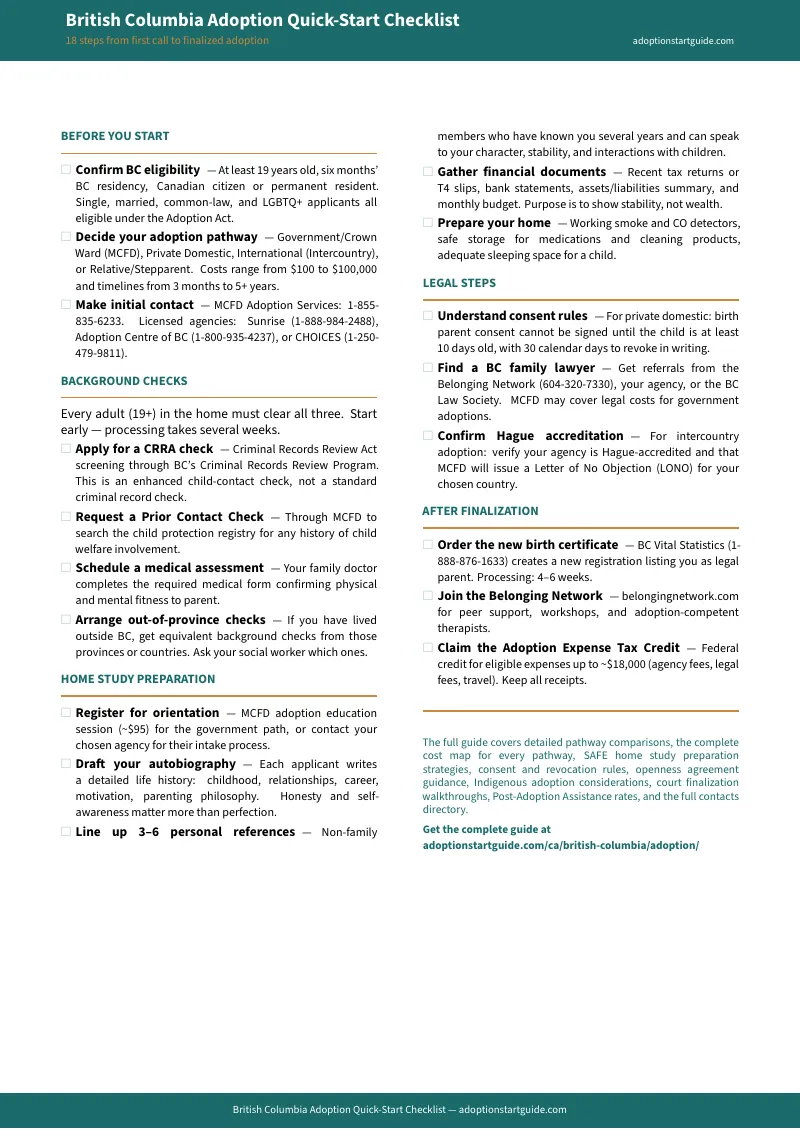
Download the British Columbia Adoption Quick-Start Checklist for a one-page overview of the key steps from pathway selection to court finalization. Free, no commitment. If you want the full roadmap with four-pathway comparisons, SAFE home study preparation, cost maps, openness agreement guidance, financial assistance details, and printable worksheets, click the button in the sidebar.
-- less than ten minutes of a Vancouver adoption lawyer's time
A single consultation with a family lawyer in Vancouver or Victoria starts at $300 to $500 per hour. Families routinely spend the first billable hour covering foundational questions this guide answers on page one. The Provincial Pathway System doesn't replace your lawyer. It makes sure you don't pay your lawyer to explain the difference between an Openness Agreement and an Access Order, to walk you through the SAFE home study process, or to tell you that Post-Adoption Assistance exists. You arrive at that first consultation ready to discuss strategy, not basics.
If the guide doesn't deliver, reply to your download email at any time for a full refund. No forms. No justification required.