
68% of children in BC foster care are Indigenous. The MCFD website gives you five steps. It doesn't mention that the background check is employer-initiated, the medical form costs $200, or that your social worker will ask about your childhood.
British Columbia licenses foster homes through the Ministry of Children and Family Development across five regions -- Vancouver Coastal, Fraser, Vancouver Island, Interior, and Northern -- plus 24 Delegated Aboriginal Agencies that operate with varying levels of child protection authority. That means a prospective foster parent in Surrey starts their journey through a different regional office, with different wait times and different staffing realities, than someone in Kelowna or Prince George. The MCFD website doesn't distinguish between these pathways. It gives you the same five-step overview regardless of where you live or which agency you'll work with.
The BC Foster Parents Association is a genuine advocacy organization. Their helpline, peer support groups, and online training resources are valuable once you're in the system. But if you're still trying to figure out whether the Criminal Records Review Act check is the same thing as a police record check (it isn't -- and you can't submit it yourself), the BCFFPA assumes a baseline of knowledge you haven't built yet. Their resources are built for existing caregivers, not applicants standing at the front door wondering which handle to pull.
Generic Canadian foster care guides describe a national process that doesn't exist. They reference Children's Aid Societies that BC doesn't have. They quote Ontario per diem rates that have nothing to do with BC's maintenance schedule. They don't mention PRIDE pre-service training, the SAFE home study model, Questionnaire 2, or the 24 Delegated Aboriginal Agencies that may have jurisdiction over the child placed in your home. A guide written for "Canada" is a guide written for nobody in particular.
The MCFD Roadmap: Your Plain-Language Guide to Foster Care in British Columbia
This guide is built for British Columbia's system and nobody else's. Every chapter, every checklist, every contact number is grounded in the Child, Family and Community Service Act, Bill 38, the Standards for Foster Homes, and the provincial realities that shape fostering in a province where nearly seven out of ten children in care are Indigenous and where the application process routinely stretches to 18 months. This is not a repurposed national handbook. It's the operational layer that sits between what MCFD posts online and what you actually need to know to get licensed and keep a child safe in BC.
What's inside
- MCFD Process Decoded -- The MCFD website gives you five steps: request information, attend an info session, submit an application, complete training, finish your home study. What it doesn't tell you is that the info session covers the "what" without the "how," that your application can sit untouched for months depending on your region's caseload, or that starting your CRRA check and PRIDE training concurrently can shave weeks off the 18-month timeline. This chapter maps the full process with realistic timelines for each of the five MCFD regions, so you know what to expect in Metro Vancouver versus Northern BC.
- CRRA and Background Check Walkthrough -- British Columbia doesn't use a standard police record check for foster care licensing. It uses the Criminal Records Review Act process -- an enhanced, employer-initiated check through the Ministry of Public Safety and Solicitor General. You cannot submit it yourself. Your MCFD office or Delegated Aboriginal Agency initiates it on your behalf. This chapter explains the CRRA process step by step, how it differs from the Police Information Check with vulnerable sector search that you also need, what "relevant offenses" actually means, and the Notice of Adjudication process if something flags. It also covers the timeline difference between urban and rural processing.
- SAFE Home Study Preparation -- The Structured Analysis Family Evaluation is the most anxiety-producing stage for most applicants. It involves two to three in-home visits, interviews with every household member, and the private history interview known as Questionnaire 2 -- where your social worker asks about your childhood, your discipline philosophy, your relationship history, and your understanding of intergenerational trauma. This chapter explains what the Home Study Practitioner is actually assessing during the "harvesting and analysis" phase, how to prepare for Q2 without scripting your answers, and what the final SAFE Report recommends about your home's approved age range and capacity.
- PRIDE Training Navigator -- BC requires approximately 35 hours of PRIDE pre-service training before licensing, delivered online through the BC Learning Centre. After approval, you have two years to complete the 50-55 hour PRIDE In-Service program. This chapter breaks both programs into weekly blocks so you can plan around your work schedule, flags the modules that matter most for your home study interviews, and explains the additional certifications -- First Aid, CPR, and the Sa'nyas Indigenous Cultural Safety Training -- that strengthen your application.
- Cultural Safety for Indigenous Children -- When 68% of children in care are Indigenous -- First Nations, Metis, and Inuit -- cultural safety isn't a checkbox. It's the defining obligation of fostering in BC. Bill 38 (2022) recognizes the inherent right of Indigenous Nations to exercise jurisdiction over child and family services. Twenty-four Delegated Aboriginal Agencies operate across the province with varying levels of authority. This chapter explains your obligations in practice: facilitating connections with Elders, supporting traditional food and ceremony, maintaining language development, and working with the child's Nation or DAA to follow a Cultural Safety Plan. It addresses the question non-Indigenous applicants ask most -- "Will I be approved to foster an Indigenous child?" -- with a direct answer and the practical framework to do it well.
- Regional Guide Across Five MCFD Regions -- Metro Vancouver applicants deal with high caseloads and long wait times. Fraser Valley applicants navigate the province's fastest-growing population corridor. Vancouver Island, Interior, and Northern BC applicants face staffing shortages that affect every stage from orientation to home study scheduling. This chapter maps each region with intake phone numbers, key contacts, and guidance on which Delegated Aboriginal Agencies operate in your area -- from Xyolhemeylh in the Fraser Valley to VACFSS in Vancouver to Carrier Sekani in the Central Interior.
- Financial Breakdown -- BC pays maintenance rates of $1,549.20 per month for children aged 0-11 and $1,726.33 for ages 12-19. Specialized care adds service payments from $591.90 (Level 1) to $2,347.67 (Level 3) per month. This chapter covers every rate tier, respite payment schedules, dental coverage ($1,000 annually), clothing allowances, travel reimbursement for family visits, and the CRA tax treatment of foster care income. It also covers costs the ministry doesn't reimburse -- the $100-$200 medical form fee, parking during training, and the gap between maintenance rates and actual expenses in Metro Vancouver's cost of living.
- Navigating the System After Licensing -- Your Resource Social Worker is your primary contact, but MCFD social worker turnover is real. This chapter covers the Family Care Home Agreement, daily logging requirements, Critical Incident Reporting, your specific rights as a foster parent including advance notice before placements, the conflict escalation pathway from your RSW to their supervisor to the Representative for Children and Youth, and the SAJE program that supports youth transitioning out of care until age 27.
Printable standalone worksheets included
- Licensing Timeline Tracker -- Every milestone from initial MCFD inquiry through licence approval, with fill-in date fields and realistic processing times for your region. Print it, update it after every contact, and always know where you stand in the process.
- Home Safety Inspection Checklist -- Room-by-room walkthrough of every requirement under BC's Standards for Foster Homes: smoke and CO detectors, bedroom minimums, egress windows, pool and hot tub fencing, firearm storage, medication lockup, and rural-specific items like well water testing and secured septic covers. Walk your home with this before the inspector arrives.
- Document Organization Sheet -- CRRA clearance, Police Information Check with vulnerable sector search, medical assessment, three references, First Aid and CPR certificates, PRIDE completion -- every document in the order you need it, with processing time estimates and the name of who initiates each one.
- Child Information Tracker -- Health card numbers, medication schedules, social worker contacts, family visit logs, cultural activity records, school notes, and incident documentation in one printable sheet. When your Resource Social Worker rotates out and the new one asks you to start from scratch, this tracker ensures continuity for the child.
Who this guide is for
- Metro Vancouver and Fraser Valley professionals -- You have career stability, a spare bedroom, and a genuine desire to help. You've looked at the MCFD website and found five steps that tell you nothing about the 18-month reality, the CRRA process, or what happens during Questionnaire 2. You want someone to explain the system in plain language before you commit to a process that will ask you to open your home, your history, and your family to professional scrutiny.
- Vancouver Island and Interior families -- You live in Victoria, Nanaimo, Kelowna, or Kamloops. You have space in your home and your life, but you're unsure how the process works outside the Lower Mainland. It works -- and your region has a critical, unmet need for foster homes that keep children connected to their communities.
- Northern BC applicants -- You're in Prince George, Terrace, or one of the smaller communities. MCFD staffing in the Northern region affects every stage of the process, from orientation scheduling to home study wait times. You need a guide that accounts for the reality of fostering where specialists may be a flight away and social worker caseloads are stretched thin.
- Kinship caregivers formalizing an arrangement -- A grandchild, niece, nephew, or family friend's child is already in your care. You need to get formally licensed to access maintenance payments, respite funding, and the support services that come with recognition as a foster caregiver. You're navigating a process you didn't plan for, and you need it explained without the bureaucratic language.
- Non-Indigenous families fostering Indigenous children -- You understand that most children in BC's care system are Indigenous. You want to help, but you're worried about the cultural obligations -- what they mean in practice, whether you'll get it wrong, how to work with a Delegated Aboriginal Agency. This guide gives you the concrete framework so you can foster with respect rather than anxiety.
- Foster-to-adopt families -- You're entering the system hoping to provide a permanent home. BC's system is fundamentally oriented toward family reunification through concurrent planning. This guide explains how permanency pathways work in BC, including adoption from care, custom adoption, and the Extended Family Program, so you go in with accurate expectations.
Why the free resources fall short
The MCFD website publishes the Standards for Foster Homes -- a document written for social workers and licensing officers, not applicants. It tells you what the rules are. It does not tell you which rules trip people up, how the CRRA differs from a police check, what your social worker is actually evaluating during the SAFE home study, or why Questionnaire 2 asks about your childhood.
The BC Foster Parents Association provides peer support, a helpline, and online training for existing caregivers. If you're still in the pre-licensing phase -- trying to figure out which MCFD region you fall under or whether your landlord needs to sign anything -- their resources assume you already understand the system you're trying to enter.
National foster care books on Amazon describe a process built for Ontario or Alberta. They don't know about the CRRA, the 24 Delegated Aboriginal Agencies, BC's PRIDE training requirements, the SAFE home study model, or the maintenance rate schedule that's different from every other province. A guide written for "Canada" will tell you to contact your local Children's Aid Society. British Columbia doesn't have one.
The free Quick-Start Checklist
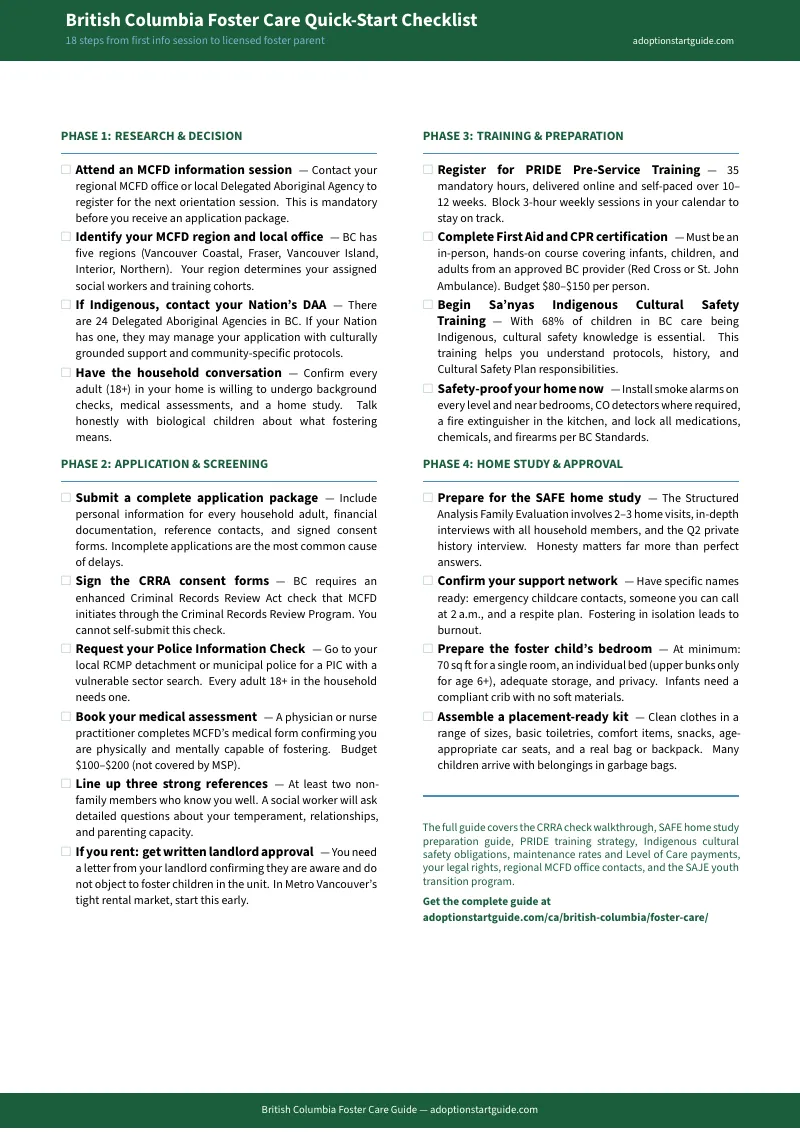
Download the British Columbia Foster Care Quick-Start Checklist for a step-by-step overview of the licensing process, from initial MCFD contact through post-licensing obligations. Free, no commitment. If you want the full guide with the CRRA walkthrough, SAFE home study preparation, regional directory, financial breakdown, and printable worksheets, click the button in the sidebar.
-- less than a single day's maintenance payment
The typical BC applicant spends months piecing together the licensing process from scattered MCFD pages, BCFFPA resources designed for existing caregivers, and Reddit threads that may or may not reflect current policy. This guide distils the most critical steps into a weekend-ready roadmap. A CRRA check submitted through the wrong channel adds months. A medical form filled out incorrectly costs you a second $200 appointment. A home inspection failed for a missing CO detector near the furnace delays your licence by however long it takes to schedule the re-inspection. One guide prevents all of it.
If the guide doesn't deliver, reply to your download email at any time for a full refund. No forms. No justification required.