
You want to adopt in New Brunswick. You just didn't expect a province with no private adoption agencies, a seven-year wait for a healthy infant, and a brand new law that made every resource you've found so far out of date.
New Brunswick is the only province in Atlantic Canada where the Department of Social Development controls the entire adoption process. There are no licensed private agencies. No competing organizations. No alternative office to call if your social worker goes on leave or your file stalls in a regional queue. DSD is your only institutional resource, and the relationship between your family and your assigned worker is the single most important variable in whether this process takes two years or five. Most families don't realize that until they're already deep into the system with no backup plan.
And the system itself just changed. In January 2024, the Child and Youth Well-being Act replaced the Family Services Act that had governed New Brunswick adoptions for decades. Every community blog post, every forum thread, every PDF you downloaded before that date references procedures, timelines, and legal provisions that may no longer apply. The DSD website has been updated in places, but the practical guidance families need — what happens at each stage, what the social worker is actually evaluating, how to prepare for the SAFE home assessment — hasn't caught up. You're navigating a new legal framework with old maps.
Then there's the pathway confusion. "Private adoption" exists in New Brunswick, but it doesn't mean what most people think. There are no agencies to manage the process for you. Private domestic adoption in this province must be arranged through a family lawyer, which means you're coordinating the legal work, the home study, and the matching process yourself while paying $250 to $500 per hour for each consultation. Crown ward adoption through DSD is free but the wait for a healthy infant can exceed seven years. International adoption adds $20,000 to $40,000 in fees on top of the home study. Most families spend months researching the wrong pathway before they realize it doesn't fit their timeline, their budget, or their family structure.
Meanwhile, the SAFE home assessment looms over everything. This is the structured evaluation where a DSD social worker visits your home, interviews you individually and as a couple, reviews your finances, checks your references, and assesses whether your environment meets the province's safety and stability standards. It's not a casual visit. It's the gate. Families who go in unprepared — who don't know what "financially stable" means in DSD terms, who haven't documented their support network, who are surprised by questions about their childhood or their relationship history — don't fail dramatically. They get flagged for follow-up assessments that add months to an already long process. And in a province with no alternative agencies, a setback with the DSD is a setback with your only option.
Nobody in the system is working against you. But the DSD's job is to assess families, not to coach them. The NB Adoption Foundation provides general information and peer support, but their site doesn't include a step-by-step process map for any of the three pathways. Generic Canadian adoption guides assume every province has licensed agencies, private matching services, and multiple organizations competing for your application. They'll tell you to "contact your local agency" when no such agency exists in New Brunswick. They reference the Family Services Act when that law has been superseded. They don't mention the $1,000 provincial adoption grant because it's NB-specific, and they don't explain how to claim the $19,580 federal adoption expense tax credit in a way that accounts for the timing rules that trip families up every year.
The Province-Specific Navigator
This is a complete New Brunswick adoption guide written for the province's current legal framework: the Child and Youth Well-being Act, DSD's centralized process, and the reality that your family's one application to the one department that handles adoption in this province is the application that has to work. Not a repurposed national overview that tells you to call an agency that doesn't exist. Every chapter, every checklist, every timeline is built around how adoption actually works in New Brunswick right now — the DSD pathway, the lawyer-led private route, the international process, and the financial supports that are unique to this province.
What's inside
- Three-pathway decision framework — Crown ward adoption through DSD, private domestic through a family lawyer, and international adoption compared side by side. Wait times, costs, eligibility requirements, and the practical trade-offs between each. Healthy infant wait through DSD can exceed seven years. Private domestic through a lawyer can move in one to two years but costs $10,000 to $20,000. International adds travel and agency fees of $20,000 to $40,000. This chapter prevents you from spending six months preparing for a pathway that doesn't match your family's timeline or budget.
- SAFE home assessment preparation — What the DSD social worker is actually evaluating during the Structured Analysis Family Evaluation, how the interview questions are structured, what documentation to have ready, and how to present your home, your finances, and your support network so the assessment moves forward without follow-up delays. Includes the safety inspection checklist: fire extinguisher placement, medication storage, pool fencing, firearms storage, and the specific items social workers flag most often in New Brunswick homes.
- Private adoption without agencies — How private domestic adoption works in a province with zero licensed agencies. The role of the family lawyer, the process for identifying a birth parent match, the consent requirements under the Child and Youth Well-being Act, the revocation period, and the court finalization steps. This is the pathway that confuses New Brunswick families most because every national guide assumes an agency is managing it. In NB, you and your lawyer are the agency.
- P.R.I.D.E. training roadmap — What the Parent Resources for Information, Development, and Education program covers, how long it takes, what DSD expects you to demonstrate by the end, and how your performance in the sessions factors into your overall assessment. P.R.I.D.E. is mandatory for all prospective adoptive parents in New Brunswick, and families who understand its purpose before they walk in perform better than families who treat it as a bureaucratic checkbox.
- Financial strategy: $20,580 in combined support — Step-by-step instructions for claiming the $1,000 New Brunswick Adoption Grant (non-taxable, one-time) and the $19,580 federal Adoption Expense Tax Credit (Line 31300). The grant is automatic for DSD placements but must be manually applied for in private and international adoptions — a detail the DSD website buries. The federal credit has a timing catch: expenses can only be claimed in the tax year the adoption order is finalized, regardless of when you actually paid them. Families who don't plan for this lose thousands in eligible deductions.
- Crown ward and foster-to-adopt pathway — How the transition from foster care to adoption works when a child in your care becomes a Crown ward. The legal steps, the change from foster per diems to adoption supports, the post-adoption subsidy for children with special needs, and the Adoption Maintenance Agreement that must be negotiated before the adoption order is signed. Once that order is granted, your leverage to negotiate ongoing support disappears.
- Bilingual province guidance — New Brunswick is Canada's only officially bilingual province, and Francophone families have the legal right to receive every stage of the adoption process — from P.R.I.D.E. training to the SAFE assessment to court proceedings — in French. The guide covers how to request French-language services from DSD, the role of Acadian community organizations, and the cultural considerations for families who want to ensure their adopted child grows up connected to Francophone identity and the French education system.
- Complete document checklist by pathway — Every form, certificate, background check, and legal filing organized by adoption type and listed in the order each pathway requires them. Criminal record checks, vulnerable sector screenings, medical reports, financial statements, reference letters, marriage or common-law declarations, and the specific DSD application forms. Organized so nothing is missing when your social worker reviews your file or your lawyer files with the court.
Printable standalone worksheets included
The guide comes with printable standalone PDFs designed for real-world use:
- Pathway Comparison Card — Crown ward, private domestic, and international adoption side by side on one page. Costs, timelines, eligibility, and legal requirements at a glance. Print it, sit down with your partner or your support person, and make the decision that shapes everything else.
- SAFE Assessment Preparation Checklist — Every item the social worker checks during the home visit, every document you need to have ready for the interview, and the questions families report being asked most often. Fill it in room by room so you walk into the assessment prepared, not anxious.
- Financial Benefits Tracker — A worksheet for tracking your adoption expenses by category as they occur, so when it's time to claim the federal tax credit you have every receipt organized and every eligible expense documented. Includes the NB Adoption Grant application reminder and deadline.
- Document Collection Tracker — Every required document for your pathway with checkboxes, submission dates, and expiry tracking. Criminal record checks expire. Medical reports expire. This worksheet ensures nothing lapses while you wait for the next stage.
Who this guide is for
- Couples exploring adoption after infertility — You've spent years and thousands of dollars on fertility treatments. You've decided adoption is your path forward, but you're looking at a seven-year provincial wait list for a healthy infant and you need to understand whether the private domestic route through a lawyer or international adoption gives you a realistic timeline. This guide lays out all three pathways so you can choose based on facts, not frustration.
- Foster parents ready to adopt their foster child — The child in your care has been made a Crown ward. You want permanency, not another temporary placement. The guide walks you through the legal transition from foster care to adoption, the subsidy negotiation that has to happen before the order is signed, and the financial shift from foster per diems to adoption support so you make the decision with complete information.
- Single applicants — You know the DSD accepts applications from single individuals, but you've heard the unofficial whispers about two-parent households getting priority. The guide explains exactly what the SAFE assessment evaluates for single applicants, how to document your support network convincingly, and what DSD social workers actually look for when assessing a single-parent household.
- Grandparents and relatives in a kinship situation — A family crisis has put you in the position of raising a child who is already part of your family. You need to understand the difference between kinship care (where the province maintains guardianship) and kinship adoption (where legal rights transfer to you), and the financial implications of each choice — including whether adopting means losing the kinship support payments you currently receive.
- Francophone and Acadian families — You want to build your family through adoption without losing your child's connection to French language and Acadian culture. The guide covers your right to French-language services at every stage, the role of organizations like AFPNB, and how the French education system in New Brunswick supports adopted children's linguistic development.
Why the free resources aren't enough
The DSD website lists adoption as a service and provides a phone number to call. It tells you adoption exists in New Brunswick. It does not walk you through how the process works step by step under the new Child and Youth Well-being Act. There is no process map. There is no explanation of what "private adoption" means in a province without agencies. There is no preparation guide for the SAFE assessment beyond a brief mention that a home study is required. The website assumes you'll figure out the details once you're assigned a social worker, and by then you're already being assessed.
The NB Adoption Foundation provides peer support, community connections, and general awareness. Their FAQ addresses common questions at a high level. But their site doesn't include the step-by-step preparation that families need to walk into the SAFE assessment ready, to understand the financial supports before the finalization deadline passes, or to navigate the private domestic route that has no agency to manage it for them.
Generic Canadian adoption guides are written for Ontario's Children's Aid Society model or BC's licensed agency landscape. They tell you to "choose an agency" when New Brunswick has none. They reference the Family Services Act when NB moved to the Child and Youth Well-being Act in 2024. They don't mention the $1,000 NB-specific adoption grant. They don't explain how private adoption works when there's no agency intermediary. Using a national guide in New Brunswick is like following directions for a highway that was rerouted two years ago.
Reddit threads and Facebook groups give you emotional support and other families' stories. But anecdotal advice from someone who adopted in 2018 under the old law, in a different region, through a different DSD office, with a different social worker, is not a strategy. It's a data point that may or may not apply to your situation. This guide provides the current framework, not last decade's.
The free Quick-Start Checklist
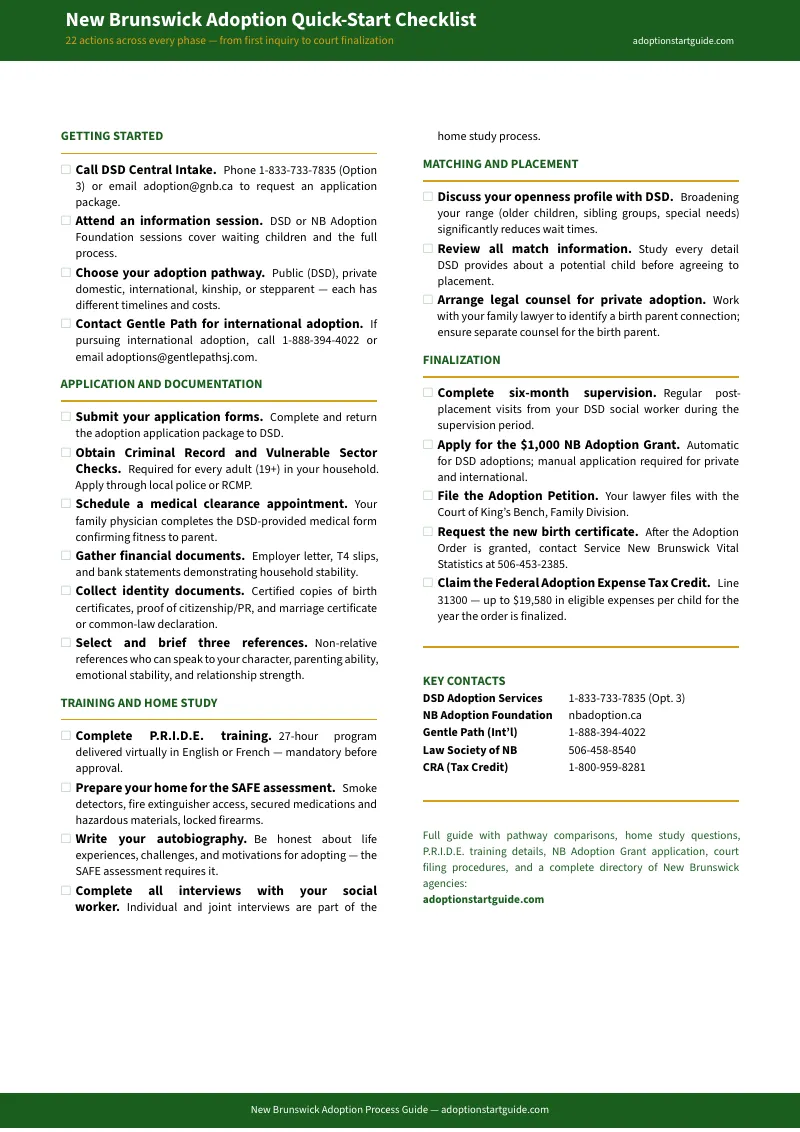
Download the New Brunswick Adoption Quick-Start Checklist for a one-page overview of the key steps from first contact with DSD to court finalization. Free, no commitment. If you want the full roadmap with three-pathway comparison, SAFE assessment preparation, private adoption walkthrough, financial strategy for $20,580 in combined support, bilingual province guidance, and printable worksheets, click the button in the sidebar.
— less than twenty minutes of a Fredericton family lawyer's time
A single consultation with a family lawyer in Moncton, Fredericton, or Saint John starts at $250 to $500 per hour. Families routinely spend that first billable hour asking foundational questions this guide answers on page one: Which pathway fits our situation? What does the SAFE assessment actually involve? How does private adoption work without an agency? Can we claim the provincial grant? The Province-Specific Navigator doesn't replace your lawyer. It makes sure you don't pay your lawyer to explain the difference between Crown ward and private domestic adoption, or to describe the P.R.I.D.E. training schedule, or to list the documents you could have gathered before the first meeting. You arrive at that consultation — if you need one at all — ready to discuss strategy, not basics. And for families pursuing Crown ward adoption through DSD, this guide may be the only structured resource you need.