You want to foster in New Brunswick. You just didn't expect a system with eight regional zones and no clear preparation path.
New Brunswick's Department of Social Development runs its foster care system through eight separate regional offices — from Moncton to the Acadian Peninsula — each with its own intake coordinator, its own PRIDE training schedule, and its own social workers conducting home studies. The provincial online portal lets you submit an expression of interest in about ten minutes. What it doesn't tell you is that the next six to twelve months involve a Double Record Check that searches both the RCMP criminal database and DSD's own internal files, a SAFE home assessment with specific bedroom measurements and building code requirements, and a mandatory 27-hour PRIDE training program that may only be offered once or twice a year in your region.
And then there's the part that blindsides people. The Social Development Record Check is not the same as your Vulnerable Sector Check. It's an internal search of DSD's own databases — every historical contact with the department, even from your childhood, even cases where you were the subject of a report that was never confirmed. No conviction required. No charge required. If your family had any involvement with Social Development going back decades, it appears on this check. The DSD portal doesn't explain what triggers a flag, what the "individual consideration" review process looks like, or how long it delays your application. Most applicants don't learn about this second check until they're already inside the system and a social worker asks them to sign the consent form.
Meanwhile, generic Canadian foster care guides use the wrong terminology for everything. They reference "Children's Aid Societies" (an Ontario structure that doesn't exist in New Brunswick), quote per diem rates from BC or Alberta that are 50 to 100 percent higher than Maritime realities, and describe home study processes that bear no resemblance to the SAFE methodology used here. The Child and Youth Well-Being Act replaced the Family Services Act in January 2024, and most publicly available content still references the old legislation. If you're preparing based on outdated or out-of-province information, you're preparing for the wrong system.
The DSD portal is the gatekeeper, not the coach. Their job is to assess your suitability, not to help you optimize your application. Your regional social worker has a caseload of thirty to fifty families and cannot spend two hours explaining bedroom square footage requirements or walking you through the Special Needs Assessment form. The NBFFA provides excellent peer support through their F.A.S.T. program, but their website is navigational chaos and the information is anecdotal rather than systematic. Facebook groups give you fragments — "it took us eight months," "they measured our windows" — without context about which regulation applies or what the social worker was actually evaluating.
This guide is the one resource built entirely around your perspective as a prospective foster parent in New Brunswick, under the current Child and Youth Well-Being Act (2022, proclaimed January 2024) and the Child and Youth Social Services Regulation (2024-6).
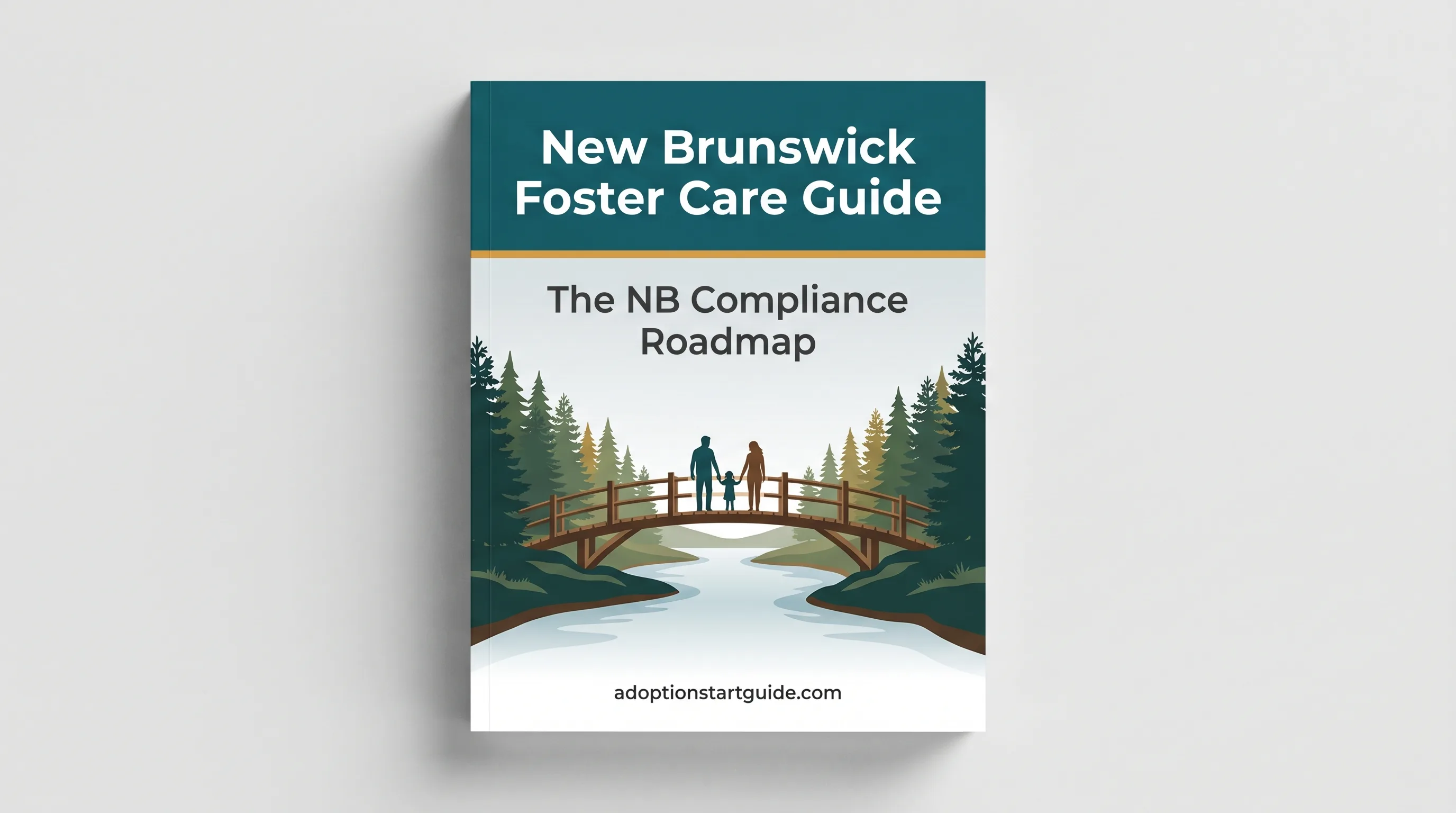
The NB Compliance Roadmap
This is a complete, New Brunswick-specific foster care guide that turns a 12-month bureaucratic process into a manageable step-by-step project. Not a repurposed national overview. Not a collection of forum advice. Every chapter, every checklist, every contact number is grounded in New Brunswick's eight-region DSD structure and the real-world experience of families who have navigated this system in Canada's only officially bilingual province.
What's inside
- Double Record Check preparation — The Vulnerable Sector Check through RCMP plus the internal Social Development Record Check explained side by side. What triggers a flag on each, how the "individual consideration" review works for non-conviction contacts, how long each takes to process, and what to disclose upfront so your application doesn't stall for months in administrative limbo. This is the step that catches families off guard because no free resource explains that it's two separate checks with two separate timelines.
- SAFE home assessment specs — The exact physical requirements from the Child and Youth Social Services Regulation: 7.4 square metre minimum bedroom size, egress windows compliant with the Building Code Administration Act, pool fencing with self-closing and self-latching gates, smoke alarms on every level, carbon monoxide detectors, firearm storage regulations, and medication lockbox placement. Room-by-room walkthrough so you fix everything before the social worker arrives, not after a failed inspection delays your file by three months.
- All 8 DSD regional zones with contacts — Every regional office from Moncton (Region 1) through the Acadian Peninsula (Region 8) with toll-free numbers, addresses, and guidance on which region covers your community. Your application "home" depends on where you live, and contacting the wrong office means your file sits in transfer. The guide routes you correctly on your first call.
- Bilingual resource directory — French-language PRIDE training schedules, Francophone social workers by region, Acadian Peninsula support groups like "Plus forts ensemble," and the NBFFA's French-language peer networks. New Brunswick is officially bilingual — this guide ensures Francophone families in Moncton, Edmundston, and the North Shore are fully supported in their first language.
- Rural-specific guidance — Well water testing requirements, wood stove compliance, heating system documentation, distance-from-services considerations, and the transportation realities of fostering in communities where the nearest DSD office is ninety minutes away. Half of New Brunswick's population lives in small towns — this section addresses what "home safety" looks like outside Fredericton and Saint John.
- Financial transparency — Basic maintenance per diem rates by age group, the Special Needs Assessment form and its 12 evaluation areas, Professional Care Home monthly stipends, clothing allowances, recreation funding, dental and vision coverage through Healthy Smiles and Clear Vision, and how foster care payments work as non-taxable reimbursements under federal law. No more budgeting on rumours from Facebook groups.
- PRIDE training navigator — The 27-hour, nine-session curriculum mapped out session by session. What each module covers, the CPR and First Aid certification requirements, how virtual delivery options work, and how to find the next available cohort in your region. Includes preparation guidance for Session 6 (discipline philosophy) and Session 9 (the informed decision) — the two sessions where social workers are actively evaluating your readiness.
- Child and Youth Well-Being Act 2024 explainer — The new legislation replaced the Family Services Act after four decades. This chapter explains what changed, how the "least intrusive intervention" principle affects placements, what your rights and obligations are under the new regulatory framework, and how the Act's child-centered philosophy shapes the home study questions your social worker will ask.
Printable standalone worksheets included
The guide comes with printable standalone PDFs designed for real-world use:
- Pre-Application Home Safety Checklist — Room-by-room walkthrough of every regulatory requirement. Walk through your house with this checklist and a measuring tape before your social worker visits. Fix what needs fixing on your timeline, not theirs.
- Document Organization Sheet — Every form, clearance, medical report, and reference letter mapped in the order DSD requests them. Bring it to your first meeting so nothing is missing.
- Regional Office Quick-Reference Card — All 8 regions, all contact numbers, all addresses on one printable page.
- Financial Planning Worksheet — Per diem rates, Special Needs Assessment categories, supplemental allowances, and monthly cost projections in one printable sheet for your household budgeting conversation.
Who this guide is for
- Couples and individuals starting from scratch — You've thought about fostering for months or years but haven't taken the first step because the DSD portal gives you a ten-minute screening quiz and then nothing. This guide takes you from "interested" to "licensed" with every step mapped in sequence.
- Rural families outside the three major cities — You live in Miramichi, Campbellton, Grand Falls, or a community where the nearest DSD office is a long drive. The process is the same but the logistics are harder. Well water, wood stoves, distance from emergency services — this guide addresses your specific reality instead of assuming everyone lives in a Fredericton suburb.
- Francophone families navigating in French — You want to complete this process in French but keep finding English-only resources. This guide identifies every French-language service point in the province — PRIDE training, social workers, peer support — so you're never forced into your second language during the most personal assessment of your life.
- Families considering respite or relief care first — You're not sure you're ready for full-time placements. New Brunswick desperately needs weekend and holiday relief caregivers. This guide explains the respite pathway and how it can serve as a low-commitment entry point before transitioning to traditional foster care.
- Kinship caregivers seeking formalization — A grandchild, niece, or nephew is already in your home through informal arrangements. The Child and Youth Well-Being Act prioritizes kinship placements but still requires the same background checks and home assessment. This guide covers what formalization means for financial support, legal authority, and the child's service plan.
Why the free resources aren't enough
The Social Supports NB portal is the official front door. It provides a screening quiz, a phone number, and a vague promise that "a worker will contact you." It tells you what the rules are without explaining how to prepare for them. It won't tell you that the DSD internal record check searches your childhood history, that your bedroom needs to be 7.4 square metres minimum, or that the next PRIDE cohort in your region might not start for four months.
The New Brunswick Foster Family Association is the best peer support organization in the province. Their F.A.S.T. program connects you with experienced foster parents. But their website has navigational issues, many links redirect to DSD, and the information is organized around current foster parents rather than prospective applicants who haven't entered the system yet.
Facebook groups like "Foster and Adoptive Families of NB" give you anecdotes — "our background check took twelve weeks," "they asked about our well water." They don't give you the regulatory citation that explains why, the specific measurement that determines pass or fail, or the sequence of steps that prevents a twelve-week delay. Anecdotes are comforting. A compliance roadmap gets you licensed.
Generic Canadian foster care books were written for Ontario's CAS model or BC's MCFD structure. They quote per diem rates from western provinces that are double or triple what New Brunswick provides. They describe intake processes that don't match DSD's eight-region structure. Using one of those guides to prepare for New Brunswick's system is like studying Alberta road signs before driving in the Maritimes.
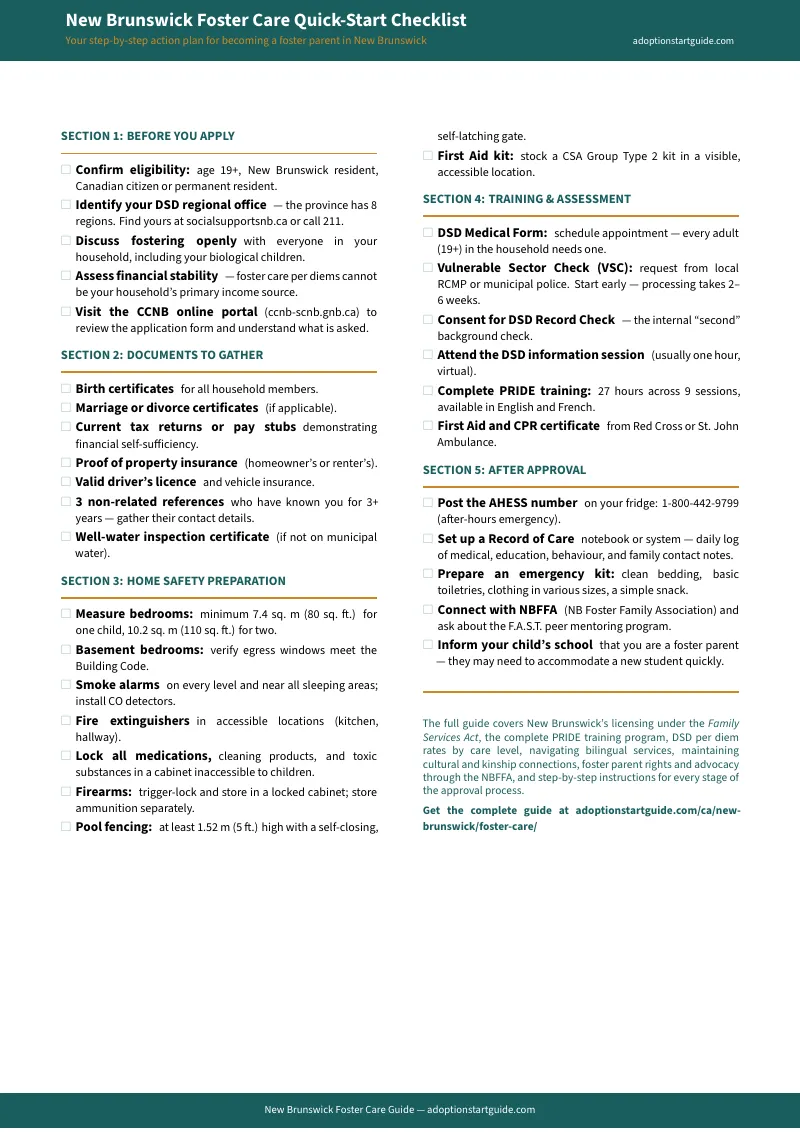
The free Quick-Start Checklist
Download the New Brunswick Foster Care Quick-Start Checklist for a one-page overview of the key steps from your first regional office call to receiving your foster home license. Free, no commitment. If you want the full NB Compliance Roadmap with Double Record Check preparation, SAFE home specs, regional contacts, financial breakdowns, PRIDE navigation, and rural-specific guidance, click the button in the sidebar.
— Less Than a Single Day's Per Diem
A single child's basic daily maintenance rate in New Brunswick covers food, housing, and personal items for one day. This guide costs less than that. It doesn't replace your social worker — it makes sure you don't spend your first three meetings with them covering basics that should have been clear before you applied. You arrive at your PRIDE training already knowing the system. You walk into your home study with every measurement checked, every document organized, and every question anticipated. That preparation is the difference between a six-month process and a twelve-month one.