
You want to adopt in Newfoundland and Labrador. You just didn't expect a province with zero private agencies, an eight-year infant waitlist, and a government system that gives you forms but no roadmap.
Newfoundland and Labrador is the only province in Canada where every domestic adoption — Crown ward, direct placement, step-parent, relative — goes through a single government department. There are no private agencies. No faith-based organizations matching birth parents with families. No alternative provider you can switch to if your CSSD caseworker is overloaded or your file goes quiet for months. The Department of Children, Seniors and Social Development (CSSD), now operating as Social Supports and Well-Being (SSWB), is your only domestic partner. If you're reading this from Ontario or Alberta, where families choose between multiple licensed agencies, understand that in NL you are joining a centralized government queue with no private-sector escape hatch.
The numbers tell the story. Approximately 900 children are in foster care and another 715 in kinship care across the province. Some are in "corporate care" — government-staffed residential placements that cost the province upward of $400,000 per child per year. The provincial government has publicly called adoption wait times "unacceptable" and set a 2026 Budget goal to double annual adoptions from 45 to 90. The Child and Youth Advocate has issued repeated calls for faster permanency. There is political will to move children into permanent homes. But between the government's stated goals and the daily reality of overloaded social workers, rural families waiting for a visiting caseworker, and an eight-year waitlist for infant placements, there is a gap the size of the province itself.
Meanwhile, the government provides the legal framework — the Adoption Act, 2013, the Children, Youth and Families Act, the Self-Help Kit for relatives and step-parents, the court forms — but it does not provide a narrative. It tells you what the rules are. It does not tell you how to navigate them. Your social worker's job is to assess you and protect the child's interests, not to coach you through the SAFE home study or explain why the matching process stalled or walk you through what happens during the six-month probationary period after a child is placed in your home. In a province where there is no second option, your own preparation is the only variable you control.
The Single-System Navigator
This is a complete, Newfoundland-and-Labrador-specific adoption guide built for the province's government-monopoly system. Not a repurposed national overview that assumes you can shop between agencies or hire a private home study assessor. Every chapter, every checklist, every contact directory is grounded in the Adoption Act, 2013, the Children, Youth and Families Act, Bill 39's Indigenous child welfare amendments, and the 2026 provincial policy landscape. Written for families who understand that in a province with one system and no alternatives, the families who prepare independently are the families who move through the process without losing years to confusion.
What's inside
- Six-pathway breakdown — Crown Ward (continuous custody), Direct Placement (private domestic), International, Inter-Provincial, Relative/Step-Parent, and Adult Adoption compared side by side. Costs, timelines, eligibility requirements, and the legal architecture of each. Many families don't realize that an eight-year infant waitlist applies to one pathway while Crown ward adoption of an older child can move within months. Others don't know that inter-provincial adoption exists as a legal option for NL families frustrated with the local waitlist. This chapter prevents you from spending months on a pathway that doesn't match your reality.
- SAFE home study preparation — What the social worker is actually evaluating during the Structured Analysis Family Evaluation, how to prepare your home and your interviews, and what the four assessment sessions cover. The government tells you a home study will happen. This guide tells you how to walk into it ready. Includes specific preparation for rural and Labrador families who may need to coordinate home visits with a social worker travelling from a regional office hours or a plane ride away.
- Indigenous adoption and Bill 39 — How the 2021 amendments to the Children, Youth and Families Act changed the adoption landscape for Indigenous children in NL. Cultural Connection Plans, Indigenous representative involvement in case planning, sibling placement requirements, and the intersection with Nunatsiavut Government and Innu Nation protocols. For Labrador families, this is not a footnote — it is the centre of the process.
- The six-month probationary period — Every adoption in NL requires a six-month probationary period before the order can be finalized, including relative and step-parent adoptions. What happens during this period, what the social worker is documenting, and a practical survival checklist that ensures the final report to the court supports your family without qualification.
- Court finalization walkthrough — Whether your adoption goes through the Supreme Court (Family Division) or Provincial Court, the guide explains which court handles your pathway, the required documents and consent forms, what happens at the hearing, and everything that follows the Adoption Order: new birth certificate, MCP card, school records, SIN, and passport updates.
- Costs and financial support by pathway — Crown ward adoption through CSSD is free. International adoption through an out-of-province agency can run $15,000 to $40,000. The guide breaks down actual costs for each pathway, explains the adoption subsidy program for Crown ward placements (which must be negotiated before finalization — not after), and walks you through the federal Adoption Expense Tax Credit worth up to $18,210.
- Post-adoption services and records access — The Adoption Act, 2013 modernized NL's records system. How to access adoption records, how Disclosure Vetoes and No-Contact Declarations work, and the search and reunion process through the Post-Adoption Services unit. For adoptees, birth parents, and adoptive families who want to understand what access looks like under the current law.
- Special situations — Dedicated sections for single parents, LGBTQ+ families, rural and Labrador families, and families adopting children with special needs. The Adoption Act explicitly allows single-person applications, and NL's human rights legislation prohibits discrimination based on sexual orientation or marital status. But the system's practical realities — social worker assumptions, home study dynamics, matching priorities — require preparation that the legislation alone doesn't provide.
Printable standalone worksheets included
The guide comes with printable standalone PDFs designed for practical, everyday use:
- Pathway Comparison Card — All six NL adoption pathways on one page: Crown Ward, Direct Placement, International, Inter-Provincial, Relative/Step-Parent, and Adult. Costs, timelines, eligibility, and legal requirements at a glance. Print it, sit down with your partner, and make the decision that shapes everything else.
- Home Study Binder Checklist — Every document CSSD needs for the SAFE assessment, organized in the order the social worker will ask for them. Birth certificates, background checks, medical clearances, financial statements, autobiographies, references. One printable sheet so nothing is missing when the social worker arrives.
- Court Filing Checklist — The full list of documents required for court finalization, including consent forms, social worker reports, financial statements, and the specific forms for Supreme Court vs. Provincial Court. Organized by pathway so you prepare exactly what your route requires.
- Timeline Planning Template — A reverse-planning worksheet where you map your target finalization date and work backward through each milestone: application, background checks, home study, matching, placement, probation, and court. Designed for families who want to see the full timeline on one page and track progress week by week.
Who this guide is for
- Couples and individuals starting the adoption process — You've decided to adopt but the government website gives you a list of adoption types and a phone number. You want to understand the full system before you make your first call to CSSD, so you know which pathway fits, what the realistic timeline looks like, and what you need to prepare before the social worker starts your file.
- Foster parents pursuing Crown ward adoption — The child in your care has a Continuous Custody order. You've been parenting them for months or years. You want to make it permanent, but the legal transition from foster placement to adoption is a separate process with its own requirements, its own timeline, and a subsidy negotiation window that closes the moment the Adoption Order is signed. This guide walks you through that transition with the financial and legal detail your caseworker may not have time to explain.
- Relatives and step-parents using the Self-Help Kit — The government provides a packet of court forms. It does not explain courtroom decorum, the probationary period, how to handle a "manager's inquiry" from CSSD, or what happens if there is a consent issue. You want a guide that translates the legal language into plain-English instructions so you can complete the process without hiring a lawyer at $150 to $300 per hour.
- Rural and Labrador families — You live in Happy Valley-Goose Bay, Labrador City, Corner Brook, or a coastal community where the nearest CSSD regional office is a drive or a flight away. The system was built around St. John's, and your reality is different: delayed home visits, visiting social workers, intersections with Nunatsiavut Government or Innu Nation protocols, and fewer local support services. This guide acknowledges "The Big Land" specifically and provides preparation strategies for families outside the Northeast Avalon.
- Families considering international or inter-provincial adoption — You've hit the eight-year infant waitlist and you want to explore alternatives. International adoption through an out-of-province agency is an option, but it costs $15,000 to $40,000 and requires navigating Hague Convention protocols alongside NL's own requirements. Inter-provincial adoption is a lesser-known pathway that may match your family with a child in another province's care system. This guide explains both routes, including costs, timelines, and how to work with agencies in Ontario or Nova Scotia while living in NL.
Why the free resources aren't enough
The CSSD website lists types of adoption and provides basic forms. It does not walk you through how any of them actually work from the applicant's perspective. There is no narrative on how to succeed in the SAFE home study, no timeline management strategy for a process that can take years, and no explanation of how the matching system actually prioritizes families. The website is built for the department's administrative needs, not for your preparation needs.
The Self-Help Kit for relative and step-parent adoptions provides the court forms. It does not explain how to fill them out correctly, how to prepare for the hearing, what happens during the probationary period, or how to handle the social worker's report. Families regularly discover they have missed a required form or filed in the wrong court after months of work, because the kit assumes you already understand the system it serves.
Generic Canadian adoption guides assume you have access to private agencies, licensed home study assessors, and multiple options when a process stalls. In NL, those assumptions are factually wrong. Using a national guide in this province is like following a map that shows roads where only ocean exists. The specific legal framework — the Adoption Act, 2013 and the CYFA — creates requirements and timelines that are different from Ontario, Alberta, or BC. The absence of private agencies creates a dependency on CSSD that no other province requires. And the geographic realities of rural Newfoundland and Labrador — especially Labrador — create logistical barriers that no mainland guide even mentions.
The Office of the Child and Youth Advocate publishes investigations and systemic reviews. They tell you what is wrong with the system. They do not tell you how to navigate it as a family. Community groups and Facebook networks provide emotional support and anecdotes. They do not provide the legal roadmap, the subsidy negotiation timeline, or the court filing checklist. Every free resource tells you that adoption in NL is possible. This guide tells you how.
The free Quick-Start Checklist
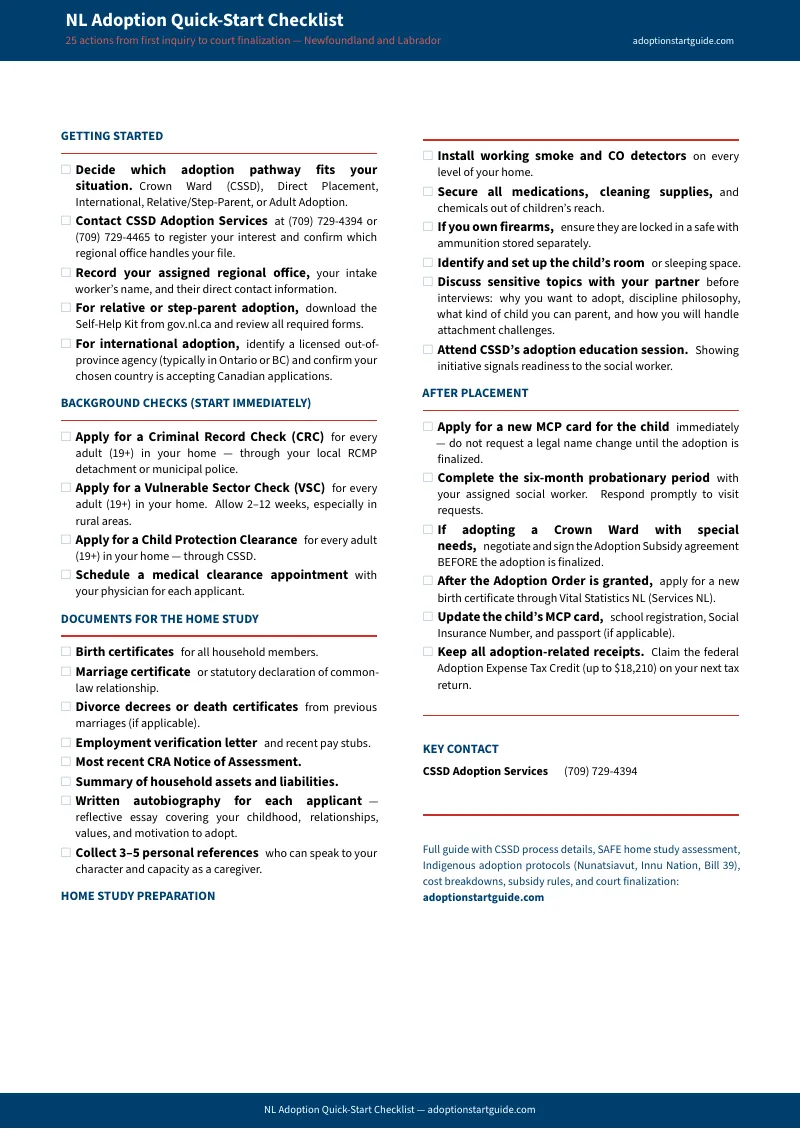
Download the Newfoundland and Labrador Adoption Quick-Start Checklist for a one-page overview of the key steps from choosing your pathway through background checks, home study preparation, and court finalization. Free, no commitment. If you want the full roadmap with the six-pathway breakdown, SAFE home study preparation, Indigenous adoption guidance, subsidy negotiation strategy, court walkthrough, and printable worksheets, click the button in the sidebar.
— less than fifteen minutes of a St. John's family lawyer's time
A single consultation with a family lawyer in St. John's runs $150 to $300 per hour. Families routinely spend that first billable hour asking foundational questions this guide answers on page one: Which pathway should we pursue? What does the home study assess? How long will this take? How much will it cost? If you live in Labrador, the airfare to reach a lawyer adds hundreds more. The Single-System Navigator doesn't replace your lawyer. It makes sure you don't pay your lawyer to explain the difference between Crown ward and direct placement adoption, or to describe the Self-Help Kit you could have downloaded yourself, or to tell you about the subsidy you should have negotiated before the court hearing. You arrive at that first consultation — if you need one at all — ready to discuss strategy, not basics. And for many relative and step-parent adoptions, this guide and the Self-Help Kit may be the only resources you need.