
You want to adopt in the Northwest Territories. You just didn't expect a territory with no private adoption agencies, two parallel legal tracks, a social worker shortage that stalls files for months, and a federal law that just shifted jurisdiction over Indigenous children to the very communities you're trying to work with.
The Northwest Territories has a population of approximately 44,000 people spread across 1.1 million square kilometres. Over 50% of residents identify as First Nations, Inuit, or Métis. Roughly 85% of children in the care of the Director of Child and Family Services are Indigenous. There are no licensed private adoption agencies anywhere in the territory. Everything — departmental adoption, private adoption, international adoption — flows through the Department of Health and Social Services (HSS) or, for Indigenous families, through Aboriginal Custom Adoption Commissioners appointed under a completely separate statute. These two tracks — the Western statutory system under the Adoption Act and the Indigenous customary system under the Aboriginal Custom Adoption Recognition Act — overlap, interact, and sometimes conflict. And since January 2020, the federal Act respecting First Nations, Inuit and Métis children, youth and families (Bill C-92, upheld by the Supreme Court of Canada in 2024) has granted Indigenous Governing Bodies the authority to assert their own jurisdiction over child welfare — meaning the legal ground is actively shifting beneath both tracks.
Then there's the practical reality. HSS struggles to recruit and retain social workers, particularly in communities outside Yellowknife. When your assigned worker transfers or resigns, your file doesn't move to the next available person — it stalls until someone is hired, oriented, and brought up to speed on a case they didn't start. Legal Aid NWT has nine lawyers for the entire territory, with waitlists and income restrictions that exclude most working families. Private family lawyers in Yellowknife charge $450 to $700 per hour. If you live outside the capital — in Inuvik, Fort Simpson, Norman Wells, Hay River, or any of the fly-in communities — a single appointment in Yellowknife costs $1,200 or more in flights alone. And the generic Canadian adoption guides written for Ontario or British Columbia assume you have agencies to call, a courthouse down the street, and a child welfare system that doesn't require you to navigate Indigenous customary law alongside territorial statute. None of that applies here.
The families who succeed in the NWT adoption system are the ones who understand it well enough to manage their own files — following up when things go quiet, gathering documents before they're asked, and knowing exactly who to call in which regional office when the system stalls. That's what this guide is for.
The Northern Dual-Track Navigation System
This is a complete, NWT-specific adoption guide built around the territory's defining legal reality: the coexistence of Western statutory adoption and Indigenous customary adoption, with a federal overlay that is actively transferring jurisdiction to Indigenous Governing Bodies. Not a repurposed provincial guide that assumes you have agencies, lawyers on every block, and a single court system. Every chapter, every checklist, every template is grounded in the NWT Adoption Act, the Aboriginal Custom Adoption Recognition Act, the Child and Family Services Act, and the Bill C-92 national standards — and the practical experience of navigating a system where a social worker's resignation can stall your file for six months.
What's inside
- All four adoption pathways mapped end to end — Custom adoption through ACARA, departmental adoption (Crown ward / foster-to-adopt), private domestic and step-parent adoption, and international adoption under the Hague Convention. Costs, timelines, eligibility, consent rules, and the specific NWT procedures for each. Many families don't realize that custom adoption — the most common form in the NWT — bypasses the court entirely through a Commissioner recognition process, or that departmental adoption includes ongoing financial support that can continue until the child turns 19. This chapter prevents you from spending months preparing for the wrong track.
- Custom adoption demystified — How the Aboriginal Custom Adoption Recognition Act works, who the Custom Adoption Commissioners are, what evidence you need for recognition, and how to register the certificate with Vital Statistics to amend the child's birth record. For Inuvialuit families: the specific 30-day notification requirement under Regulation 2021-3 of the Inuvialuit Qitunrariit Inuuniarnikkun Maligaksat, the role of the Inuvialuit Enrolment Committee, and the internal appeal process that removes disputes from the NWT court system entirely. For Tłı̨chǫ, Gwich'in, Sahtu, and Dene families: the traditional protocols, the kinship care framework, and how community recognition translates to territorial legal recognition.
- Bill C-92 placement priorities in plain language — The federal Act establishes five priority levels for placing Indigenous children: parent, extended family, community member, other Indigenous family, then non-Indigenous family. This chapter explains what "priority 5" actually means for non-Indigenous applicants — it's not a ban, it's a bar you need to clear — and exactly how to demonstrate the cultural competence that satisfies both the Director and the child's Indigenous Governing Body. Families who understand this framework from the start approach the process as partners, not petitioners.
- Cultural Connection Plan framework — A structured approach to the Cultural Support Plan required under CFS Standards 9.5 and 10.15 for non-Indigenous families adopting Indigenous children. Covers the four pillars: language connection (Dene Zhatie, Inuvialuktun, Tłı̨chǫ Yatıı̀), community re-engagement through seasonal visits and traditional activities, kinship maintenance with birth family and Elders, and rights preservation covering Treaty status, Land Claim benefits, and Jordan's Principle eligibility. This is the plan that makes or breaks a non-Indigenous family's application, and no free resource provides a practical template for building one.
- Home study preparation for the Northern context — What HSS social workers assess during the family assessment, including the Northern Housing Assessment that accounts for social housing and the territory's high cost of living. The cultural competency questions that non-Indigenous applicants must answer convincingly — including demonstrated understanding of the residential school system and the Sixties Scoop. The RCMP Vulnerable Sector Check, the HSS MatrixNT record check, the medical clearance, the financial documentation, and the autobiographical narrative. Plus: how video-conducted interviews work for families in remote communities, and when an in-person visit is mandatory.
- Navigating the social worker shortage — The NWT's child welfare system has high turnover, particularly outside Yellowknife. When your caseworker leaves, your file doesn't automatically transfer to someone who understands it. The guide provides a case management framework so you can track every completed step — whether the orientation is done, whether the genogram is filed, whether the medical clearance is in — and hand that tracking document to the next worker who picks up your case. In a system where continuity depends on the family, not the institution, this is the chapter that keeps your adoption moving forward.
- Adoption Assistance Program and financial planning — How the NWT's financial support works for families adopting Crown ward children with special needs: up to 60% of the basic foster care rate, with reviews every three years, continuing until age 19. The critical rule: negotiate the support level before the adoption order is finalized. After the order is signed, your leverage disappears. The guide also covers the federal Adoption Expense Tax Credit, the specific NWT government fees ($536 for the Pre-Placement Report, $108 for the Family Union Report, $26 for a new birth certificate), and realistic budget breakdowns for each pathway.
- NWT Supreme Court finalization — What the Petition for Adoption must include, the consent forms and revocation windows (10 to 21 days), the Pre-Placement and Family Union Reports, and how the non-adversarial hearing works. For families outside Yellowknife: the court logistics and realistic expectations for scheduling.
- International adoption from the NWT — Because no territorial agencies exist, NWT residents must work with agencies in southern provinces (typically Alberta) while HSS handles the local home study and monitoring. The guide walks you through coordination between HSS, the southern agency, and Immigration, Refugees and Citizenship Canada (IRCC), plus the Hague Convention requirements and realistic cost expectations of $30,000 or more.
- Complete contacts directory — HSS Adoption Services, Vital Statistics, the NWT Supreme Court Registry, Legal Aid NWT, the Outreach Legal Aid Clinic (one hour of free advice), Jordan's Principle, CRA for the tax credit, and every regional HSS office from Beaufort-Delta to Yellowknife. Plus the Indigenous organizations: Inuvialuit Regional Corporation, Gwich'in Tribal Council, Sahtu Secretariat, Dene Nation, Tłı̨chǫ Government, Deh Cho First Nations, NWT Métis Nation, and Akaitcho Territory Government. The phone numbers and fax lines that are buried in government PDF directories are listed here in one place.
Printable standalone worksheets included
The guide comes with printable standalone PDFs designed for real-world use:
- Pathway Comparison Card — Custom adoption (ACARA), Departmental, Private, and International adoption side by side on one page. Costs, timelines, eligibility, consent requirements, and the governing legislation for each. Print it, discuss it with your family, and make the decision that shapes everything else.
- Cultural Connection Plan Worksheet — A structured template covering language, community visits, kinship maintenance, and rights preservation. Fill it in before the home study so you walk into the assessment with a concrete plan that satisfies both HSS and the child's Indigenous Governing Body.
- Home Study Document Tracker — Every document the system requires, organized by category (identification, health, conduct, financial, housing, references), with checkboxes and dates so you can track what's submitted and what's outstanding — and hand the tracker to a new caseworker if yours leaves.
Who this guide is for
- Non-Indigenous professionals in Yellowknife — You're a GNWT employee, educator, or healthcare worker who has built a life in the North. You want to adopt, but you know that 85% of children in care are Indigenous and you're uncertain about whether Bill C-92 still allows non-Indigenous families to adopt, what the Cultural Connection Plan actually requires, and how to approach an Indigenous Governing Body without overstepping. This guide gives you the legal pathway and the cultural framework so you can proceed with confidence and respect.
- Indigenous families formalizing a customary adoption — You're already raising this child. Your community already recognizes the arrangement. But the federal government doesn't — not for passports, not for health benefits, not for Indian status registration, not for Land Claim inheritance. The Aboriginal Custom Adoption Recognition Act provides a simple procedure to give your family's arrangement the same legal force as a court order, and this guide walks you through every step from gathering evidence to receiving the Commissioner's certificate to updating the birth record.
- Foster parents considering permanency — The child in your care has a Permanent Custody Order. The permanency planning process has shifted from reunification to adoption. You know the child and the child knows you, but the transition from foster parent to adoptive parent involves different paperwork, potentially a different caseworker, and a court process you haven't navigated before. The guide explains the Crown ward pathway, the probationary period waiver for long-term placements, and the subsidy negotiation that must happen before finalization.
- Families in remote communities — You live in Inuvik, Fort Simpson, Norman Wells, or a fly-in community hundreds of kilometres from Yellowknife. A $1,200 round-trip flight is the cost of a single missed appointment. The guide covers video-based home study interviews, regional HSS office contacts, and the logistical planning that prevents unnecessary travel to the capital.
- Anyone pursuing international adoption from the NWT — There are no agencies in the territory and no one in HSS whose job is to walk you through the Hague Convention process. The guide explains how to use out-of-territory agencies, coordinate with IRCC, and satisfy territorial requirements so that living in the NWT doesn't mean your international adoption plan ends at a bureaucratic wall.
Why the free resources aren't enough
The HSS website provides a brochure and basic web pages that tell you adoption exists in the NWT. It lists definitions, eligibility requirements, and contact information. It does not explain how the Cultural Connection Plan works in practice, what evidence a Custom Adoption Commissioner actually needs, how Bill C-92's placement priorities affect non-Indigenous applicants, or what to do when your social worker leaves mid-process. It assumes a functioning system where a caseworker will guide you through every step, and the reality is that HSS is a small department serving a complex dual-track framework with chronic staffing shortages.
Legal Aid NWT provides coverage for certain family law matters, but adoption planning rarely rises to crisis-level priority on their docket. The territory has nine Legal Aid lawyers total, with long waitlists and income restrictions. The Outreach Legal Aid Clinic offers one hour of free advice — valuable, but not enough to navigate a multi-month legal process. Private family lawyers charge $450 to $700 per hour, and there are few of them.
Indigenous government resources — from the Inuvialuit Regional Corporation, the Tłı̨chǫ Government, the Dene Nation — provide information on custom adoption recognition. But their guidance is designed for their citizens and their communities. No free resource bridges the gap between territorial recognition under ACARA and federal registration under the Indian Act for the layperson. No free resource explains how a non-Indigenous family can satisfy both the Director and the Indigenous Governing Body at the same time.
Generic Canadian adoption guides are written for the Ontario and British Columbia market. They assume private agencies, readily available lawyers, a single court system, and no Indigenous customary law. They don't mention ACARA because it doesn't exist in most of Canada. They don't explain Bill C-92's NWT implementation because the NWT's demographic reality — a majority-Indigenous territory where most children in care are Indigenous — makes the federal law operate differently here than anywhere else. Using a national guide to navigate NWT adoption is like using a highway map to find a bush trail — it looks relevant until you need it to actually work.
The free Quick-Start Checklist
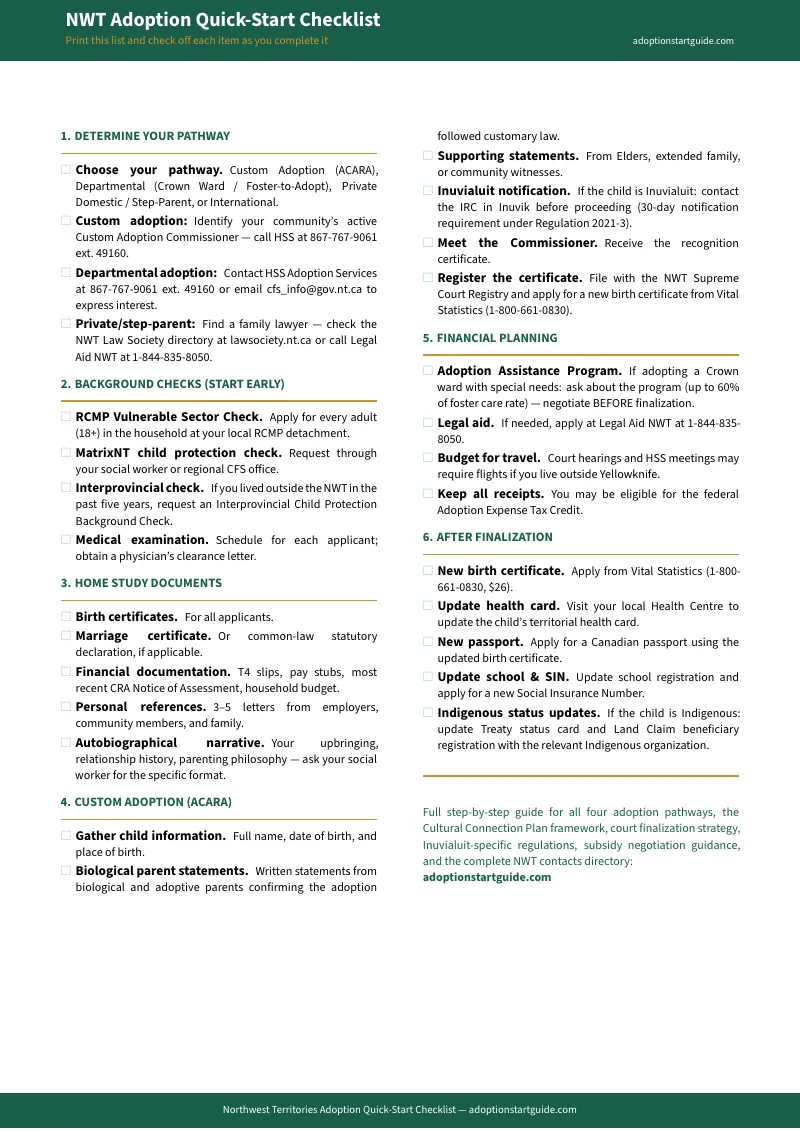
Download the Northwest Territories Adoption Quick-Start Checklist for a one-page overview of the essential action items — from identifying your pathway and starting background checks to gathering home study documents and post-finalization steps. Free, no commitment. If you want the full roadmap with all four pathways mapped end to end, the Cultural Connection Plan framework, Bill C-92 placement priorities explained, Inuvialuit-specific regulations, home study preparation, subsidy negotiation strategy, the complete NWT contacts directory, and printable worksheets, click the button in the sidebar.
— less than four minutes of an NWT family lawyer's time
A single consultation with a private family lawyer in Yellowknife starts at $450 per hour, and senior practitioners charge $700. The first hour is almost always spent on foundational questions this guide answers in the opening chapters — what ACARA is, how Bill C-92 changes the placement priorities, which pathway applies to your situation, what documents the home study requires, and whether the child's Indigenous Governing Body needs to be notified. The Northern Dual-Track Navigation System doesn't replace your lawyer. It makes sure you don't pay your lawyer to explain the basics of a system you could have understood before the meeting started. You arrive at that first consultation ready to discuss strategy, not definitions. And for many families — especially those formalizing a customary adoption through a Commissioner — this guide may be the only resource you need to move from confusion to a completed recognition certificate without ever setting foot in a courtroom.