You want to adopt in the Yukon. You just didn't expect a system where 11 First Nations hold legal veto power over placements, the legislature rewrote the rules in 2022, and the handful of family lawyers in the entire territory charge $200 to $350 an hour.
The Yukon is the only jurisdiction in Canada where territorial adoption law and First Nations self-government agreements operate in parallel with equal legal authority. Under the Yukon First Nations Self-Government Act, each of the 11 self-governing First Nations has "exclusive power to enact laws in relation to adoption of and by citizens." That's not a cultural courtesy. It's a constitutional fact. For 96% of the children in the territorial care system — children who are Indigenous — the First Nation's consent is as legally binding as a court order. No other province or territory works this way. And in 2022, Bill 11 amended the Child and Family Services Act to make that consent mandatory and to require a Cultural Plan for every Indigenous child in care. If your adoption preparation is based on a generic Canadian guide written for Ontario or BC, you're preparing for the wrong system.
Then there's the practical reality of doing anything legal in a territory of 44,000 people. The Department of Health and Social Services is your only institutional resource for domestic adoption. There are no private adoption agencies in the Yukon. HSS social workers are frequently overwhelmed, and their website tells you adoption exists without explaining how any pathway actually works step by step. If you need a lawyer, the entire territory has roughly nine private family law practitioners — all in Whitehorse. Legal Aid has restrictive eligibility criteria and long waitlists, and their focus is crisis intervention, not adoption planning. If you live in Dawson City, Watson Lake, or any of the smaller communities, the Yukon Supreme Court operates on a circuit system. Miss a filing deadline before the judge visits your community, and your finalization doesn't slip by a week. It slips by three to six months.
Meanwhile, the social dynamics of a small territory create pressure that no southern guide acknowledges. Your social worker may be someone you see at the grocery store. The First Nation whose consent you need may be the community you live in. There is no anonymity in the Yukon adoption process, and navigating the cultural, legal, and interpersonal dimensions of that reality without a map is how families lose months to uncertainty, spend thousands on legal fees answering questions that should have been resolved before the first consultation, or simply give up because the system felt impenetrable.
The Dual-Sovereignty Navigation System
This is a complete, Yukon-specific adoption guide built around the territory's defining legal reality: the concurrent jurisdiction of territorial law and First Nations self-government. Not a repurposed provincial guide that assumes you have agencies to call, a courthouse down the street, and a child welfare system that doesn't require negotiation with a sovereign government. Every chapter, every checklist, every template is grounded in the 2022 amendments to the Child and Family Services Act, the 11 self-government agreements, and the practical experience of families who have navigated adoption in the smallest legal market in Canada.
What's inside
- Self-government authority explained — Which of the 11 First Nations have active child welfare laws, what "exclusive power" over adoption actually means for your application, and how to identify whether the child's First Nation operates its own adoption process or works through the territorial system. This is the question that paralyzes most non-Indigenous applicants, and no free resource answers it in plain language. You'll understand the legal architecture before you make your first phone call.
- Four-pathway comparison — Crown ward adoption through HSS, customary adoption under First Nations authority, private domestic adoption, and step-parent adoption compared side by side. Costs, timelines, eligibility, consent requirements, and the practical differences between each. Many families don't realize they qualify for more than one pathway, or that the subsidized Crown ward route includes financial support that continues after finalization. This chapter prevents you from spending months preparing for the wrong track.
- First Nations consent strategy — How the mandatory consent requirement works under the 2022 amendments, what the First Nation evaluates when deciding whether to approve a placement, and how to demonstrate your commitment to cultural continuity in a way that is genuine and sufficient. The guide explains the process from the First Nation's perspective — what they need to see from you, not just what the court requires — so you can approach the relationship as a partner rather than a petitioner.
- Cultural Plan framework — A structured template for the Cultural Plan that Bill 11 requires for every Indigenous child in care. Covers language connection, Elder mentorship, traditional practices, ceremony participation, and ongoing ties to the child's First Nation community. This is not a checkbox exercise. The home study evaluates your plan for substance, and this framework gives you the structure to build one that satisfies both the social worker and the Nation.
- Circuit court readiness strategy — How the Yukon Supreme Court circuit operates for communities outside Whitehorse, when the court visits your community, and exactly what documents must be filed before the judge arrives. Includes a reverse-timeline worksheet so you can work backward from your community's next scheduled sitting and track every filing deadline week by week. In a circuit system, preparation is measured in seasons, not business days.
- Legal services navigation — A directory of private family law practitioners in the territory, guidance on preparing for an intake meeting so a lawyer says yes to your file, and strategies for reducing billable hours by handling the documentation and cultural planning yourself before the first consultation. In a territory where every lawyer is overbooked, showing up prepared is the difference between getting representation and being told to call back in six months.
- Adoption subsidy and financial planning — How the Yukon's adoption assistance program works for Crown ward adoptions, including the daily rates by location (Area I, II, and III), the "Acknowledgement of Special Need" that secures long-term support, and the critical rule that subsidies must be negotiated before finalization. Once the adoption order is signed, your leverage disappears. The guide also covers the federal Adoption Expenses Tax Credit and territorial benefits so you make the financial decision with full information.
- International adoption from the Yukon — Because there are no private agencies in the territory, international adoption requires contracting an out-of-territory agency in BC or Alberta, securing a "Letter of No Objection" from the Yukon Director of HSS, and coordinating with IRCC for the child's immigration. The guide walks you through this three-step process and the Hague Convention requirements, so the absence of local agencies becomes a logistical challenge rather than a dead end.
- Home study preparation for the Yukon context — What HSS social workers assess, how to prepare your home within the Yukon's housing realities (you do not need to own a home), and the cultural competency questions that non-Indigenous applicants must answer convincingly. Covers the RCMP Vulnerable Sector Check, the Interprovincial Child Protection Background check, the physician's medical report, and the autobiographical statement.
- Complete document checklist by pathway — Every form, certificate, background check, and legal filing organized by adoption type in the order the system expects them. Nothing is missing when the court arrives or the First Nation sits down with your file.
Printable standalone worksheets included
The guide comes with printable standalone PDFs designed for real-world use:
- Pathway Comparison Card — Crown Ward, Customary, Private, and Step-Parent adoption side by side on one page. Costs, timelines, eligibility, and consent requirements at a glance. Print it, sit down with your family, and make the decision that shapes everything else.
- First Nations Consent Preparation Checklist — The documents, commitments, and Cultural Plan elements the First Nation evaluates when deciding whether to approve a placement. Organized so you can track your preparation and walk into the meeting with evidence, not intentions.
- Circuit Court Readiness Tracker — A timeline worksheet you fill in with your community's next court visit dates, then work backward through filing deadlines and document preparation milestones. Designed to tape to your fridge and track progress week by week.
- Cultural Plan Template — A structured template covering language, Elder mentorship, traditional practices, ceremony, and ongoing community ties. Fill it in before the home study so you walk into the assessment with a concrete plan that satisfies both HSS and the child's First Nation.
Who this guide is for
- Non-Indigenous professionals in Whitehorse — You're a government worker, teacher, or health professional who has built a life in the Yukon. You want to adopt, but you're acutely aware that 96% of children in care are Indigenous and you're uncertain about whether you're "allowed" to adopt a First Nations child, what cultural obligations come with it, and how to approach a self-governing Nation for consent without overstepping. This guide gives you the legal pathway and the cultural framework so you can proceed with confidence and respect.
- Long-term foster parents pursuing permanency — The child in your care has a Continuing Custody Order. You want to give them a legal family, not another temporary placement. The guide explains the Crown ward adoption pathway, the subsidy negotiation that must happen before finalization, and the First Nations consent requirement for Indigenous children so the transition from foster parent to adoptive parent doesn't stall on a step you didn't see coming.
- First Nations families formalizing a customary adoption — Your community already recognizes the arrangement. But the federal government doesn't — not for passports, not for the Canada Revenue Agency, not for settlement land inheritance. Whether you're going through your Nation's own adoption process or seeking a Yukon Supreme Court order to formalize the arrangement, the guide maps both paths so you can protect the child's legal rights without feeling like the system is overriding your traditions.
- Families pursuing international adoption from the Yukon — There are no private agencies in the territory and no one in HSS whose job it is to walk you through the Hague Convention process. The guide explains how to use out-of-territory agencies, secure the Letter of No Objection, and coordinate with IRCC so that living in the Yukon doesn't mean your international adoption dream ends at a bureaucratic wall.
Why the free resources aren't enough
The Yukon HSS website lists adoption types and provides forms for inter-country adoption. It tells you adoption exists in the territory. It does not explain how the mandatory First Nations consent process actually works, what a Cultural Plan needs to contain, how to approach a self-governing Nation as a non-Indigenous applicant, or what the practical difference is between a Crown ward adoption and a customary adoption formalized through the court. It assumes a functioning system where a social worker will guide you through every step, and the reality is that HSS is a tiny department serving a complex dual-sovereignty framework with limited capacity.
Legal Aid Yukon provides representation to eligible clients in child protection matters, but adoption planning is rarely urgent enough to rank on their docket. The waitlist for intake is long, their focus is crisis-driven, and if your household income exceeds the eligibility threshold, you're directed to the private bar — where a handful of lawyers serve the entire territory's family law needs at $200 to $350 an hour.
Generic Canadian adoption guides assume every jurisdiction has licensed agencies, intake offices, and a courthouse within driving distance. They don't mention the Yukon First Nations Self-Government Act because it doesn't exist anywhere else. They don't address the Teslin Tlingit Peacemaker Court because it's unique in Canada. They don't explain that 11 sovereign governments have veto power over adoption placements because that reality is exclusive to the Yukon. Using a national guide to navigate Yukon adoption is like using a highway map to cross a river — it looks relevant until you need it to actually work.
First Nations self-government offices hold deep cultural authority and community-specific citizenship information, but their guidance is designed for citizens of the Nation, not for the non-Indigenous family trying to understand how the process looks from the outside in. The guide bridges that gap — translating the legal and cultural requirements into practical steps for every buyer profile in the territory.
The free Quick-Start Checklist
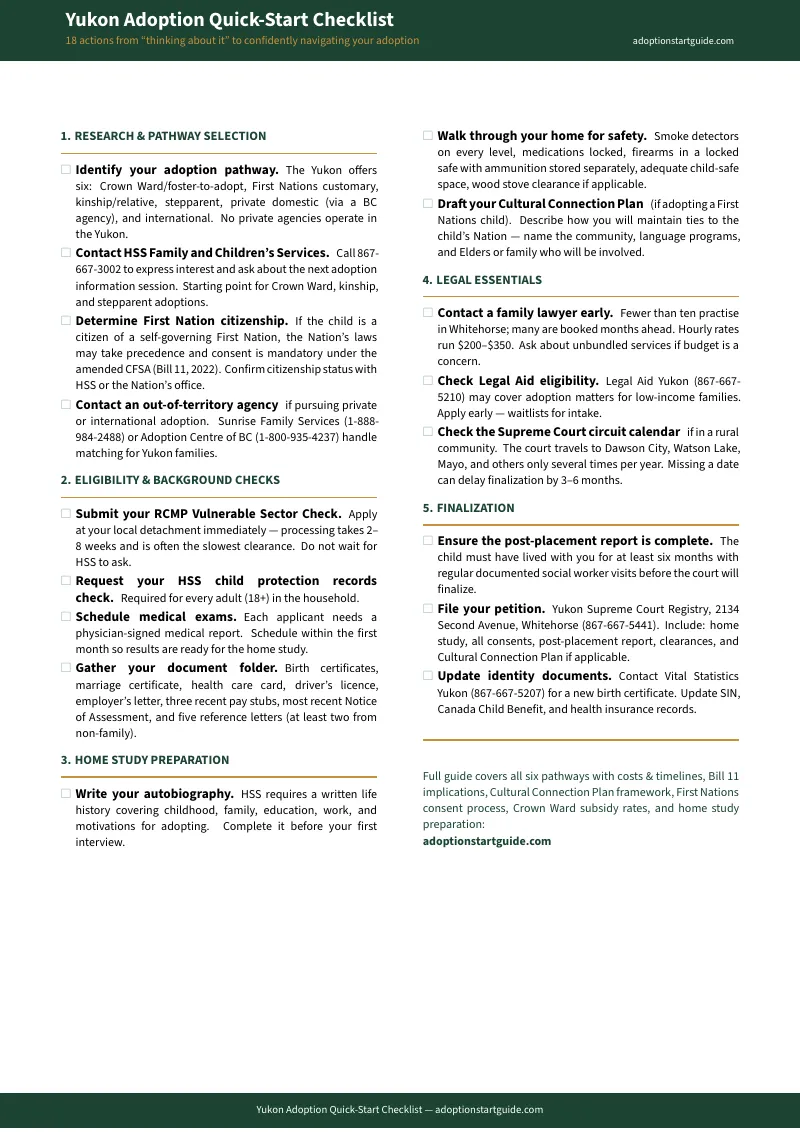
Download the Yukon Adoption Quick-Start Checklist for a one-page overview of the key steps from identifying your adoption pathway to securing First Nations consent to court finalization. Free, no commitment. If you want the full roadmap with self-government authority explained, consent strategy, Cultural Plan framework, circuit court readiness tracker, legal services directory, subsidy negotiation guidance, and printable worksheets, click the button in the sidebar.
— less than fifteen minutes of a Yukon family lawyer's time
A single consultation with a private family lawyer in Whitehorse starts at $200 to $350 per hour, and the first hour is almost always spent on foundational questions this guide answers before page ten — what the self-government agreements mean for your application, which pathway applies to your situation, whether the First Nation has its own adoption process, and what the Cultural Plan actually needs to contain. The Dual-Sovereignty Navigation System doesn't replace your lawyer. It makes sure you don't pay your lawyer to explain the basics of a system you could have understood before the meeting started. You arrive at that first consultation ready to discuss strategy, not definitions. And for many families — especially those formalizing a customary adoption or pursuing a Crown ward placement — this guide may be the only resource you need to move from confusion to a completed application.