You want to foster in the Yukon. Then you discovered the territory runs two child welfare systems at once.
The HSS website says "become a community caregiver" and gives you a phone number. It does not explain that 11 of 14 Yukon First Nations have signed Self-Government Agreements — constitutionally protected modern treaties that grant them authority over the care of their children. It does not mention that when an Indigenous child is placed in your home (93% of children in care are Indigenous), the child's First Nation becomes a full partner in the care plan with its own legal framework, its own cultural requirements, and its own decision-making process. Kwanlin Dün uses Peacemaking Circles. Teslin Tlingit Council has a Peacemaker Court. Carcross/Tagish First Nation enacted a Family Act that defines caregiving as a "shared clan responsibility." These are not theoretical distinctions. They determine how your placement works day to day.
The 2026 Auditor General's report confirmed what families on the ground already knew: the department is running at 62% staffing capacity. Social workers are overloaded. Ninety percent of Indigenous children in care lack a completed cultural plan despite it being legally required. Seventy-four percent of children did not receive their mandated monthly face-to-face visits. The system needs more foster homes urgently — but it cannot adequately support the ones it has.
Meanwhile, the practical information you need is scattered across the Child and Family Services Act, the 2022 Bill 11 amendments, the federal Act respecting First Nations children (Bill C-92), eleven separate Self-Government Agreements, HSS policy documents, and whatever your social worker — if they're not one of the 38% of unfilled positions — tells you over the phone.
The Dual-System Navigator
This is a complete, Yukon-specific foster care guide built for the territory's defining challenge: navigating the intersection of territorial government bureaucracy and First Nations sovereign authority. Not a southern Canadian manual rebranded for the North. Not a generic "how to foster in Canada" overview. Every chapter, every checklist, every rate and requirement is grounded in the Yukon Child and Family Services Act, the 2022 Bill 11 amendments, Bill C-92, and the self-government agreements that eleven First Nations have signed.
What's inside
- Legislative framework decoded — Three layers of law govern every foster placement in the Yukon: the territorial CFSA, the federal Bill C-92, and the self-government agreements. This chapter explains how they interact, where territorial law yields to First Nations jurisdiction, and what "concurrent jurisdiction" means when a social worker from HSS and a liaison from Kwanlin Dün First Nation are both involved in your placement. Written in plain language, not legalese — because understanding this framework is the difference between navigating the system and being confused by it.
- All 11 self-governing First Nations mapped — From Champagne and Aishihik First Nations in Haines Junction to Vuntut Gwitchin in Old Crow, each nation has its own approach to child welfare. Kwanlin Dün's Peacemaking Circles, Tr'ondëk Hwëch'in's "Ni'ehłyat Nidähjì'" department, Teslin Tlingit Council's Peacemaker Court under Haa Ḵusteeyí values, and the Carcross/Tagish Family Act where caregiving is a "sacred honour." Community locations, agreement dates, service delivery models, and what to expect when working with each nation's child and family services team. Plus the three non-self-governing nations (Liard, Ross River Dena Council, White River) and how their placements work through CYFN.
- Eligibility requirements — northern-specific — The RCMP Vulnerable Sector Check and medical clearance are standard. But Yukon adds requirements that no southern guide covers: wood stove emission ratings (max 2.5g/hour) and 36-inch clearance from combustibles. Well water testing for rural homes. Redundant heating sources for -40°C winters. The actual bedroom-sharing policy — more flexible than most people believe. Firearm double-lock storage with ammunition in a separate locked location. Water temperature maximums at 49°C. Every requirement that's specific to fostering in a northern territory where the heating system is a safety-critical feature of your home.
- Step-by-step application process — Initial contact with Family and Children's Services through license issuance, mapped to a 6-to-12-month timeline. The PRIDE pre-service training (29-30 hours), the Cultural Competency Assessment for non-Indigenous applicants, the home study (or video home study for families in Dawson City, Watson Lake, or Old Crow), the three references, and the annual license renewal. Each stage includes what to prepare, what to expect, and how to handle the delays caused by the territory's 62% staffing capacity — because the timeline the department quotes assumes full staffing.
- Cultural obligations handbook — When an Indigenous child is placed in your home, the 2022 CFSA amendments require a Cultural Plan. This chapter turns that requirement into practice: how to facilitate ceremony participation, how to access traditional foods (caribou, moose, salmon), how to support land-based activities, where to find language resources for eight Indigenous languages (Southern Tutchone, Northern Tutchone, Tlingit, Gwich'in, Kaska, Upper Tanana, Hän, Tagish), and how to work with the child's First Nation to maintain their citizenship and territorial connections. Written for non-Indigenous foster parents as practical guidance — not a lecture on reconciliation, a toolkit for doing it.
- Financial support breakdown — Basic daily rates of $34.61 to $37.04 per child depending on age. Annual clothing allowance. Full medical and dental coverage through HSS and Yukon Health. Property damage coverage up to $2,400 per incident. Specialized "difficulty of care" rate augmentations for children with complex needs. Supplemental fuel and transportation allowances for rural families. All non-taxable. The guide explains what each payment covers, how it compares to the actual cost of living in the Yukon (groceries in Watson Lake cost significantly more than in Whitehorse), and how to access additional support when the flat territory-wide rate falls short.
- Rural Yukon toolkit — For families in Dawson City, Watson Lake, Carmacks, and Old Crow. The video home study process and how to prepare for it. Working with your local RCMP detachment for background checks. Managing fostering when the nearest social worker is a six-hour drive — or a charter flight — away. The "small community" reality where everyone knows you're a foster parent and your social worker is your neighbour at the post office. Privacy strategies and support structures for rural foster families.
- Systemic advocacy strategies — The Auditor General found that HSS is failing to meet its own mandated standards. Your social worker may be new, undertrained, or covering caseloads meant for two people. The guide includes a Training and Compliance Log template so you can track your own licensing requirements (since the department may not), a checklist for monitoring whether HSS is meeting its obligations for your placement, and guidance on when and how to escalate concerns through the Yukon Child and Youth Advocate or the Yukon Ombudsman.
- Transitions and permanency pathways — Reunification (the primary goal), customary care (care according to First Nations traditions without a formal court order), permanent guardianship under the CFSA, adoption from foster care, and aging-out support to age 26 (financial stipends, housing navigation, continued social worker access). Each pathway explained so you understand where your role fits in the child's long-term plan — and what happens when plans change.
- Resource directory — Family and Children's Services (central intake and regional offices), RCMP Whitehorse and rural detachments, Council of Yukon First Nations (CYFN), Kwanlin Dün First Nation Child & Family Liaison, Teslin Tlingit Council, Tr'ondëk Hwëch'in, Yukon Legal Aid, the Child and Youth Advocate, YPLEA (Yukon Public Legal Education Association), the Family Law Information Centre, and community health contacts across the territory.
Who this guide is for
- Whitehorse professionals considering fostering — You've lived here long enough to care about this community. But you're conscious that 93% of children in care are Indigenous, and you need to understand your legal and cultural obligations before you start the process. Not the buzzwords — the actual requirements. What does "cultural continuity plan" mean in practice? What happens at a Peacemaking Circle? How do you present yourself when meeting with a First Nation's Family Council? This guide gives you the framework so you can approach the process with confidence, not anxiety.
- First Nations families formalizing kinship care — You're already caring for a relative or clan member. You've been doing this since before the government got involved. But formalizing the arrangement — becoming a licensed "community caregiver" — gives you access to the daily rates, medical coverage, and educational subsidies that ensure the child gets every resource they deserve. The guide shows you how to navigate HSS paperwork without surrendering your family's authority. Your self-government agreement protects your rights; this guide helps you exercise them.
- Rural families outside Whitehorse — In Dawson City, Watson Lake, or Carmacks, HSS coverage is thin. You may have been asked to take an emergency placement by a social worker covering three communities. The guide is designed for your reality: remote application processes, video home assessments, and the logistics of fostering where "the nearest specialist" means a flight to Whitehorse. Includes the specific challenges of Old Crow, where everything is flown in and routine medical appointments require air travel.
- Recent arrivals from southern Canada — You moved from Alberta, BC, or Ontario for a government contract or a fresh start. You fostered down south, or you thought about it. The Yukon is not what you're used to. "Foster parent" is "community caregiver." The First Nations jurisdiction is fundamentally different from anything south of 60. The allowances, the training, the home study — all of it reflects a territory with 44,000 people, -40°C winters, and a child welfare system where the Auditor General found 22% of adults in extended family homes were missing criminal record checks. The guide bridges the gap between what you knew and how things work here.
Why the free resources aren't enough
The HSS "Become a Community Caregiver" page is technically accurate but bureaucratically impenetrable. It lists steps without explaining context. It does not explain how the 11 Self-Government Agreements change the process for 93% of the children you'll be asked to care for. It does not address the Auditor General's findings that the department is failing to track mandatory safety training or complete cultural plans. It's a compliance document, not a navigation tool.
The Child and Family Services Act and the 2022 Bill 11 amendments are the legal authority, but they're dense legislative text written for lawyers and policy analysts. The self-government agreements are constitutional documents designed for intergovernmental relations, not prospective foster parents. Bill C-92 is federal legislation that assumes you already understand how Indigenous jurisdiction works in your territory.
Facebook groups — Whitehorse Community Board, various Yukon parenting groups — give you anecdotes from people whose experience may be years out of date or specific to a First Nation that doesn't apply to your placement. Word of mouth in a territory of 44,000 people is powerful but unreliable. One family's experience with a KDFN liaison in Whitehorse tells you nothing about working with Vuntut Gwitchin in Old Crow or Selkirk First Nation in Pelly Crossing.
The FLIC (Family Law Information Centre) and YPLEA (Yukon Public Legal Education Association) provide legal information but cannot give strategic "how-to" advice. They'll tell you what the law says. They won't tell you what to expect when the department is running at 62% capacity and your social worker hasn't returned your call in two weeks.
The free Quick-Start Checklist
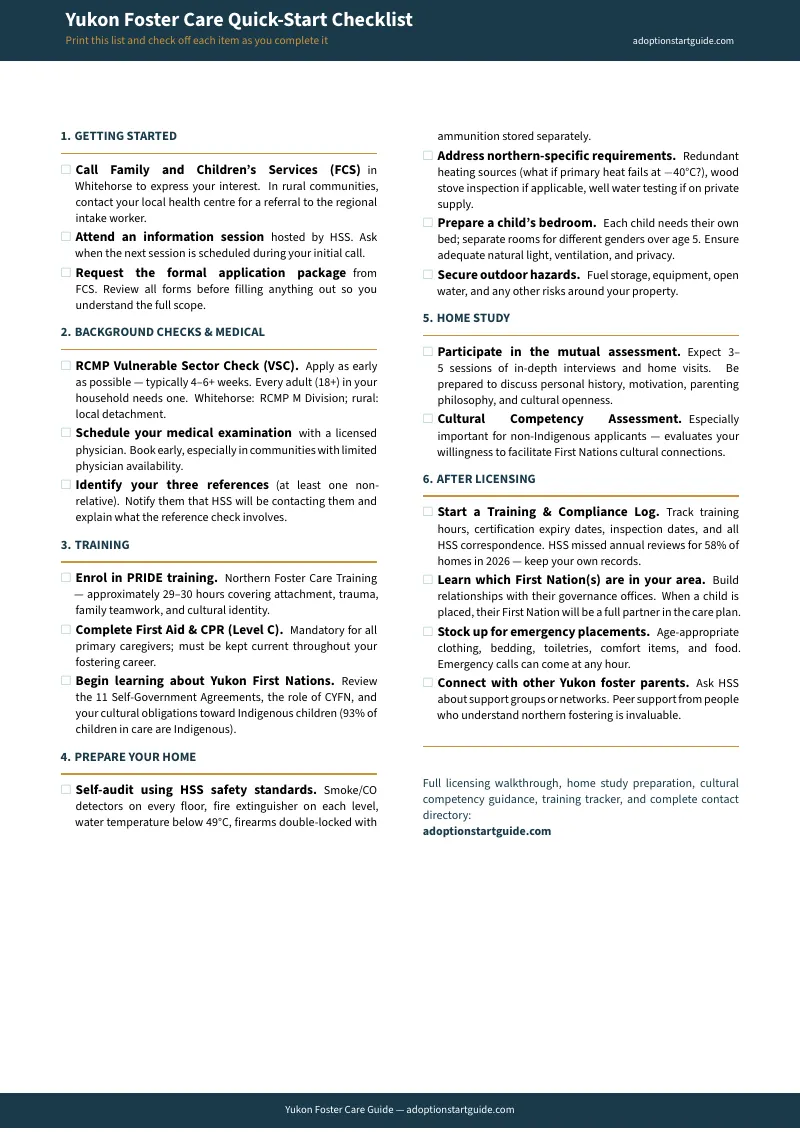
Download the Yukon Foster Care Quick-Start Checklist for a 20-step overview of the process from initial inquiry to licensing. Free, no commitment. If you want the full guide with the legislative decoder, the self-government map, the cultural obligations handbook, the rural toolkit, and the systemic advocacy strategies, click the button in the sidebar.
— less than a phone call with a Whitehorse family lawyer
A family law consultation in Whitehorse runs $300 to $500 per hour. Even the "Meet with a Lawyer" program costs $30 for thirty minutes — and you won't get foster care navigation, just a general legal overview. Legal Aid is reserved for low-income residents and has significant waitlists. The Dual-System Navigator gives you the equivalent of hours of procedural and legal orientation for a fraction of what a single phone call with a lawyer costs. It doesn't replace legal counsel. It makes sure you don't spend your first consultation learning what "concurrent jurisdiction" means.