
Ireland runs fewer than 10 domestic infant adoptions a year — and nobody tells you that until you've already started the process.
You went to the Adoption Authority of Ireland website looking for a clear path to becoming a parent. What you found was a legal framework written for policymakers, not families. It mentions the Adoption Act 2010 and the Declaration of Eligibility and Suitability without explaining that this declaration expires after two years — and if you haven't been matched with a child in that window, you go back to the start. It references the home study assessment without telling you what the Tusla social worker actually asks about your childhood, your infertility history, and your marriage. And it doesn't mention the number that redefines everything: fewer than 10 domestic infant placements happen per year across the entire country. Birth parents choose. You wait.
If you're considering intercountry adoption, you discovered that Ireland's sole accredited mediation agency — Helping Hands Adoption Mediation Agency — manages programmes in just five countries, with a combined waiting list of fewer than 30 families. Vietnam places mostly toddlers and children with special needs. India has referred exactly one child since the programme opened. The Philippines programme holds provisional accreditation. Each country has its own fee structure, post-placement reporting requirements, and risk of closure — and the total cost runs between €35,000 and €57,000 before you factor in travel, legal fees, and the months of unpaid leave you'll need. Nobody laid that out in one place before you started making calls.
And if you're a foster carer hoping to adopt the child already in your home, you learned that Tusla's primary objective is reunification with the birth family. An adoption order from foster care requires a High Court finding that the birth parents have failed in their duties for at least 36 months — a process that is often contested, slow, and emotionally devastating even when it succeeds.
The DES-to-Order Roadmap: Your Complete Guide to Adoption in Ireland
This guide is built for the Irish adoption system and nobody else's. Every chapter, every checklist, every legal reference is grounded in the Adoption Act 2010, the Birth Information and Tracing Act 2022, AAI regulatory standards, Tusla assessment procedures, and the High Court and Circuit Court processes that determine whether your adoption takes two years or seven. It's not a repurposed international handbook. It's the practical layer between what the government publishes online and what you actually need to know — for your pathway, under current Irish law.
What's inside
- The Adoption Act 2010 Decoded — The 2010 Act replaced a patchwork of older legislation and integrated the Hague Convention into Irish law. It centralised authority in the AAI, imposed strict assessment standards, and created the Declaration of Eligibility and Suitability as the legal gateway to any adoption in Ireland. This chapter translates each relevant section into plain language, explains how the Act interacts with the Birth Information and Tracing Act 2022, and covers what the new right of adoptees to access their birth certificates means for you as an adoptive parent from day one.
- AAI, Tusla, and HHAMA — Who Does What — The biggest source of confusion for Irish applicants is the bifurcated system. The AAI issues your DES and maintains the register. Tusla conducts the information meetings and the home study. Helping Hands mediates intercountry dossiers. PACT provides specialist domestic assessment. This chapter maps out exactly which body handles each stage of the process, the sequence of handoffs between them, and the contact details and timelines for each — so you stop calling the wrong office and waiting for callbacks that never come.
- The Three Pathways Mapped — Domestic infant adoption, intercountry adoption, and foster-to-adopt each have different eligibility criteria, timelines, costs, and emotional realities. This chapter lays out all three side by side so you can see which pathway fits your situation before you commit years to the wrong one. It covers the eligibility matrix — the 21-year minimum age, the marital and civil partnership requirements since the 2015 Marriage Equality Referendum, and the rights of single applicants and same-sex couples under current law.
- Home Study Deep-Dive — The psychosocial assessment is the most anxiety-inducing phase of the Irish adoption journey. A Tusla social worker or PACT assessor interviews you over months, probing your childhood experiences, your relationship dynamics, how you've processed infertility, your financial stability, your physical and mental health including BMI, and your readiness for open adoption and trauma-informed parenting. This chapter breaks down every assessment domain documented in current guidelines, the questions you should prepare for, how to approach the infertility conversation honestly, and the common mistakes that stall applications — starting with trying to present a perfect life.
- The DES: Your Two-Year Clock — The Declaration of Eligibility and Suitability is the single most important document in the Irish adoption process. Without it, you cannot adopt domestically or internationally. It expires after two years, with a possible 12-month extension. This chapter explains the application process, the Article 15 report sequence for intercountry applicants, exactly how the clock works, what triggers an extension, and what happens if you need to reapply — including the emotional and practical cost of starting the assessment over.
- Intercountry Adoption: Country-by-Country Matrix — A quick-reference guide to Ireland's five active intercountry programmes: Vietnam, USA, Thailand, India, and the Philippines. For each country, this chapter covers the current status, the number of Irish families on the waiting list, the age and profile of children typically placed, the fee structure from HHAMA's €10,850 base cost through to the sending country's programme fees, post-placement reporting requirements, and the realistic wait time. It addresses programme closure risk directly — because committing €15,000 to a country that suspends adoptions six months later is the nightmare scenario every intercountry applicant fears.
- Foster-to-Adopt: The High Court Pathway — For long-term foster carers, adoption is the legal recognition of a bond that already exists. But in Ireland, this pathway runs through the High Court, not the Circuit Court, and requires proving that the birth parents have failed in their duties for at least 36 months. This chapter covers the legal threshold, the typical timeline, how non-consensual adoption orders work when birth parents object, and how to prepare for a process that can feel adversarial even when the outcome is in the child's best interest.
- Costs of Adoption in Ireland — From virtually free (domestic adoption through Tusla) to €57,000+ (intercountry adoption with travel and overseas agency fees), the cost range is enormous. This chapter breaks down each pathway's costs line by line, including the hidden expenses that information sessions gloss over: notarisation and apostille fees, translation costs, multiple trips abroad, time off work for weekday Tusla appointments, and the counselling you may need but that isn't covered by the HSE.
- Open Adoption, Identity, and the 2022 Act — The Birth Information and Tracing Act 2022 gave adoptees an absolute right to their birth certificates and early life records. "Secret" adoption no longer exists in Ireland. The National Contact Preference Register means your child may one day seek contact with their birth family — and understanding this from the beginning shapes how you parent. This chapter covers the modern Irish approach to open adoption, the spectrum from letterbox contact to direct meetings, and how to talk to your child about their origins in a system that now proactively facilitates reunion.
Printable standalone worksheets included
- Adoption Pathway Decision Matrix — Work through eligibility, timeline, cost, and emotional readiness for each of the three pathways. Print it, fill it in with your partner, and clarify your direction before contacting Tusla.
- Document Organisation Checklist — Every document required for domestic, intercountry, and foster-to-adopt adoption, organised by phase with checkboxes and notes on processing times and expiry dates.
- Home Study Preparation Worksheet — Structured prompts for every assessment domain the social worker will cover: childhood history, relationship stability, infertility resolution, health disclosure, financial transparency, and open adoption readiness. Complete it before your first interview.
- DES Timeline Planner — A visual planning tool for tracking your two-year Declaration window, key milestones, document renewal dates, and extension eligibility — so you never lose months to expired paperwork.
Who this guide is for
- Prospective domestic adopters — You want to adopt an infant or young child through the AAI and Tusla. You need to understand the statistical reality, the assessment process, and what distinguishes a strong application from one that stalls in the system for years.
- Intercountry adoption families — You're considering adopting from Vietnam, the USA, Thailand, India, or the Philippines through HHAMA. You need to understand the costs, the current status of each programme, the realistic wait times, and the post-placement reporting obligations before you commit financially and emotionally.
- Long-term foster carers — You've cared for this child for years. You want the legal permanence of an adoption order. But you need to know the High Court threshold, the 36-month rule, and how to navigate a process designed around reunification, not adoption.
- Same-sex couples and single applicants — Irish law allows you to adopt since the 2010 Act and the 2015 Marriage Equality Referendum. But questions about relationship stability, support networks for sole applicants, and social worker attitudes still shape the experience. This guide addresses those realities directly.
- Step-parents formalising an existing family — You already parent this child every day. You want the legal recognition. This guide covers the consent requirements, the process through the Circuit Court, and the documentation you need to gather.
Why the free resources aren't enough
The AAI website publishes legal frameworks and policy overviews written for the adoption system, not for the families trying to navigate it. It tells you that adoption exists. It tells you to contact Tusla for an information meeting. It does not tell you that domestic infant adoption is a single-digit-per-year occurrence, that the DES expires in 24 months whether you've been matched or not, or that ordering your Garda vetting and medical report in the wrong sequence can add months to your timeline.
Tusla's information pages describe the procedural steps without addressing the emotional preparation that determines whether you pass the home study comfortably or spend six months in remedial assessment. They explain that a social worker will conduct interviews. They don't explain that the social worker will ask you to describe how your parents disciplined you as a child, how you grieved your last failed IVF cycle, and whether your marriage can survive the stress of parenting a child who has experienced institutional neglect.
Forums like Boards.ie and Rollercoaster.ie provide emotional support from families who have been through the process. But advice that was correct for a Vietnam adoption in 2019 may be wrong for a Vietnam adoption in 2026, because programme statuses change, fee structures update, and HHAMA's accreditation in specific countries can shift with little notice. And a post from a Dublin couple's domestic experience tells you nothing about the intercountry dossier timeline or the High Court foster-to-adopt threshold.
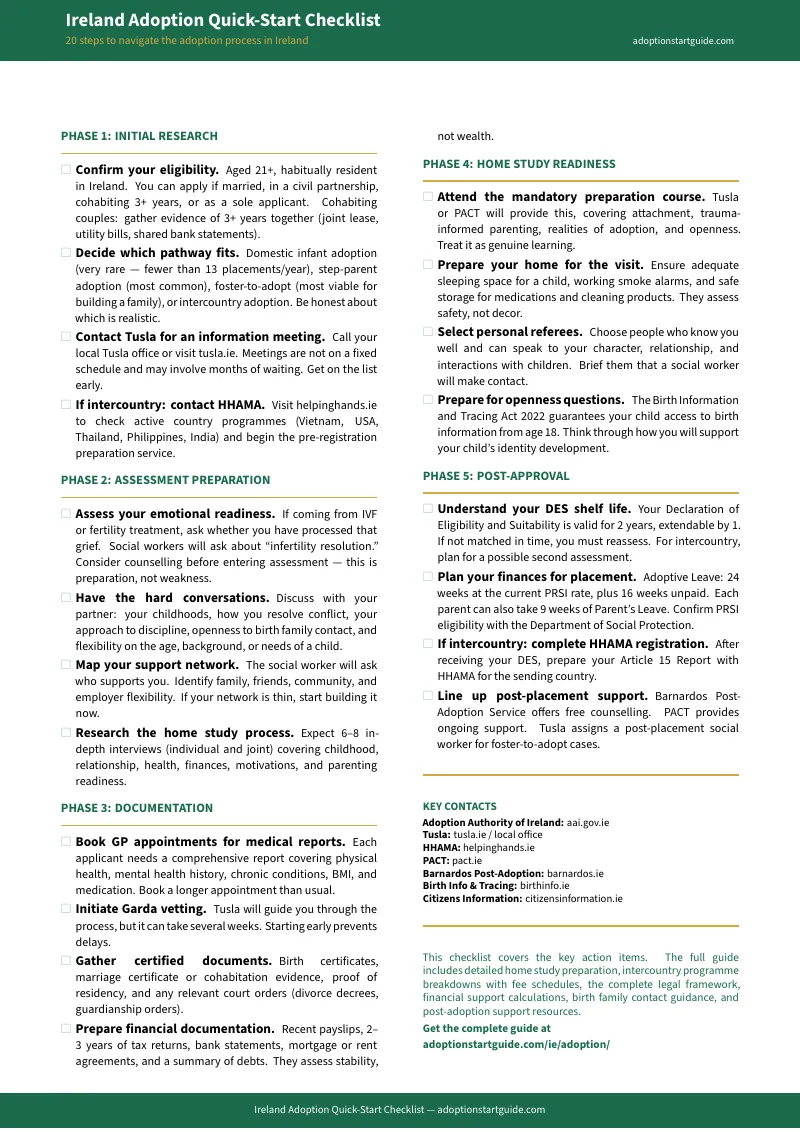
The free Quick-Start Checklist
Download the Ireland Adoption Quick-Start Checklist for a step-by-step overview of the adoption process, from choosing your pathway through post-adoption rights and support. Free, no commitment. If you want the full guide with the Adoption Act 2010 decoded, three-pathway analysis, home study deep-dive, intercountry country matrix, foster-to-adopt legal pathway, cost breakdowns, and printable worksheets, click the button in the sidebar.
— less than one hour with a family solicitor
The typical Irish adoption applicant spends months piecing together the process from AAI publications, Tusla information meetings, HHAMA fee schedules, forum threads on Boards.ie, and phone calls to social workers who handle hundreds of cases. They discover the domestic scarcity reality after they've already invested emotionally. They learn about the DES expiry clock after their paperwork has already started to age. They find out about HHAMA's €10,850 base fee after they've mentally committed to intercountry adoption. This guide puts the critical decisions, realistic timelines, financial requirements, and legal thresholds in front of you before you spend a euro or a year on the wrong pathway.
If the guide doesn't deliver, reply to your download email at any time for a full refund. No forms. No justification required.