The Tusla Assessment Is a 16-Week Journey. Most Applicants Walk In Blind.
You've been thinking about fostering for months — maybe years. You've read everything on Tusla.ie. You've scrolled through forum threads on boards.ie looking for someone who can tell you what the home study visits are actually like. And you still don't have a straight answer.
That's because Tusla's website tells you the rules. It doesn't tell you the strategy. It won't explain which questions trip people up during the assessment, how the Garda vetting committee really weighs an old conviction, or what your Link Social Worker actually expects from you in the first six months.
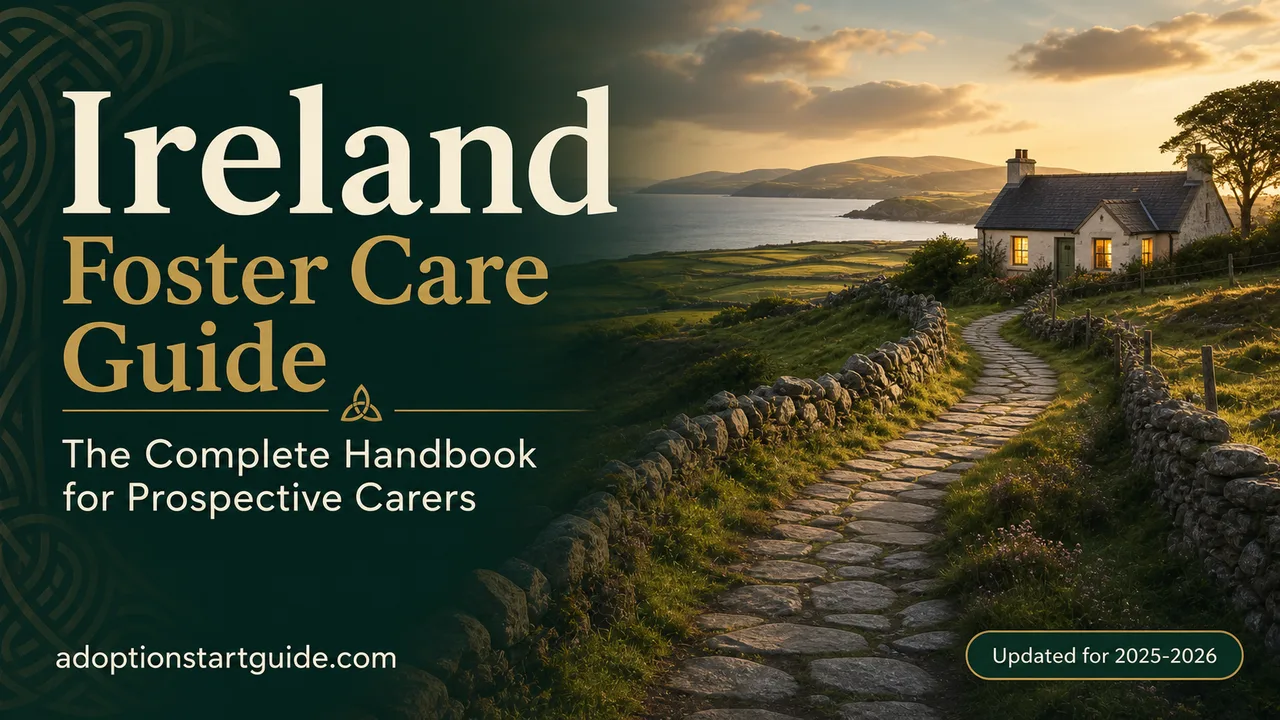
The Ireland Foster Care Guide is the Tusla Assessment Roadmap — a single document that turns the 4–9 month journey from first enquiry to approved foster carer into a clear, step-by-step process. Every chapter is built on current Irish legislation, 2025/2026 allowance rates, and the real experiences of carers who've been through the system.
What You Get
The Full Tusla Assessment — Visit by Visit
The 8–12 home study visits are the heart of the process, and the part that causes the most anxiety. The guide breaks down what your social worker evaluates at each stage — room and fire safety checks, your childhood history, the eco-gram, parenting approach, views on birth family contact, and the identity and diversity discussion. You'll know what's coming before it arrives.
The Garda Vetting Decoder
Minor conviction from twenty years ago? Wondering what "specified information" means? The guide explains exactly how the National Vetting Bureau process works, what the Decision Making Committee weighs when reviewing disclosures, which offences are automatic disqualifiers, and which are assessed in context. This section alone can save you months of unnecessary worry.
The Complete Financial Picture
The weekly allowance is €400 (under 12) and €425 (ages 12–18) — and it's fully tax-free. But most applicants don't know about the Back to School Allowance (€160/€285), the Carer's Support Grant (€2,000 per year), or that they can claim Child Benefit after six months. The guide maps every financial support available and confirms the allowance is disregarded in means tests for all social welfare payments.
Assessment Questions Handbook
Social workers ask about discipline, about your own childhood, about how you'd handle a child grieving for their birth parents. The guide covers the most common questions across six categories — with guidance on how to prepare honest, thoughtful responses rather than rehearsed scripts.
Tusla vs Private Agencies — An Honest Comparison
Should you foster through Tusla directly or through a private agency like Orchard, Origins, or Fostering First Ireland? The guide compares assessment timelines, support levels, matching processes, and the real trade-offs of each path so you can make an informed decision.
Every Type of Foster Care Explained
General, relative/kinship (Section 36), emergency, short-term, long-term, respite, and private agency — each type has its own regulatory framework and assessment nuances. The guide explains who each type suits and how the process differs.
Your Rights and the Legal Framework
The Child Care Act 1991, National Standards for Foster Care 2003, HIQA's role — and what to do if things go wrong. The guide covers your rights as a carer, Tusla's complaints process, and where to get advocacy support through the IFCA.
First Placement: The Practical Reality
Matching, settling in, managing birth family access visits, care plan reviews, and building a working relationship with your Link Social Worker. The guide prepares you for the transition from approved carer to active placement.
Plus: Your Quick-Start Checklist
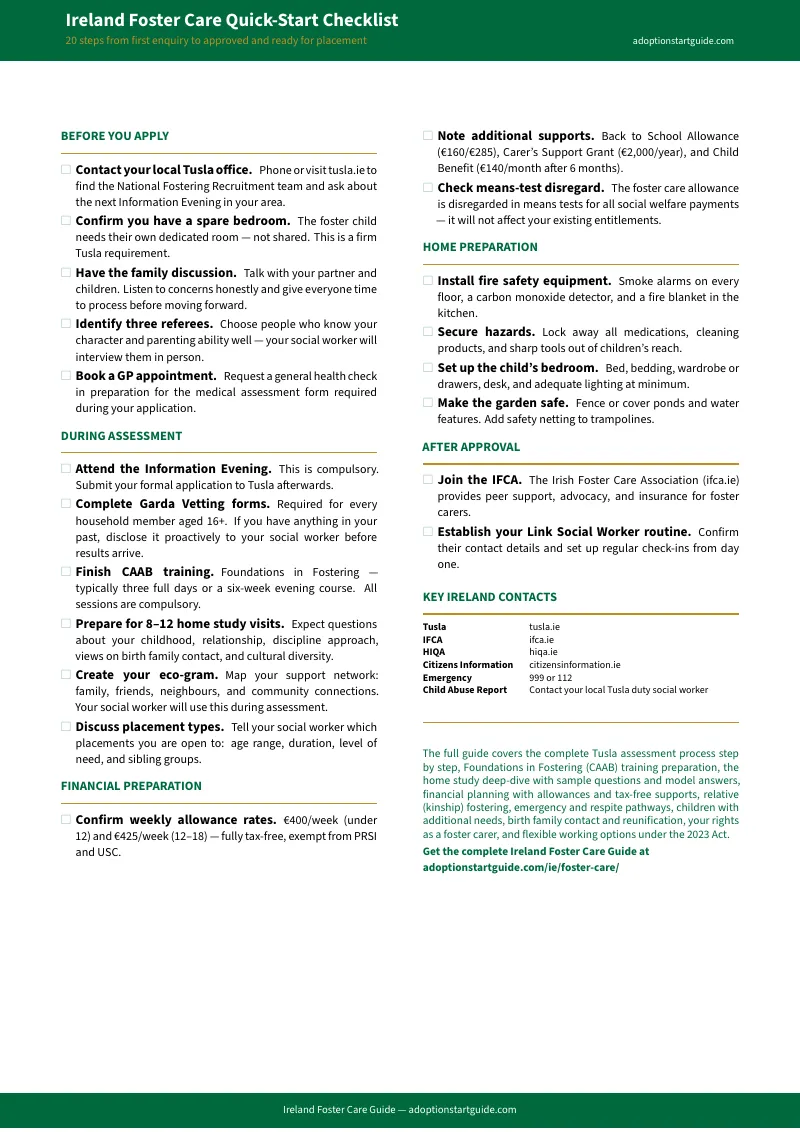
Every purchase includes the Ireland Foster Care Quick-Start Checklist — 18 actionable items organised by phase, from your first Tusla call through to your first placement. Print it, stick it on the fridge, and check items off as you go.
Who This Is For
- First-time applicants who want to walk into the Tusla assessment with confidence, not confusion
- Kinship carers (grandparents, aunts, uncles) suddenly navigating the Section 36 process during a family crisis
- Empty nesters who have the spare room and the heart — but want to understand how today's system works
- Couples exploring foster-to-adopt who need realistic expectations about concurrent planning in Ireland
- Anyone with Garda vetting concerns who wants to understand the real rules before applying
Why Not Just Use Free Resources?
Tusla.ie gives you the eligibility criteria and application forms — but it's written from an agency perspective, not a family one. The IFCA website is focused on supporting existing carers, often in the context of disputes. Private agency blogs (Orchard, Origins, Compass) provide useful content but funnel you toward their own services. Forum threads on boards.ie and Rollercoaster mix helpful advice with alarming anecdotes from years ago.
The Ireland Foster Care Guide synthesises all of this into one current, unbiased document. It's written for the family, not the agency. Every section answers the questions that keep prospective carers awake at night — with specifics, not generalities.
Our Promise
If the guide doesn't make you feel more confident and better prepared for the Tusla process, email us and we'll refund you in full. No forms, no hassle.
— Less Than an Hour of a Social Worker's Time
Professional fostering consultations start at hundreds of euros. The Ireland Foster Care Guide gives you the strategic preparation that Tusla's free materials don't — at a fraction of the cost.
Download the free checklist to see the quality for yourself, or get the full Ireland Foster Care Guide and walk into your assessment prepared.