
You want to become a foster caregiver in New Zealand. Oranga Tamariki wants you to read a 120-page Caregiver Kete, navigate a website that explains policy but not process, and somehow work out what the Section 7AA repeal actually means for your application before your social worker calls you back.
You went to the Oranga Tamariki website and found the "Becoming a Caregiver" page. It told you there are five steps. It did not tell you that those five steps typically take six months or longer, that the timeline depends almost entirely on the availability of a single social worker in your region, or that the "Tiaki Oranga" assessment tool they use to evaluate you covers dimensions of wellbeing that nobody explains in plain language until you're already sitting across from an assessor. It told you to call 0508 CARERS. You called. You left your details. Someone would get back to you.
While you waited, you joined a Facebook group for NZ foster carers. You found a whānau caregiver in Northland who had been caring for her mokopuna for four months with no formal approval and was still receiving emergency vouchers instead of the full allowance. You found a Pākehā couple in Wellington who were told they needed to demonstrate "cultural competency" with Māori tamariki but nobody would explain what that actually looks like in the Tiaki Oranga assessment, especially now that Section 7AA has been repealed and the legal framework says one thing while the practice expectations say another. You found a caregiver in Hamilton who discovered during their police vetting that an incident from fifteen years ago -- one that never went to court -- was released to Oranga Tamariki because the Clean Slate Act does not apply to caregiver checks. They had no idea that was possible. Neither did you. You closed the tab.
Then you looked at Caring Families Aotearoa. Their website was professional and their advocacy work impressive -- the PACE therapeutic training model, the allegation support service, the annual Excellence in Foster Care Awards. But when you tried to find specific guidance on how to prepare for the home assessment, what the 2026 allowance rates actually are, or how the Higher Foster Care Allowance works, you found most of the useful content is behind membership and designed for caregivers who are already approved. You are not already approved. You are trying to become approved, and the gap between "interested" and "approved" is where most people get stuck or give up entirely.
You checked Barnardos NZ. They run their own foster care programme in Auckland and other regions. Their information was clear and warm, focused on the "village" concept of caregiving. But it described their own internal network, their own recruitment process, their own support model. It did not describe how the general Oranga Tamariki state process works, how it differs from the NGO pathway, or what happens when you're caring for a child through the state system and your social worker changes for the third time in eighteen months. Barnardos recruits for Barnardos. They do that well. But that is not the same as preparing you for the system.
The New Zealand Caregiver's Complete Roadmap
This guide is built for how the New Zealand foster care system actually works in 2026 -- after the Section 7AA repeal, after the April 2026 allowance update, and under the National Care Standards regulations that Oranga Tamariki is currently struggling to meet across its regional offices. Every chapter reflects current New Zealand law under the Oranga Tamariki Act 1989, the Tiaki Oranga assessment framework, the police vetting requirements administered through Te Kāhui Kāhu, and the operational realities that the Caregiver Kete and agency brochures systematically leave out. It is not a generic fostering handbook with "New Zealand" in the title. It is the operating manual for Aotearoa's system as it stands right now.
What's inside
- Approval Process Walkthrough -- First Call to First Placement -- The full chronological roadmap from your initial 0508 CARERS enquiry through the information session, police vetting, Tiaki Oranga assessment, home visits, panel approval, and placement matching. Each stage includes realistic timeframes, the specific documents you need to have ready, and the common delays that push a three-month timeline out to six months or longer -- so you can prevent them instead of discovering them.
- Police Vetting Deep Dive -- New Zealand's caregiver vetting through Te Kāhui Kāhu is more invasive than a standard employment check. The Clean Slate Act does not apply. Convictions you thought were spent, police interactions that never led to charges, family violence incidents where you were the victim -- all of it can be released. The guide explains exactly what gets disclosed, how Oranga Tamariki evaluates the results, how overseas police certificates work if you've lived abroad, and how to address your history honestly in a way that demonstrates growth rather than concealment.
- Tiaki Oranga Assessment Preparation -- The Tiaki Oranga tool evaluates you across multiple dimensions: safety and protection, attachment and resilience, identity and integrity, support and teamwork. The guide translates these from policy language into the actual questions your assessor will explore, the answers that demonstrate capability without sounding rehearsed, and the common mistakes that raise concerns -- like describing your motivation as "saving" a child rather than supporting one.
- Home Assessment Standards -- Room by Room -- What the social worker is actually checking when they walk through your home. Safe sleep requirements for tamariki under two (cot, wahakura, or pēpi-pod -- no bed-sharing), pool and spa fencing compliance, firearms storage, medication and hazard lockaway, dampness and heating standards, and bedroom sharing guidelines. The guide provides the specific physical standards so you can fix issues before the visit rather than fail because of a pool gate latch.
- Cultural Competency and Te Toka Tūmoana -- Despite the 2025 repeal of Section 7AA, 69% of tamariki in care identify as Māori. The Te Toka Tūmoana practice model still requires caregivers to support whakapapa connections, promote mana tamaiti, and integrate tikanga Māori into daily care. For Pacific tamariki, the Va'aifetū framework applies. The guide explains what cultural competency actually looks like in practice -- correct name pronunciation, Matariki celebrations, facilitating kaumātua contact, supporting iwi and hapū connections -- so you can meet these expectations with genuine understanding rather than performative anxiety.
- Whānau and Kinship Care Fast-Track -- If you're a grandparent, aunt, uncle, or family connection who has just taken in a child, you need the emergency pathway: how to move from unapproved status (basic vouchers only) to fully approved caregiver (full weekly allowance, clothing grants, establishment payment). The guide covers the expedited assessment timeline for kinship carers, the specific documentation shortcuts available, and how to access funding immediately rather than waiting months while covering costs out of your own pocket.
- 2026 Allowance Rates, HFCA, and Hidden Grants -- Current weekly board rates by age bracket (updated April 2026), pocket money, four-weekly clothing allowances, birthday and Christmas allowances, the $350 establishment grant per child, the $10 weekly small cost payment, initial school uniform funding, and the Higher Foster Care Allowance for tamariki with complex needs -- including real case examples of HFCA approvals for therapeutic services, after-school care, and specialised dietary needs. The guide ensures you claim everything you're entitled to, not just the base rate that appears on the website.
- Caregiver Rights and Complaint Pathways -- What to do when the system fails you. How to escalate when your social worker doesn't visit every eight weeks as required under the National Care Standards. How to challenge a decision you disagree with. How to access the independent Aroturuki Tamariki monitoring reports. How to file a complaint with Oranga Tamariki's internal process and when to go to the Ombudsman. Because knowing you have recourse changes how you interact with the system from the first day.
- Placement Types and Matching -- The difference between emergency, short-term, long-term, respite, and specialist placements. How the matching process works. What "therapeutic caregiving" means and the training pathway to get there. How the new "All About Me" plan recording tool affects your role. And what actually happens when a placement ends -- whether through reunification, transition to another caregiver, or the child aging out of the system.
- Support Networks and Organisations -- Caring Families Aotearoa, Barnardos NZ, Immerse, local caregiver support groups, and the 0508 CARERS line mapped out by what each organisation actually provides, who they serve best, and where the gaps are. So you build a support network before your first placement, not after you're already overwhelmed.
Print-ready standalone worksheets included
In addition to the full guide and the quick-start checklist, your download includes six standalone printable PDFs you can use independently:
- Approval Process Checklist -- Track every step from your first 0508 FAMILY call through panel approval with date and notes columns.
- Home Safety Self-Inspection Checklist -- Room-by-room walkthrough of every item your social worker will check during the home assessment.
- Tiaki Oranga Assessment Prep Sheet -- The four wellbeing domains with key questions and space for your own reflections before each assessment session.
- Financial Planning Worksheet -- 2026 allowance rate tables, entitlements checklist, and budget planner for your household finances.
- Whānau Care Fast-Track Guide -- The expedited pathway for family members who already have a child and need formal approval and full funding.
- Key Contacts and Resources -- Fridge sheet with emergency numbers, key organisations, regional offices, and fill-in spaces for your social workers' details.
Who this guide is for
- First-time caregivers who've been thinking about fostering for months -- You have the spare room and the motivation. You've browsed the Oranga Tamariki website and called 0508 CARERS. You need the step-by-step process that tells you what happens after the phone call -- the realistic timeline, the vetting process, the assessment framework, and the home standards -- so you stop waiting for information and start preparing with it.
- Whānau and kinship carers who already have a child in their home -- Your mokopuna, niece, nephew, or family connection was placed with you in an emergency. You're providing care right now without formal approval and without the full allowance. You need the fast-track pathway to get approved and funded, because every week without formal status costs you money and legal protections you don't know you're missing.
- Pākehā families navigating cultural obligations -- You want to foster. You know most tamariki in care are Māori. You're willing to support cultural connections but you're anxious about doing it wrong, being judged as insufficient, or failing the cultural competency component of the assessment. The guide gives you the practical actions -- not just the principles -- so you can demonstrate genuine capability.
- People worried about their police history -- You have something in your past. An old conviction, a police interaction, a family violence incident where you were a witness. You don't know whether it disqualifies you and you're afraid to find out. The guide explains exactly what gets released, how Oranga Tamariki evaluates it, and how to present your history in a way that demonstrates the person you are now.
- Specialist and professional caregivers -- You have a background in education, healthcare, or social work and you're interested in high-needs, therapeutic, or youth justice placements. You need the HFCA details, the specialist placement criteria, and the training pathway that turns caregiving into a professionalised role with appropriate funding and clinical support.
- Auckland families dealing with the housing squeeze -- Tāmaki Makaurau has the most acute caregiver shortage in the country, driven by the cost of living and the difficulty of providing a spare bedroom when rental prices make a three-bedroom house a luxury. The guide addresses Auckland-specific realities: which agencies operate in your area, what the bedroom requirements actually are, and how the allowance maps against real Auckland costs.
Why the free resources fall short
The Oranga Tamariki website publishes policy and directs you to call 0508 CARERS. The "Becoming a Caregiver" page lists five high-level steps that describe the process the way a tourist brochure describes a country -- technically accurate, practically useless for someone who needs to actually navigate it. The Caregiver Kete is a 120-page handbook that covers the values, the vision, and the support contacts, but it was written for people who are already approved. It does not tell you how to pass the assessment, how to handle the vetting conversation about your past, or what the allowance rates actually are in numbers rather than policy language.
Caring Families Aotearoa provides excellent advocacy, therapeutic training, and allegation support for existing caregivers. Their Strategic Plan talks about professionalisation and a National Centre for Excellence. But if you are not yet in the system, their most useful resources sit behind membership. They serve the carer you will become, not the applicant you are now. Barnardos NZ runs a strong fostering programme, but their information describes their own network. If you're going through the general Oranga Tamariki pathway -- which is most people -- their guidance covers a different process than the one you'll actually experience.
Facebook groups give you real stories from real caregivers, and that matters. But the advice is unsorted, emotional, and impossible to verify against current regulations. A carer who went through the system in 2022 is describing a process that predates the Section 7AA repeal, the April 2026 allowance update, and the Tiaki Oranga assessment tool. Their experience is real. Their information may not be.
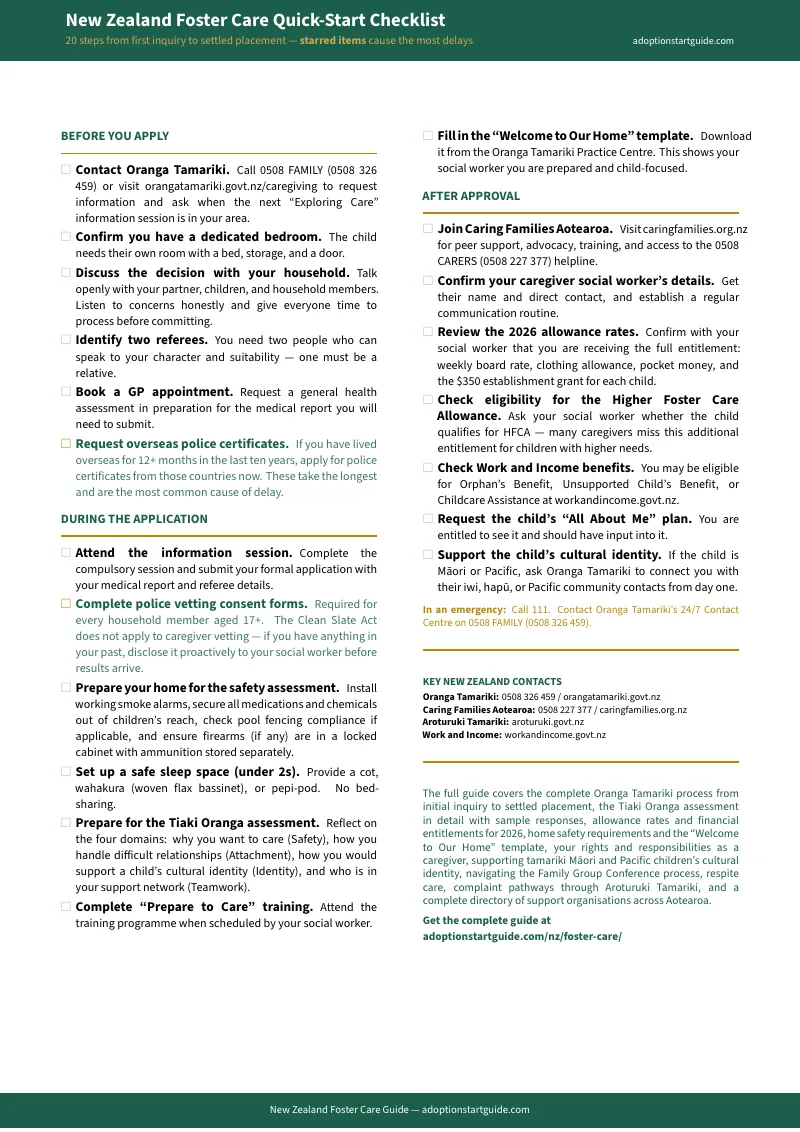
The free Quick-Start Checklist
Download the New Zealand Foster Care Quick-Start Checklist for the essential steps from first enquiry through the approval process -- including the police vetting requirements and home safety items that cause the most delays. Free, instant download, no commitment. If you want the full guide with the approval process walkthrough, the police vetting deep dive, the Tiaki Oranga assessment preparation, the cultural competency framework, the whānau care fast-track, the 2026 allowance breakdown with HFCA details, caregiver rights and complaint pathways, and the support network directory, click the button in the sidebar.
-- less than one week's worth of the small cost payment you might not know you're entitled to
One incomplete vetting form adds weeks to your timeline. One misunderstanding about what cultural competency looks like in the Tiaki Oranga assessment creates anxiety that leaks into every answer you give. One missed allowance -- the establishment grant, the HFCA, the clothing top-up -- costs you more in a single month than this guide costs once. Caregivers who understand the system before they enter it pass the assessment on their first attempt, claim every dollar they're entitled to, and walk into their first placement prepared for the reality rather than the brochure version.
If the guide doesn't deliver, reply to your download email at any time for a full refund. No forms. No justification required.