You want to adopt in Singapore. And the MSF website just made you feel less prepared than when you started.
You typed "how to adopt a child in Singapore" into Google and landed on msf.gov.sg. You found a six-step process. You clicked through it. You learned that you need a Pre-Adoption Briefing, a Disclosure Briefing, an Adoption Suitability Assessment, a Letter of Eligibility, a Guardian-in-Adoption investigation, and a Family Justice Court order. Then you clicked "back" and searched for "adoption in Singapore experience" hoping someone on singaporemotherhood.com or HardwareZone had explained what any of this actually feels like. You found a thread from 2019. It mentioned a "Home Study Report." The MSF website doesn't mention a Home Study Report. You're not sure if they're the same thing or if something changed. (Something changed. The Home Study Report no longer exists. The Adoption of Children Act 2022 replaced it with the Adoption Suitability Assessment, which came into full effect on 15 October 2024. Most forum posts don't know this yet.)
Maybe you've been through IVF. Maybe you did three fresh cycles and two frozen cycles at KKH or NUH, used the government's 75% co-funding, and came out the other side with a negative pregnancy test and $15,000 less in your savings. For women over 40, the success rate of ART in Singapore is about 6%. If you're in that demographic, adoption isn't your Plan B. It's the plan you should have been given honest information about from the beginning. But the system that handles fertility treatment and the system that handles adoption don't talk to each other, and nobody bridges the gap between "IVF didn't work" and "here is exactly how adoption works, step by step, with real costs and real timelines."
Maybe you're a step-parent. You married someone with a child from a previous marriage, and that child calls you Mum or Dad. But legally, you have no parental rights. If something happens to your spouse, the child's biological parent — the one who hasn't been involved for years — has a stronger legal claim than you do. You know you need to formalize this through a step-parent adoption, but when you search for "step-parent adoption Singapore," every result is a law firm charging $3,000 to $5,000 to tell you things you could understand yourself if someone wrote them in plain English.
Maybe you're a PR married to a Singaporean and someone told you that you need a "Letter of Support" from your home country's embassy. Nobody explained what that letter says, which embassies issue them easily, which ones take six months, or what happens to your ASA application while you wait.
The ACA 2022 Adoption Navigator
This guide exists because the Adoption of Children Act 2022 created a rigorous, transparent system — and then nobody wrote a practical manual for navigating it. The MSF website explains the law. The Authorised Adoption Agencies explain their services. The law firms explain their fees. None of them explain the whole picture: what each step actually involves, how much it costs, how long it takes, what the social worker is looking for in your ASA interview, and which government benefits your adopted child qualifies for that most applicants don't discover until after finalization. The ACA 2022 Adoption Navigator is the plain-English roadmap that the system itself doesn't provide.
What's inside
- ASA Interview Preparation System — The Adoption Suitability Assessment is not an exam, but most applicants treat it like one and freeze up. This chapter breaks down what the social worker is evaluating: marital stability, financial solvency (including CPF, debt levels, and investment portfolios), physical and mental health, and the adequacy of your home environment. It explains the difference between what the form asks and what the assessor is actually looking for — so you walk in prepared, not anxious. Covers how to present your financial situation honestly when you've just spent $15,000 on IVF, and how to address common concerns about age gaps, mental health history, and single-parent applications.
- Agency Comparison Guide — Singapore has four Authorised Adoption Agencies: TOUCH Community Services, Fei Yue Community Services, Lutheran Community Care Services (LCCS), and APKIM Centre for Social Services (ACOSS). Each has different session schedules, fee structures, and specializations — ACOSS focuses on Muslim families and works within Syariah rulings, while TOUCH and Fei Yue serve the broader community. This chapter compares all four with contact details, so you choose an agency based on fit, not guesswork.
- Complete Cost Breakdown by Adoption Type — Local infant adoption through an agency typically costs $31,000 to $43,000. Intercountry adoption runs $38,000 to $56,000+. Step-parent adoption costs $4,000 to $9,000. This chapter itemizes every fee at current 2025–2026 rates: mandatory briefings ($75–$150/person), ASA fee ($2,000 or $1,100), agency placement fee ($25,000–$35,000), the Guardian-in-Adoption fee (rising to $750), legal fees ($3,000–$8,000), and the Dependant's Pass for foreign-born children ($360). No surprises six months in.
- Baby Bonus and Government Benefits Calculator — Most applicants don't realize that adopted children qualify for nearly all the same pro-family benefits as biological children. Your first adopted child is eligible for up to $20,000 in combined benefits: $11,000 cash gift, $5,000 CDA First Step Grant, and $4,000 in government co-matching. A third child qualifies for $32,000. This chapter walks you through the Baby Bonus eligibility rules, the Child Development Account, and the enhanced adoption leave (12 weeks for mothers, 4 weeks of mandatory paternity leave from April 2025). Most families discover these benefits only after their adoption is finalized — this guide puts them in front of you before you even start, so you can factor them into your financial planning.
- Step-Parent and Relative Adoption Pathway — The process for step-parents and relatives is faster and cheaper than unrelated adoption, but it has its own complications. The other biological parent must sign a notarized Form ACA-2 consent. If they refuse, you need to understand Section 37 of the ACA 2022 — the grounds for dispensing with consent. This chapter covers the consent process, the court's test for dispensing with consent, the reduced ASA fee ($1,100), and the specific evidence the Guardian-in-Adoption looks for in step-parent cases.
- Intercountry Adoption Country Profiles — China suspended non-relative adoptions in August 2024. Vietnam requires adopters to be at least 20 years older than the child and involves extensive document translation through the Ministry of Justice. India's CARA system has 3–5 year wait times but offers transparent electronic tracking. This chapter profiles each country's current program status, realistic timelines, and total costs — including the travel and accommodation that agency fees don't cover — so you choose a country program with your eyes open.
- Legal Framework Under the ACA 2022 — The new law introduced criminal penalties for obtaining consent through fraud, mandatory payment disclosure to the court, and stricter agency oversight. This chapter translates the legal framework into practical rules: what payments are permitted, what the court will scrutinize, how the Guardian-in-Adoption fee increase affects your budget, and why any "broker" who offers a baby without a transparent fee schedule is a legal liability.
- Post-Adoption Roadmap — After the court grants your Adoption Order, you need to apply for a new birth certificate through ICA, apply for Singapore Citizenship if the child is foreign-born (2–6 months processing), register for Baby Bonus through LifeSG, update your will, and notify your employer about adoption and paternity leave. This chapter puts every post-finalization step in order so nothing falls through the cracks during the most overwhelming week of your life.
- 6 Standalone Printables — Eligibility self-check, ASA interview preparation worksheet, agency comparison card, cost breakdown with budget planner, government benefits reference card, and post-adoption checklist. Print them, take them to appointments, stick them on your fridge. Each one works as a standalone document you can use without opening the full guide.
Who this guide is for
- Couples who've completed or are ending IVF — You've spent years and tens of thousands of dollars on fertility treatment. You are emotionally exhausted and financially depleted. You need to know whether adoption is realistic for you, how much it will cost on top of what you've already spent, and exactly how long the process takes. This guide gives you the honest answer — with the cost offsets from Baby Bonus and adoption leave that most fertility clinics never mention.
- Step-parents who want legal parental rights — Your stepchild calls you Dad or Mum, but legally you're a stranger. The step-parent adoption chapter covers the consent process, the grounds for dispensing with consent if the other parent is absent or refuses, and the reduced fees that make this the most affordable adoption pathway in Singapore.
- PRs and foreigners married to Singaporeans — The Letter of Support from your home embassy can take weeks or months. The guide tells you exactly what the letter must say, which embassies are straightforward, and how to structure your ASA application so the embassy wait doesn't stall everything else.
- Muslim families navigating Syariah requirements — ACOSS (APKIM Centre for Social Services) specializes in Muslim family placements. The guide explains how Syariah rulings interact with the ACA 2022 framework, what ACOSS offers that the other three agencies don't, and how the CMIO matching process works in practice.
- Single applicants — Single individuals can adopt in Singapore, but single males cannot adopt female children except in special circumstances. The guide explains the legal restrictions, the practical considerations the social worker evaluates for single-parent ASA cases, and what "special circumstances" means in court practice.
- Families considering intercountry adoption — You're open to adopting from overseas but you don't know which countries have active programs, how long the wait is, or what the total cost looks like once you add travel, translation, and foreign legal fees. The country profiles chapter gives you the real numbers so you can make a decision, not just a wish.
Why the free resources fall short
The MSF website is accurate and comprehensive — in the way that legislation is comprehensive. It tells you the rules. It does not tell you what the social worker is looking for when they sit across from you at your kitchen table during the ASA. It does not tell you when in the process to contact a lawyer, how to time your application so the Guardian-in-Adoption fee increase doesn't catch you off guard, or which briefing sessions fill up three months in advance.
The adoption forums on singaporemotherhood.com are full of real experiences — and many of them are from families who adopted under the old law. They reference "Home Study Reports" that no longer exist. They quote fees that have changed. They describe timelines based on a regulatory structure that was fully replaced in October 2024. The advice isn't wrong in spirit, but it's wrong in detail, and the details are where families lose time and money.
Law firms publish blog posts with accurate legal information, but their incentive is to make the process seem complex enough to justify $3,000–$5,000 in legal fees. A step-parent adoption where both parties consent is genuinely straightforward — but no law firm will tell you that, because "straightforward" doesn't generate billable hours.
The four Authorised Adoption Agencies — TOUCH, Fei Yue, LCCS, and ACOSS — provide excellent briefings and conduct professional assessments. But their role is assessment and placement, not education. They will not compare themselves to each other. They will not tell you whether your case would be better served by a different agency. And they will not explain the full cost picture, because their fee is only one piece of a $31,000–$56,000 total.
The free Quick-Start Checklist
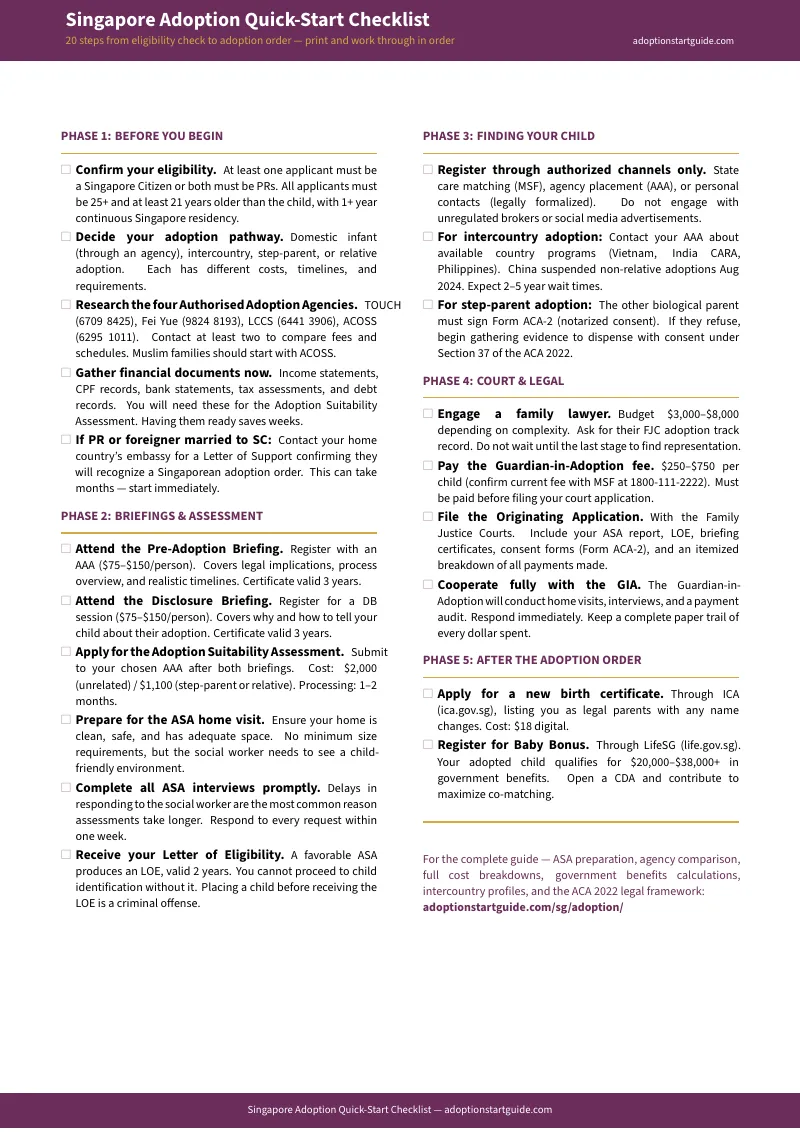
Download the Singapore Adoption Quick-Start Checklist for a structured overview of the entire process — from eligibility confirmation through post-adoption registration. Free, no commitment. It includes the key milestones across all five phases, the critical documents you need to gather early, and the four AAA contact numbers. If you want the full guide with the ASA Interview Preparation System, the complete cost breakdowns, the Baby Bonus calculations, the intercountry country profiles, the step-parent pathway, and the legal framework analysis, click the button in the sidebar.
— less than one hour with a family lawyer
A family lawyer in Singapore charges $300 to $500 per hour. The Guardian-in-Adoption fee just increased to $750. A single re-run of the ASA because you didn't prepare properly costs $2,000 and sets you back months. The total adoption journey runs $4,000 to $56,000 depending on your pathway — and the families who understand the process before they enter it spend less, wait less, and avoid the delays that come from navigating a system nobody bothered to explain in plain English. This guide puts the complete ACA 2022 framework — every step, every fee, every agency compared, every government benefit calculated — in your hands for less than a single consultation with the professionals you'll eventually need. Families who start informed choose the right agency, prepare for their ASA with confidence, and claim the Baby Bonus benefits their child is entitled to from day one.
If the guide doesn't deliver, reply to your download email at any time for a full refund. No forms. No justification required.