
Alabama's adoption code was completely rewritten in 2023. Most of the advice you'll find online still cites the old law.
You decided to adopt. Maybe you've been trying to conceive for years and a doctor finally said the words you already knew. Maybe your granddaughter was removed by DHR and you're parenting her from a recliner you didn't plan to share. Maybe you married the love of your life two years ago and want to make it legal with their child. Whatever the reason, you went looking for answers — and what you found was a mess.
The Alabama Legislature repealed the entire Alabama Adoption Code (Title 26, Chapter 10A) in 2023 and replaced it with the Alabama Minor Adoption Code (Chapter 10E). Consent revocation timelines changed. Investigation standards changed. The Putative Father Registry procedures were updated. And yet when you search "how to adopt in Alabama," you find blog posts from Birmingham law firms still citing Section 26-10A-14 — a statute that no longer exists. You find adoption.org pages referencing "the five-day revocation period" without explaining that the 2023 code created a second window — a 14-day "reasonable withdrawal" petition — that didn't exist before.
You went to the DHR website. You found a PDF titled "NON-DHR ADOPTION" that's written for caseworkers processing files, not for a parent sitting at a kitchen table with a laptop and a question: what do I actually need to do first?
You called an adoption attorney. The initial consultation was $300, and what you learned in that hour was that you need a home study, background checks, and "it depends on your situation." You could have found that on Google. What you couldn't find — anywhere — was a single resource that explains the complete Alabama adoption process under the current law, with actual costs, actual timelines, actual forms, and the specific procedural traps that cause adoptions to stall, get contested, or fall apart.
The Alabama Adoption Compliance System
This guide exists because the information gap in Alabama adoption isn't about access — it's about accuracy and organization. The law changed. The internet didn't update. And the people who have current knowledge — adoption attorneys and DHR caseworkers — charge by the hour or speak in bureaucratic shorthand. This guide translates the current Alabama Minor Adoption Code into a step-by-step process that a family can follow from "we want to adopt" to "the judge signed the decree."
What's inside
- Five Adoption Pathways Compared — Foster-to-adopt through DHR ($0–$1,500), private agency ($25,000–$45,000), independent attorney-facilitated ($15,000–$30,000), stepparent ($1,500–$5,000), and relative/kinship adoption. Each pathway explained with realistic costs, timelines, and the specific legal requirements that differ between them. Most families don't realize that a stepparent adoption requires one year of residency before finalization, or that relative adoptions may qualify for a simplified "limited investigation" instead of a full home study.
- Home Study Preparation Guide — The home study is a 3-to-4-month investigation that most families find more stressful than it needs to be. This chapter explains exactly what the social worker evaluates — motivation, biographical history, financial stability, home safety, health assessments, and references — and reframes the process from an interrogation to what it actually is: a structured assessment designed to approve families, not reject them. Includes the complete document checklist: certified birth certificates, marriage license, divorce decrees, FBI fingerprints, ABI state check, DHR abuse registry, NSOPW search for all household members 14 and older, medical reports, tax returns, pay stubs, and the six reference letters (four unrelated, two relatives).
- Background Check and Clearance Guide — Every adult in your home needs five separate clearances: FBI fingerprint, Alabama Bureau of Investigation, DHR Child Abuse and Neglect Central Registry, NSOPW sex offender search, and out-of-state clearances under the Adam Walsh Act if anyone lived elsewhere in the past five years. This chapter walks you through each one — how to schedule fingerprinting through Fieldprint, what disqualifies you automatically (violent felonies, sex crimes, crimes against children), and how the exception process works for non-violent offenses with enough rehabilitation time. Background clearances expire after 12 months. If your court date slips, you may need to redo them — this chapter helps you track the timeline.
- Consent, Parental Rights, and the Putative Father Registry — This is where Alabama adoptions succeed or fail. The birth mother cannot sign consent until five days after birth. Once signed, she has five business days to revoke automatically, then 14 days to petition for "reasonable withdrawal" through the court. After that, consent becomes irrevocable except in cases of proven fraud or duress. The Putative Father Registry is the single most important safeguard for your adoption — if a biological father doesn't register within 30 days of the child's birth, his consent is "irrevocably implied" and he forfeits the right to contest. This chapter explains exactly how to request a certified search through the DHR Office of Permanency and why skipping this step can destroy an otherwise complete adoption.
- Court Process and Finalization — Alabama adoptions are finalized in Probate Court, but if you're adopting from foster care, the TPR phase happens in Juvenile Court — and many families are confused when their case moves between courts. This chapter covers the petition filing deadline (30–60 days after the child enters your home), the 60-day physical custody requirement, the 120-day dispositional hearing deadline under the new code, the Accounting of Disbursements (a sworn affidavit listing every dollar spent), and county-specific filing fees: Jefferson County $175, Mobile $111, Madison $52, Montgomery $111.
- Post-Finalization Steps — Filing the Report of Adoption with the Center for Health Statistics ($25), obtaining the new birth certificate, understanding that the original certificate is sealed but accessible to the adoptee at age 19 under Act 2019-319, updating Social Security, wills, health insurance, and the Contact Preference Form for birth parents.
- Foster-to-Adopt Deep Dive — TIPS-MAPP training (10 weeks, 30 hours), the matching process through DHR and the Alabama Heart Gallery, financial support (monthly adoption subsidy, Medicaid, federal adoption tax credit of over $15,000, Title IV-E funding), and how to navigate the transition from foster placement to permanent adoption after TPR. Includes the hardest conversation no one prepares you for: supporting reunification when your heart wants a different outcome.
- Complete Cost Breakdown — Home study costs ($1,500–$3,000), attorney fees for uncontested adoptions ($3,000–$7,000), birth mother support under the "act of charity" standard (Section 26-10E-33 — what you can and cannot legally pay for), filing fees by county, and every financial assistance program available: adoption subsidies, Medicaid continuation, the federal tax credit, employer adoption benefits, and adoption grants.
- Common Pitfalls — The ten mistakes that delay, complicate, or kill Alabama adoptions: expired clearances, premature consent (voids it entirely), failing to check the Putative Father Registry, underestimating the Accounting of Disbursements, misunderstanding open adoption enforceability (not legally binding in Alabama), the 300-day presumed paternity rule after divorce, and more.
Appendices
- Alabama Adoption Agencies Directory — Lifeline Children's Services, Alabama Baptist Children's Homes, Catholic Social Services (sliding scale, 10% AGI cap at $15,000), AGAPE, Adoption Rocks, and Children's Aid Society/APAC — with locations, specialties, and fee structures.
- Court Filing Checklist — Every document required for your Probate Court petition: adoption petition (Code Section 26-10E-16), signed consent documents, TPR orders, home study report, certified Putative Father Registry search, and the sworn accounting affidavit.
- Questions to Ask Your Attorney — The specific questions that reveal whether your adoption lawyer knows the 2023 code update, has experience in your county's Probate Court, and can handle a Putative Father Registry complication.
- Key Alabama Contacts — DHR main office, ICPC office in Montgomery, Putative Father Registry, Center for Health Statistics, and county Probate Court contact information.
Printable standalone worksheets included
- Home Study Document Checklist — Every document needed for your Alabama adoption home study, organized by category (identification, legal, clearances, health, financial, references, training) with date-submitted and date-received tracking columns. Print it and work through it before your social worker asks for anything.
- Court Filing Checklist — Complete checklist for your Probate Court adoption petition, with every required document listed alongside its statutory reference (Section 26-10E-16 through 26-10E-23). Includes conditional documents for ICPC, stepparent, and immigration cases.
- Expense Tracking Worksheet — Fillable worksheet for tracking every dollar spent on the adoption. Category codes, payee and description columns, a totals summary, and a pre-formatted sworn statement template for the Accounting of Disbursements affidavit. Start using this from day one — it is dramatically easier than reconstructing six months of spending the week before your hearing.
Who this guide is for
- Families pursuing private or agency adoption — You've decided to adopt an infant through a licensed agency or independent attorney. You need to understand how Alabama's consent laws, home study requirements, and cost structure work before you start writing checks. The difference between knowing the Accounting of Disbursements requirement before you spend money and learning about it when your attorney sends the affidavit is the difference between a clean filing and a frantic scramble to reconstruct six months of receipts.
- Foster parents ready to adopt — A child in your home has had parental rights terminated. You've been the primary caregiver for months or years. Now you need to understand the specific legal pivot from foster placement to adoption — how Probate Court jurisdiction works, what "first consideration" means in practice, and how the adoption subsidy carries forward after finalization.
- Kinship caregivers — A grandchild, niece, or nephew was placed with you after a DHR removal. You assumed the adoption would be simple because you're family. It's simpler — but not simple. You still need a home study (though you may qualify for a limited investigation), background checks, and court approval. This guide explains which requirements you can't skip and which ones have waiver provisions.
- Stepparents — You've been parenting this child for years. You want to make it legal. You assumed it was paperwork. Then you learned about the one-year residency requirement, the need for the biological parent's consent (or a TPR if they won't give it), and background checks for every adult in the household. This guide shows you the actual process so you can plan realistically instead of getting blindsided at your attorney's office.
Why free resources fall short
The DHR website publishes adoption policy manuals written for caseworkers processing files — not for families trying to understand the process. The language is bureaucratic, the organization is procedural rather than chronological, and the forms are scattered across multiple pages without a clear order.
National adoption websites — American Adoptions, Adoption.com, Adoption Network — provide general overviews that describe a generic "adoption process" without accounting for the specific quirks of Alabama law. They don't explain the Putative Father Registry as a binary procedural requirement. They don't explain the two-tier consent revocation window created by the 2023 code. They don't mention the Accounting of Disbursements — the sworn affidavit that Alabama requires for every dollar spent, from the birth mother's medical bills to her travel expenses.
Local attorneys offer initial consultations at $200–$500 per hour. These are case evaluations, not process education. They'll tell you what you need for your specific situation. They won't walk you through the entire adoption framework so you understand where your situation fits before you start the billing clock. At $300 per hour, the first two hours of basic orientation cost more than this entire guide — and you'll still need the attorney afterward.
The free Quick-Start Checklist
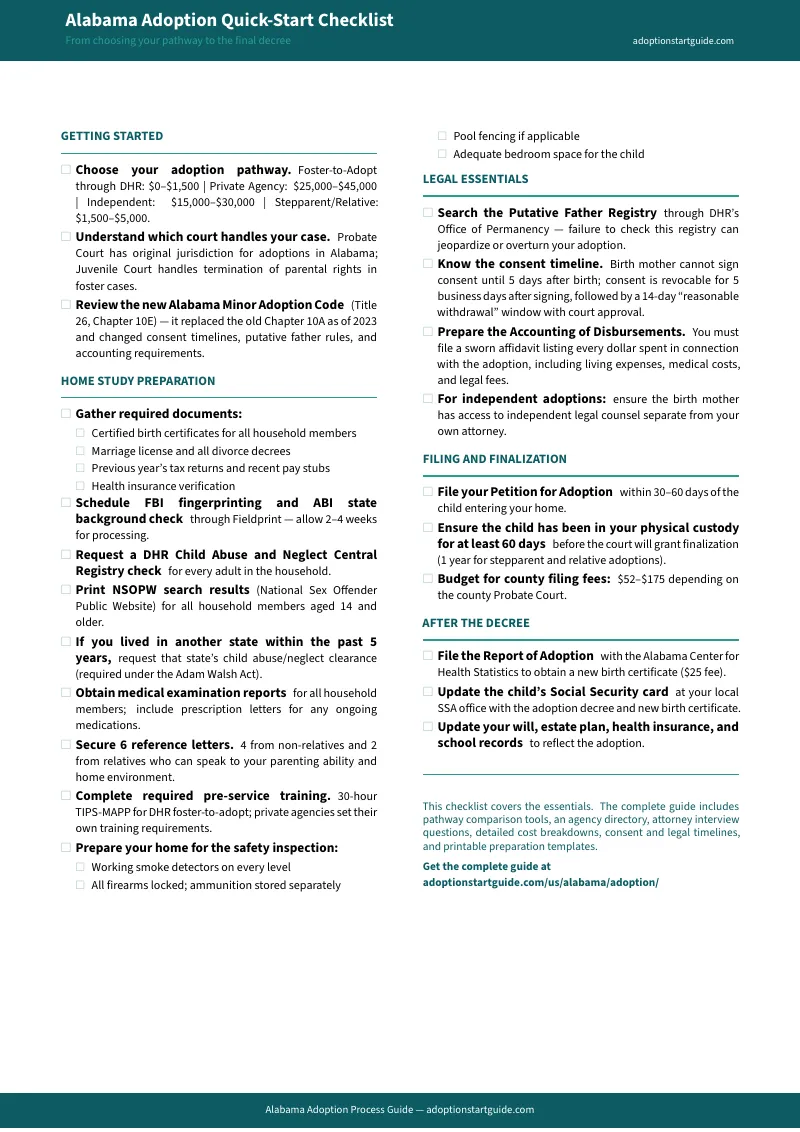
Download the Alabama Adoption Quick-Start Checklist for a 21-step overview of the process — from choosing your pathway through post-finalization. Free, no commitment. If you want the full guide with the pathway comparison, agency directory, consent timeline explanation, Putative Father Registry walkthrough, cost breakdowns, and attorney interview questions, click the button in the sidebar.
— less than fifteen minutes of an adoption attorney's time
An Alabama adoption attorney charges an average of $300 per hour. A failed home study because of an expired clearance delays your finalization by weeks. A consent document signed on day four instead of day five voids the entire agreement. An unchecked Putative Father Registry can overturn a completed adoption. One guide prevents all of these. One read-through saves you hours of billable attorney time explaining things you could have known before you walked in.
If the guide doesn't deliver, reply to your download email at any time for a full refund. No forms. No justification required.