You called the OCS regional office, sat through a 45-minute phone orientation, and came away with one instruction: "Complete CORE Training and submit your application." Nobody mentioned which of the five regional offices processes your paperwork, what happens when ICWA applies to more than half the children in care, or why your background check requires fingerprinting every household member over age 16.
Alaska runs foster care through the Office of Children's Services — a single state agency stretched across five regions, from Anchorage to Bethel to Utqiagvik, with licensing workers who sometimes manage double the legal caseload limit. OCS publishes manuals. The Alaska Center for Resource Families delivers CORE Training. Private Child Placement Agencies like Catholic Community Service and Family Centered Services handle specialized placements. And the Department of Public Safety controls the fingerprint-based background checks that gate the entire process. Four separate entities, zero coordination from the applicant's perspective. Nobody maps how these pieces connect or what order they happen in across your specific region.
The Indian Child Welfare Act is where most non-Native foster parents lose their nerve entirely. Over 50% of children in Alaska OCS custody are Alaska Native or American Indian. ICWA establishes a placement preference hierarchy — extended family first, then a tribally-licensed home, then another Indian foster home — that overrides standard OCS procedures. The phrase "active efforts" appears in every case plan but nobody explains what it means in your daily life as a foster parent. Non-Native families hear about ICWA at orientation and walk away convinced they'll bond with a child only to have that child moved. Some quit before they start. The reality is more nuanced than the fear, but no free resource explains it in plain language.
Meanwhile, Alaska has lost nearly 500 foster homes since 2018. Approximately 2,939 children sit in state custody. Children have slept in the Anchorage OCS office on Business Park Boulevard because there were no available beds. The system needs you — but the system cannot guide you through itself.
The OCS Navigator System
This guide is built exclusively for Alaska's OCS system and nobody else's. Every chapter, every checklist, every contact reference is grounded in current Alaska Statutes Title 47, the Alaska Administrative Code 7 AAC 67, OCS policy, and the real-world experience of families who have navigated licensing across all five regions — Anchorage, Northern, Southcentral, Southeastern, and Western. Not a national foster care overview. Not a recruitment brochure from a Child Placement Agency. The operational layer between what OCS posts online and what you actually need to know to get licensed — under current conditions, in your specific region, on realistic timelines.
What's inside
- ICWA plain-language guide for foster parents — This is the chapter that doesn't exist anywhere else. Over half of Alaska foster placements involve ICWA-eligible children, yet no free resource explains the placement preference hierarchy, "active efforts" versus "reasonable efforts," tribal intervention rights, or the role of Regional ICWA Specialists in plain English for non-Native caregivers. This chapter replaces the fear and confusion with practical understanding — what to expect, how to support a child's tribal connections, and how the preference system works in practice so ICWA becomes something you understand rather than something you dread. Written with equal care for tribal kinship caregivers navigating the formal licensing path from inside the system.
- Background check and fingerprinting walkthrough — Alaska requires FBI fingerprint checks, Alaska Department of Public Safety criminal history checks, OCS Central Registry clearance, and sex offender registry searches for every person aged 16 or older living in your home. If you've lived outside Alaska in the past five years, OCS must request abuse registry information from those states too. This chapter maps the entire clearance sequence, explains the barrier crime categories (permanent, 10-year, 5-year, 3-year), walks you through the variance request process for non-permanent offenses, and identifies the specific documentation you need before your licensing worker even begins the process. The background check is where applications stall — this chapter prevents that.
- Regional office navigator — Which office handles your case depends on where you live, but the boundaries aren't intuitive. Wasilla processes some Western region cases. Juneau covers islands accessible only by ferry. Bethel and Nome serve communities reachable only by bush plane. This chapter maps every regional office, explains how licensing workers schedule visits in your area (including the "cluster visit" protocol for remote communities), provides direct contact information beyond the general intake line, and tells you what to do when your licensing specialist leaves — because turnover at double caseload is the norm, not the exception.
- CORE Training navigator — The mandatory pre-service training through the Alaska Center for Resource Families runs approximately 10.5 hours covering the OCS child protective process, trauma-informed care, attachment, cultural competency, and ICWA foundations. ACRF offers three delivery methods: live virtual sessions, self-paced online (10-week deadline), or a self-paced workbook for areas with limited internet. This chapter tells you which format works best for your situation, what to expect from each module, how the Individual Training Plan works after licensure, and what ongoing hours you'll need annually — including the mandated reporter training and Reasonable and Prudent Parent Standard modules required in year two.
- Home inspection prep for Alaskan homes — Your licensing worker inspects against 7 AAC 67 and 7 AAC 10 standards, and Alaska-specific requirements include things national guides never mention: carbon monoxide detectors mandatory for oil, wood, gas, or propane heat (which covers nearly every home in the state), emergency evacuation capability within three minutes, disaster preparedness kits with one gallon of water per person per day and nonperishable food, and heating device shielding for children under six. This chapter provides the complete room-by-room walkthrough — firearms stored unloaded in a locked safe with ammunition separate, medications locked, all hazardous materials inaccessible, smoke detectors in every bedroom and on every level, 2A:10BC fire extinguisher on each floor. Handle every item before inspection day, not after.
- Board rates, geographic multipliers, and financial planning — Alaska's July 2024 rate increase brought base daily rates to $34.01 (ages 0-5), $38.63 (ages 6-11), and $40.73 (ages 12-20), but what makes Alaska unique is the geographic multiplier — Bethel at 1.5x, Utqiagvik at 1.6x, Nome at 1.45x, Kodiak at 1.2x. A child aged 12-20 in Utqiagvik earns $65.17 per day. This chapter covers base rates, multipliers for your location, Difficulty of Care augmented rates (1.5x to 6x minimum wage hourly), Medicaid and Denali KidCare coverage, the one-time clothing allowance, the FosterWear discount program, property damage reimbursement through the Special Needs Hotline, and the financial self-sufficiency requirement that your household income must cover your existing expenses without counting the stipend.
- Rural and bush community licensing — If you live off the road system, the standard licensing path looks different. OCS may grant variances for building code requirements in bush communities where housing doesn't conform to urban standards, provided the home is safe and consistent with community norms. CORE Training is available by workbook for areas with unreliable internet. Licensing workers fly in on cluster visits rather than scheduling weekly appointments. This chapter addresses every specific concern for rural foster parents — from wood-stove safety standards to coordinating medical appointments that require air travel to regional hubs, to the monthly telephone orientation schedule for communities without in-person sessions.
- Kinship and relative placement pathway — Alaska uses "Provisional Licensing" for relatives, allowing kinship caregivers to care for a child for up to 90 days while the full licensing process is finalized. If a grandchild, niece, nephew, or family friend's child lands in your home through OCS, you need to understand the difference between being an unlicensed relative placement and a licensed foster home — particularly regarding the higher reimbursement rates and Medicaid access available to licensed homes. This chapter walks through the emergency placement protocol, expedited background checks, the path from provisional to full licensure, and accessing every financial support you're entitled to.
Printable standalone worksheets included
- Licensing Timeline Tracker — Every milestone from first OCS contact through final license approval, with fill-in date fields. Print it, update it after every interaction, and always know where you stand in the process across your specific region.
- Home Safety Inspection Checklist — Room-by-room walkthrough of every 7 AAC 67 and 7 AAC 10 requirement, including Alaska-specific items like carbon monoxide detectors for fuel-burning heat, disaster preparedness kits, and heating device shielding.
- Document Organization Sheet — Application forms, fingerprint clearance records, character references (three minimum, at least one non-relative), financial disclosures, medical assessments, CORE Training certificates, and military permission (if applicable) — organized by phase with checkboxes and submission dates.
- Financial Planning Worksheet — Current board rates by age group, your regional geographic multiplier, Difficulty of Care rate tiers, Denali KidCare coverage details, and the financial self-sufficiency pre-calculation in one printable sheet.
Who this guide is for
- Anchorage and Mat-Su families ready to act — You attended the OCS orientation, felt the urgency of 2,939 children in custody, and want to move forward efficiently. But between DPS fingerprinting, CORE Training scheduling, agency selection, and the home study, you have no single map of the process from start to finish. This guide is that map — built for the Anchorage and Southcentral regions where most new licenses originate.
- Tribal kinship caregivers navigating formal licensing — You're already caring for a relative's child or your tribal community has identified you as the right placement. You need to understand the difference between provisional and full licensing, how to access the higher reimbursement rates, and how to coordinate with your Tribal Family Coordinator and the OCS Regional ICWA Specialist. This guide has a dedicated chapter for your pathway.
- Foster-to-adopt families — You're entering the system hoping to provide a permanent home. Alaska prioritizes reunification, and concurrent planning means the department works toward return while also preparing a secondary permanency plan. This guide explains how that dual track works in practice, the legal timeline for termination of parental rights, and what "concurrent" means in daily life when you're attached to a child whose primary plan is still return home.
- Fairbanks, Juneau, and Northern region families — Your OCS regional office operates differently than Anchorage. Orientation schedules, licensing worker availability, and training delivery methods vary by region. This guide covers the statewide standards that apply everywhere plus the regional-specific coordination you need for the Northern and Southeastern offices.
- Rural hub and bush community residents — You live in Bethel, Nome, Kotzebue, Kodiak, or a village accessible only by plane or boat. In-person orientations happen rarely if at all in your community. Your home may not meet urban building codes. You need a guide that acknowledges your reality — distance training options, variance procedures, cluster visit scheduling, geographic multiplier rates, and the specific logistical challenges of fostering where the nearest specialist appointment is a $300 flight away.
- Non-Native families concerned about ICWA — You've heard that over half of Alaska foster children are Native and that ICWA creates placement preferences. You're worried about bonding with a child who might be moved. This guide explains exactly how ICWA works in Alaska, what "active efforts" means for you as a caregiver, and how to be an informed, supportive member of the child's team rather than an anxious bystander hoping the law doesn't apply to your situation.
- Single adults and LGBTQ+ families — Alaska law allows any person 21 or older to foster regardless of marital status, sexual orientation, or gender identity. If two adults head the household, both must apply and complete the full screening. This guide addresses your specific concerns — demonstrating financial stability as a single applicant, building your support network for the home study, and navigating agency selection without assumptions about family structure.
Why the free resources aren't enough
The OCS website is a manual repository, not a guide. It publishes the Child Protection Services Manual, the Foster Care Rate Schedule, and the licensing application. It does not tell you the order in which to complete these steps across your specific region, what happens when your background check flags a 15-year-old misdemeanor, or how to choose between OCS direct licensing and a private Child Placement Agency when nobody is permitted to recommend one path over another.
Orientation — whether in-person or by phone — is a recruitment event. It exists to communicate urgency and inspire you to apply. You'll hear about 2,939 children and 500 lost homes. You won't get a strategy for navigating the background check when your household includes a 17-year-old stepchild who needs clearance, or a walkthrough of what happens when your licensing specialist leaves mid-process and nobody returns your calls for three weeks.
The Alaska Center for Resource Families delivers excellent CORE Training. It is also a state-contracted entity. Its materials are designed to teach trauma-informed care and OCS procedures, not to provide candid operational guidance about system delays, caseworker turnover, or how to manage the power dynamics between OCS, tribal authorities, and your family in an ICWA case.
National foster care books describe a generic process that doesn't account for Alaska's geographic multiplier reimbursement system, the five-region OCS structure, ICWA's dominance in over half of cases, bush community licensing variances, or the fact that your licensing worker might need to charter a bush plane to visit your home. A guide written for Texas or Ohio cannot help you in Alaska.
The free Quick-Start Checklist
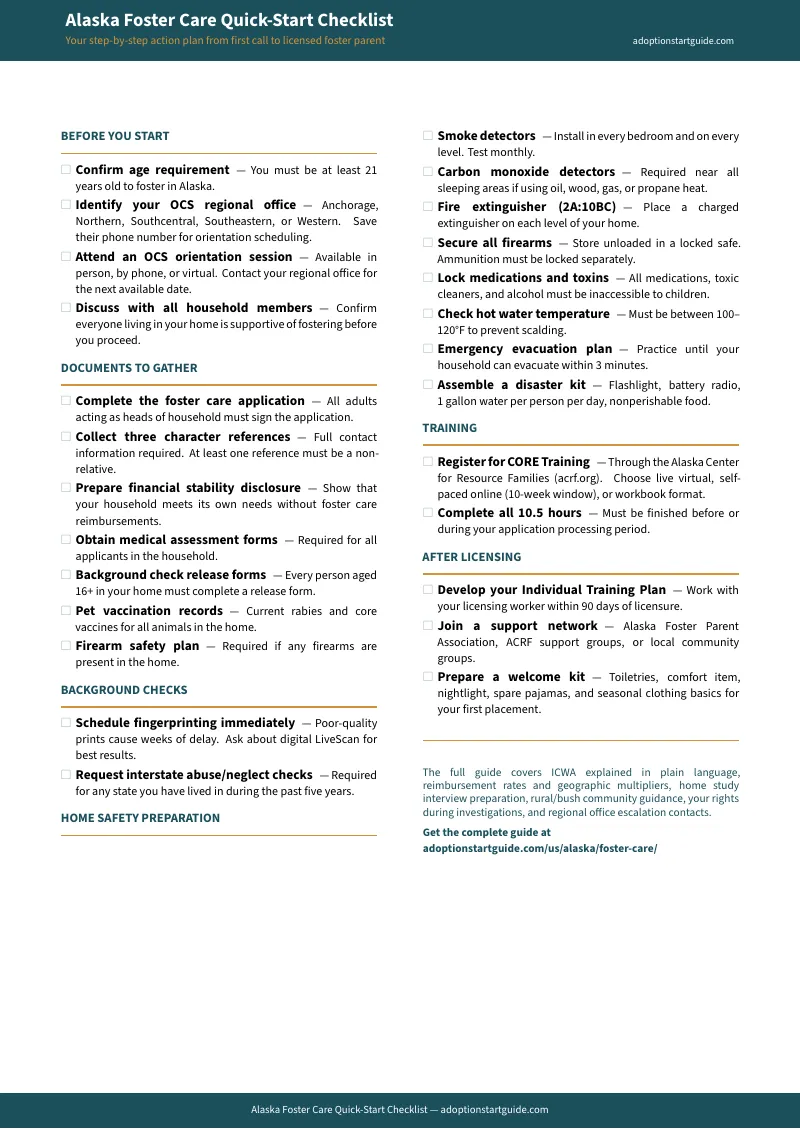
Download the Alaska Foster Care Quick-Start Checklist for a one-page overview of the licensing process, from first OCS contact through final license approval. Free, no commitment. If you want the full guide with the ICWA plain-language walkthrough, background check navigator, regional office contacts, room-by-room home inspection prep, financial planning with geographic multipliers, rural licensing chapter, kinship pathway, and all the printable worksheets, click the button in the sidebar.
— less than a Bethel-to-Anchorage flight ticket
A roundtrip flight from Bethel to Anchorage runs $281 to $381. A missed signature or misunderstood requirement that forces an extra trip to your regional office is a $300 mistake. Every week your licensing is delayed by a paperwork error or a background check submitted incorrectly is a week you're not receiving the $34 to $65 daily board rate — depending on the child's age and your geographic zone. This guide costs less than a single day's board rate for a teenager in Anchorage, and it prevents the mistakes that turn a four-month process into an eight-month ordeal.
If the guide doesn't deliver, reply to your download email at any time for a full refund. No forms. No justification required.