
Arizona adoption runs through DCS, the Putative Father Registry, 22 tribal nations, and a fingerprint clearance system that stalls families for months. Nobody hands you a roadmap that connects all four.
You called DCS and sat through a foster care orientation. Or you reached out to a private agency in Scottsdale and got a fee schedule that started at $15,000 and climbed from there. Either way, you started searching for clarity. The DCS website gave you dense paragraphs about licensing standards and concurrent planning requirements. The agency website gave you a polished overview and a contact form. Reddit gave you one family's story from 2021 and a warning about a caseworker in Maricopa County who never returns calls. And somewhere in the middle of all that, you came across something called the Putative Father Registry and realized that Arizona has adoption laws most families have never heard of until they are already deep in the process.
That is the moment most Arizona families realize the gap between "wanting to adopt" and "knowing how to adopt in this specific state" is wider than they expected. The Department of Child Safety manages foster licensing and adoption subsidies. The Putative Father Registry under ARS 8-106.01 creates a 30-day post-birth deadline that can make or break an independent adoption. The DPS fingerprint clearance system requires every adult in your household to hold a Level 1 card before a home study can even begin. And if the child may have any connection to one of Arizona's 22 federally recognized tribes, ICWA transforms the consent timeline, the placement preferences, and the legal standard from "reasonable efforts" to "active efforts." Four different systems, four different agencies, four different sets of deadlines. Miss one and the entire process can stall or unravel.
National adoption guides describe a generic process: find an agency, complete a home study, get matched, finalize. In Arizona, the process forks depending on whether you are going through DCS foster-to-adopt, a private licensed agency, an independent attorney-facilitated adoption, a stepparent petition, or a kinship placement. Each fork has different costs, different timelines, different consent requirements, and different court procedures. A guide written for California or New York will not mention ARS 8-106.01 (the Putative Father Registry), or the difference between IVP and Non-IVP fingerprint clearance cards, or the fact that the adoption subsidy agreement must be signed before the finalization decree or your negotiating leverage disappears entirely.
An adoption attorney in Phoenix or Scottsdale charges $250 to $400 per hour. Every hour you spend in that office asking basic procedural questions is an hour you could have walked in already understanding. This guide does not replace an attorney. It makes sure you use one efficiently.
The PFR Compliance System: Your Guide to Adoption in Arizona
This guide is built for the system Arizona families actually navigate: the intersection of state statutes, tribal sovereignty, DCS bureaucracy, DPS fingerprinting, and Superior Court procedures that vary by county. Every chapter reflects current Arizona Revised Statutes, the 2023 Brackeen Supreme Court decision on ICWA, DCS's subsidy and certification programs, and the specific financial resources available to families in 2026. It is not a repurposed national handbook with the state name swapped in. It is the operational layer between what DCS posts online and what you actually need to know to bring your child home through your pathway, under current law, in your part of the state.
What's inside
- Putative Father Registry Compliance Walkthrough — Arizona's PFR under ARS 8-106.01 is the single most consequential risk factor in independent and private agency adoptions. The law states that sexual intercourse constitutes legal notice of a possible pregnancy, meaning "I didn't know about the baby" is not a defense. This chapter walks through the DHS search process, the 30-day post-birth filing deadline, how to obtain the Certificate of Diligent Search, and exactly what happens if an unregistered father surfaces after placement. This is how you make your adoption legally bulletproof.
- All Five Adoption Pathways Compared — Foster-to-adopt through DCS costs nothing and includes monthly subsidies of $590 to $815 or more. Private agency adoption runs $15,000 to $45,000. Independent adoption costs $7,000 to $25,000. Stepparent adoption ranges from $1,500 to $5,000. Kinship adoption is typically under $3,000. This chapter lays out the realistic costs, timelines, legal requirements, and ARS citations for each pathway so you can choose the right track before spending money or time on the wrong one.
- Level 1 Fingerprint Clearance Card System — Every adult in your household needs a Level 1 card from the DPS Public Services Portal before the home study can proceed. This chapter explains the difference between IVP and Non-IVP cards (and why IVP processes in 2 to 4 weeks while Non-IVP can take 6 to 12 weeks), the exact portal steps at psp.azdps.gov, what to do if you have a prior offense that triggers a "precluding offense" flag, how to apply for the Good Cause Exception, and where to find adoption-approved LiveScan locations outside the Phoenix metro area.
- ICWA Navigation Framework — Arizona is home to 22 federally recognized tribes. This chapter explains when ICWA applies, how the 10-day post-birth consent rule changes your timeline, what "active efforts" means in practice compared to the standard "reasonable efforts," how tribal placement preferences work, when Arizona courts have granted "good cause" exceptions, and how the 2023 Brackeen Supreme Court decision affects Arizona proceedings. Whether the child has confirmed tribal heritage, possible heritage, or no known connection, this framework tells you exactly what steps apply to your situation.
- Home Study Preparation Under Arizona Standards — Every background check (Level 1 fingerprint card, central registry check, out-of-state clearances), every medical exam requirement, every physical safety standard (pool with 5-foot fence and self-closing gate, firearms unloaded in locked safe with ammunition stored separately, smoke detectors in every bedroom and every floor, medications and chemicals locked). This chapter includes the complete document checklist and strategies for families in Prescott, Yuma, Sierra Vista, and other areas outside the Phoenix-Tucson corridor where finding a certified home study provider is the first real challenge.
- The 72-Hour Consent Rule — Under ARS 8-107, a birth parent cannot sign consent until at least 72 hours after the child's birth. Once signed, consent is irrevocable unless the parent proves fraud or duress. This chapter walks through the exact timing, how the 72-hour window interacts with the PFR's 30-day deadline, who must be present, and why this combination of a short waiting period and strong irrevocability provision provides significant legal certainty once consent is executed.
- DCS Adoption Subsidy Guide — DCS adoption assistance pays monthly maintenance of $590 to $815 or more based on the child's level of need, provides AHCCCS (Arizona Medicaid) coverage, and reimburses up to $2,000 in non-recurring legal and court costs. This chapter includes the rate structure, how to document special needs eligibility, and the rule that matters more than any other: the Adoption Assistance Agreement must be signed before the finalization decree. Once the judge signs, the state has no obligation to negotiate.
- Verified Accounting Statement Preparation — Arizona law under ARS 8-114 requires that all payments made to or for a birth mother be filed with the court. Amounts over $1,000 require a court motion for pre-approval. This chapter explains exactly how to track expenses from day one, which categories judges approve (rent, utilities, maternity medical), which raise red flags, and how to prepare the statement so it clears the court without questions.
- County Attorney "Hidden" Services — In Maricopa and Pima Counties, the County Attorney's office handles uncontested DCS adoptions for free. This chapter explains exactly how to access this service, what qualifies as "uncontested," and what the limitations are. Private agencies and attorneys rarely mention this option because it competes directly with their fee-based services.
- Agency and Attorney Directory — Arizona's Children Association, Christian Family Care, Catholic Charities, Hand in Hand, Child Crisis Arizona, and the Maricopa County Bar Family Law referral service. How to verify an agency's DCS licensing status. What to look for when choosing an attorney experienced in Arizona adoption law. Red flags that suggest an agency's wait times or fee structures are not transparent.
- Post-Finalization Paperwork Sequence — New birth certificate from Arizona Department of Health Services Vital Records, new Social Security card, insurance enrollment, sealed records, and the federal adoption tax credit (up to $17,280 per child via IRS Form 8839). The exact sequence so nothing falls through the cracks after the decree is signed.
10 standalone printable worksheets included
In addition to the 15-chapter guide, you get 10 standalone PDFs you can print individually and use at your desk, in your attorney's office, or during your home inspection: Adoption Pathway Comparison, Fingerprint Clearance Card Walkthrough, PFR Compliance Checklist, Home Study Prep Checklist, Adoption Budget Worksheet, Court Filing Checklist, Expense Tracking Worksheet, Agency and Attorney Directory, ICWA Quick Reference, and Post-Finalization Checklist.
Who this guide is for
- Families considering foster-to-adopt through DCS — You want to understand concurrent planning, the PS-MAPP or CORE training requirements, the subsidy negotiation, and the timeline from licensing to finalization before you attend your first orientation.
- Couples or individuals pursuing private or independent adoption — You need to navigate the PFR compliance process, the 72-hour consent window, agency fee structures, and Superior Court procedures without spending hours at $300 per hour learning basic procedures.
- Grandparents and relatives raising a child — You have been caring for this child and need a clear path to legal permanence through kinship adoption. In Arizona, kinship placements are the preferred outcome under DCS policy, but the legal formalities can feel overwhelming without a step-by-step guide.
- Stepparents adopting a spouse's child — You want to understand the streamlined process, the consent or TPR requirements for the non-custodial parent, and the typical 3- to 6-month timeline.
- Families relocated from another state — You moved to Arizona from California, Washington, or the Midwest and brought assumptions from your previous state's laws. Arizona's PFR, fingerprint clearance system, and ICWA exposure are fundamentally different from what you may have researched before.
Why not piece it together from free resources?
You could. DCS posts their certification requirements online. AZCourtHelp has the adoption prehearing guide. Reddit has threads from families in Phoenix and Tucson sharing their experiences. Christian Family Care and Catholic Charities each describe their own programs.
The problem is assembly. DCS tells you the rules but not the strategy. AZCourtHelp gives you the hearing steps but not the PFR compliance process. Reddit gives you personal experiences but not the current legal framework. No single free resource covers all five adoption types, the PFR walkthrough, ICWA navigation, the fingerprint clearance system, subsidies, the Verified Accounting Statement, the County Attorney option, and the post-finalization paperwork in one document. You end up with 40 browser tabs, conflicting advice from different years, and the nagging feeling that you are missing something critical. In Arizona adoption, the thing you miss can cost you months of delay, thousands in unnecessary legal fees, or a failed adoption that could have been prevented.
This guide consolidates it all into one reference. One document. One read-through to understand the full picture. One reference to keep open as you move through each phase.
Satisfaction guarantee
If the guide does not deliver what this page promises, email [email protected] for a full refund. No questions, no hassle.
— Less Than One Hour with an Adoption Attorney
A single consultation with an adoption attorney in Scottsdale or Phoenix costs $250 to $400. This guide covers every question most families spend that first hour asking: the adoption types, the costs, the consent rules, the PFR, the fingerprint system, the home study requirements, ICWA, and the court procedures. You will still need an attorney for your adoption. But you will walk into that first meeting prepared, focused, and ready to use their time on your specific situation instead of basic orientation.
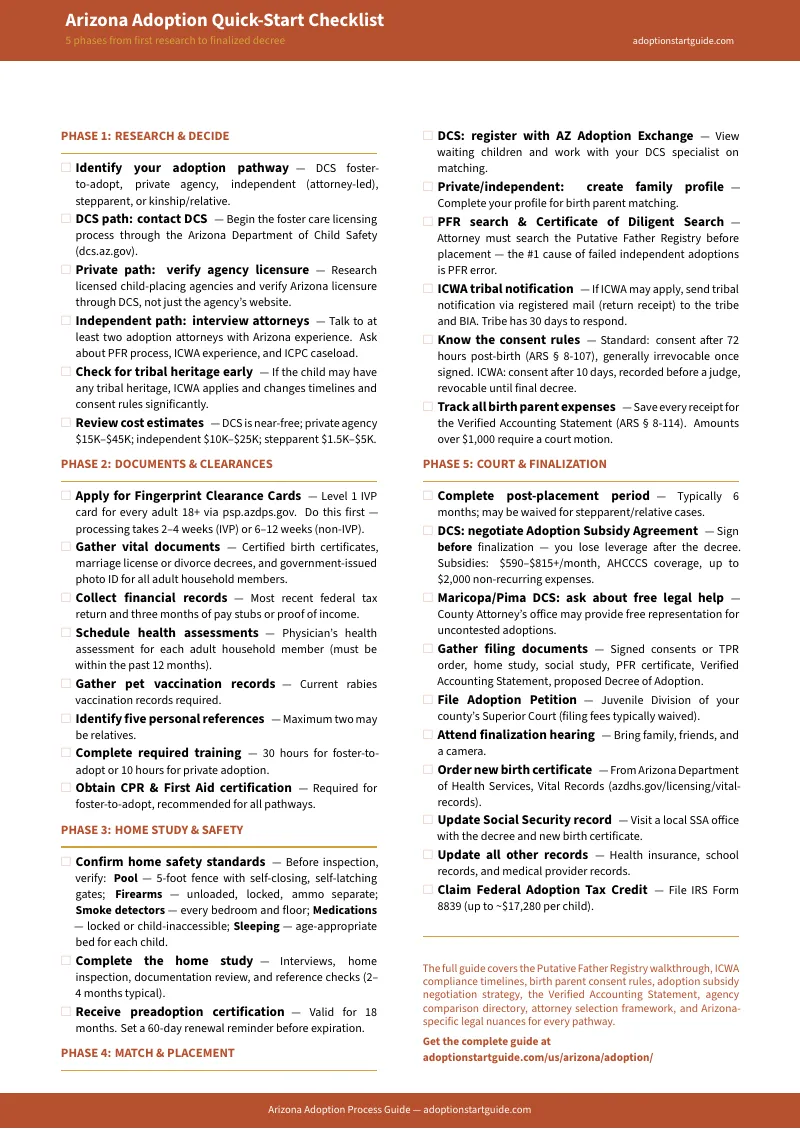
Download the free Arizona Adoption Quick-Start Checklist to see the 20 critical first steps. Or get the complete guide and start your adoption journey with the full picture from day one.