
Colorado has 64 counties running 64 different foster care systems, a caseworker turnover rate above 20%, and a state website full of broken links. You're ready to open your home. The system isn't ready for you.
You went to CO4Kids to learn how to become a foster parent. Half the links led to pages that no longer exist. The ones that worked told you the basics — minimum age 21, background check, home study — then pointed you to your county department of human services. So you called your county. Denver DHS put you on a waitlist for orientation. Jefferson County sent you to a voicemail that was never returned. El Paso County told you to attend an information session at a church, but couldn't tell you what documents to bring.
So you searched online. You found Reddit threads in r/Denver with foster parents warning about 6-month licensing delays. You found Facebook groups where someone said county licensing limits you to local placements and someone else said that's wrong. You found a blog post from 2023 explaining the PRIDE training curriculum. Colorado replaced PRIDE with TIPS-MAPP years ago. Nobody updated the blog post. And somewhere between the third broken CO4Kids link and the fourth contradictory Facebook comment, you started wondering whether the system even wants you.
It does. Colorado has thousands of children in out-of-home care and not enough certified homes — especially for teens and sibling groups. The problem isn't demand. The problem is that Colorado doesn't run a foster care system. It runs 64 of them. Each county department of human services sets its own orientation schedule, manages its own caseworker caseload, and interprets the 12 CCR 2509-8 regulations with its own local priorities. A family in Larimer County has a different experience than a family in Pueblo County. A family going through a private child placement agency gets different support than a family licensing directly through the county. And nobody explains any of this until you're already committed to whichever path you stumbled into first.
The 64-County Navigation System: One Guide Through Colorado's Decentralized Licensing Maze
This guide is built for how Colorado's foster care system actually works in 2026 — the county-administered structure under CDHS oversight, the TIPS-MAPP pre-service training curriculum, the SAFE home study methodology, the 12 CCR 2509-8 regulatory standards that govern every inspection, and the county-vs-CPA decision that determines your placement reach, support level, and licensing timeline. Every chapter reflects current Colorado law and the July 2025 board rate update, not the outdated information that dominates search results and Facebook groups. It is the operating manual for getting licensed in the Centennial State — through your county, through your chosen pathway, under current conditions.
What's inside
- County vs. CPA Decision Framework — Colorado gives you two paths to licensure: directly through your county DHS (community-focused, free, but dependent on local caseworker availability in a system with 20%+ turnover) or through a private child placement agency like Hope & Home, Savio House, or Lutheran Family Services Rocky Mountains (statewide placement reach, dedicated mentors, 24-hour emergency lines, but potentially longer initial matching). This chapter maps both options across the Front Range, Colorado Springs, Northern Colorado, and the Western Slope so you choose based on your goals — not whichever office answered the phone first.
- TIPS-MAPP Training Roadmap — Colorado's 27-hour pre-service training is where most families hit their first real wall. The TIPS-MAPP curriculum covers trauma-informed parenting, cultural responsiveness, and the realities of working within the child welfare system. This chapter breaks down what each session covers, how hybrid and online options work for rural families on the Western Slope and Eastern Plains, and what the facilitators are actually evaluating — so you show up prepared, not blindsided.
- SAFE Home Study Decoder — The Structured Analysis Family Evaluation goes far beyond a home inspection. Questionnaire I and II ask about your childhood, your disciplinary philosophy, your marital stability, and your trauma history. The physical inspection requires 35 square feet of indoor space per child, 75 square feet of outdoor play area, firearm storage protocols, pet vaccination records, and documentation most families don't know they need until the caseworker asks. This chapter translates the 12 CCR 2509-8 standards into a room-by-room walkthrough and prepares you for the interview questions that make applicants feel exposed.
- 2025-2026 Board Rates and Financial Planning — Colorado's tiered reimbursement system ranges from $1,286 per month for basic care of young children to $3,279 per month for treatment foster care. Health First Colorado (Medicaid) covers medical, dental, and behavioral health for every child in care. The Foster Care Success Act provides tuition waivers at public colleges. This chapter gives you the exact daily rates updated July 2025, explains how the tier system works, and includes a budget worksheet so you can plan on real numbers — not the vague "stipend" figure from a 2022 blog post.
- Background Check and Disqualification Navigator — Every adult in your household needs fingerprint-based state and FBI background checks. CBI processing times vary by county. This chapter covers which offenses permanently disqualify, which have waiting periods, how the waiver process works, and the CPS central registry check — including what happens if you have a prior referral that was unfounded. Disclosed history with context beats discovered history without it, every time.
- Kinship Care Fast-Track — When a family member's child is removed, you're thrust into crisis licensing. The county wants an answer in days, not months. This chapter covers the expedited kinship pathway, the financial support available to kinship providers, the legal differences between foster care licensing, legal custody, and guardianship — and how to get authority over medical, educational, and travel decisions as fast as Colorado's system allows.
- ICWA and Tribal Compliance — Colorado's 2023 CO-ICWA codifies the Indian Child Welfare Act into state law, with specific agreements involving the Southern Ute and Ute Mountain Ute tribes. If you're matched with a child who falls under ICWA, the law mandates placement preferences, "active efforts" requirements, and cultural compacts. This chapter replaces confusion with practical understanding — what ICWA means for your placement, not what it means in a law review article.
- Partner Alignment Framework — If one partner is fully committed and the other is hesitant, the SAFE home study will surface that divide. Based on the TIPS-MAPP model, this section helps couples work through the decision together before the home study begins — covering expectations about reunification, the emotional toll of temporary placements, and the specific questions caseworkers ask about relationship stability.
Printable standalone worksheets included
- Licensing Timeline Tracker — Every milestone from initial county or CPA contact through final certification, with fill-in date fields so you always know where your case stands in a system that loses paperwork.
- Home Safety Inspection Checklist — Room-by-room walkthrough of every 12 CCR 2509-8 physical standard: square footage, water temperature, firearm storage, medication lock-up, outdoor area, smoke and CO detectors, pet vaccination records.
- Document Preparation Checklist — Background checks, medical clearances, financial records, reference letters, pet records, auto insurance, and training certificates in the order your caseworker expects them — organized into a binder before your first meeting.
- Monthly Budget Worksheet — Daily rates by age group and care level (July 2025 update), Health First Colorado coverage, clothing allowances, and household expense tracking in one printable sheet.
Who this guide is for
- Denver Metro and Front Range families — You're in Denver, Jefferson, Arapahoe, Adams, or Douglas County. You've been waiting weeks for a callback from your county DHS. You need a roadmap that tells you what to do right now — which documents to gather, whether to go county or CPA, and how to build momentum while the system moves at its own pace. Colorado's most populated corridor has the longest wait times and the most options. This guide sorts both.
- Colorado Springs faith community — You attended a Wait No More event or heard the call through your church. You're motivated by something deeper than paperwork. But the state's SAFE home study asks questions about your beliefs, your childhood, and your discipline philosophy that feel more like an interrogation than an interview. This guide prepares you for those conversations so you walk in confident, not defensive.
- Rural and Western Slope families — You're in a county where the nearest TIPS-MAPP training is a two-hour drive and the local DHS office has one caseworker handling foster care. You need to know about hybrid training options, how CPAs can extend your reach beyond your county, and what happens when your well water needs testing and the nearest approved lab is in Grand Junction.
- Kinship caregivers — A grandchild, niece, nephew, or family friend's child needs a safe home now. You didn't plan for this. You need the fastest path to legal authority — medical decisions, school enrollment, travel — and you need to know what financial support is available so you're not carrying the full cost alone.
- LGBTQ+ families — Colorado law protects you. The state explicitly prohibits discrimination against foster care applicants based on sexual orientation or gender identity. But knowing the law and knowing the process are different things. This guide covers the licensing pathway without assumptions about family structure.
- Foster-to-adopt families — You want to adopt and you've heard fostering is one pathway. You need to understand that foster care's primary goal is reunification with the birth family, how Colorado's concurrent planning works, and what the realistic timeline looks like from placement to permanency — so your expectations match the system you're entering.
Why the free resources fall short
CO4Kids is the official state portal. It gives you an overview of the process and links to county offices. Several of those links are broken. The ones that work send you to county websites that list phone numbers for offices staffed by caseworkers managing caseloads well above recommended levels. You call. You wait. You call again.
The CDHS publishes the 12 CCR 2509-8 regulations — the actual rules governing foster home certification. They're written for caseworkers and licensing specialists, not families. They'll tell you that 35 square feet of indoor space per child is required. They won't tell you which room measurements count, what happens if your spare bedroom is two feet short, or how the caseworker decides if your outdoor area qualifies.
Facebook groups like "Colorado Foster Parents" are active and well-intentioned. They're also unfiltered. Someone posts that their county took three months to license. Someone else says theirs took eight. A third person says private agencies are faster but more expensive. None of them are wrong — they're describing 64 different systems. Without knowing which county, which pathway, and which year, their advice is a coin flip applied to your life.
And the generic foster care books on Amazon? They'll inspire you. They won't tell you the difference between licensing through Denver DHS and licensing through Hope & Home. They won't explain why El Paso County's process feels different from Larimer County's. They won't have the July 2025 board rates or the 2023 CO-ICWA requirements. They describe fostering in America. You need to get licensed in Colorado.
The free Quick-Start Checklist
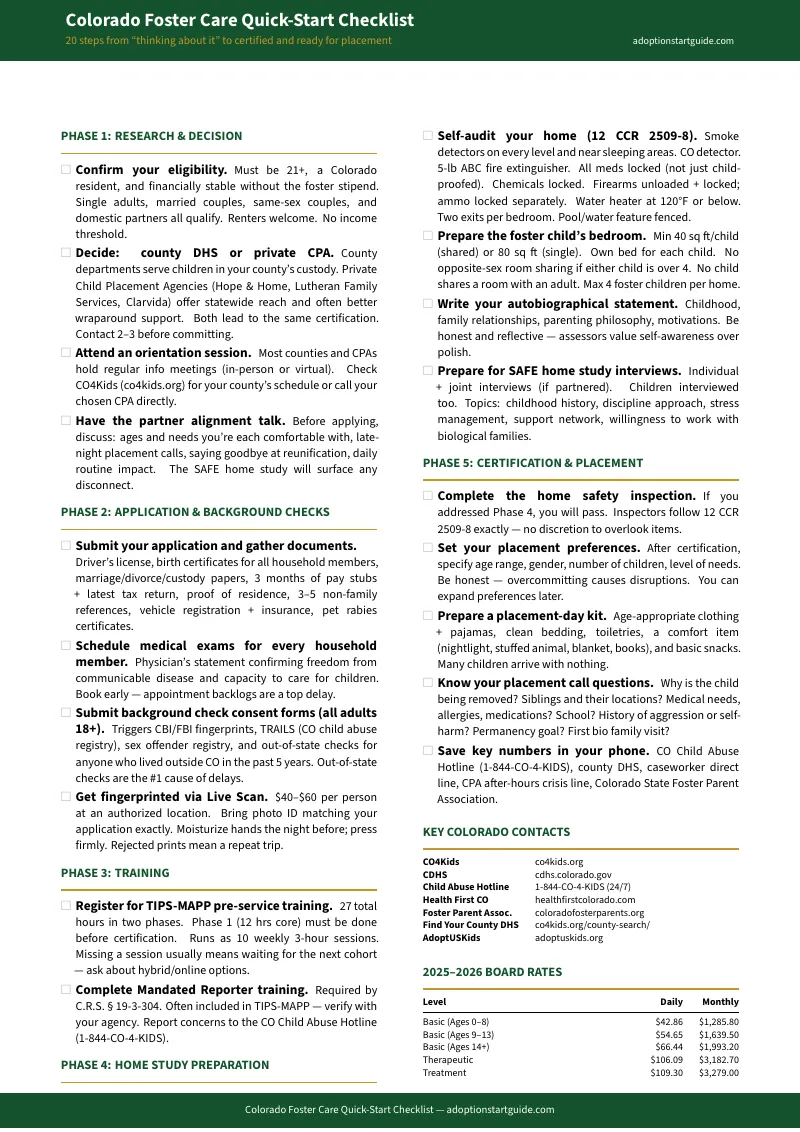
If you're not ready for the full guide, start here. Download the Colorado Foster Care Quick-Start Checklist for a one-page action plan covering the licensing steps in the order the system expects you to complete them. Free, no commitment. It includes the county-vs-CPA decision point and the key documents to start gathering tonight. If you want the full guide with the 64-county navigation framework, the SAFE home study decoder, the 2025-2026 financial breakdown, the ICWA compliance chapter, the partner alignment framework, and all four printable worksheets, click the button in the sidebar.
— less than a Rocky Mountain National Park day pass
A missed background check deadline costs you two months. A failed first home study visit because you didn't know about the firearm storage protocol or the square footage requirement means a follow-up visit and another month of waiting. A family that chose the wrong pathway — county when they wanted statewide reach, or CPA when they wanted local community connection — and realized it six months in has to start over. This guide puts the entire Colorado foster care licensing system — 64-county navigation, TIPS-MAPP training preparation, SAFE home study standards, 2025-2026 board rates, background check requirements, ICWA compliance, kinship pathways, and partner alignment — in your hands for less than a day pass to Rocky Mountain National Park.
If the guide doesn't deliver, reply to your download email at any time for a full refund. No forms. No justification required.