You're ready to adopt in Connecticut. Then you discovered that the Probate Court, the Superior Court for Juvenile Matters, and DCF each handle a different piece of the process -- and none of them explain how the pieces connect.
Connecticut is not like most states. It runs a dual-court system where voluntary adoptions go through one of 54 Probate Court districts and DCF-involved adoptions go through the Superior Court for Juvenile Matters. Same statutes, different courts, different judges, different procedures. What Connecticut calls "identified adoption" under C.G.S. Section 45a-728 requires a licensed agency even when you find the birth mother yourself -- direct placement is a felony, not an option. The $1,500 cap on birth mother living expenses is buried in the statute, and the 45-day waiting period after initiating the home study catches families who assumed they could accelerate placement around a due date. And since 2021, every Connecticut-born adoptee aged 18 or older can access their original birth certificate with no restrictions, which means the concept of a "closed" adoption is legally temporary regardless of what you're told at placement.
You've already done the research. You found the DCF website, which covers foster-to-adopt but says nothing about private agency or identified adoption. You found ctprobate.gov, which gives you the PC-603 petition form and a $250 fee schedule but no explanation of when to file, in what order, or which of the 54 districts has jurisdiction over your case. You found the Connecticut General Assembly website, where C.G.S. Title 45a runs for dozens of sections with cross-references to Chapter 803, Section 17a-112, and the 2026 reforms under Senate Bill 5004. And you found attorneys in Fairfield County billing $350 to $600 per hour, while families in Hartford and New Haven pay $250 to $450 for the same advice delivered with less gold on the nameplate.
The information exists. It's scattered across DCF fact sheets, Probate Court user guides, the Connecticut General Statutes, agency orientation packets, and county-specific procedural rules. Piece it together yourself and you'll burn weeks reading documents that explain the rules but never tell you the order of operations as a parent.
The Dual-Court Decoder
This is a complete, Connecticut-specific adoption guide built around the problem every family in this state hits: navigating a system where two separate courts, a state child welfare agency, and a network of licensed agencies each own a piece of the process but none of them tell you which court is yours, which forms to file first, or how to avoid the procedural traps hidden in the Connecticut General Statutes. Not a national overview. Not an agency brochure designed to funnel you into one program. Every chapter, every checklist, every cost figure is grounded in C.G.S. Title 45a Chapter 803, current DCF policies, the 2026 legislative reforms, and the real-world experience of families who have adopted in Connecticut.
What's inside
- Seven-pathway comparison table -- Foster-to-adopt through DCF, private agency, identified adoption, stepparent, co-parent, relative/kinship, and adult adoption mapped side by side. Costs, timelines, which court you file in, whether a home study is required, and subsidy eligibility for each pathway so you choose the right one before investing months in the wrong direction. Foster-to-adopt runs $0. Private agency costs $25,000 to $65,000. Stepparent adoption with the home study waiver can be $1,500 to $3,000. That decision deserves more than a caseworker's one-sentence summary.
- The Probate vs. Superior Court decision tree -- Connecticut's dual-court system is the most common source of confusion. Voluntary adoptions file in Probate Court. DCF-involved adoptions finalize in the Superior Court for Juvenile Matters. This chapter maps which court handles your case, how to find your Probate district using the ctprobate.gov court locator, and the procedural differences between the two systems including filing requirements, hearing formats, and timelines.
- The identified adoption protocol -- Connecticut does not allow true independent adoption. Under C.G.S. Section 45a-728, even when you find the birth mother yourself, a licensed agency must conduct the home study, provide birth parent counseling, and manage all financial transfers. Direct payments to birth parents are a felony. Living expenses are capped at $1,500 absent court approval. The 45-day waiting period runs from the initiation of the home study. This chapter breaks down the full process, the fee structures, and the legal boundaries that other states don't impose.
- The 48-hour consent rule and putative father protections -- Under C.G.S. Section 45a-715, a birth mother cannot execute consent until 48 hours after birth. Once the court accepts it, the consent is generally final and irrevocable -- no multi-day revocation window like some states. This chapter also covers putative father notification requirements under C.G.S. Section 45a-716, including the documentation standard for "diligent search" when the father's whereabouts are unknown. A missed step here is the primary legal vulnerability in Connecticut private adoptions.
- The stepparent home study waiver -- C.G.S. Section 45a-733 lets the Probate Court waive the mandatory home study for stepparent adoptions, saving $2,450 to $4,000 in agency fees and months of processing time. The waiver applies equally to same-sex married couples. This chapter explains when the waiver is granted, when the court may still require a study, and the cost difference between married stepparent and unmarried co-parent adoptions.
- Open records and Post-Adoption Contact Agreements -- Since July 2021, every Connecticut-born adoptee aged 18+ has unrestricted access to their original birth certificate. The era of permanently sealed records is over. This chapter explains C.G.S. Section 45a-715a on enforceable Post-Adoption Contact Agreements (PACAs), how to negotiate one before finalization, and why informal agency "promises" of ongoing contact carry no legal weight once the decree is signed.
- The 2026 DCF reforms (SB 5004) -- The most significant child welfare reform since the Juan F. consent decree was lifted in 2022. New kinship support grants, a public DCF performance scorecard launching January 2027, fresh investigator assignments after three reports on the same household, and a statutory mandate that caseworkers record the child's expressed opinions. This chapter explains how these reforms affect foster-to-adopt families, kinship caregivers, and anyone interacting with DCF.
- Financial guide by pathway and region -- Attorney rates across four geographic markets (Fairfield County $350-$600/hr, Hartford Metro $250-$450/hr, New Haven/Waterbury $250-$450/hr, Rural/Eastern CT $200-$350/hr). Private agency fee breakdowns including application, enrollment, home study, birth parent counseling, and finalization. DCF adoption assistance subsidies ($779-$1,413/month depending on the child's age and needs), HUSKY Medicaid, college tuition waivers, and the federal tax credit up to $17,280 per child. The critical rule: sign the Adoption Assistance Agreement before finalization or lose eligibility permanently.
- LGBTQ+ and single-parent pathways -- Connecticut's nondiscrimination protections are among the strongest in New England. Same-sex married couples qualify for the stepparent home study waiver. Second-parent adoption under C.G.S. Section 45a-724(a)(3) covers unmarried partners. This chapter explains the legal differences, cost implications, and how to secure parental rights that hold up in every state.
Who this guide is for
- Fairfield County professionals exploring private adoption -- You navigate complex systems for a living. But adoption involves a dual-court system where the Probate Court, DCF, and licensed agencies each assume you already understand the other two. You've exhausted the IVF cycle and you're ready for clarity, not another agency orientation packet designed to funnel you into a $60,000 program. This guide is the briefing document you'd write for yourself if you had the time.
- Foster parents ready to make it permanent -- The child in your care just had reunification ruled out. You've been told to "start the adoption paperwork," but the transition from PRIDE-trained foster parent to adoptive parent involves the Superior Court for Juvenile Matters, post-placement supervision reports, and an Adoption Assistance Agreement that must be executed before the judge signs the decree. This guide maps that transition.
- Kinship caregivers who need legal standing -- You've been raising your grandchild, niece, or nephew for months or years. You lack legal authority. The child's parent has abandoned them or is involved with DCF. The 2026 reforms under SB 5004 created new kinship support grants and strengthened placement preferences for relatives. This guide covers the kinship pathway, termination of parental rights, and the subsidies you're entitled to.
- Stepparents adopting a spouse's child -- The absent parent hasn't been involved in years. C.G.S. Section 45a-733 governs the home study waiver, but the waiver isn't automatic -- the court decides whether to grant it based on your specific circumstances. This guide walks you through consent or termination, the waiver petition, and finalization in Probate Court.
- LGBTQ+ families securing legal parentage -- Your marriage or planned family requires legal recognition for the non-biological parent. The stepparent waiver saves married couples $3,000 or more. Second-parent adoption covers unmarried partners but requires a full home study. This guide explains both pathways and the cost difference so you choose the right one.
- Families navigating an identified adoption -- You've found a birth mother through personal connections, advertising, or an attorney. You assumed you could proceed directly. Connecticut says no. A licensed agency must be involved for counseling, the home study, and all financial transfers. This guide breaks down C.G.S. Section 45a-728, the $1,500 expense cap, the 45-day waiting period, and how to budget for a process that costs $20,000 to $50,000 even when you found the match yourself.
Why the free resources aren't enough
DCF's website is solid for the public foster-to-adopt pathway. It explains orientations, PRIDE training, and the caseworker process. But it provides zero guidance on private agency or identified adoption. If you're not fostering first, DCF has nothing for you.
The Connecticut Probate Courts website gives you the PC-603 petition form, a $250 fee schedule, and a user guide for termination of parental rights. But forms without narrative are like tax forms without instructions. They tell you what the court needs. They don't tell you which of the 54 Probate districts handles your case, when to file relative to the home study, or what happens between the petition and the finalization hearing.
The Connecticut General Assembly website publishes the full text of C.G.S. Title 45a, Chapter 803. It is technically complete. It is also written for attorneys, cross-referenced to statutes in other titles, and organized by legal concept rather than by parental decision. Reading the raw statutes will tell you everything and explain nothing.
National adoption books mention "state laws" without explaining Connecticut's dual-court system, the identified adoption requirement, or the 2021 open records shift that changed the meaning of "closed" adoption in this state. They reference putative father registries and revocation windows that don't apply in Connecticut. They discuss "the court" without distinguishing between 54 Probate districts and a handful of Superior Court for Juvenile Matters locations.
Connecticut adoption attorneys answer all of these questions. At $250 to $600 per hour. Families routinely spend their first billable hour covering foundational questions this guide answers in Chapter 1.
Printable standalone documents included
The guide comes with printable standalone PDFs designed for real-world use:
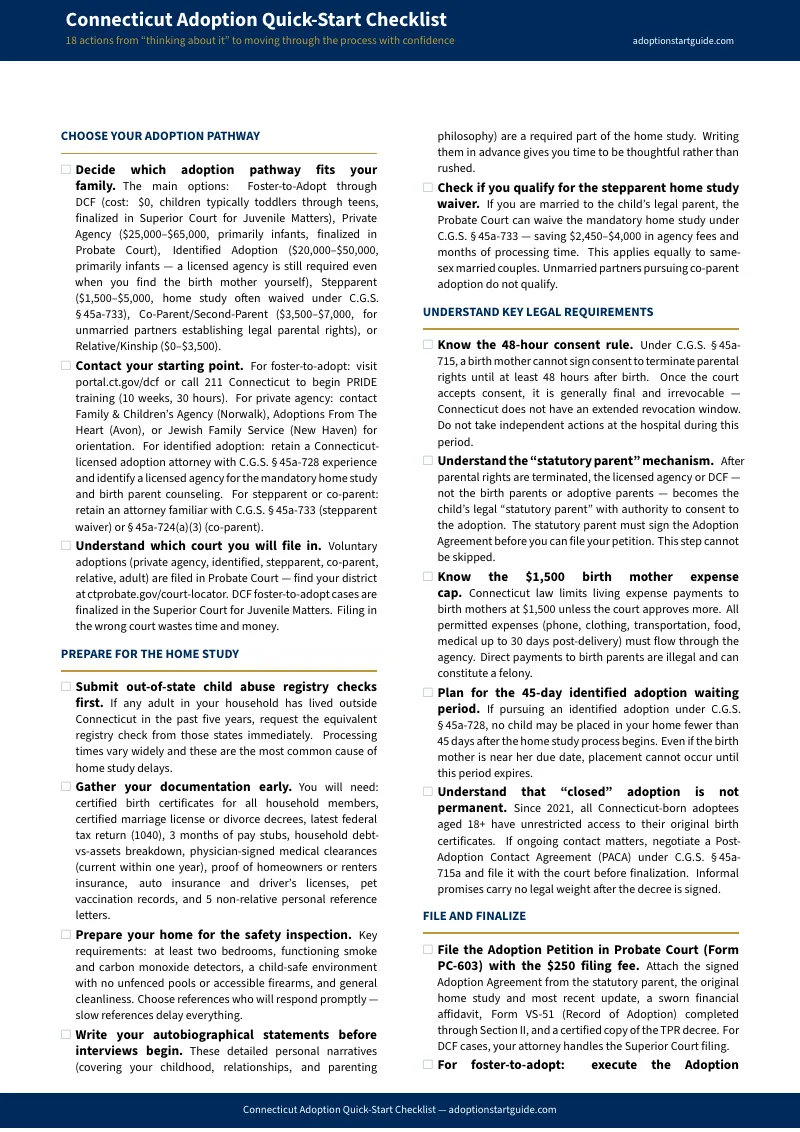
- Quick-Start Checklist -- The 18 actions from choosing your pathway to post-finalization paperwork on one printable page. Pin it to your fridge and check off each step as you complete it.
The free Quick-Start Checklist
Download the Connecticut Adoption Quick-Start Checklist for a one-page overview of the key steps from first inquiry to finalization. Free, no commitment. If you want the full guide with the dual-court decoder, the identified adoption protocol, the 48-hour consent rule walkthrough, the stepparent home study waiver guide, the 2026 DCF reform analysis, and all the cost breakdowns by pathway and region, click the button in the sidebar.
-- less than one minute of a Fairfield County adoption attorney's time
The average adoption attorney in Fairfield County bills $350 to $600 per hour. Hartford and New Haven attorneys charge $250 to $450. Families routinely spend their first billable hour covering foundational questions this guide answers in Chapter 1. The Dual-Court Decoder doesn't replace your attorney. It makes sure you don't pay your attorney to teach you the basics of Connecticut adoption law.