Your keiki has been part of your ohana for years. The state of Hawaii says that means nothing until a judge signs a decree.
You have been raising this child. Maybe your sister asked you to take them when things fell apart. Maybe your tūtū has been the real parent since infancy. The arrangement has a name — hānai — and it has worked in Hawaiian families for centuries. But when you walked into the school enrollment office, they asked for legal guardianship papers you don't have. When you called the pediatrician to authorize a procedure, they wanted proof of parental authority. When you looked into DHHL homestead successorship, you learned that without a formal adoption decree under HRS §578, your hānai child has no legal claim to the land your family has held for generations. The cultural tradition that has sustained your ohana does not carry legal weight in the Family Court. Nobody explained the gap between what hānai means to your family and what it means to the state.
Maybe hānai is not your situation at all. Maybe you are a military family stationed at Schofield Barracks or Pearl Harbor, trying to start an adoption during your three-year window before the next PCS order reshuffles everything. JAG told you they can advise but not represent you in civilian Family Court. The Honolulu attorneys you called charge $300 to $500 per hour, and you still don't know whether your mainland home study transfers to the First Circuit or whether you need to start from scratch. Maybe you live on Maui or the Big Island and discovered that most adoption attorneys and licensed agencies are on Oahu — meaning every meeting, every filing, every court hearing could require a round-trip flight at $113 to $270 depending on how much notice you get. Maybe you are a stepparent who assumed the process would be straightforward, and then you opened the Family Court website and found a maze of forms — 1F-P-3066, 1F-P-3067, Asset and Debt Statements, Safe Family Home Reports, Medical Information Forms — with no explanation of which ones apply to your situation or your circuit.
The DHS website is built for caseworkers, not families. The Family Court self-help page lists forms without context. The Third Circuit requires documents the First Circuit doesn't. Catholic Charities runs the HANAI orientation program for foster-to-adopt families, but their role ends at licensing — they don't walk you through the petition, the consent timeline, or the six-month supervised placement period. And none of these sources address the question that local families are actually asking: how do I protect what hānai built without turning my family into a court case?
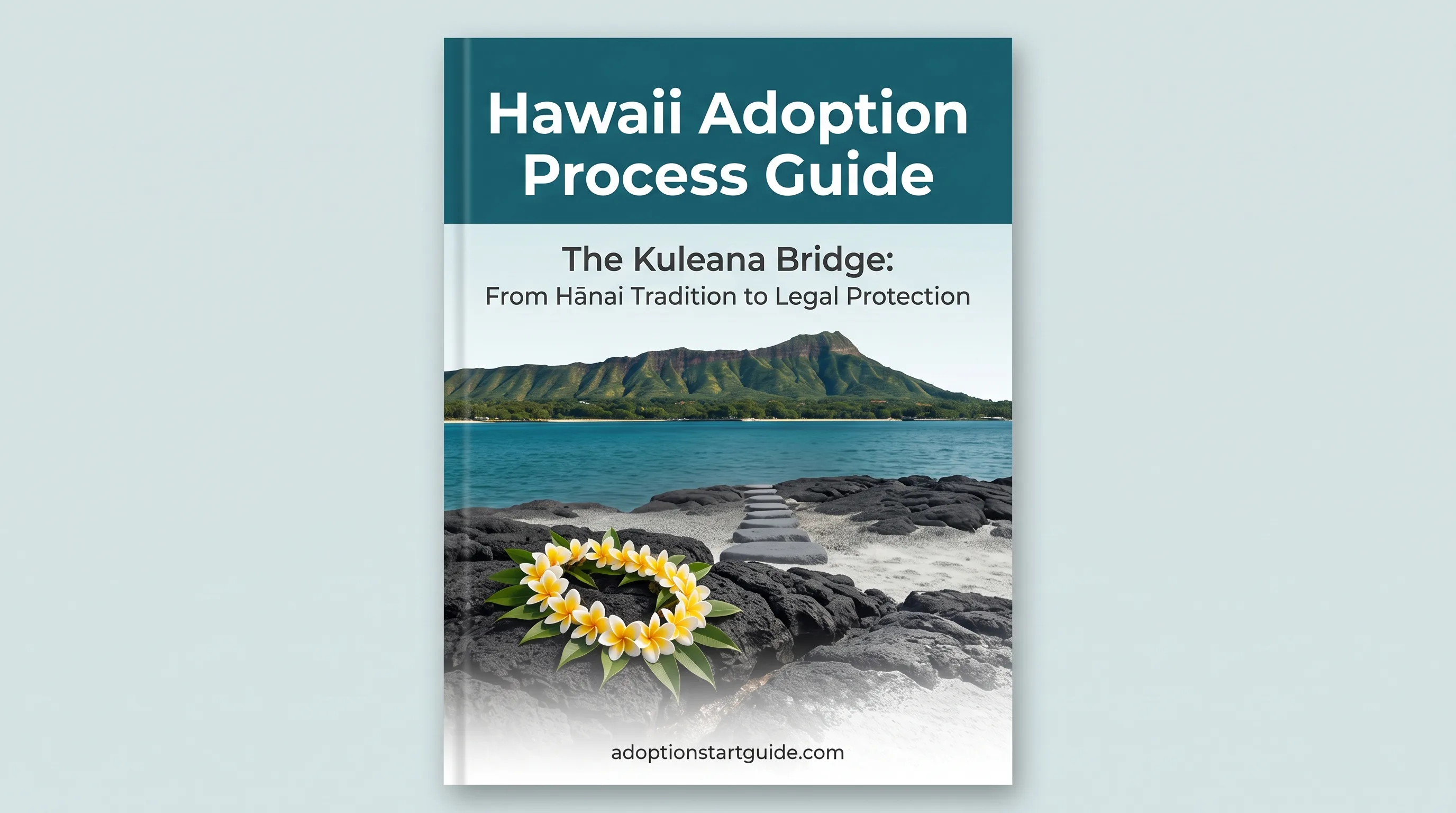
The Kuleana Bridge: Your Complete Roadmap to Hawaii Adoption
This guide is built around a simple principle — kuleana. The responsibility to protect your child's legal future and the privilege of doing it in a way that honors how your family actually works. It covers every adoption pathway recognized under HRS Chapter 578, every judicial circuit from the Kapolei Courthouse on Oahu to Puuhonua Kaulike on Kauai, the specific financial assistance programs Hawaii families qualify for, and the cultural and logistical realities that generic mainland adoption guides completely miss. It is written for the system Hawaii families actually navigate — the one where hānai families, military families, neighbor island families, and stepparent families each face a different set of obstacles that no single DHS webpage or orientation session addresses.
What's inside
- Hānai-to-Legal Transition Framework — The step-by-step process for formalizing a hānai arrangement through Family Court without disrupting the relationship that already exists. Covers consent from biological parents under HRS §578-2, the 72-hour post-birth consent rule, what happens when a birth parent cannot be located, and how to handle the cultural conversation with family members who view court proceedings as unnecessary or disrespectful. Includes the DHHL homestead successorship requirements — specifically the 25% Native Hawaiian blood quantum documentation and how a legal adoption decree establishes the familial relationship DHHL requires for lease succession.
- Four-Circuit Court Navigator — Hawaii's Family Court operates across four judicial circuits, and each one has quirks that affect your timeline. The First Circuit (Oahu) handles the highest volume at the Ronald T.Y. Moon Kapolei Courthouse. The Second Circuit (Maui, Molokai, Lanai) files through Hoapili Hale in Wailuku. The Third Circuit (Big Island) splits between Hale Kaulike in Hilo and Keahuolu in Kona — and requires an Asset and Debt Statement that other circuits do not. The Fifth Circuit (Kauai) processes through Puuhonua Kaulike in Lihue. This chapter maps the filing requirements, typical timelines, and courthouse-specific procedures for each circuit so you know exactly what your court expects before you file.
- Military Family PCS Playbook — For families stationed at Schofield Barracks, Joint Base Pearl Harbor-Hickam, Marine Corps Base Hawaii Kaneohe, or Fort Shafter. Covers the realistic adoption timeline within a three-to-four-year Hawaii tour, home study transferability between Hawaii and mainland states, ICPC requirements if PCS orders arrive mid-adoption, what JAG legal assistance offices can and cannot do for your case, and how to coordinate with Army Community Service (Building 690, Schofield) or the Military & Family Support Center (Building 1105, JBPHH) for referrals. Includes the specific question to ask your attorney about First Circuit jurisdiction for military families — because HRS §578-1 allows filing in the circuit where the petitioner "is in military service," which may give you options.
- Legal Framework Decoder — HRS Chapter 578 (§578-1 through §578-17) translated into plain English. Consent requirements, including the 72-hour post-birth waiting period and the rule that children age 10 and older must give their own written consent. Grounds for dispensing with parental consent when a parent has deserted for 90 days or failed to provide care for two years. The TPR process under §587A-33 for foster care cases. Act 298 (2025, gender-neutral parentage effective January 2026), SB 974 (foster youth savings accounts), and SB 812 (non-binary birth certificate designations). Every statute explained in the context of your actual adoption pathway, not as an abstract legal reference.
- Home Study Preparation Guide — What the social worker evaluates during in-home visits, the documents you need assembled before the first appointment, and the Hawaii-specific factors that trip families up. Multi-generational housing is common in Hawaii — every adult in the household needs background clearances through the Hawaii Criminal Justice Data Center, FBI fingerprinting, and a DHS Central Registry check. The guide covers sleeping arrangement rules (siblings of the same gender may share a bed up to age 6), financial stability thresholds, and reference letter guidance. For neighbor island families, it addresses the logistics of scheduling home study visits when your provider is based on Oahu.
- Financial Planning Framework — Cost breakdown by pathway. Foster-to-adopt through DHS is nearly free, with non-recurring expense reimbursement up to $2,000. Private agency adoption runs $10,000 to $30,000. Independent adoption costs $8,000 to $15,000, driven largely by Honolulu attorney rates of $300 to $500 per hour. Stepparent and relative adoptions range from $500 to $2,500. This chapter maps the DHS adoption assistance payments ($576 to $676 per month based on age, plus up to $570 per month in Difficulty of Care supplements), the federal adoption tax credit (up to $16,810 per child), and the Higher Education Board allowance for eligible youth. Includes a fill-in budget worksheet so you can plan the full financial picture before you commit to a pathway.
- Neighbor Island Logistics Guide — For families on Maui, the Big Island, or Kauai who face the reality that most adoption professionals and agencies are on Oahu. Which steps can be handled remotely versus which require in-person appearances. How to find the limited number of attorneys and home study providers who practice on your island. Inter-island travel budgeting for court hearings you cannot avoid. Circuit-specific filing differences that Oahu-based attorneys may not flag. The goal is to minimize unnecessary flights and maximize what you can prepare from home.
- Agency and Attorney Directory — Licensed child-placing agencies in Hawaii: Catholic Charities Hawaii (DHS contractor for the Statewide Resource Families program), Hawaii International Child (intercountry and domestic infant placements, Honolulu-based home study provider), Child & Family Service (crisis support and therapeutic services since 1899), and A Family Tree (domestic infant and foster care, Honolulu). Attorney referral guidance organized by pathway and island, with what to ask in a first consultation, typical fee structures for contested versus uncontested cases, and the advertising prohibition under §346-17 that prevents families from publicly soliciting birth parents without an agency license.
- Post-Adoption Roadmap — What happens after the decree is signed. New birth certificate application (including the non-binary "X" option under SB 812 effective January 2026), Medicaid continuation for children adopted from foster care, post-adoption counseling resources through Child & Family Service and the DHS Post-Adoption Services Unit, and the process for accessing sealed records if medical history or ancestry documentation is needed later.
Printable standalone worksheets included
- Adoption Timeline Tracker — Every milestone from first agency contact or hānai formalization decision through court finalization decree, with fill-in date fields organized by pathway. Print it, update it after every meeting and court date, and always know exactly where your case stands.
- Home Study Document Checklist — HCJDC state clearance, FBI fingerprint check, DHS Central Registry search, sex offender registry verification, medical exams, financial records, reference letters, and home safety items organized in the order the social worker expects them. Check off each item as you complete it.
- Financial Planning Worksheet — Costs by pathway, adoption assistance calculation, federal tax credit eligibility, non-recurring expense reimbursement tracking, and inter-island travel budgeting in one printable sheet.
- Court Filing Checklist by Circuit — The specific forms and documents required for your judicial circuit — including the Third Circuit's Asset and Debt Statement and the SFHR and MIF forms that apply across all circuits. No guessing about which paperwork your courthouse needs.
Who this guide is for
- Hānai families ready to formalize — You have been raising a keiki in the hānai tradition and now need legal recognition for school enrollment, medical authority, insurance coverage, or DHHL homestead successorship. You want to honor the relationship that already exists while securing the legal protections that the Family Court requires under HRS §578. The guide walks you through the transition without treating your family arrangement as something that needs to be "fixed."
- Military families on island — You are stationed on Oahu and want to adopt during your Hawaii tour. You need to understand the First Circuit timeline, whether your existing home study transfers, what happens if PCS orders arrive before finalization, and how to coordinate JAG advice with civilian legal representation. The PCS Playbook chapter is built for your situation.
- Stepparent adopters — Your spouse's child has been living with you, and you want to make the legal relationship match the real one. You need to know whether the absent biological parent's consent is required, how the 90-day desertion or two-year failure-to-support standards work under HRS §578-2, and what the uncontested process actually costs in your circuit — because the $3,000 flat fees you are seeing online may be negotiable for straightforward cases.
- Foster-to-adopt families — You are licensed through DHS or Catholic Charities and the permanency goal for your foster child has changed to adoption. You need to understand the TPR timeline under §587A-33, the adoption assistance negotiation before the decree is signed, and the concurrent planning process that DHS uses — because the transition from foster parent to legal parent involves paperwork and deadlines that your caseworker may not proactively explain.
- Neighbor island families — You live on Maui, the Big Island, or Kauai and every adoption resource you have found is centered on Oahu. You need circuit-specific filing guidance, a realistic budget for inter-island travel, and a strategy to minimize the number of trips to Honolulu. The guide covers your circuit's requirements so you arrive prepared, not surprised.
Why free resources fall short
The DHS website is designed for foster care licensing and child welfare case management — not for families trying to understand the full adoption process across all pathways. The Family Court self-help center lists dozens of forms without explaining which ones apply to your type of adoption or your judicial circuit. The Third Circuit's Asset and Debt Statement requirement is buried in a filing checklist that most families never find until their petition is returned incomplete. Catholic Charities runs the HANAI pre-service training program, but their mandate is resource family licensing — they do not guide families through the legal petition, the consent process, or the post-placement supervision period.
National adoption guides describe a generic state system. Hawaii's system is shaped by hānai traditions that have no mainland equivalent, a military population that cycles through every three to four years, four judicial circuits spread across islands you cannot drive between, and a cost of legal services that reflects Honolulu's position as one of the most expensive legal markets in the country. A guide written for Ohio or Texas will not mention DHHL homestead successorship, ICPC for military PCS moves, inter-island filing logistics, or the fact that your home study provider on the Big Island may be a two-hour drive from Kona to Hilo.
Honolulu adoption attorneys charge $300 to $500 per hour. A flat-fee uncontested adoption starts at $3,000 before court costs. A single consultation runs $190. The guide gives you the complete Hawaii adoption system — every pathway, every circuit, every financial program, every form — so that when you do hire an attorney, you are paying them to execute, not to educate you from scratch.
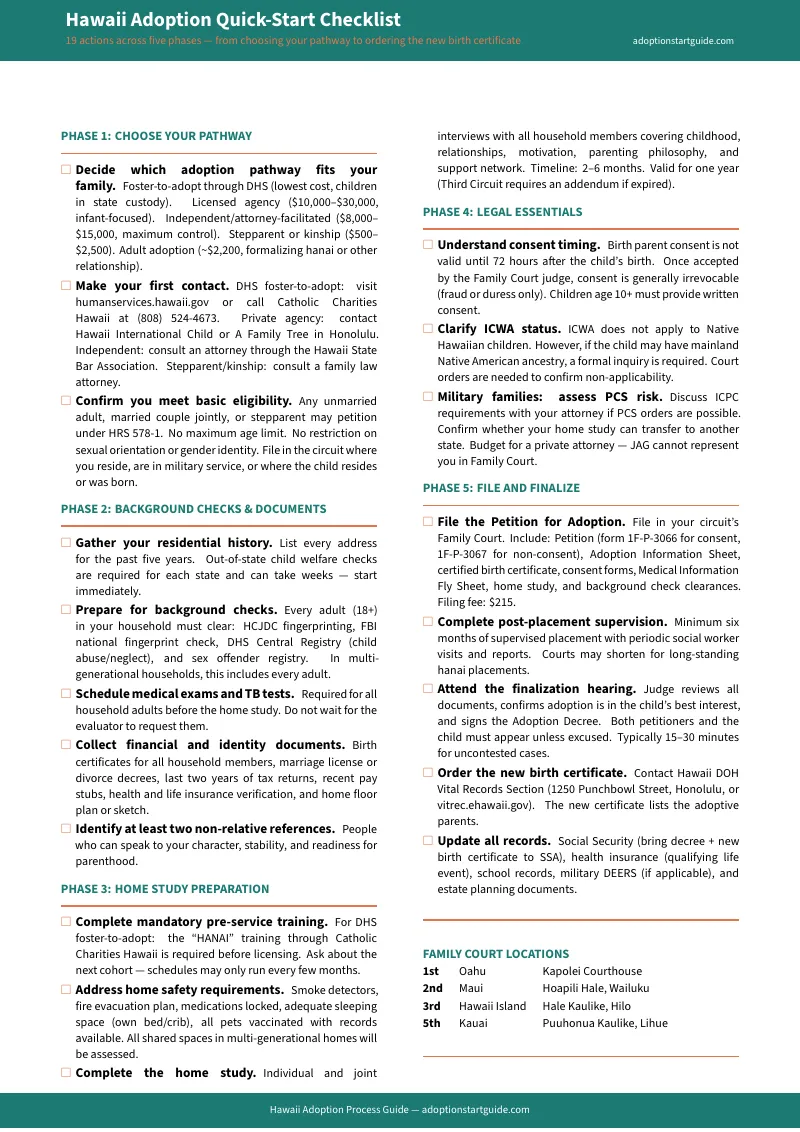
The free Quick-Start Checklist
Download the Hawaii Adoption Quick-Start Checklist for a structured overview of the adoption process — from identifying your pathway and judicial circuit through court finalization. Free, no commitment. It includes the four-pathway decision framework and the circuit lookup, which are the two items that cause the most confusion in the Hawaii system. If you want the full guide with the Hānai-to-Legal Transition Framework, Four-Circuit Court Navigator, Military PCS Playbook, financial planning worksheets, and court filing checklists by circuit, click the button in the sidebar.
— less than half an hour with a Honolulu family law attorney
Honolulu adoption attorneys charge $300 to $500 per hour. Private agency fees start at $10,000. A single inter-island flight for a court hearing on Oahu costs $113 to $270. This guide puts the entire Hawaii adoption system — the hānai formalization process, the four-circuit court navigator, the military PCS playbook, the financial assistance programs, and the agency and attorney directory — in your hands for less than the cost of an initial consultation. Families who understand the process before they enter it file cleaner petitions, avoid unnecessary inter-island trips, negotiate stronger adoption assistance agreements, and spend their attorney hours on legal strategy instead of basic orientation.
If the guide doesn't deliver, reply to your download email at any time for a full refund. No forms. No justification required.