Idaho runs seven regional DHW offices that each operate differently. The state website treats them as one system. They aren't.
You felt the call to foster. Maybe your Bishop asked the Ward to step up. Maybe you moved to the Treasure Valley from Portland or Seattle and finally have the space. Maybe a grandchild was just removed by the Department of Health and Welfare and you got the phone call nobody prepares for. Whatever brought you here, you went to healthandwelfare.idaho.gov looking for a clear starting point.
What you found was a maze of accordion menus, references to IDAPA 16.06.02, and the instruction to "contact your regional office" repeated as though all seven regions work the same way. They don't. Region 4 in Ada County is overburdened and backlogs intake calls for weeks. Region 7 in Bonneville and Madison Counties is deeply woven into the local faith community and moves at a different pace. Region 1 in Kootenai County serves families on 20-acre parcels who need to know whether their well water, wood stove, and irrigation ditch will pass inspection before a state worker drives two hours to find out. The DHW website doesn't distinguish between any of them.
You probably also searched for the training requirements and found conflicting information. Some pages still reference PRIDE training. Others mention FIRST (Fostering Idaho Resources & Skills Training) — seven sessions, three hours each — without clarifying which program your region is actually running in 2026 or whether you can complete any of it online. You found the Background Check Unit but not the 4-digit employer agency code your region uses to waive the fingerprinting fee. You found the phrase "free from dangerous objects" in the safety standards but no practical guidance on what that means for a family with livestock, a woodshop, or firearms stored in a gun safe.
So you asked around. The Idaho Foster Parent Association pointed you to their "Village" for clothing and beds — resources for families who are already licensed, not families trying to get through the door. Your Ward shared what worked for the last family who fostered, but that was three years ago and the training curriculum has changed since. National foster care books on Amazon describe a generic process that doesn't account for Idaho's seven regions, the PRIDE-to-FIRST transition, or the specific IDAPA safety standards that govern rural properties differently from suburban homes in Meridian.
You're in the gap between wanting to foster and knowing how to start in Idaho — and nobody is meeting you there.
The 7-Region Idaho Licensing Roadmap
This guide is built for the Idaho DHW system and nobody else's. Every chapter, every checklist, every form reference is grounded in the current Idaho Administrative Code (IDAPA 16.06.02), the operational realities of the seven regional DHW offices, and the 2025-2026 training requirements that have shifted from PRIDE to FIRST. It covers the gap between what the state posts online and what you actually need to know to get from "interested" to "licensed" without failed inspections, months of silence from a regional office, or unnecessary drives to a DHW building for answers you could have had in thirty minutes of reading.
What's inside
- Step-by-Step Licensing Process — Idaho's licensing process runs through distinct stages from initial inquiry through license approval, and most of it flows through your regional DHW office. This guide walks you through each stage in order: what happens, what DHW expects from you, which forms to submit and when, and how to avoid the stalls that stretch a 90-day target into six months or longer. You'll know what's coming before your licensing worker tells you — because in some regions, they won't tell you until you ask.
- FIRST Training Walkthrough — Idaho's mandatory pre-service training has transitioned from the older PRIDE curriculum to FIRST (Fostering Idaho Resources & Skills Training) — seven sessions, three hours each, covering trauma-informed care, behavioral management, and the legal framework of foster care in Idaho. This chapter breaks down what each session covers, what trainers evaluate, and how to access virtual or hybrid options if you're in a rural area where in-person sessions run only once per quarter. If you've been told "PRIDE" by one source and "FIRST" by another, this chapter resolves the confusion.
- Home Safety Inspection Checklist — Derived directly from IDAPA 16.06.02. Smoke detectors on every level and near sleeping areas. Carbon monoxide detectors near any carbon-monoxide-producing equipment. Firearms stored locked, unloaded, and separate from ammunition. Pool barriers with locking access. Hot tub covers that lock. The specific rules on "dangerous objects" and "environmental hazards" translated from regulatory language into a room-by-room walkthrough you can complete with a clipboard and a trip to the hardware store. For rural properties: well water testing requirements, livestock area separation, irrigation ditch fencing, and wood-stove safety standards that the state applies differently than you'd expect.
- Home Study Preparation — The home study is the most personally intensive part of the process. Your licensing worker evaluates motivation, relationship stability, discipline philosophy, childhood history, financial management, and capacity to work within the DHW system. This chapter explains what they're actually looking for — including the "harmonious home life" standard that causes more anxiety than any safety checklist — and reframes the visit from an interrogation into what it really is: a process designed to rule families in, not rule them out. Includes guidance on what you must disclose, what you can decline to discuss, and how to present a rural or non-traditional household confidently.
- Region-by-Region Guidance — What a family in Region 4 (Ada County, Boise) experiences is fundamentally different from what a family in Region 1 (Kootenai, Bonner) or Region 7 (Bonneville, Madison) faces. Urban regions have shorter wait times but heavier caseloads. Rural regions have fewer staff, longer drives, and stronger community integration. East Idaho regions are deeply connected to LDS ward infrastructure. This chapter maps all seven regions so you know the culture of your office, the realistic timeline, and the 4-digit employer agency code for your Background Check Unit registration.
- Financial Reality Breakdown — Current Idaho board rates by age category, Treatment Foster Care rates versus regular care rates, Medicaid coverage for every foster child, and the financial supports most families never learn about until months after licensing. Idaho's board rates are lower than many Western states, and the Medicaid landscape is shifting under managed care changes delayed to 2030. This chapter gives you the full financial picture so you can plan sustainably rather than discovering the gaps after your first placement.
- Kinship Care Fast-Track — If a grandchild, niece, nephew, or family friend's child was placed with you after a DHW removal, you're already parenting under crisis conditions. You didn't plan for this, and you may not know that full licensure unlocks support payments and services that emergency placement alone doesn't provide. This chapter explains provisional approval, expedited safety requirements, and the path from emergency caregiver to fully licensed resource parent — on the compressed timeline that kinship situations demand.
- Foster-to-Adopt Pathway — For families entering the system with adoption as their ultimate goal. How concurrent planning works in Idaho, when a foster family receives first consideration for adoption, how Termination of Parental Rights unfolds in Idaho courts, and what the Adoption Assistance program provides — including up to $2,000 in nonrecurring expense reimbursement, the adoption tax credit, and continued Medicaid until age 18. This chapter also addresses the hard truth: reunification with biological parents is the legal priority, and you must genuinely support it even when your heart wants a different outcome.
- Tribal ICWA Compliance — Idaho's tribal landscape — Nez Perce, Coeur d'Alene, Shoshone-Bannock, Shoshone-Paiute, and Kootenai — is almost entirely absent from standard DHW orientations. If you accept placement of a child with tribal membership or eligibility, you enter a dual-jurisdiction framework with separate social workers, legal standards, and timelines governed by the Indian Child Welfare Act. This chapter provides the tribal ICWA contacts, explains what changes in your obligations, and prepares you for a reality that catches most foster parents off guard.
Printable standalone worksheets included
- Home Safety Self-Inspection Checklist — Room-by-room walkthrough of every physical requirement under IDAPA 16.06.02. Fire safety, sleeping arrangements, hazardous materials, firearms, water safety, rural property standards, and grounds. Walk your house with this before the licensing worker visits.
- Required Documents Checklist — Every form and supporting document organized by when you need it: before your first regional office contact, with your application, for the home study, and for ongoing post-licensing compliance.
- Background Check Tracking Log — Idaho BCI state criminal, FBI fingerprint, child abuse registry, sex offender registry — track submission dates, result dates, and clearance status for every adult in your household. Includes the employer agency code field for each region.
- FIRST Training Session Tracker — All seven sessions listed with space to record completion dates and notes. Print it and bring it to training.
- Emergency Evacuation Plan Template — IDAPA 16.06.02.232 requires a written emergency evacuation plan posted in a prominent location. This fill-in-the-blank template meets the requirement and eliminates a common home study failure point.
- Monthly Caseworker Visit Log — Document every visit, every topic discussed, every concern raised. This log protects you and ensures continuity when caseworkers turn over.
- Key Contact Information Sheet — Regional DHW office, licensing worker, child's caseworker, IFPA coordinator, school, pediatrician, tribal ICWA contact, respite provider — all on one printable page.
Who this guide is for
- First-time prospective foster parents — You've been thinking about this for months. You attended a church event, heard about the shortage, or felt the calling. You went to the DHW website and found accordion menus and regulatory language where you expected a step-by-step guide. You need someone to lay out the process in plain language and tell you what to do this week.
- Faith-motivated families — Your Ward, your congregation, or your own conviction brought you here. The spiritual calling is the engine. This guide is the operational roadmap — it handles the IDAPA regulations, the Background Check Unit codes, and the regional office logistics so your calling doesn't stall in a bureaucratic maze.
- Kinship caregivers — A grandchild, niece, or nephew was placed with you after a removal. The child is already in your home. You didn't plan for this. Now you need to get licensed to access full support payments and services, and you're navigating a system you never expected to enter on a timeline you didn't choose.
- Rural and agricultural families — You have the land, the stability, and the heart to foster, but you live on acreage with well water, livestock, outbuildings, and wood heat. You need to know whether your property qualifies before a licensing worker makes the drive — and the DHW website's "free from dangerous objects" standard doesn't tell you what that means for a working ranch.
- Transplants from other states — You fostered or considered fostering in California, Oregon, or Washington. Idaho's decentralized, region-based system is nothing like what you're used to. In those states, the state runs the process centrally. Here, the region is king. Don't apply using out-of-state expectations.
Why the free resources fall short
The DHW website publishes the IDAPA 16.06.02 foster care licensing standards — a regulatory document written for licensing workers and administrators, not for families sitting at the kitchen table trying to figure out if their spare bedroom qualifies. It tells you what the rules are. It doesn't tell you which rules trip people up, how regions differ in practice, or what your licensing worker is actually evaluating during the home study.
The Idaho Foster Parent Association (IFPA) provides essential community support — clothing closets, the "Village" network, and peer mentoring. But IFPA is built for families who are already licensed. If you're pre-licensing, their resources assume you've already gotten through the door you're still trying to find.
LDS Family Services offers self-reliance courses and leader consultation, but they've stepped back from direct foster care licensing. They refer members to the state system — which means you have the spiritual motivation but no technical roadmap for the DHW process.
National guides on Amazon and AdoptUSKids describe a generic foster care process that doesn't account for Idaho's seven regional offices, the PRIDE-to-FIRST training transition, the employer agency codes for background check fee waivers, the rural property interpretation of "dangerous objects," or the tribal ICWA contacts for Nez Perce and Coeur d'Alene placements. A guide written for a national audience will tell you to "contact your local agency." In Idaho, that means figuring out which of seven regional offices serves your county, what their current intake timeline looks like, and what to say when you call — and nobody has published that in plain language.
The free Quick-Start Checklist
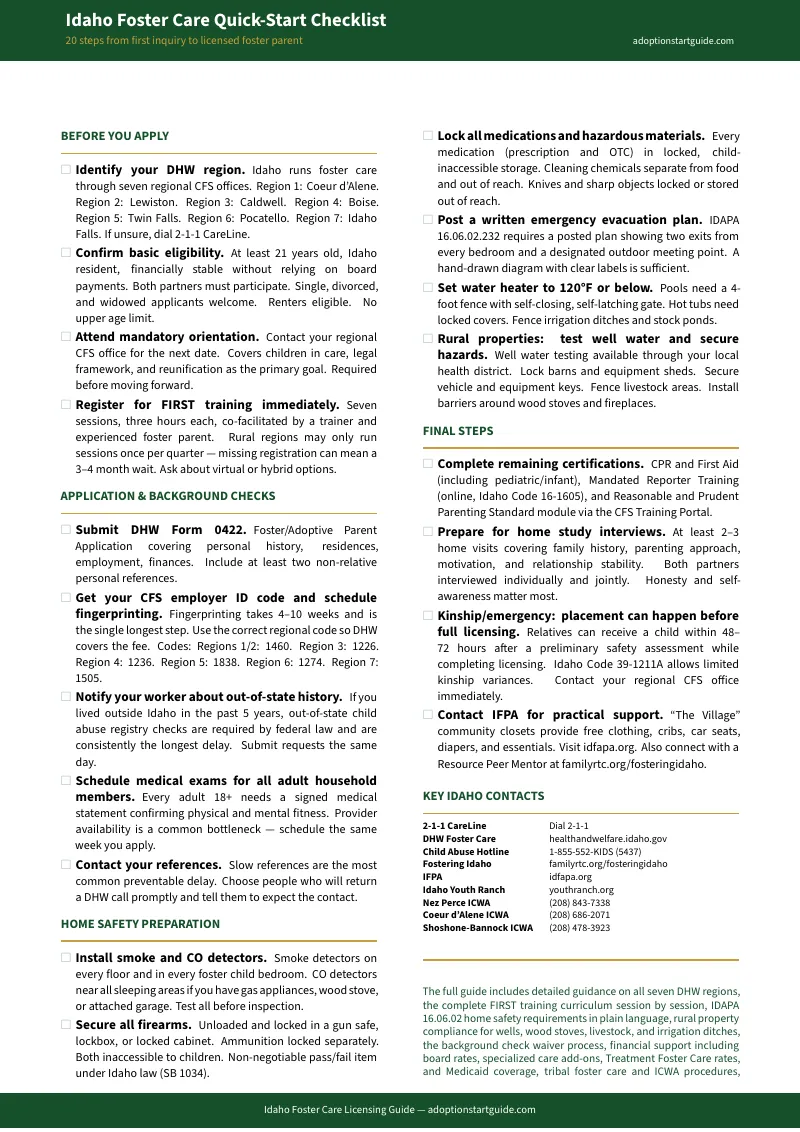
Download the Idaho Foster Care Quick-Start Checklist for a phase-by-phase overview of the licensing process, from your first DHW inquiry through post-licensing obligations. Free, no commitment. If you want the full guide with the FIRST training walkthrough, home study preparation, financial breakdown, region-by-region guidance, kinship fast-track, tribal ICWA compliance, and all seven printable worksheets, click the button in the sidebar.
— less than a tank of gas in rural Idaho
One trip from a rural county to the nearest DHW regional office costs more in fuel than this guide. One failed home inspection because of an unsecured firearm, a missing carbon monoxide detector, or an unfenced irrigation ditch delays your first placement by 30 days or more. One missed FIRST training session because you didn't know about the virtual option costs you an entire quarter in a region that only runs classes four times a year. One checklist prevents that. One chapter on the home study saves you the anxiety that makes good families quit before they finish.
If the guide doesn't deliver, reply to your download email at any time for a full refund. No forms. No justification required.