
You want to foster a child in Illinois, but the DCFS website sends you in circles, Rule 402 reads like a legal textbook, and every agency orientation is a recruitment pitch disguised as preparation.
Illinois has over 18,000 children in DCFS care right now. The state needs foster families urgently. But the system built to license you was designed for caseworkers and attorneys, not for the families it's trying to recruit. The Department of Children and Family Services publishes Rule 402 — 89 Illinois Administrative Code Part 402 — as a dense regulatory document that prescribes everything from the temperature of your bathwater to the square footage of a bedroom, without ever explaining what it means for your home, your family, or your timeline. You can spend hours on the DCFS website and leave knowing less than when you started.
Then there's the agency question. Illinois runs foster care through a hybrid system: you can license directly through DCFS, or through a private Purchase of Service agency like Lutheran Social Services of Illinois, Hephzibah, Little City, Aunt Martha's, or one of dozens of others. DCFS won't recommend an agency. The agencies won't mention that direct DCFS licensing exists. Let It Be Us offers licensing coaches and webinars, but their mission is recruiting for partner agencies. Every stakeholder presents their piece of the puzzle without showing you the full picture — because they're incentivized not to.
The home study is where motivated families stall. The background check process runs FBI fingerprinting, a CANTS (Child Abuse and Neglect Tracking System) check, a sex offender registry search, and criminal history checks on every adult in your household — simultaneously, through different offices, with different processing times. One stalled clearance freezes your entire application. And in a system where investigator vacancy rates exceed 20% and caseworker turnover disrupts continuity of care, your application is competing for attention against thousands of others in an overwhelmed bureaucracy.
The Rule 402 Compliance System
This guide is built for the Illinois DCFS licensing process and nothing else. Every chapter, every checklist, every contact reference is grounded in current 89 Ill. Adm. Code Part 402 requirements, DCFS operational procedures, and the real differences between licensing paths in Cook County versus downstate Illinois. Not a national foster care overview. Not an agency recruitment pitch. The independent navigation layer between what DCFS publishes online and what you actually need to know to move from first inquiry to approved license — under current regulations, on current timelines, in your specific part of Illinois.
What's inside
- POS agency vs. DCFS direct-licensing decision matrix — This is the comparison the Illinois system is designed not to provide. DCFS won't recommend a private agency. Agencies won't mention direct DCFS licensing as an alternative. This chapter compares licensing through a Purchase of Service agency (LSSI, Hephzibah, Little City, Aunt Martha's, Catholic Charities, Children's Home & Aid, UCAN, and others) versus licensing directly through DCFS by caseload ratios, after-hours crisis support, worker turnover, training format, matching philosophy, and geographic service areas. Includes which POS agencies serve which counties and which ones have established LGBTQ+-affirming track records — so you choose based on your family's needs, not based on who had the best orientation presentation.
- Room-by-room home audit based on Rule 402 — The DCFS home inspection checks your home against the administrative code, and the pass/fail threshold is more specific than "safe and clean." This chapter gives you the complete walkthrough: the 40-square-foot bedroom minimum for the first child (35 for each additional), the same-floor requirement for infants that catches Chicago families in multi-level homes, hot water temperature maximum of 115 degrees for homes with children under 10, smoke detector placement within 15 feet of every sleeping room and on every floor including the basement, egress requirements for basement and attic bedrooms (two exits, one providing direct outdoor access), locked storage for medications and cleaning supplies, and the "dangerous tools" lockup requirement. Handle every item before the licensing worker arrives.
- Background check and CANTS tracker — FBI fingerprinting, the Child Abuse and Neglect Tracking System check, sex offender registry screening, and Illinois criminal history checks run through different offices with different processing times. This chapter maps each check to its processing agency, explains the case-by-case review process for prior offenses (including decade-old misdemeanors and non-violent charges that forums treat as automatic disqualifiers but often are not under DCFS's actual standards), and includes follow-up templates for when your clearance stalls. In a system with over 20% investigator vacancies, documented follow-up is not optional — it's the strategy experienced Illinois foster parents say is the only way to keep a delayed clearance moving.
- PRIDE pre-service training navigator — Illinois requires 27 hours of PRIDE (Parent Resources for Information, Development, and Education) pre-service training as a condition of licensure. This chapter covers what PRIDE training actually involves, how sessions are scheduled across different agencies and regions, online and hybrid alternatives where available, and how to coordinate training completion with the rest of your licensing timeline so a scheduling gap doesn't add months to your process. For kinship caregivers, covers the expedited training pathway under the KIND Act.
- KIND Act fast-track for kinship caregivers — The Kinship in Demand Act, effective July 2025, created separate certification standards for relative caregivers. If a grandchild, niece, nephew, or other relative has been placed with you — or is about to be — this chapter explains the expedited licensing pathway, the flexible home standards, the financial support available during the certification process, and the difference between traditional foster licensing and kinship certification under the new law. This information isn't consolidated anywhere else because the Act is new and DCFS implementation guidance is still catching up to the legislation.
- Chicago vs. downstate operational guide — Cook County and the collar counties handle more DCFS cases than the rest of the state combined, but the operational culture, agency availability, and timeline look completely different depending on whether you're in Logan Square or Peoria. This chapter maps the practical differences: which POS agencies serve which regions, how licensing worker caseloads differ between urban and rural offices, how training availability varies, and what timeline to expect based on your location. A family in Springfield navigating the system needs different information than a family in Evanston, and national guides treat them identically.
- Agency interview script and comparison worksheet — Before you commit to a POS agency and trigger the official DCFS tracking process, you should ask questions that recruitment orientations won't answer. This chapter provides the interview questions that expose real operational differences: What is your current caseworker-to-family ratio? What does after-hours support look like? What is your average licensing timeline? How does matching work? What happens if I need a different caseworker? The printable comparison worksheet lets you evaluate two or three agencies side by side on the criteria that actually affect your day-to-day experience as a foster parent.
- Board payment and financial support breakdown — Illinois provides a monthly board payment to cover the child's food, clothing, shelter, and daily supervision needs. This chapter breaks down the current payment rates by age group and level of care, explains specialized foster care rates for children with medical or behavioral needs, details the additional allowances for clothing, school supplies, and activities, and clarifies what the board payment is intended to cover versus what comes out of your own pocket. For kinship caregivers, explains the financial support available during and after the KIND Act certification process.
Printable standalone worksheets included
- Licensing Timeline Tracker — Every milestone from first inquiry through approved license, with fill-in date fields and realistic processing windows for each step. Print it, update it after every caseworker interaction, and always know where you stand in the three-to-nine-month process.
- Rule 402 Home Safety Inspection Checklist — Room-by-room walkthrough of every requirement in 89 Ill. Adm. Code Part 402. Walk your home with this before the licensing worker arrives so you pass on the first visit.
- POS Agency Comparison Worksheet — Side-by-side evaluation grid for comparing up to three agencies on caseload ratios, after-hours support, training format, matching philosophy, and geographic coverage. Fill this out after attending orientations and before committing.
- Background Check Status Tracker — Each required clearance mapped to its processing office, submission date, expected processing time, and follow-up dates. When you have four simultaneous checks running through four different agencies, this keeps you from losing track of which one is holding up your approval.
Who this guide is for
- Chicago families navigating Cook County's agency overload — You've attended an orientation at LSSI, looked at Hephzibah, heard about Little City, and realized every session was a recruitment pitch, not preparation. This guide gives you the POS agency comparison matrix that the system is designed not to provide — so you choose the agency that fits your family, not the one with the best marketing. It also addresses the same-floor infant requirement that catches families in multi-level Chicago homes and the egress rules for basement bedrooms in older buildings.
- Downstate and suburban families — You're outside the Cook County agency cluster, and the POS options thin out quickly. Some agencies don't serve your county. Training schedules are less frequent. Your licensing worker carries a different caseload than their Chicago counterpart. This guide maps which agencies serve which regions and what timeline to realistically expect when you're not in the metro area.
- Kinship caregivers who need answers now — A grandchild, niece, nephew, or family member's child has been removed by DCFS or is at risk of removal. You need to understand the KIND Act expedited pathway, the flexible home standards for relative caregivers, and the financial support available during certification. The guide has a dedicated kinship pathway because your situation is fundamentally different from a traditional applicant — you didn't choose to enter this system, but you need to navigate it faster than anyone.
- LGBTQ+ families — Illinois was the first state to develop an LGBTQI+ youth service policy, and all foster parents must complete mandatory LGBTQI+ training. But agency culture varies. Some POS agencies have long, documented histories of affirming practice. Others comply with the mandate and stop there. This guide identifies which agencies have established affirming track records — because "allowed" and "supported" are not the same thing.
- Foster-to-adopt families — You're entering the system with the goal of permanency. Illinois law provides a preference in adoption proceedings for foster parents who have cared for a child for more than a year. This guide explains how concurrent planning works in practice, what the reunification timeline looks like, and how the transition from foster license to adoption proceeds when termination of parental rights occurs — so you understand the legal landscape before your first placement, not after you've bonded with a child.
- Single applicants and renters — Illinois law allows single adults 21 and older to foster, and homeownership is not required. But the application process doesn't make this obvious, and many prospective parents assume they'll be disqualified before they start. This guide addresses your specific situation — proving financial stability as a single applicant, meeting Rule 402 space requirements in a rental, and demonstrating your support network to the home study evaluator.
Why the free resources aren't enough
The DCFS website is a regulation repository, not a guide. It publishes Rule 402 as raw administrative code, links frequently redirect to other DCFS pages that redirect to other DCFS pages, and the site assumes you already understand the difference between direct licensing and POS agency licensing, between PRIDE and agency-specific training supplements, and between Cook County operations and downstate operations. Finding what you need on dcfs.illinois.gov is a research project, not a quick read.
Let It Be Us is the largest foster care recruitment organization in Illinois, and their licensing coaches and webinars are genuinely helpful. But their mission is recruitment for partner agencies. They will not compare their partner agencies against each other, they will not discuss the direct DCFS licensing path as an alternative, and they will not tell you which agencies serve your county if that agency isn't one of their partners. Their information is good. It is not complete.
Reddit, Facebook groups, and foster parent forums provide emotional support and conflicting advice. A family whose POS agency handled everything in Chicago gives different guidance than a kinship caregiver in Carbondale navigating DCFS directly without a caseworker who returns calls. Crowdsourced guidance is well-intentioned and situationally unreliable. An answer that worked for one agency, one licensing worker, one county may be wrong for yours.
National foster care resources describe a generic licensing process that doesn't account for Illinois's Rule 402 specifics, the POS agency vs. DCFS choice, the KIND Act kinship pathway, the same-floor infant requirement, the 115-degree water temperature rule, or the 20% investigator vacancy rate that means your application may sit unassigned for weeks. A guide written for Texas or Ohio won't help you in Illinois.
The free Quick-Start Checklist
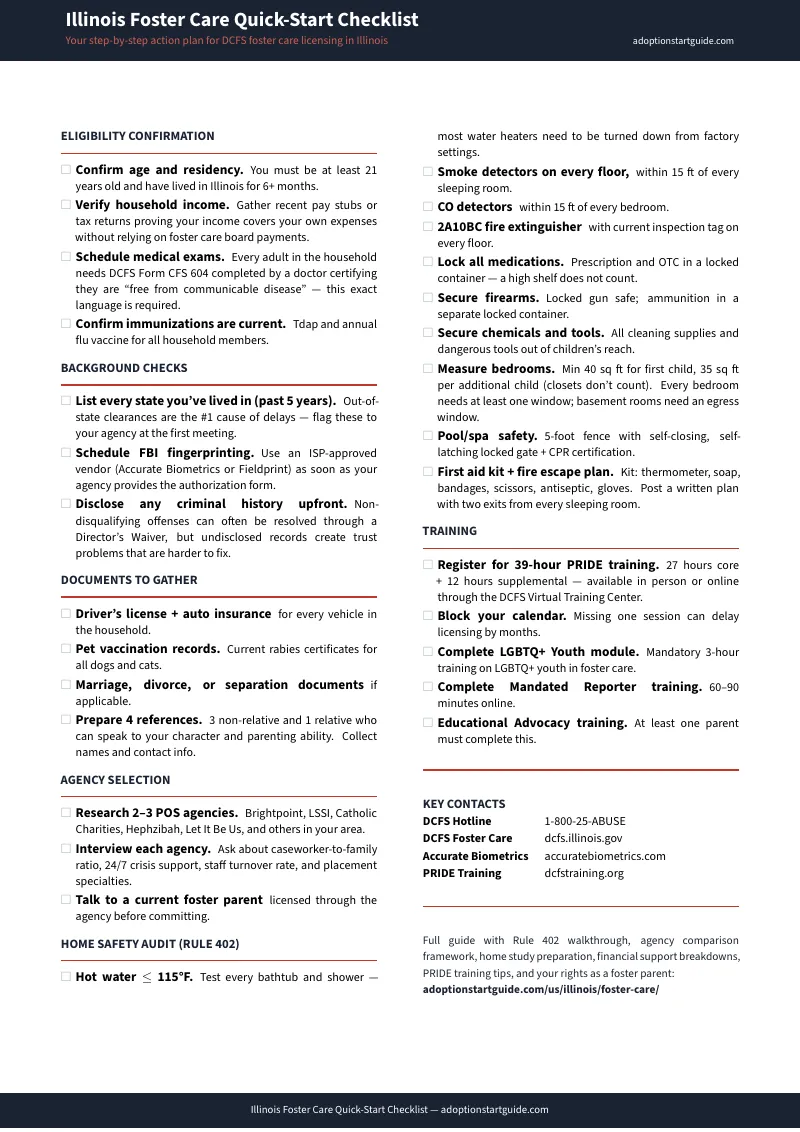
Download the Illinois Foster Care Quick-Start Checklist for a one-page overview of the licensing process, from first inquiry through approved license. Free, no commitment. If you want the full guide with the POS agency decision matrix, room-by-room Rule 402 home audit, background check tracker, KIND Act kinship pathway, PRIDE training navigator, agency interview script, board payment breakdown, and all the printable worksheets, click the button in the sidebar.
— less than one fingerprinting fee
The FBI fingerprinting costs $20 to $60 per adult. A medical physical for your household runs hundreds of dollars if you're uninsured. And every week your licensing is delayed by a stalled background check, a failed home inspection, or a rejected medical form is a week a child spends waiting for a stable home. This guide costs less than the cheapest fingerprinting fee you're already going to pay — and it prevents the mistakes that turn a three-month process into a nine-month ordeal.
If the guide doesn't deliver, reply to your download email at any time for a full refund. No forms. No justification required.