Indiana has four legal adoption pathways, three subsidy programs, 92 county courts, and a Putative Father Registry that can unravel everything if you miss a deadline. The DCS website tells you what the rules are. It doesn't tell you how to actually get through them.
You decided to adopt. Maybe the permanency hearing changed your foster child's goal from reunification to adoption and you're suddenly navigating Termination of Parental Rights. Maybe you and your spouse spent three years on IVF and you're ready for a different path to parenthood — but the $30,000 price tag on private infant adoption stopped you cold. Maybe you've been "Dad" to your stepchild for six years and you want the birth certificate to match. Maybe your grandchild landed in your lap after a DCS removal and you need to make this permanent before the system moves them somewhere else.
Whatever brought you here, you went to the in.gov/dcs/adoption website looking for a clear starting point. What you found was a collection of policy chapters written for caseworkers, references to RAPT training and SNAP Councils and Regional Adoption Consultants, links to state forms (SF 53186, SF 54609, SF 54713) scattered across multiple pages, and the phrase "contact your local DCS office" repeated as though all 92 county offices work the same way. They don't.
What you didn't find was a plain-language answer to the question every Indiana family asks first: which of the four pathways is right for my situation, what exactly do I need to do on that pathway, and how do I avoid the mistakes that cost families thousands of dollars or months of delay?
So you turned to Reddit. r/Adoption. r/Indianapolis. You posted your question and got the response that defines this system: "Get a lawyer." A good Indiana adoption attorney charges $200 to $400 an hour. Kirsh & Kirsh — one of the state's most prominent adoption firms — charges a $17,500 attorney fee plus a $27,500 service fee. Adoptions of Indiana runs $3,000 for the home study plus $14,700 for placement. These are excellent firms doing excellent work. But if you're a foster parent whose child just became legally free, a stepparent filing a straightforward consent adoption, or a kinship grandmother who needs the legal process explained — you don't need a $27,500 service package. You need someone to translate Indiana Code 31-19 into a step-by-step plan you can actually follow.
The Indiana Permanency Roadmap
This guide is built for Indiana's adoption system and nobody else's. Every chapter, every checklist, every form reference is grounded in Indiana Code 31-19, the DCS adoption policies, the current subsidy rate schedules, and the operational realities of a state where the Regional Adoption Consultant often has more authority over your case than your day-to-day caseworker — and most families don't learn that until the subsidy negotiation is already over.
What's inside
- Four-Pathway Decision Framework — Foster-to-adopt through DCS, private agency infant, independent (attorney-facilitated), and stepparent/kinship. Each pathway mapped with cost ranges, timelines, training requirements, and the specific steps from first inquiry through final decree. Most families pick the wrong pathway because nobody explains all four. This guide lays them side by side so you choose the one that matches your budget, your timeline, and where you are right now.
- Home Study Prep Guide — the 5 hard disqualifiers vs. the 20 fears that don't matter — A conviction for child abuse is an absolute bar. Living in a 2-bedroom apartment is not. A past bankruptcy is not. Being single is not. Being over 50 is not. This chapter separates the real requirements from the anxiety, walks you through the SF 53186 Physical Environment Checklist before the caseworker does, and tells you exactly how to prepare your autobiography, financial disclosures, and references so the home study confirms your readiness instead of creating months of worry.
- Putative Father Registry Timing Guide — The PFR is governed by IC 31-19-5, and the search timing is one of the most technically dangerous steps in any Indiana adoption. Search too early — before the statutory window closes — and you've invalidated the search and potentially the entire adoption. This chapter maps the exact deadlines and the correct sequence so your attorney or agency gets it right the first time.
- Subsidy Negotiation Playbook — Indiana's adoption assistance comes in two tiers: AAP (federal, Title IV-E) and SAS (state-funded). The monthly rates range from $847 to $2,384 depending on the child's assessed level of need. Here is what no one tells you: the rate is negotiable, and the person you negotiate with is your Regional Adoption Consultant, not your caseworker. This chapter explains how to document a child's needs, when to request a rate review, and your legal right to renegotiate after finalization when needs change.
- The Consent Rules That Protect You — Birth mothers cannot sign consent until 72 hours after birth. After signing, there is a 15-day withdrawal window under IC 31-19-10-3. For stepparent adoptions, an absent biological parent's consent can be waived under IC 31-19-9-8 if they've abandoned the child for six months or failed to provide support for a year. This chapter explains every consent scenario across all four pathways, with the exact statutory references, so you know when the adoption becomes legally unshakeable.
- County Court Filing Guide — Filing fees, venue rules, and scheduling expectations for Marion, Allen, Hamilton, Vanderburgh, St. Joseph, Lake, Tippecanoe, and Monroe counties — plus how to find the right court in any of Indiana's 92 counties. Includes the required documents checklist for the petition: consent forms, home study report, PFR search affidavit, TPR order, ICPC approval, and supervision report.
- Financial Planning Chapter — The federal adoption tax credit ($16,810 per child for 2025 finalizations), the Indiana state credit (up to $2,500), NRAE reimbursement ($2,000 per child for foster care adoptions), Medicaid continuation through age 18, and faith-based grants from Traders Point Christian Church, Hands of Hope, Lifesong for Orphans, Show Hope, and The Abba Fund. This chapter shows you how to stack every available dollar so the adoption that looks like $30,000 actually costs a fraction of that.
- Post-Adoption Roadmap — Post-Adoption Contact Agreements (what's enforceable and what isn't under IC 31-19-16), accessing original birth certificates and adoption records, subsidy renegotiation after finalization, the SF 54713 continuation beyond age 18, and Indiana Post-Adoption Services. The process doesn't end at the decree — this chapter makes sure you don't miss the deadlines that protect your child's benefits.
Who this guide is for
- Foster parents moving toward adoption — Your foster child's permanency goal just changed. The caseworker is talking about TPR timelines and SNAP Councils and subsidy agreements, and you're trying to figure out what happens between now and the day the judge signs the decree. You need the CHINS-to-TPR pipeline explained in plain language, a subsidy negotiation strategy, and someone to tell you what the Regional Adoption Consultant's role actually is — before you sit across the table from one.
- Infant adoption seekers — You've moved past IVF and you're ready to build your family through adoption. The agency fees are staggering, the wait times are uncertain, and nobody mentioned that Indiana allows independent adoption through an attorney — a pathway that can save $10,000 to $25,000 if you've already connected with a birth mother. You need the agency comparison questions, the PFR timing guide, the consent rules, and the full cost breakdown before you sign a contract.
- Stepparents who want to be "Dad" or "Mom" on paper — You've been parenting this child for years. You need the legal recognition to match — for school enrollments, medical decisions, inheritance, and the peace of mind that comes with permanency. The biological parent either consents or has been absent, and you need to know exactly how IC 31-19-9-8 handles waiver of consent, what "diligent search" means, and whether the court will waive the home study in your case.
- Kinship caregivers — grandparents, aunts, uncles — You didn't plan to become a parent again. A DCS removal or a family crisis put this child in your home, and now you need stability that guardianship can't provide. You need to understand the difference between guardianship and adoption (it's bigger than you think), the expedited kinship pathway, and how to access subsidies and Medicaid that most kinship families never learn about.
Why the free resources aren't enough
The DCS website publishes policy chapters designed for caseworkers. It tells you what forms you need. It doesn't tell you how to get your caseworker to sign them, how to prepare for a RAC interview, or which of the four pathways actually fits your situation. The "contact your local DCS office" instruction assumes all 92 county offices operate identically. They don't — Marion County Superior Court runs 60 to 90 days from filing to hearing; rural counties vary wildly.
Bethany Christian Services and Adoptions of Indiana provide educational materials, but their information is tied to their own agency requirements — marriage length minimums, age limits, faith expectations — and families routinely mistake agency policies for state law. They are not the same thing.
NACAC's Indiana subsidy page is the most detailed free resource on adoption assistance, but it reads like a federal regulation manual. If you're not already familiar with Title IV-E eligibility criteria and the distinction between AAP and SAS, the page creates more confusion than it resolves.
Reddit and Facebook groups are valuable for emotional support, but the most common answer to procedural questions is "get a lawyer" — which is useful advice if you have $200 to $400 per hour and a specific legal question. It is not useful if you need the entire process explained from start to finish before you even know which questions to ask.
The free Quick-Start Checklist
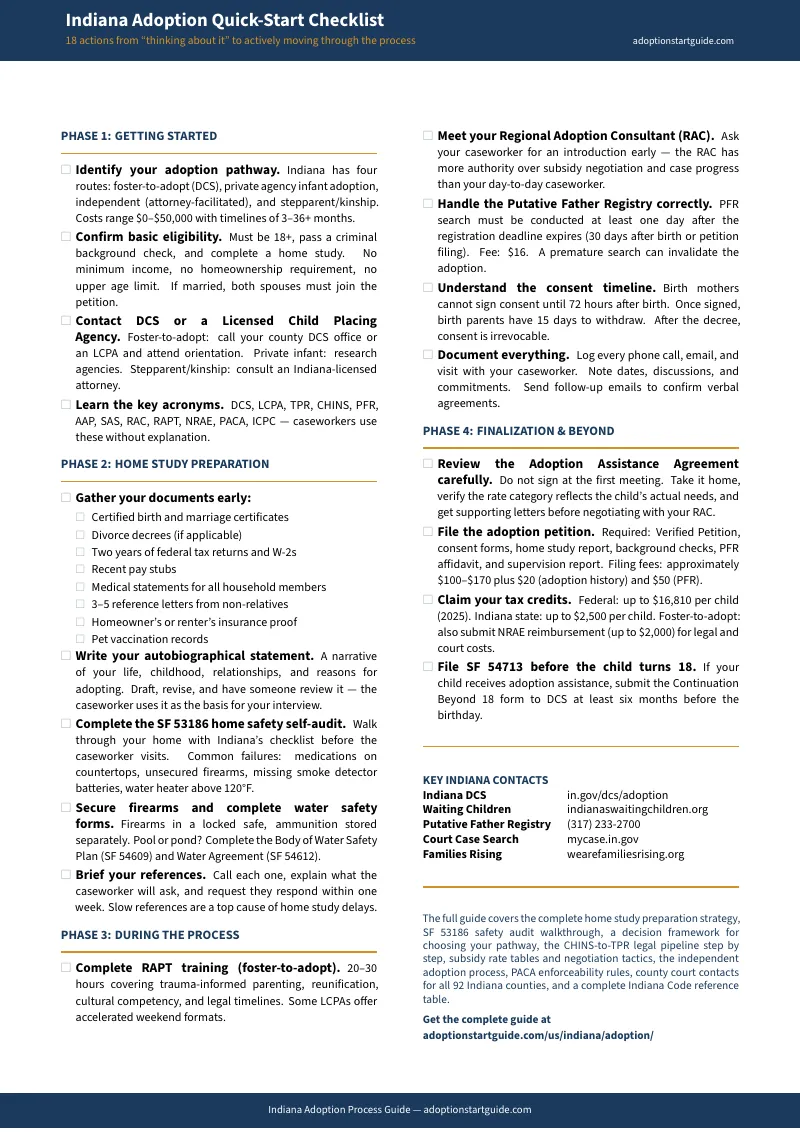
Download the Indiana Adoption Quick-Start Checklist for a one-page overview of the adoption process — the four pathways, the key requirements, and the first steps for each. Free, no commitment. If you want the full guide with the pathway decision framework, home study preparation, subsidy negotiation playbook, consent rules, county court filing guide, financial planning chapter, and post-adoption roadmap, click the button in the sidebar.
— less than ten minutes of an Indiana adoption attorney's time
An Indiana adoption attorney charges $200 to $400 per hour. A single missed deadline on the Putative Father Registry search can invalidate an adoption. A subsidy agreement signed without understanding the RAC's role can lock you into a rate that doesn't cover your child's actual needs — for years. One missed SF 54713 filing before your child turns 18 can terminate benefits that were supposed to continue through college. These are the mistakes that cost thousands. This guide prevents them.
If the guide doesn't deliver what you need, reply to your download email at any time for a full refund. No forms. No justification required.