
You want to foster a child in Indiana, but the DCS website reads like a 400-page legal brief, KidTraks keeps rejecting your invoices, and nobody told you about the 35,000-person childcare voucher waitlist until after orientation.
Indiana has roughly 13,000 children in Department of Child Services care and a shrinking pool of licensed homes — down to approximately 3,200 statewide. The state needs foster families badly. But the system built to license you was designed for state attorneys and caseworkers, not for the families it's trying to recruit. The DCS Child Welfare Manual runs 400-plus pages of policy language organized by chapter and section number. It uses acronyms like CHINS, TPR, RFCS, and FCM without ever explaining what they mean for your family, your home, or your Tuesday evening. You can spend an entire weekend on in.gov/dcs and leave more confused than when you started.
Then there's the agency question. Indiana lets you license directly through DCS or through a private Licensed Child-Placing Agency — The Villages, Firefly Children, Bethany Christian Services, Damar Services, Childplace, Family Ark, or one of dozens of others. DCS won't recommend an agency. The agencies won't mention that direct DCS licensing exists. Every orientation is a recruitment pitch wrapped in a training session, and nobody is incentivized to show you the full picture. Meanwhile, the RAPT training program has replaced the old TIPS-MAPP curriculum, and the scheduling works differently depending on whether you're doing it through DCS or an LCPA — but nobody consolidates that information because nobody owns the comparison.
And then the 2025 crisis hit. Indiana's Child Care and Development Fund voucher program froze, leaving 35,000 families on a waitlist. If you're a working parent planning to foster an infant or toddler, childcare was supposed to be covered — and suddenly it isn't. Senate Enrolled Act 4 carved out 200 priority slots and the FROG Fund is being tapped for emergency relief, but navigating that system requires knowing where to apply, through whom, and in what order. The DCS website doesn't explain it. Your RFCS may not know about it. And the Facebook groups are full of families who found out too late.
The Indiana Licensing Roadmap
This guide is built for the Indiana DCS licensing process and nothing else. Every chapter, every checklist, every form reference is grounded in current IC 31-27 requirements, 465 IAC 2-1.5 administrative rules, and the real operational differences between licensing through DCS directly versus through an LCPA — across all 18 DCS regions and 92 counties. Not a national foster care overview. Not an agency recruitment pitch. Not a book about the emotional journey of fostering. This is the independent navigation layer between what DCS publishes online and what you actually need to know to move from first inquiry to approved license — under current regulations, on current timelines, in your specific part of Indiana.
What's inside
- LCPA vs. DCS direct-licensing decision matrix — This is the comparison the Indiana system is designed not to provide. DCS won't recommend an agency. Agencies won't mention direct licensing as an alternative. This chapter compares licensing through The Villages, Firefly Children, Bethany Christian Services, Damar Services, Childplace, Family Ark, and other LCPAs versus licensing directly through DCS — by caseload ratios, training format, after-hours crisis support, worker turnover, geographic coverage across the 18 DCS regions, and specialization (Damar for developmental disabilities, Benchmark for therapeutic placements). Includes which agencies serve which counties so you choose based on your family's needs, not based on who had the best orientation.
- KidTraks financial portal walkthrough — The number-one complaint from Indiana foster parents is rejected KidTraks invoices. The $200 initial clothing allotment, the $0.50-per-mile travel reimbursement, the $50 birthday allowance, the $300 personal allowance — they all go through KidTraks, and minor formatting errors mean rejected claims and 60-day payment delays. This chapter walks you through the portal step by step: how to submit per diem claims, how to attach case documentation correctly, what triggers automatic rejection, and how to fix it before your invoice sits in limbo for two months. Experienced Indiana foster parents say this single chapter would have saved them more frustration than anything else in the first year.
- Childcare voucher crisis navigator — In 2025, Indiana's CCDF waitlist hit 35,000 families. If you're a working parent fostering an infant, the $1,206 average monthly cost of infant care versus the $840 state per diem creates a $366 gap that nobody warned you about at orientation. This chapter maps the FROG Fund emergency process, the 200 priority slots carved out under Senate Enrolled Act 4, and how to work with your Regional Foster Care Specialist to push your application to the front. The DCS website says vouchers are "available." This chapter tells you how to actually get one.
- 18-region DCS system decoded — Indiana's 92 counties are organized into 18 DCS regions, each with its own Regional Director, its own RFCS staffing levels, and its own operational culture. A family in Hamilton County (Region 3) navigating the system looks completely different from a family in Vanderburgh County (Region 4). This chapter maps every region, identifies which LCPAs serve which counties, explains how licensing worker caseloads vary, and gives you a realistic timeline based on your location — not the generic "three to six months" the DCS website publishes.
- RAPT training breakdown — Indiana requires 10 hours of Resource and Adoptive Parent Training before initial licensure, split across four modules: RAPT I (3 hours, trainer-led), RAPT II (4 hours, self-paced on IU Canvas), RAPT III (3 hours, trainer-led), and RAPT IV (6 hours, adoption only). This chapter breaks down each module — what's actually covered, how to register through [email protected], how to set up the IU guest account for the Canvas portal, and how to schedule the trainer-led sessions around a full-time job. A scheduling gap between RAPT I and III is one of the most common licensing delays, and this chapter shows you how to avoid it.
- Home study demystified — The home inspection checks your home against IC 31-27 and the Resource Family Home Physical Environmental Checklist (SF 53186). The 50-square-foot bedroom minimum per child. Smoke detectors within 10 feet of every bedroom door and on every floor. Fire extinguishers in operating condition on every level. Firearms unloaded and locked with ammunition stored separately. The pool fencing and water safety plan requirement. This chapter gives you the complete room-by-room walkthrough so you know exactly what the licensing worker checks — and what you can stop worrying about. The inspector is looking for functional safety, not whether your closets are organized.
- Background check and CPI tracker — FBI fingerprinting through Identogo, the Child Protection Index search for everyone 6 and older, the National Sex Offender Registry check for everyone 14 and older, local criminal records for every jurisdiction you've lived in over the past five years — all running simultaneously through different offices with different processing times. This chapter maps each check to its processing office, explains the waivable versus nonwaivable offense framework under IC 31-27-4-13 (including decade-old misdemeanors and dismissed charges that forums treat as automatic disqualifiers but are often waivable under DCS's actual standards), and includes follow-up templates for when your clearance stalls. In a system where the Central Office Background Check Unit processes thousands of checks, documented follow-up is not optional.
- FCM vs. RFCS vs. CASA hierarchy explained — Prospective parents don't understand who does what. Your Family Case Manager handles the child's case. Your Regional Foster Care Specialist handles your licensing and support. A Court Appointed Special Advocate represents the child's interests in court. They report to different supervisors, operate on different timelines, and sometimes give conflicting guidance. This chapter maps the hierarchy so you know who to call for what — and who to escalate to when calls aren't returned.
- Per diem and financial support breakdown — Indiana provides a daily per diem tiered by age and level of care: $27.86 per day for a standard infant placement, up to $78.41 for a Therapeutic Plus teenager. Plus the $200 initial clothing allotment, $300 annual personal allowance, $50 birthday and $50 holiday allowances, and respite care reimbursement. This chapter breaks down every payment stream, explains what the per diem is intended to cover versus what comes out of pocket, and details the financial gap between licensed and unlicensed kinship care — because unlicensed relatives may only receive limited stipends through Kinship Indiana Support Services, and nobody explains that difference at orientation.
Printable standalone worksheets included
- Licensing Timeline Tracker — Every milestone from first interest form through approved license, with fill-in date fields and realistic processing windows for each step across all 18 DCS regions. Print it, update it after every RFCS interaction, and always know where you stand.
- Home Safety Inspection Checklist (SF 53186 Companion) — Room-by-room walkthrough of every requirement on the Resource Family Home Physical Environmental Checklist. Walk your home with this before the licensing worker arrives so you pass on the first visit.
- LCPA Comparison Worksheet — Side-by-side evaluation grid for comparing up to three Licensed Child-Placing Agencies on caseload ratios, after-hours support, training format, geographic coverage, and specialization. Fill this out after attending orientations and before committing.
- Background Check Status Tracker — Each required clearance mapped to its processing office, submission date, expected processing time, and follow-up dates. When you have FBI fingerprinting, CPI checks, sex offender registry searches, and local criminal records all running through different agencies, this keeps you from losing track of which one is holding up your approval.
Who this guide is for
- Indianapolis metro families navigating the agency overload — You're in Hamilton, Hendricks, or Johnson County (Region 3). You've attended an orientation at The Villages, looked at Firefly Children, heard about Bethany Christian Services, and realized every session was a recruitment pitch, not preparation. This guide gives you the LCPA comparison matrix that the system is designed not to provide — so you choose the agency that fits your family, not the one with the best marketing. If you're a working parent, it also maps the FROG Fund and Senate Enrolled Act 4 priority slots for childcare vouchers, because the $366 monthly gap between infant care costs and the state per diem doesn't appear in any orientation packet.
- Fort Wayne, Evansville, and South Bend families — You're outside the Indianapolis metro, and the agency landscape looks different. Fewer LCPAs serve your county. RAPT training sessions are less frequent. Your RFCS carries a different caseload than their Region 3 counterpart. This guide maps which agencies serve which regions and what timeline to realistically expect when you're not in the capital.
- Kinship caregivers who need answers now — A grandchild, niece, nephew, or sibling's child has been removed by DCS or is about to be. You need to understand the expedited kinship vetting process, the difference between licensed and unlicensed relative care (and why that difference means hundreds of dollars per month in per diem you may not receive), and how to access Kinship Indiana Support Services. The guide has a dedicated kinship pathway because your situation is fundamentally different from a traditional applicant — you didn't choose to enter this system, but you need to navigate it faster than anyone.
- Single applicants and renters — Indiana law allows single adults 21 and older to foster, and homeownership is not required. But the application process doesn't make this obvious, and many prospective parents assume they'll be disqualified before they start. This guide addresses your specific situation — demonstrating financial stability as a single applicant (the "sufficient income" standard, not a specific threshold), meeting the 50-square-foot bedroom requirement in a rental, and preparing your references and autobiography for the home study.
- Foster-to-adopt families — You're entering the system with the goal of permanency. Indiana's "15 of 22" rule means DCS generally files for Termination of Parental Rights if a child has been under state supervision for 15 of the most recent 22 months. This guide explains how that timeline works in practice, what CHINS adjudication means for your placement, and how the transition from foster license to adoption proceeds — including the Title IV-E Adoption Assistance Program and State Adoption Subsidy — so you understand the legal landscape before your first placement.
- Faith-motivated families — Churches like Traders Point Christian Church, Connect Church, and Northview are the primary recruitment pipeline for foster care in Indiana. You heard a sermon, joined a Care Community, and felt called to act. This guide takes that calling and gives it a concrete operational plan — because inspiration gets you to orientation, but the RAPT registration process, KidTraks portal, and DCS regional structure require a different kind of preparation.
Why the free resources aren't enough
The DCS website is a policy repository, not a guide. It publishes IC 31-27 and the Child Welfare Manual as raw legal text, links redirect to other DCS pages that redirect to other DCS pages, and the site assumes you already understand the difference between direct DCS licensing and LCPA licensing, between RAPT I and RAPT II, and between a Family Case Manager and a Regional Foster Care Specialist. Finding what you need on in.gov/dcs is a research project, not a quick read.
The Villages offers excellent RAPT training sessions — but their training is specific to families licensing through The Villages. They won't compare themselves against Firefly Children or Bethany Christian Services. They won't explain the direct DCS licensing path. And they won't walk you through the KidTraks portal, because invoicing isn't part of their pre-service curriculum. Their information is good. It is not complete.
IFASFA — the Indiana Foster, Adoptive and Supportive Families Association — provides strong advocacy and peer support for already licensed parents. But their resources assume you've already navigated the licensing process. They're the support network for year two, not the roadmap for month one.
Reddit, Facebook groups, and foster parent forums provide emotional support and conflicting advice. A family whose LCPA handled everything in Indianapolis gives different guidance than a kinship caregiver in Evansville navigating DCS directly with an RFCS who carries 80 cases. Crowdsourced guidance is well-intentioned and situationally unreliable. An answer that worked for one agency, one licensing worker, one DCS region may be wrong for yours.
National foster care books on Amazon describe a generic licensing process that doesn't account for Indiana's RAPT curriculum, the KidTraks financial portal, the 18-region DCS structure, the 2025 childcare voucher crisis, the FROG Fund, Senate Enrolled Act 4, or the specific difference between waivable and nonwaivable offenses under IC 31-27-4-13. A guide written for Texas or Ohio won't help you in Indiana.
The free Quick-Start Checklist
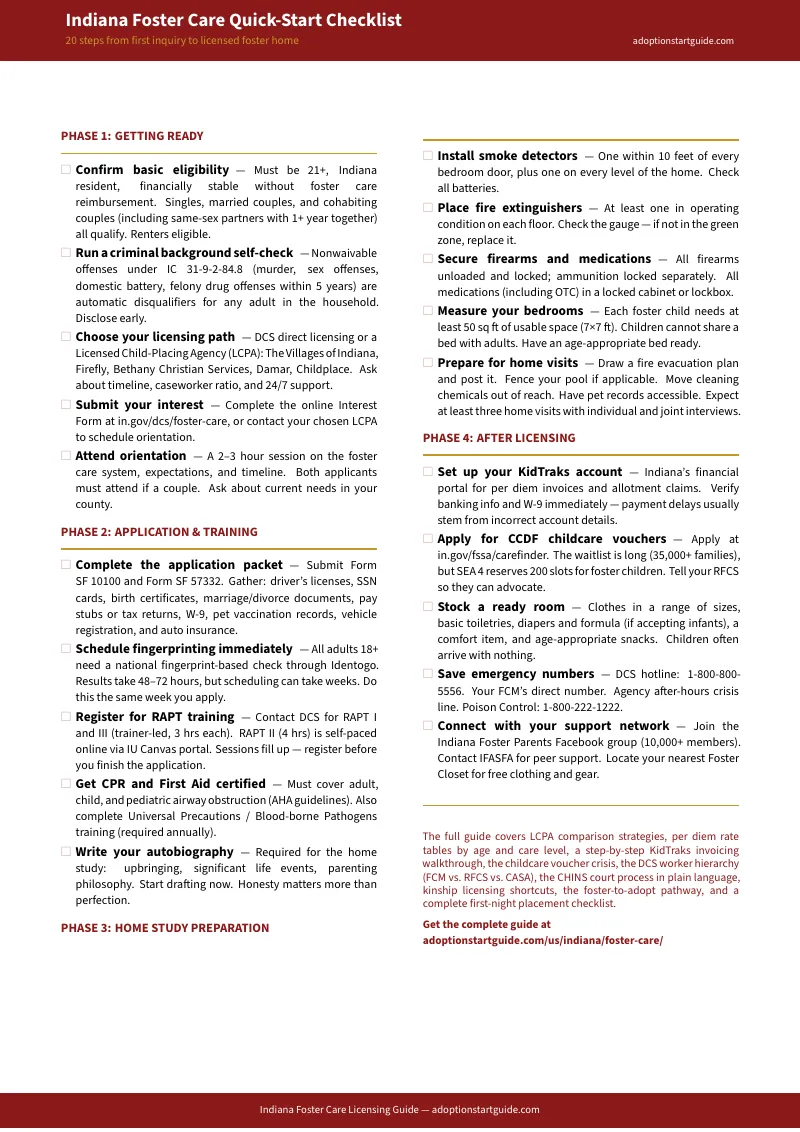
Download the Indiana Foster Care Quick-Start Checklist for a one-page overview of the licensing process, from first interest form through approved license. Free, no commitment. If you want the full guide with the LCPA decision matrix, KidTraks walkthrough, childcare voucher navigator, 18-region DCS map, RAPT training breakdown, home study preparation, background check tracker, worker hierarchy guide, per diem breakdown, and all the printable worksheets, click the button in the sidebar.
— less than one Identogo fingerprinting fee
The FBI fingerprinting through Identogo costs around $40 per adult. CPR and First Aid certification runs $50 to $100. And every week your licensing is delayed by a stalled background check, a failed home inspection, or a KidTraks invoice rejected for a formatting error is a week a child spends waiting for a stable home. This guide costs less than the fingerprinting fee you're already going to pay — and it prevents the mistakes that turn a three-month process into a nine-month ordeal.
If the guide doesn't deliver, reply to your download email at any time for a full refund. No forms. No justification required.