
Kansas has over 6,000 children in out-of-home care and not enough licensed foster homes. You called DCF for help getting started. They gave you five contractor phone numbers and told you to pick one.
You decided to foster. Maybe your church ran a CarePortal campaign. Maybe a relative's child was removed and you got the call from a caseworker you'd never heard of. Maybe you've been thinking about this for years and finally searched "how to become a foster parent in Kansas." Whatever brought you here, you went to dcf.ks.gov looking for a clear starting point.
What you found was a maze. Kansas is unlike almost every other state in the country. In 1996, Kansas became the first state to fully privatize its foster care and adoption services. DCF doesn't train you. DCF doesn't license you directly. DCF doesn't assign you a caseworker. Instead, DCF contracts with private agencies — Saint Francis Ministries, TFI Family Services, KVC Kansas, Cornerstones of Care, EmberHope Connections — who handle everything from orientation through support. The state divided itself into eight catchment areas, each with a designated Case Management Provider. And unless you already know what "CMP" and "CPA" mean and how they differ, you're stuck on the first page of a system that assumes you've already figured out the organizational chart.
So you turned to Facebook. "Kansas Foster Parents." "Fostering Kansas." "KC Metro Caregiver." You posted your question and got the answer that defines this system: "It depends on your area — ask your worker." But you don't have a worker yet. That's the whole problem. You're in the gap between wanting to foster and knowing which of five contractors to call first — and nobody is meeting you there.
The contractor manuals are available online. TFI publishes a 90-page Care Provider Manual. KVC has a Foster Parent Welcome Book. These documents are thorough, written by compliance teams to manage risk and document policy. They use acronyms like PDP (Partnership Development Plan) and CAP (Corrective Action Plan) without explaining the psychological toll these administrative tools take on a family. They will not tell you which contractor has the highest caseworker turnover in your region. They will not explain the difference between a CMP and a CPA and why that distinction determines whether you have any choice at all in who supports you. They will not mention the EmberHope transition in Wichita or what it means for families in Sedgwick County who started the process with Saint Francis and woke up one morning with a new contractor they'd never spoken to.
National foster care books on Amazon — The Connected Parent, Foster the Family — will prepare your heart for fostering. They will not tell you that Kansas has eight catchment areas, that your zip code determines your Case Management Provider, or how to navigate the CLARIS database system where your application actually gets processed. A guide written for a national audience will tell you to "contact your local agency." In Kansas, that means figuring out which of five contractors serves your county, whether you can license through a different agency than the one assigned to your area (you can), and what to say when you call. Nobody has published that in plain language.
The Kansas System Navigator
This guide is built for the Kansas privatized foster care system and nobody else's. Every chapter, every checklist, every form reference is grounded in the Kansas Administrative Regulations (KAR Agency 30, Article 47), the Revised Kansas Code for Care of Children (KSA 38-2201 et seq.), the Gail Finney Memorial Foster Care Bill of Rights (KSA 38-2201a), and the operational realities of the eight catchment areas that divide this state. It covers the gap between what DCF posts online and what you actually need to know to get from "interested" to "licensed" without unnecessary delays, failed inspections, or months of silence from a contractor who never explained the next step.
What's inside
- The Privatized System Explained — Kansas's foster care model is unlike any other state. This chapter maps the entire structure: DCF as regulator, CMPs as case managers, CPAs as foster parent sponsors, and the eight catchment areas with their designated contractors (Saint Francis, TFI, KVC, Cornerstones of Care, EmberHope). You'll understand who holds the power in your county, who handles the money, and who you actually call at 2 AM when there's a crisis. Most importantly, you'll learn the critical insight that most families don't discover until mid-process: you do not have to use the CMP in your area for your licensing. You can choose a different CPA — and this chapter explains when and why you should.
- Step-by-Step Licensing Process — Kansas's licensing process has six stages, from initial contractor contact through DCF license issuance via the CLARIS system. This guide walks you through each one in order: what happens, what your contractor expects from you, which forms to submit and when (FCL 401, FCL 002, FCL 411, CCL 009, FCL 402), and how to avoid the common stalls that stretch a 3-to-6-month process to 12. You'll know what's coming before your licensing specialist tells you — because in many agencies, they won't tell you until you ask.
- Contractor Comparison — Saint Francis Ministries in western Kansas. TFI Family Services in northeast, southeast, and south central Kansas. KVC Kansas in the Johnson County suburbs. Cornerstones of Care in KC Metro. EmberHope Connections in Wichita. Each agency has a different culture, different strengths, different challenges, and different caseworker-to-family ratios. This chapter profiles all five major CMPs and the independent CPAs (DCCCA, Eckerd Connects, CALM), gives you eight pointed questions to ask during your interview, and explains what the answers reveal about the support you'll actually receive.
- TIPS-MAPP Training Walkthrough — The mandatory 30-hour, 10-session TIPS-MAPP (Trauma Informed for Permanency and Safety) training is the single biggest time commitment in the process — and the point where many Kansas families drop out. This chapter breaks down all ten sessions, explains what your trainers are evaluating at each stage, and shows you how to prepare so the training deepens your readiness instead of overwhelming it. It also covers the 21-hour "Deciding Together" alternative for families with scheduling conflicts, and the ancillary requirements — First Aid/CPR (must be in-person), Safe Sleep, Universal Precautions, and Medication Administration.
- Home Safety Inspection Checklist — Derived directly from KAR 30-47-820 and KAR 30-47-821. Bedroom measurements (70 sq ft single, 45 sq ft per child shared), the bunk bed rule for children 6+, smoke detector and carbon monoxide detector placement, fire extinguisher requirements, firearm and ammunition storage in separate locked containers, medication lockbox standards, pool fence height (4 feet minimum), and pet vaccination requirements. Walk your house with this checklist before the licensing specialist walks it for you. The most commonly cited inspection failure in Kansas is unlocked medications. A $15 lockbox from the hardware store prevents a 30-day delay.
- Home Study Preparation — Your licensing specialist will interview every household member and evaluate your motivation, relationship dynamics, discipline philosophy, support systems, and autobiography. This chapter explains what they're actually looking for — self-awareness, not perfection — and reframes the home study from an interrogation to what it really is: a process designed to build a case for why your home is a good resource.
- Financial Reality Breakdown — Current Kansas reimbursement from approximately $20/day for Basic 1 care (~$600/month) to $37/day for emergency placements and $159.60/day for Therapeutic Foster Care, plus clothing stipends ($320-$700/year), Foster Care Child Care assistance for working parents, KanCare (Medicaid) coverage for every child, respite care, and mileage reimbursement for trips over 40 miles. The daily stipend is not income — it's a reimbursement for the child's expenses. But knowing the full financial picture, including the supports most families never learn about until months after licensing, is the difference between fostering sustainably and burning out.
- Kinship Care Fast-Track — If a grandchild, niece, nephew, or NRKIN (Non-Related Kin) child was placed with you after a DCF removal, you're already parenting under emergency circumstances you didn't plan for. The financial difference between informal care ($10/day) and full licensing (starting at $20/day plus KanCare, childcare assistance, and clothing allowances) is thousands of dollars per year. This chapter explains the 2024 abridged kinship licensing regulations, the KinPact program, the Kinship Navigator system, and how to move from emergency caregiver to fully licensed resource parent without starting from scratch.
- Foster-to-Adopt Pathway — For families entering the system with adoption as their ultimate goal. How concurrent planning works in Kansas, when a foster family receives first consideration for adoption, how Termination of Parental Rights unfolds under KSA 38-2269, Adopt Kansas Kids (adoptkskids.org), and adoption subsidies. This chapter also addresses the hardest truth: Kansas operates with a reunification-first philosophy — 53% of children return to their biological families — and you must genuinely support that even when your heart wants a different outcome.
- The Sedgwick County Transition — In July 2024, the Wichita metro contract transferred from Saint Francis Ministries to EmberHope Connections. Wichita accounts for roughly 20% of the state's foster care population. If you live in Sedgwick County or began the licensing process with Saint Francis before the handover, this guide explains what changed, what was transferred, and how to verify that your training hours and documentation made the transition intact.
- Foster Parent Rights and Escalation Ladder — The Gail Finney Memorial Foster Care Bill of Rights (KSA 38-2201a) gives you 22 specific, enforceable rights: the right to be treated with dignity, to receive information about a child before placement, to say no to a placement without retaliation, to attend court hearings, and to file a grievance when your rights are violated. When a caseworker stops returning calls, this chapter gives you the escalation path — caseworker to supervisor to contractor leadership to DCF Foster Care Licensing Division to Kansas Protection Report Center — that no contractor publishes on their website.
Printable standalone worksheets included
- Home Safety Self-Inspection Checklist — Room-by-room walkthrough of every physical requirement under KAR 30-47-820 and KAR 30-47-821. Fire safety, sleeping arrangements, hazardous materials, firearms, water safety, property and grounds. Walk your house with this before the licensing specialist visits.
- TIPS-MAPP Session Tracker — All ten sessions plus ancillary training (First Aid/CPR, Safe Sleep, Universal Precautions, Medication Administration) with space to record completion dates and notes. Print it and bring it to training.
- Background Check Tracking Log — KBI name-based criminal, FBI fingerprint (Identogo), CANIS registry, sex offender registry, and multi-state registry checks — track submission dates, clearance dates, and status for every household member age 10+.
- Medication Administration Record — The daily log Kansas requires foster parents to maintain for every child in care. Child's name, KanCare number, medication, prescribing physician, dosage, time given, foster parent initials.
- Monthly Drill and Incident Log — Fire and tornado drill documentation required by Form FCL 011, plus critical incident reporting. Print one per month.
- Key Contact Information Sheet — Contractor/CPA, licensing specialist, child's caseworker, after-hours crisis line, DCF, school, pediatrician, respite provider, Children's Alliance of Kansas, and statewide emergency numbers — all on one printable page.
- Contractor Contact Directory — All five CMPs with areas served, phone numbers, and websites. The one page you need before you make your first call.
Who this guide is for
- First-time prospective foster parents — You've been thinking about this for months or years. You called DCF, got referred to five contractors, and still don't know which one to call. You went to the dcf.ks.gov website and found a regulatory archive where you expected a step-by-step guide. You need someone to map the privatized system in plain language and tell you what to do this week.
- Kinship caregivers — A grandchild, niece, nephew, or family friend's child was placed with you after a DCF removal. The child is already in your home. You didn't plan for this. Now you need to get licensed to access full reimbursement and support services, and you're navigating a system you never expected to enter on a timeline you didn't choose.
- Military families at Fort Riley and Fort Leavenworth — You want to foster during your Kansas tour. You may have fostered in another state. Kansas's privatized model is different from what you're used to, and your PCS timeline means you need to move through the process efficiently before the next transfer. This guide translates the Kansas system for families who've navigated child welfare in other states.
- Wichita and Sedgwick County families — You're in the epicenter of the state's foster care need. Sedgwick County accounts for 20% of Kansas foster children. The 2024 contractor transition from Saint Francis to EmberHope created confusion about which agency handles what and whether in-progress applications needed to restart. This guide sorts the transition out so you can move forward.
- Faith-motivated families — CarePortal, your church's Foster and Adoption Ministry, or your own convictions brought you here. The calling is the engine. This guide is the map — it handles the regulatory navigation so your mission doesn't stall in a privatized maze of contractor acronyms and form numbers.
- Foster-to-adopt families — You're entering the system with the hope of eventually providing a permanent home. You need to understand how Kansas handles concurrent planning, TPR, and the transition from foster placement to adoption — and why the licensing step is the prerequisite for everything that follows.
Why the free resources fall short
The DCF website publishes orientation materials and links to contractor websites. But DCF's role in the privatized model is regulatory oversight — they don't walk families through the process, and their website reflects that. You'll find references to CLARIS, Form FCL 401, KAR 30-47 regulations, and contractor contact information, but no plain-language explanation of how the pieces fit together or what to do when you get conflicting information from different agencies.
Contractor manuals are thorough but intimidating. TFI's Care Provider Manual is 90 pages of compliance documentation written for agency risk management, not for a family sitting at the kitchen table trying to figure out if their spare bedroom is 45 square feet. KVC's Welcome Book is more accessible but still assumes you've already chosen them as your CPA. No contractor manual will tell you: "You might want to license with a different agency because the CMP in your area has high caseworker turnover." That assessment is exactly what an independent guide can offer.
Facebook groups are valuable for community. The constant refrain is "ask your worker" — which is exactly what you can't do when you don't have a worker yet because you haven't figured out which contractor to call. Reddit threads on r/Kansas and r/Wichita discuss the systemic problems honestly, but they're not a substitute for a structured pathway through those problems.
The Children's Alliance of Kansas provides kinship resources and training referrals, but their materials are built for families already connected to a contractor. If you're pre-licensing — stuck in the most confusing window of the entire journey — you need something that meets you before you've made your first call.
The free Quick-Start Checklist
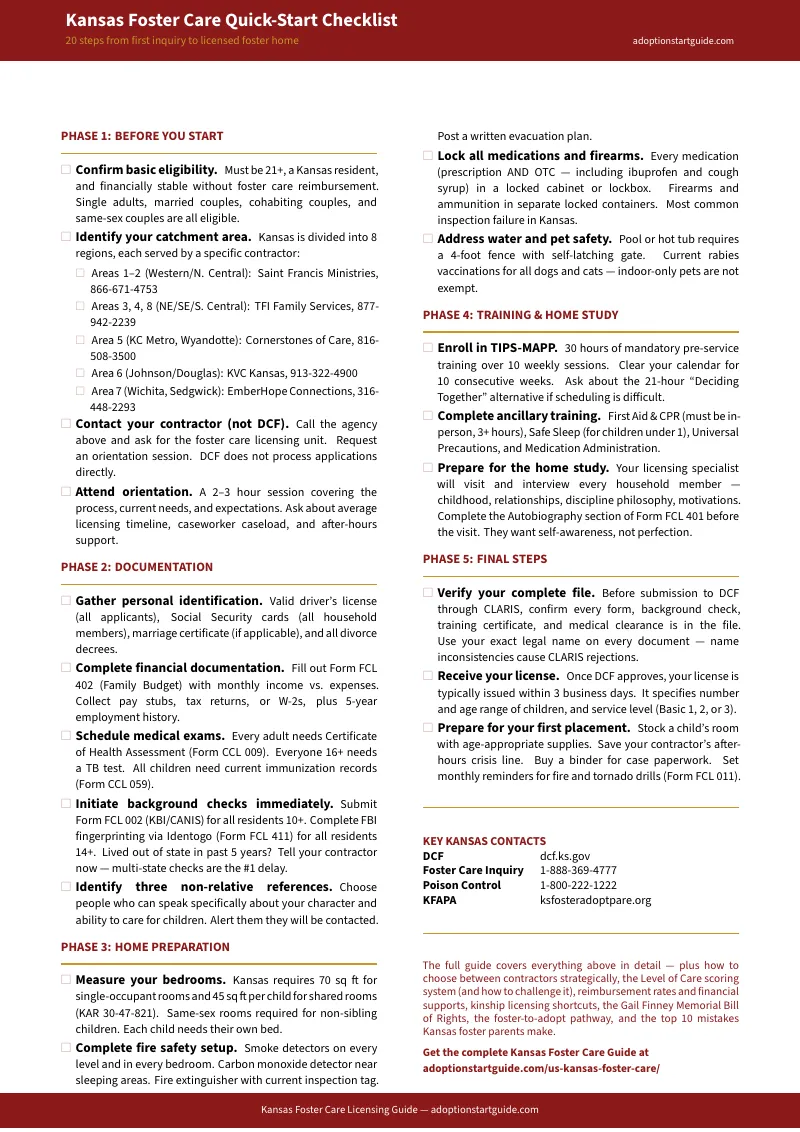
Download the Kansas Foster Care Quick-Start Checklist for a 20-step overview of the licensing process, from identifying your catchment area contractor through preparing for your first placement. Free, no commitment. If you want the full guide with the privatized system breakdown, contractor comparison, TIPS-MAPP walkthrough, home study preparation, financial breakdown, kinship fast-track, Sedgwick County transition details, and all seven printable worksheets, click the button in the sidebar.
— less than one hour of a family attorney's time
A Kansas family law attorney in Johnson County charges $250 or more per hour. A failed home inspection because of unlocked medications — the most common inspection failure in Kansas — delays your first placement by 30 days. That's one month of a $600 reimbursement you didn't receive for a problem that costs $15 to fix with a lockbox from the hardware store. One checklist prevents that. One chapter on the contractor comparison saves you from committing to an agency that doesn't match your family's needs.
If the guide doesn't deliver, reply to your download email at any time for a full refund. No forms. No justification required.