Maine runs adoption through 16 independent county Probate Courts. The state website describes one process. There are actually sixteen.
You started looking into adoption in Maine. Maybe you've been fostering through OCFS and the child's permanency goal changed to adoption. Maybe you're a grandparent raising a grandchild because of the opioid crisis and you want legal permanency. Maybe you're a stepparent who's been in this child's life for years and wants to make it official. Maybe you and your partner decided on private infant adoption and expected a clear, navigable system in a small state. Whatever brought you here, you went to the Maine Judicial Branch website and the OCFS pages looking for answers.
What you found was a patchwork. The Judicial Branch publishes Probate Court forms but doesn't tell you which ones apply to your adoption type. OCFS describes the foster-to-adopt pathway but glosses over the split between District Court (where Termination of Parental Rights happens) and Probate Court (where the adoption is actually finalized). Sixteen county Probate Courts each have their own elected Register of Probate, their own scheduling quirks, and their own expectations for how a petition should look — and nobody publishes those local preferences. You found references to Title 18-C, which replaced Title 18-A in 2019, but half the free resources online still cite the old statute. One wrong form number and your petition gets returned.
You probably also discovered the VS-9 form — the certificate of adoption that goes to the Office of Vital Records — and the disbursement accounting requirement, which asks you to document every dollar spent in the adoption process. These two documents cause more petition rejections in Maine Probate Courts than any other filing issue, and neither one is explained in plain language anywhere on the state website.
So you looked for help. OCFS has a web page on adoption, but caseworker turnover is running at 60%, and the person you spoke to last month may not be there when you call back. Adoptive and Foster Families of Maine (AFFM) provides peer support, but they're built for families already in the system. The few local agencies — Maine Children's Home Society, Good Samaritan Agency, Full Circle Adoptions — are reputable but their waitlists reflect the reality of a small state with limited infrastructure. National adoption guides on Amazon describe a generic process that doesn't account for Maine's Probate Court system, the Title 18-C statutes, MICWA requirements for Wabanaki children, or the 72-hour post-birth consent rule with its 5-day revocation window. A guide written for a national audience will tell you to "work with your local court." In Maine, that means figuring out which of sixteen county Probate Courts handles your petition, what that specific Register of Probate expects in the filing, and whether your adoption type even belongs in Probate Court at all.
You're in the gap between wanting to adopt and understanding how Maine's system actually works — and nobody is meeting you there.
The 16-County Adoption Navigator
This guide is built for Maine's adoption system and nobody else's. Every chapter, every checklist, every form reference is grounded in the current Title 18-C statutes (effective 2019), the operational realities of sixteen independent Probate Courts, and the OCFS requirements for families adopting from foster care. It covers the gap between what the state posts online and what you actually need to know to move from "considering adoption" to "finalized in Probate Court" without rejected petitions, missed filing deadlines, or months of confusion about which court has jurisdiction over your case.
What's inside
- Step-by-Step Adoption Process — Maine's adoption process runs through distinct stages that differ depending on your adoption type: foster-to-adopt, private agency, independent, stepparent, or kinship. This guide walks you through each pathway from initial decision through finalization, explaining what happens at each stage, which forms to file and when, and how to avoid the procedural stalls that turn a 6-month timeline into 18 months or longer. You'll understand the split jurisdiction between District Court and Probate Court before you file your first document.
- Probate Court Navigation — Sixteen counties, sixteen Registers of Probate, sixteen sets of local expectations. This chapter maps how each county's Probate Court handles adoption petitions — filing requirements, hearing scheduling, and the local conventions that determine whether your petition moves quickly or gets returned for revision. Includes guidance on the Consent to Adopt form, the Petition for Adoption, and the post-placement investigation report that the court requires before finalization.
- Home Study Preparation — Whether you're working with OCFS or a licensed private agency, the home study evaluates your home environment, background, motivation, parenting capacity, and readiness to adopt. This chapter explains what evaluators are actually looking for — including the financial stability, relationship dynamics, and support system questions that cause the most anxiety — and reframes the home study from an interrogation into what it really is: a process designed to prepare families, not disqualify them. Includes specific guidance for single applicants, same-sex couples, kinship caregivers, and families in rural counties.
- Title 18-C Legal Framework — Maine's adoption statutes were completely rewritten when Title 18-C replaced Title 18-A in 2019. Any resource citing the old statute is giving you wrong form numbers, wrong procedures, and wrong legal standards. This chapter breaks down the current law in plain language: consent requirements (including the 72-hour post-birth waiting period and the 5-day revocation window), grounds for dispensing with consent, the putative father registry, and the rights of biological parents at every stage.
- VS-9 Form and Disbursement Accounting — The VS-9 certificate of adoption and the disbursement accounting statement are the two most common reasons adoption petitions get returned or delayed in Maine Probate Courts. The VS-9 goes to the Office of Vital Records to issue a new birth certificate. The disbursement accounting documents every financial transaction in the adoption. This chapter walks you through both documents line by line so they're completed correctly the first time.
- MICWA and Wabanaki Tribal Compliance — Maine's Indian Child Welfare Act (MICWA) is more stringent than the federal ICWA. If the child you're adopting is a member or eligible for membership in any of the five Wabanaki tribes — Penobscot Nation, Passamaquoddy (Pleasant Point and Indian Township), Houlton Band of Maliseets, Mi'kmaq Nation, or Aroostook Band of Micmacs — MICWA governs the adoption and imposes additional notice, placement preference, and jurisdictional requirements that supersede standard state procedures. This chapter provides tribal contacts, explains the heightened evidentiary standards, and walks you through a process that catches most adoptive families off guard.
- Foster-to-Adopt Pathway — For families adopting a child currently in OCFS custody. How the permanency goal shifts from reunification to adoption, when Termination of Parental Rights occurs in District Court, how the adoption petition then moves to Probate Court, and what adoption assistance is available — including monthly subsidies, Medicaid until age 18, and nonrecurring adoption expense reimbursement up to $2,000. This chapter also addresses the emotional reality: you may have fostered this child for a year or more, and the legal process has its own timeline that doesn't always match your family's.
- Financial Reality Breakdown — Attorney fees for private adoption in Maine range from $250 to $400 per hour. Agency fees for domestic infant adoption can run $25,000 to $45,000. Foster-to-adopt through OCFS has minimal direct costs but significant time investment. This chapter maps the full financial landscape for each adoption type, including adoption assistance subsidies, the federal adoption tax credit, employer adoption benefits, and the specific Maine programs most families never learn about until after finalization.
Printable standalone worksheets included
- Adoption Process Checklist — Phase-by-phase overview of the entire adoption process, from initial decision through finalization and post-adoption requirements. Print it and check items off as you go.
- Required Documents Checklist — Every form and supporting document organized by adoption type and by when you need it: before agency contact, with your application, for the home study, for the Probate Court petition, and for post-finalization.
- Home Study Preparation Worksheet — The questions evaluators will ask, organized by category: personal history, relationship dynamics, parenting philosophy, financial stability, support network, and home environment. Space to draft your responses before the interviews begin.
- VS-9 and Disbursement Accounting Guide Sheet — Field-by-field walkthrough for both forms, with common errors flagged so you don't file a document that gets returned.
- Background Check Tracking Log — Maine SBI criminal history, FBI fingerprint, child abuse and neglect registry, sex offender registry — track submission dates, result dates, and clearance status for every adult in the household.
- Post-Placement Visit Log — Document every post-placement supervisory visit: topics discussed, evaluator observations, follow-up items. This log protects you and ensures continuity if your assigned worker changes.
- Key Contact Information Sheet — OCFS district office, assigned caseworker, Probate Court Register, adoption attorney, agency contact, pediatrician, school, tribal ICWA coordinator (if applicable), and support group — all on one printable page.
Who this guide is for
- Foster-to-adopt families — You've been fostering a child through OCFS and the permanency goal has changed to adoption. The child is already in your home. Now you need to navigate the legal process — Termination of Parental Rights in District Court, adoption petition in Probate Court, adoption assistance applications — while continuing to parent through the uncertainty. You need a guide that covers both the OCFS side and the court side in one place.
- Private infant adoption seekers — You and your partner are pursuing domestic infant adoption through a licensed agency or independently. You expected a small state to mean a simple process. Instead you found limited agency options, long waitlists, attorney fees that add up fast, and a consent framework with specific timing windows that can unravel a match if you don't understand them. You need the legal and procedural details before you commit financially.
- Kinship caregivers — A grandchild, niece, nephew, or family friend's child landed in your home because of the opioid crisis, parental incarceration, or a family emergency. You've been parenting without legal authority, and you want permanency. You may not know that kinship adoption through OCFS comes with subsidies and Medicaid that private adoption doesn't — or that your county's Probate Court has specific expectations for kinship petitions. You need a guide that starts where you are, not where a traditional adoptive parent starts.
- Stepparents — You've been in this child's life for years. The biological parent is absent, deceased, or willing to consent. You assumed the paperwork would be straightforward. Then you found out that Maine requires a home study even for stepparent adoptions, that you need to address the absent parent's rights (or petition to dispense with consent), and that your county's Probate Court may have a 3-month or 6-month waiting period before the hearing. You need the step-by-step process for your specific situation.
Why the free resources fall short
The OCFS website describes the foster-to-adopt pathway in broad strokes — enough to understand the concept, not enough to navigate the process. It doesn't explain the split between District Court (TPR) and Probate Court (finalization), the specific forms each court requires, or the reality that 60% caseworker turnover means the person guiding you through the process may change multiple times before you reach finalization.
The Maine Judicial Branch publishes Probate Court forms, but without context. You can download a Petition for Adoption, but you won't know whether your adoption type requires a Consent to Adopt, a Petition to Dispense with Consent, a VS-9, or all three — or which county-specific conventions apply to your filing. The forms assume you already know the process. If you did, you wouldn't be searching for help.
Adoptive and Foster Families of Maine (AFFM) provides invaluable peer support, training, and community. But AFFM is built for families already in the system. If you're pre-adoption, trying to figure out which pathway applies to your situation and which court handles your petition, their resources assume knowledge you don't yet have.
National adoption guides on Amazon and AdoptUSKids describe a generic process that doesn't account for Maine's 16 independent Probate Courts, the Title 18-C statutes that replaced Title 18-A in 2019, the VS-9 and disbursement accounting requirements, MICWA compliance for Wabanaki children, or the 72-hour consent rule with its 5-day revocation window. A guide written for a national audience will tell you to "work with your local court." In Maine, that means figuring out which of sixteen county Probate Courts handles your case, what that specific Register of Probate expects, and whether you need to be in District Court first — and nobody has published that in plain language.
The free Quick-Start Checklist
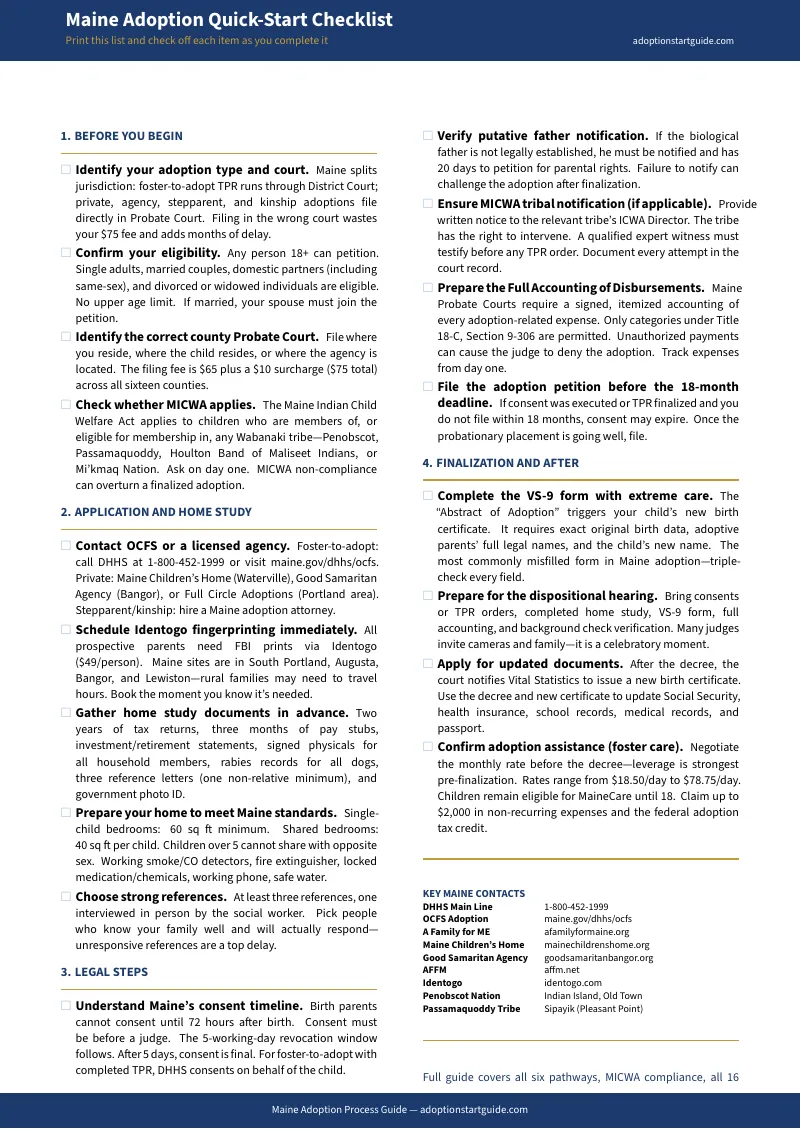
Download the Maine Adoption Quick-Start Checklist for a phase-by-phase overview of the adoption process, from your initial decision through finalization and post-adoption requirements. Free, no commitment. If you want the full guide with the Probate Court navigation, Title 18-C legal framework, home study preparation, VS-9 walkthrough, MICWA compliance, financial breakdown, and all seven printable worksheets, click the button in the sidebar.
— less than one hour of an adoption attorney's time
One consultation with a Maine adoption attorney runs $250 to $400 per hour — and most of that first hour is spent explaining the process you could have understood before you walked in. One rejected Probate Court petition because of a VS-9 error or a missing disbursement accounting delays your finalization by weeks or months. One missed consent revocation deadline can unravel an entire match. One guide prevents all of it.
If the guide doesn't deliver, reply to your download email at any time for a full refund. No forms. No justification required.