Maryland has 24 county offices that license foster parents, and the state website won't tell you which one runs the process your way.
You started on the DHS website looking for a clear path to becoming a resource parent. What you found was a library. Dozens of SSA policy directives. COMAR Title 07 regulation language written for caseworkers, not families. Links to manuals like "SSA #25-02" alongside fifty others with no indication of which ones apply to you. You expected a step-by-step guide. You got an archive.
So you called the DHS general number — 1-800-332-6347. You were told to contact your local department of social services. You asked for the number. They told you to check the website. The website listed 24 jurisdictions with no phone numbers for their foster care recruitment teams. You're three hours in and you haven't started anything.
Eventually you found your county's LDSS, and you sat through a 90-minute information meeting. It was encouraging. The caseworker explained that Maryland needs resource families. You were told about PRIDE training — 27 hours of pre-service classes spread across nine sessions. What they didn't tell you is that Montgomery County runs PRIDE monthly, but Garrett County might offer it twice a year. If you missed the February cohort in Western Maryland, you're waiting until fall. Nobody mentioned that. Nobody mentioned that Baltimore City uses MAPP instead of PRIDE and the curriculum is different. Nobody mentioned that your county's processing speed, training calendar, and caseworker availability would determine whether you're licensed in 120 days or 12 months.
Then you turned to the internet. A foster parent on Reddit told you that you need a separate bedroom for each child. That's another state's rule — not Maryland's. Someone in a Facebook group said a medical marijuana card is an automatic disqualification. COMAR doesn't say that — it depends on the caseworker's safety assessment. But you can't confirm any of this because the state's own resources don't address these questions directly. And the one thing every Maryland applicant eventually discovers is that advice from Montgomery County may not apply in Wicomico County. Each of the 24 jurisdictions operates with its own culture, its own pace, and its own interpretation of the same COMAR regulations.
The County Navigation System: Your Operational Guide to Maryland Foster Care Licensing
This guide is built for Maryland's county-administered foster care system — the real one, not the simplified version on the DHS website. Every chapter addresses the specific regulations under COMAR 07.02.25, the operational differences between the 24 Local Departments of Social Services, and the regional realities that national guides have no framework for. It's not a repurposed handbook from another state. It's the layer between what DHS publishes for professionals and what you actually need to know to get licensed — in your county, under the rules that apply right now, updated for the 2025 Moore-Miller Administration reforms.
What's inside
- 24-County LDSS Directory with Direct Welcome Line Numbers — This is the single most wasted resource in the Maryland system. Thousands of prospective parents call the state DHS number and get bounced for weeks before discovering that their local LDSS is the actual licensing authority. This chapter gives you the direct recruitment contact for every jurisdiction in the state — the number that connects you to the person who schedules information meetings, not the general switchboard. Stop calling the wrong office.
- PRIDE vs. MAPP Training Strategy with Regional Calendar Planning — Maryland requires 27 hours of pre-service training, but the curriculum and schedule vary by county. Most jurisdictions use PRIDE (Parent Resources for Information, Development, and Education). Baltimore City uses MAPP (Model Approach to Partnerships in Parenting). Rural Western Maryland counties like Garrett and Allegany sometimes partner with Washington County to host joint sessions. This chapter maps the training landscape by region so you can plan around the actual availability in your area — not the availability you assumed existed. If your county only offers PRIDE twice a year, you'll know before you miss the window.
- Background Check and Clearance Roadmap — CPS, Criminal, FBI, and the Flags That Delay — Every adult in your household must clear multiple layers of screening: Child Protective Services history, criminal background checks through both state and federal databases, sex offender registry checks, and the specific Maryland requirements under COMAR 07.02.25. If anyone in your household has any history — an old charge, a dismissed case, an investigation that went nowhere — the review process has specific factors that determine the outcome. Most applicants don't learn how this works until they're already inside it. This chapter walks you through each clearance, explains what triggers additional review versus what creates a presumptive bar, and shows you how to prepare your documentation before the fingerprinting appointment rather than scrambling after a flag you didn't expect.
- Angel's Law Compliance and the Home Safety Standards Nobody Mentions — Maryland maintains some of the most specific home safety requirements in the country. Angel's Law requires cordless window coverings on every window accessible to a child. COMAR mandates that firearms be stored unloaded in a locked container with ammunition in a separately locked location. Smoke detectors, carbon monoxide detectors, hot water temperature limits, and the 2025 update that includes e-cigarettes and vaping under the smoke-free home requirement — these are the items that fail first-time inspections. This chapter is a room-by-room walkthrough of every physical requirement, with the specific deficiencies that cause the most failures. Walk your home with this chapter before the inspector arrives, not after.
- Kinship and Restricted Caregiver Pathway — Emergency Placement to Full Licensure — If you're a grandparent, aunt, uncle, or extended family member who took in a child during a CPS intervention, you may have been approved on a provisional basis. But provisional status doesn't provide the same financial support as full licensure. Maryland's 2025 kinship reforms under the Moore-Miller Administration increased kinship rates by 33%, and the "Restricted Caregiver" track assigns you a dedicated home worker and provides monthly payments equivalent to regular foster care. This chapter maps the transition from emergency placement to licensed relative resource parent, explains the 120-day provisional window, and identifies the deadlines that kinship caregivers miss most often.
- Financial Reality — 2025 Stipend Rates, Regional Variations, and the Costs Nobody Covers at Orientation — Maryland's foster care maintenance rates differ by the child's age and level of care — Regular, Intermediate, and Intensive. But the monthly stipend is only part of the financial picture. This chapter breaks down the actual rates by category, the clothing and personal needs allowances, childcare subsidies available to working resource parents, and the out-of-pocket costs that don't appear in any recruitment brochure — transportation for birth parent visitations, lost wages from mandatory court hearings, and the gap between what the system reimburses and what caregiving actually costs. Federal employees get the OPM Paid Parental Leave breakdown showing how intermittent PPL works for foster placements.
- CINA Court Proceedings and Your Right to Be Heard — The licensing process is half the journey. The other half happens in the courtroom. Maryland's CINA (Child in Need of Assistance) proceedings move through Shelter Care, Adjudication, Disposition, Review, and Permanency Planning stages — each with a specific timeline and a specific role for you as the resource parent. You have a statutory right to notice and the right to be heard at every CINA proceeding, but many caseworkers fail to provide the mandated 10-day notice. This chapter explains each stage in plain English, maps the 11-month permanency timeline, and provides templates for exercising your rights so you're never excluded from the child's legal journey.
- The CJAMS System and Maryland Terminology Decoded — Maryland replaced CHESSIE with the new CJAMS (Child, Juvenile, and Adult Management System) platform, and resource parents must now use it to document visits and medical records. This chapter explains the digital requirements alongside the terminology every Maryland resource parent needs: LDSS, CINA, TPR, SAFE home study, Restricted Caregiver, Trial Home Visit, and the specific vocabulary your caseworker uses daily. Stop guessing what the acronyms mean during meetings that determine a child's future.
Printable standalone worksheets included
- Licensing Timeline Tracker — Every milestone from your first Welcome Line call through your licensure letter, with fill-in date fields. Print it, update it after every LDSS contact, and always know where you stand in the 120-day process.
- Home Safety Inspection Checklist — Room-by-room walkthrough of every COMAR 07.02.25 requirement: Angel's Law window coverings, firearm storage, smoke detectors, CO detectors, hot water temperature, medication storage, and the e-cigarette/vaping rule. Walk your home with this before the health and safety survey.
- Document Organization Sheet — CPS clearance, criminal background check, FBI fingerprint results, medical forms, personal references, PRIDE/MAPP training certificates, CPR/first aid certification — every document you need, in the order you need it, with checkboxes.
- Financial Planning Worksheet — Monthly stipend rates by age group and care level (Regular, Intermediate, Intensive), clothing allowances, and the hidden costs in one printable sheet for your household budget conversation.
Who this guide is for
- First-time prospective resource parents — You want to foster in Maryland but every Google search leads to a different county page, a different phone number, or regulation text written for bureaucrats. You don't need more information. You need the right information organized into a sequence you can follow. This guide translates COMAR 07.02.25 and the 24-jurisdiction landscape into a linear path from first phone call to licensed home.
- Kinship caregivers — A grandchild, niece, nephew, or family friend's child was removed and placed with you. The child is already in your home. You need to move from provisional approval to full licensure within the window, access the 33% higher kinship rates under the 2025 reforms, and understand the Restricted Caregiver track. This guide maps the emergency-to-licensed transition step by step.
- Federal employees in the Wealth Corridor — You work at NIH, Fort Meade, the SSA, or Andrews. You know OPM offers Paid Parental Leave for foster placements, but you don't know how intermittent PPL works for court hearings and social worker visits. This guide breaks down the federal employee benefits alongside the Maryland licensing requirements for Montgomery, Anne Arundel, Howard, and Prince George's Counties.
- Suburban families in the DC-Baltimore corridor — Montgomery, Howard, Anne Arundel, and Prince George's Counties each operate differently. Training frequency, processing speed, and caseworker availability vary dramatically between adjacent counties. This guide maps those differences so you know what to expect from your specific LDSS before the first phone call.
- Rural families on the Eastern Shore and in Western Maryland — Your county may offer PRIDE training once or twice a year. The nearest physician for your mandatory medical exam may be an hour away. Cross-jurisdictional training arrangements with neighboring counties can get you licensed months faster. This guide covers the realities that county-level websites never mention.
Why the free resources aren't enough
The Maryland DHS website is a library, not a guide. It publishes COMAR regulations, SSA policy directives, and administrative manuals designed for caseworker compliance — not for a family trying to figure out which county office to call first. You can spend days reading policy documents and still not know whether your local LDSS runs PRIDE in January or September.
The Maryland Resource Parent Association provides community and chapter links, but many of their resources haven't been updated since 2020. They don't address the CHESSIE-to-CJAMS transition, the 2025 kinship rate increases, or the Moore-Miller Administration reforms that changed how the system operates.
Private agencies — Arrow Child & Family Ministries, Bethany Christian Services, Catholic Charities — provide polished orientation materials. They exist to recruit for their specific agency model, which often includes higher requirements than the standard LDSS license. They won't explain the 24-county LDSS variation because they want you inside their private network, not comparing your options across the full state system.
Generic foster care books on Amazon cost more than this guide and don't know what Angel's Law is, can't explain the difference between PRIDE and MAPP, and have never heard of CJAMS. A $20 book written for a national audience cannot tell you that Garrett County partners with Washington County for training, or that your county's Welcome Line is the call that actually starts the process.
The free Quick-Start Checklist
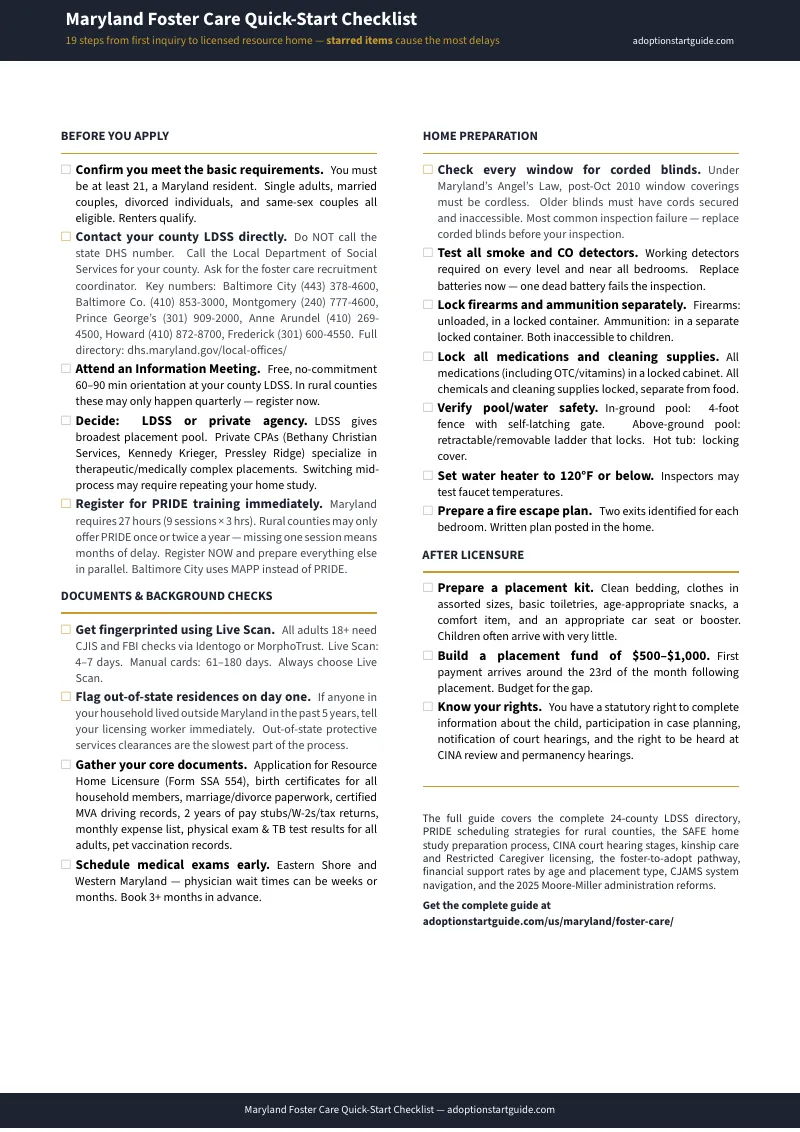
Download the Maryland Foster Care Quick-Start Checklist for a one-page overview of the licensing process, from your first Welcome Line call through your licensure letter. Free, no commitment. If you want the full guide with the County Navigation System, background check roadmap, home safety walkthrough, financial breakdown, and printable worksheets, click the button in the sidebar.
— less than a crab cake sandwich to save months of confusion
The typical Maryland applicant spends weeks calling the wrong offices, missing training windows, and piecing together the licensing process from fragments scattered across 24 county websites and a state portal designed for caseworkers. This guide distills the most critical decisions into a single weekend read. A missed PRIDE cohort in a rural county delays your licensure by six months. One training calendar prevents that. A failed home inspection because of corded window blinds or improper firearm storage adds months to your timeline. One checklist prevents that.
If the guide doesn't deliver, reply to your download email at any time for a full refund. No forms. No justification required.