Massachusetts splits adoption across two court systems, 14 Probate Court divisions, and a set of rules that changed on January 1, 2025. The state website describes one process. The reality is far more complicated.
You started looking into adoption in Massachusetts. Maybe DCF changed your foster child's permanency goal from reunification to adoption and you suddenly need to understand Termination of Parental Rights hearings in Juvenile Court and finalization petitions in Probate Court. Maybe you're a couple in Brookline or Newton who spent years on fertility treatments and you're now researching private infant adoption through agencies like Adoptions With Love or Wide Horizons for Children. Maybe you and your partner are an LGBTQ+ couple who heard about the 2025 Massachusetts Parentage Act and want to know exactly what a "confirmatory adoption" means for your family. Maybe you're a grandparent in Worcester who's been raising a grandchild informally and you need legal permanency before the next school enrollment. Whatever brought you here, you went to Mass.gov and the court system website looking for answers.
What you found was a system that scatters critical information across multiple agencies. The DCF website describes the foster-to-adopt pathway in broad strokes but doesn't explain how a Care and Protection case in Juvenile Court transitions to an adoption petition in Probate and Family Court. The Massachusetts Court System publishes forms like the CJP 87 Petition for Adoption and the TC 0050 Disclosure Affidavit, but provides no guidance on how to fill them out, which county division expects them, or when the Citation must be served. You found references to MAPP training but can't get a straight answer on the current waitlist for the 10-week program. You read about the "Four-Day Rule" for birth parent consent but nobody explains what happens after that irrevocable signature. And you discovered that the CORI, SORI, and CARI background checks apply to every person in your household over age 11 — including your college-age child who came home for the summer.
You probably also ran into the specifics that trip up Massachusetts families and nobody else. The Dog Breed Rule, where DCF policy generally prohibits placing children under 12 in homes with certain breeds. The lead paint compliance requirement for homes with children under six, where painting over lead isn't sufficient — you need a certified de-leader and a compliance letter. The fact that you must file your adoption petition in the Probate and Family Court division where you live, not where the child was born or where the agency is located. And the reality that 14 different Probate Court divisions — Suffolk, Middlesex, Worcester, Norfolk, Essex, and nine others — each have their own filing conventions, scheduling practices, and expectations for how a petition should be presented.
National adoption guides on Amazon describe a generic process. Massachusetts adoption attorneys charge $350 to $600 per hour. MARE tells you about waiting children but not how to navigate the legal finalization. You're in the gap between wanting to adopt and understanding how the Commonwealth's system actually works — and nobody is meeting you there.
The Dual-Court Adoption Navigator
This guide is built for Massachusetts adoption and nobody else's. Every chapter, every checklist, every form reference is grounded in the current Massachusetts General Laws, the operational realities of 14 Probate and Family Court divisions, the DCF regulatory framework, and the 2025 Massachusetts Parentage Act. It covers the gap between what the state posts online and what you actually need to know to move from "considering adoption" to "decree entered" without rejected petitions, missed Citation deadlines, or months of confusion about which court has jurisdiction over your case.
What's inside
- Step-by-Step Adoption Process — Massachusetts handles adoption differently depending on the pathway: foster-to-adopt through DCF, private agency, independent, stepparent, kinship, or confirmatory adoption under the 2025 Parentage Act. This guide walks you through each pathway from initial decision through Probate Court finalization, explaining what happens at each stage, which forms to file and when, and how to avoid the procedural delays that turn a 6-month timeline into 18 months. You'll understand the dual-court split — Juvenile Court for Care and Protection and TPR cases, Probate and Family Court for the adoption petition itself — before you file your first document.
- 14-Division Probate Court Navigation — Fourteen divisions of the Probate and Family Court, each with its own clerk's office, scheduling conventions, and filing expectations. This chapter maps how each division handles adoption petitions — Suffolk, Middlesex, Worcester, Norfolk, Essex, Plymouth, Bristol, Barnstable, Hampshire, Hampden, Franklin, Berkshire, Dukes, and Nantucket. Includes guidance on the Citation process, Service of Process rules (you can't just mail it), the Return of Service requirements, and the local conventions that determine whether your petition moves forward or gets returned.
- Home Study Preparation — Whether you're working with DCF or a licensed private agency, the home study evaluates your home environment, background, parenting capacity, and readiness to adopt. This chapter explains what social workers are actually assessing — including the Bedroom Rule (minimum two bedrooms), lead paint compliance for homes with children under six, the Dog Breed Rule, and the CORI/SORI/CARI background checks for every household member over age 11. Includes specific guidance for LGBTQ+ couples, single applicants, kinship caregivers, and families in multi-family housing common in Boston, Cambridge, and Somerville.
- MAPP Training and DCF Requirements — The Massachusetts Approach to Partnerships in Parenting is a mandatory 10-week, 30-hour training program for all prospective foster and adoptive parents going through DCF. This chapter covers the curriculum, what evaluators observe during sessions, how the training assessment feeds into your home study, and strategies for managing the waitlist. Also covers the newer PAYA framework and how DCF's own Diligent Recruitment Plan acknowledges their training materials need updating.
- 2025 Massachusetts Parentage Act — Effective January 1, 2025, the MPA fundamentally changed how parentage is established in the Commonwealth. For LGBTQ+ families, this means new pathways to legal recognition — but organizations like GLAD still recommend confirmatory adoption as a protective measure, especially for families who travel to states with less progressive laws. This chapter explains voluntary acknowledgment of parentage, de facto parentage, and why a Probate Court decree still matters even when the MPA says it shouldn't have to.
- MARE and the Matching Process — The Massachusetts Adoption Resource Exchange is a quasi-governmental recruitment exchange that operates independently of any single agency. This chapter explains how to use the MARE portal to search for waiting children, how the Heart Gallery and "Sunday's Child" features work, how to attend Meet and Greet events, and how to navigate the DCF-to-MARE matching pipeline. Most families don't realize you can use MARE without committing to a specific agency's placement fees.
- ICWA Compliance for Wampanoag Tribes — If the child you're adopting is a member or eligible for membership in the Mashpee Wampanoag Tribe or the Wampanoag Tribe of Gay Head (Aquinnah), the Indian Child Welfare Act imposes specific notice, placement preference, and jurisdictional requirements. Failure to follow ICWA procedures can invalidate an adoption years after finalization. This chapter provides tribal contacts, explains the federal requirements as applied in Massachusetts courts, and walks you through a process that catches most adoptive families off guard.
- Financial Reality Breakdown — Private domestic infant adoption in Massachusetts can cost $30,000 to $60,000 through a licensed agency. Attorney fees run $350 to $600 per hour. Foster-to-adopt through DCF has minimal direct costs but significant time investment. This chapter maps the full financial landscape for each adoption type, including DCF adoption subsidies (which are negotiable before the decree is signed), the federal adoption tax credit, employer adoption benefits, Massachusetts-specific programs, and the "DCF/Private Agency Hybrid" model where you use a private agency for the home study but match through MARE to reduce placement fees.
Printable standalone worksheets included
- Adoption Process Checklist — Phase-by-phase overview of the entire adoption process, from initial decision through Probate Court finalization and post-adoption requirements. Print it and check items off as you go.
- Required Documents Checklist — Every form and supporting document organized by adoption type and by phase: before agency contact, with your application, for the home study, for the Probate Court petition (including CJP 87 and TC 0050), and for post-finalization.
- Home Study Preparation Worksheet — The questions social workers will ask, organized by category: personal history, relationship dynamics, parenting philosophy, financial stability, support network, and home environment. Space to draft your responses before the interviews begin.
- CORI/SORI/CARI Tracking Log — Track Criminal Offender Record Information, Sex Offender Registry Information, and Court Activity Record Information checks for every household member over age 11. Submission dates, result dates, clearance status, and notes on discretionary waivers for aged misdemeanors.
- Citation and Service of Process Tracker — After filing your Petition for Adoption, the court issues a Citation that must be properly served on biological parents. This tracker ensures you follow the Return of Service rules that trip up more Massachusetts petitioners than any other procedural step.
- Post-Placement Visit Log — Document every post-placement supervisory visit: topics discussed, evaluator observations, follow-up items. This log protects you and ensures continuity if your assigned social worker changes — a real concern given DCF's documented turnover rates.
- Key Contact Information Sheet — DCF area office, assigned social worker, Probate Court division and clerk, adoption attorney, agency contact, MARE coordinator, pediatrician, school, tribal ICWA coordinator (if applicable), and support group — all on one printable page.
Who this guide is for
- Foster-to-adopt families — You've been fostering a child through DCF and the permanency goal has changed from reunification to adoption. You're somewhere between the Juvenile Court TPR process and the Probate Court adoption petition, and nobody has explained how those two court systems connect. You may have been through MAPP training and a home study, but the legal finalization is a different process entirely — and the 2,800 children currently waiting for permanent placement in Massachusetts represent both the urgency and the complexity of this pathway.
- Private infant adoption seekers — You've exhausted fertility options and you're evaluating agencies like Adoptions With Love, The Home for Little Wanderers, or Wide Horizons for Children. You've seen the price tags — $30,000 to $60,000 — and you want to understand the legal framework before you commit financially. The Four-Day Rule for birth parent consent and the irrevocable nature of that consent once signed are Massachusetts-specific protections that matter to your decision, and you need them explained clearly.
- LGBTQ+ couples — You're building a family in one of the most progressive states in the country, and the 2025 Parentage Act should make things straightforward. But GLAD and Fenway Health still recommend a confirmatory adoption decree — especially if you travel to or might relocate to a state that doesn't recognize the MPA. You need to understand second-parent adoption, confirmatory adoption, and exactly what the new law does and doesn't protect.
- Kinship caregivers and stepparents — A grandchild, niece, nephew, or stepchild landed in your care through a DCF placement, a family crisis, or a marriage. You've been parenting without legal authority, and you need permanency. You may be eligible to waive the home study requirement through a CJD 400 motion, and you may not realize that kinship adoption through DCF comes with subsidies and Medicaid that private adoption doesn't. You need a guide that starts where you are.
Why the free resources fall short
The Mass.gov DCF website describes the foster-to-adopt pathway in broad strokes — enough to understand the concept, not enough to navigate it. It doesn't explain the dual-court jurisdictional split, the specific forms each court requires, or the operational reality that the person guiding you through the process may change before you reach finalization.
MARE provides an invaluable recruitment exchange — the Heart Gallery, Sunday's Child, Meet and Greet events — but MARE's mission is matching, not legal finalization. They'll help you find a child. They don't walk you through the Citation, Service of Process, and Probate Court petition that actually make that child your son or daughter.
The Massachusetts Court System publishes forms — CJP 87, TC 0050, CJD 400 — but without context. You can download a Petition for Adoption, but you won't know whether your situation requires a Consent to Adopt, a petition to dispense with consent, ICWA notice to the Mashpee Wampanoag Tribe, or all three. The forms assume you already know the process. If you did, you wouldn't be searching for help.
National adoption guides on Amazon describe a generic process that doesn't account for Massachusetts's 14 Probate Court divisions, the MAPP training requirement, the Dog Breed Rule, lead paint compliance, the CORI/SORI/CARI checks, the 2025 Parentage Act, or ICWA requirements for Wampanoag children. A guide written for a national audience tells you to "work with your local court." In Massachusetts, that means figuring out which of fourteen Probate and Family Court divisions handles your case, what that specific clerk's office expects in the filing, and whether your case needs to pass through Juvenile Court first — and nobody has published that in plain language.
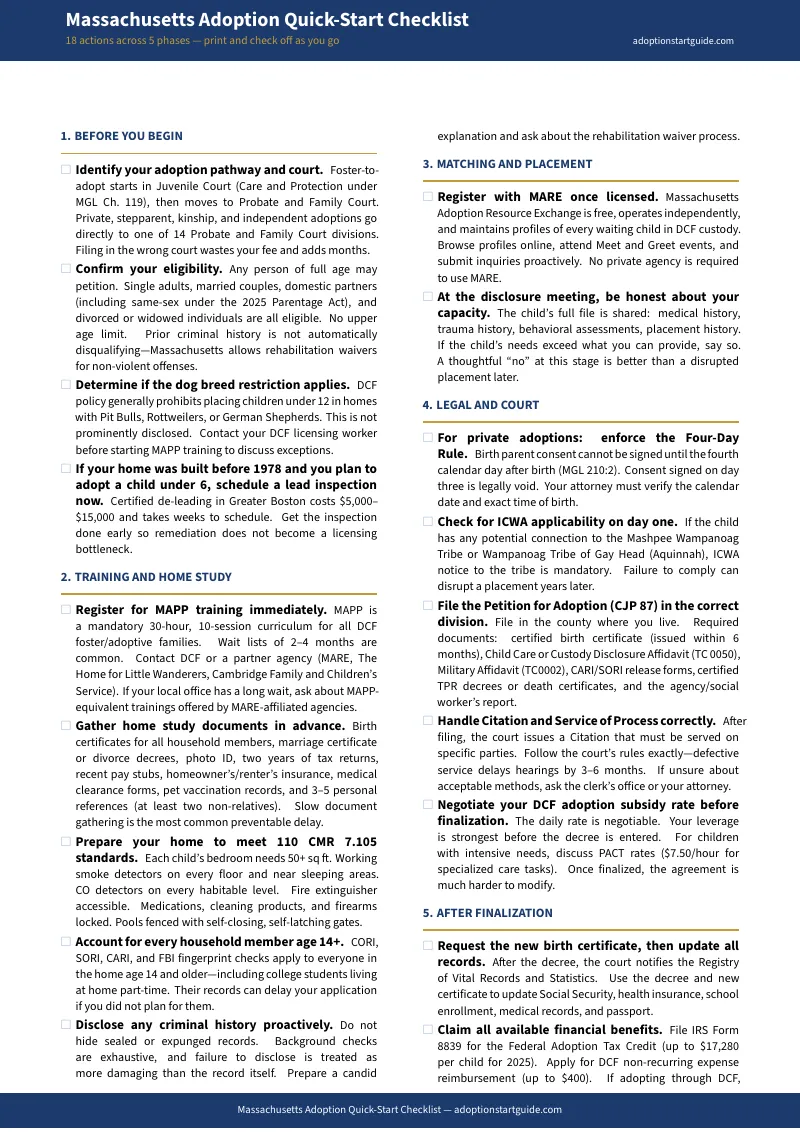
The free Quick-Start Checklist
Download the Massachusetts Adoption Quick-Start Checklist for a phase-by-phase overview of the adoption process, from your initial decision through Probate Court finalization and post-adoption requirements. Free, no commitment. If you want the full guide with the 14-division Probate Court navigation, 2025 Parentage Act analysis, MAPP training preparation, home study guidance, ICWA compliance, financial breakdown, and all seven printable worksheets, click the button in the sidebar.
— less than one hour of a Massachusetts adoption attorney's time
One consultation with a Massachusetts adoption attorney runs $350 to $600 per hour — and most of that first hour is spent explaining the process you could have understood before you walked in. One rejected Probate Court petition because of a Citation error or a missing Return of Service delays your finalization by three to six months. One misstep on ICWA notice can invalidate an adoption years later. One missed CORI disclosure can derail a home study that took months to schedule. One guide prevents all of it.
If the guide doesn't deliver, reply to your download email at any time for a full refund. No forms. No justification required.