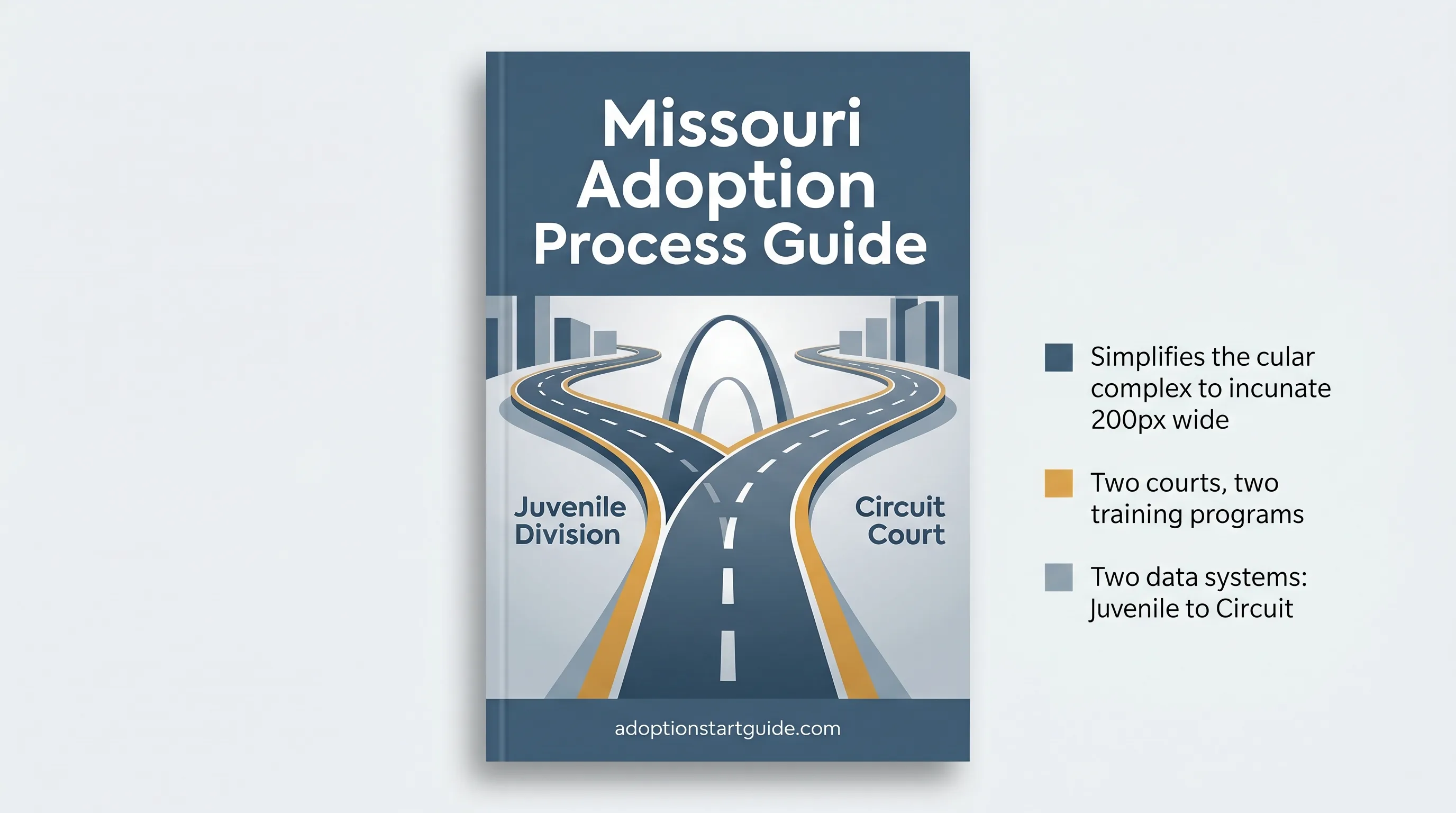
Missouri adoption moves through two separate courts. Nobody tells you when the handoff happens or what changes when it does.
You attended your STARS training — or maybe you're partway through the new MO C.A.R.E. curriculum and unsure whether your hours still count. Your P4C caseworker said the permanency goal changed to adoption, and then the Juvenile Court filed a TPR petition against the biological parents. For a moment, it felt like progress. Then nothing happened for weeks. When you called your caseworker, they told you the TPR is being handled in Juvenile Division. When you asked about finalization, they said that happens in Circuit Court. When you asked how the case moves from one court to the other, they told you to talk to your attorney. When you asked what attorney, they gave you a phone number and a reminder that the state doesn't cover legal representation for adoptive parents in most cases.
That is the moment most Missouri families realize the system was never designed to guide them through the entire adoption. The Children's Division places children. The Juvenile Court handles protection and termination. The Circuit Court handles finalization. Three separate entities, three separate timelines, three separate sets of paperwork — and no single person whose job it is to walk you through the transitions between them. The Child Welfare Manual is over 1,000 pages long and written for social workers, not parents. The DSS website lists requirements but not the order you complete them. Your P4C agency — FosterAdopt Connect, Cornerstones of Care, Great Circle — handles foster care services, but their role in the adoption process changes once TPR is granted, and that change is rarely explained until you're already confused by it.
If you're pursuing private infant adoption, the complexity shifts but doesn't shrink. Missouri allows birth parents to sign consent just 48 hours after delivery. That window is one of the shortest in the country, and it means every legal detail — the Putative Father Registry search, the Form 580-2223 filing, the 15-day deadline for a putative father to respond — must be locked down before the baby arrives, not after. Families working with national adoption consultants regularly discover that their consultant has no idea how the Missouri Putative Father Registry actually works, or that the registry search must be filed as a separate action from the adoption petition. Stepparent adopters face a different wall: Missouri's abandonment standard requires proving that the absent parent failed to provide support or maintain contact for a statutory period, and the burden of proof in a contested case is on you.
Generic adoption books describe a process where a single agency walks you from application to finalization. In Missouri, the process moves through a P4C agency, then the Children's Division, then the Juvenile Division, then the Circuit Court — with a training system (STARS to MO C.A.R.E.) that changed mid-stream, a data system (FACES to CCWIS) that is actively migrating, and county-level court procedures that vary between St. Louis City, Jackson County, and Greene County in ways that no national resource can account for. A guide written for Texas or Ohio will not mention P4C agencies, the Spaulding addendum, or why your caseworker from the CD and your caseworker from the P4C sometimes give you contradictory instructions about the same document.
The Two-Court Roadmap: Your Insider Guide to Missouri Adoption
This guide is built for the system Missouri families actually navigate — the two-court structure, the P4C-to-CD handoff, the training transition, the data migration, and the county-level court procedures that determine whether your finalization takes six months or eighteen. Every chapter reflects the current Missouri statutes, the 2025 MO C.A.R.E. training requirements, the FACES-to-CCWIS transition timeline, and the specific financial programs Missouri families qualify for. It is not a repurposed national handbook. It is the operational layer between what DSS posts online and what you actually need to know to adopt in Missouri — through your pathway, under current conditions, in your judicial circuit.
What's inside
- Two-Court System Map — Missouri adoption moves from the Juvenile Division (where TPR is filed and custody is transferred) to the Circuit Court (where the adoption petition is heard and the decree is entered). This chapter maps exactly when and how that transition happens, who initiates it, what paperwork transfers between courts, what paperwork you file fresh, and what the six-month minimum custody requirement means for your finalization timeline. No more wondering which court you're in or what happens next.
- STARS-to-MO C.A.R.E. Training Transition Guide — Missouri replaced STARS with MO C.A.R.E. as the mandatory pre-service training. If you started STARS but haven't finalized, this chapter explains which hours transfer, what the new 30-hour MO C.A.R.E. curriculum requires, and how the Spaulding addendum (the additional 7-12 hours specific to adoption) fits into your timeline. Includes a training hour tracker so you know exactly where you stand.
- Home Study Preparation Checklist — Every document the home study requires, organized in the order the social worker expects them: CANREG (Child Abuse and Neglect Registry) clearance, FCSR (Family Care Safety Registry) background check, FBI and MSHP fingerprint-based checks, CS-50 financial disclosure, and Case.net court record search. This chapter tells you what each clearance costs, how long each takes to process, and which ones expire if your case moves slowly.
- Consent and Putative Father Registry Decoder — Missouri birth parents can sign consent 48 hours after delivery. Once signed, consent is irrevocable except under narrow fraud or duress claims. The Putative Father Registry must be searched as a separate legal action — Form 580-2223 filed with the Bureau of Vital Records — and a putative father has just 15 days to respond after notice. This chapter walks you through the 48-hour timeline, the registry search process, and the specific documentation your attorney needs to have prepared before the birth.
- FACES-to-CCWIS Documentation Audit Template — Missouri is migrating from the legacy FACES database to the new CCWIS system. During this transition, documents get lost — medical histories, placement records, social summaries. This fill-in audit template helps you verify that every document the court requires for finalization actually exists in your file before you reach the hearing. Families who catch missing documents early save months of delays.
- Missouri Adoption Subsidy Calculator — MASP (Missouri Adoption Subsidy Program) pays $368 to $2,034 per month depending on the child's level of need, plus MO HealthNet coverage until age 18 (or 21 for qualifying children), plus up to $2,000 in non-recurring adoption expense reimbursement. This chapter includes the three-tier rate structure, how to document "special needs" eligibility, and the critical rule: the subsidy agreement must be signed before the final decree. Once the judge signs, the terms are locked.
- County-Specific Court Procedures — Missouri has 45 judicial circuits, and the adoption process varies by county. St. Louis City (22nd Circuit) requires a separate Juvenile Officer referral. Jackson County (16th Circuit) has its own family court division with different scheduling procedures. Greene County (31st Circuit) handles cases through a Commissioner rather than a Judge for certain hearings. This chapter covers the procedural differences in the state's highest-volume circuits so you know what to expect in your courthouse.
- Federal Adoption Tax Credit Guide — The federal adoption tax credit for 2025 is up to $17,280 per child. This chapter explains which expenses qualify, how the credit phases out at higher incomes, the difference between the credit for foster-to-adopt (which requires no qualifying expenses) and private adoption, and the IRS Form 8839 filing instructions. Most families leave money on the table because they don't track qualifying expenses in real time.
- Missouri Employer Adoption Benefits Directory — Major Missouri employers offer adoption assistance benefits that families regularly miss. Oracle/Cerner (Kansas City) provides up to $10,000 in reimbursement. Boeing (St. Louis) offers adoption leave and financial assistance. BJC HealthCare, AB InBev, and Emerson Electric each have programs that stack with the federal tax credit and the $2,000 state reimbursement. This chapter lists the programs, eligibility requirements, and how to file claims.
- Open Adoption PACA Framework — Missouri's Post-Adoption Contact Agreement (PACA) allows legally enforceable open adoption arrangements. This chapter explains when a PACA makes sense, what the court considers when approving one, how to negotiate contact terms with the biological family, and the enforceability limits — including what happens if one party stops honoring the agreement.
- Adoption Records Access Guide — The Missouri Adoptee Rights Act changed how adult adoptees access their original birth certificates and adoption records. This chapter covers the Adoption Information Registry in Jefferson City, the process for requesting non-identifying information, the requirements for accessing identifying information, and the timeline for receiving records after a request is filed.
Printable standalone worksheets included
- Adoption Timeline Tracker — Every milestone from first P4C contact through Juvenile Court TPR, Circuit Court finalization, and amended birth certificate, with fill-in date fields. Print it, update it after every caseworker meeting, and always know where your case stands in the two-court process.
- Home Study Document Checklist — CANREG, FCSR, FBI/MSHP clearances, CS-50, medical reports, references, and home safety items organized in the order the social worker expects them.
- FACES-to-CCWIS Document Audit Worksheet — Verify that every required document — medical history, placement records, social summary, prior court orders — exists in your file before finalization. Catches the gaps the system migration creates.
- Financial Planning Worksheet — Costs by pathway, MASP subsidy calculation, federal tax credit, employer benefits, and non-recurring expense reimbursement tracking in one printable sheet.
Who this guide is for
- Foster parents pursuing adoption in St. Louis or Kansas City — You've been caring for a child through a P4C agency and the permanency goal just changed to adoption. Your P4C worker says one thing, your CD worker says another, and neither has explained what happens when the case moves from Juvenile Court to Circuit Court. You need a roadmap that covers the two-court transition, the training requirements under MO C.A.R.E., the subsidy negotiation process, and what your agency is required to provide versus what you handle yourself.
- Families pursuing private infant adoption — You're working with an agency or attorney to adopt a newborn. You want to understand the 48-hour consent window, how to search the Putative Father Registry, what the 15-day response deadline means for your timeline, and how to protect your placement from legal challenges. You've heard stories about failed placements costing $20,000 to $50,000 and you want to make sure every legal step is handled before the delivery, not after.
- Kinship and grandparent adopters in rural Missouri — You stepped in when a child needed family. You've been providing care informally, but the school wants legal documentation and the pediatrician needs consent authority. You want to understand the difference between subsidized guardianship and full adoption in Missouri, whether you'll lose your current financial support by switching, and how to navigate the process in a judicial circuit that may not have a single private adoption agency within 60 miles.
- Stepparent adopters — The child already lives in your home and calls you a parent. You want to make it legal. You need to know Missouri's abandonment standard, what happens if the biological parent contests the adoption, whether you can proceed without the absent parent's consent, and how to file in your local Circuit Court without paying $5,000 to an attorney for a process you can largely prepare yourself.
Why the free resources fall short
The Missouri DSS website publishes the Child Welfare Manual — over 1,000 pages of policy written for social workers, not families. It explains what the Children's Division is supposed to do. It does not explain what you are supposed to do when the CD and your P4C agency give you conflicting instructions about training requirements during the STARS-to-MO C.A.R.E. transition. The Missouri Courts self-help page provides basic forms but explicitly warns that adoption is too complex for pro se filings. The Missouri Adoption Exchange and Heart Gallery help you find waiting children but offer no guidance on what happens after the match — the TPR timeline, the home study, the subsidy negotiation, the finalization hearing.
Private agency materials — from FosterAdopt Connect, Christian Family Services, Adoption and Beyond — describe their own process. They do not give you an agnostic view of how the Putative Father Registry works across all 45 judicial circuits, why Jackson County court procedures differ from St. Louis City, or how to audit your file for documents lost in the FACES-to-CCWIS data migration. Each agency shows you their slice of the system. Nobody shows you the whole map.
Missouri adoption attorneys charge $250 to $400 per hour. A one-hour consultation covers your specific questions but not a complete walkthrough of the two-court system, not subsidy negotiation strategy, not a documentation audit template, and not a training hour tracker for the MO C.A.R.E. transition. The guide puts the entire Missouri adoption system in your hands for a fraction of what a single legal hour costs.
The free Quick-Start Checklist
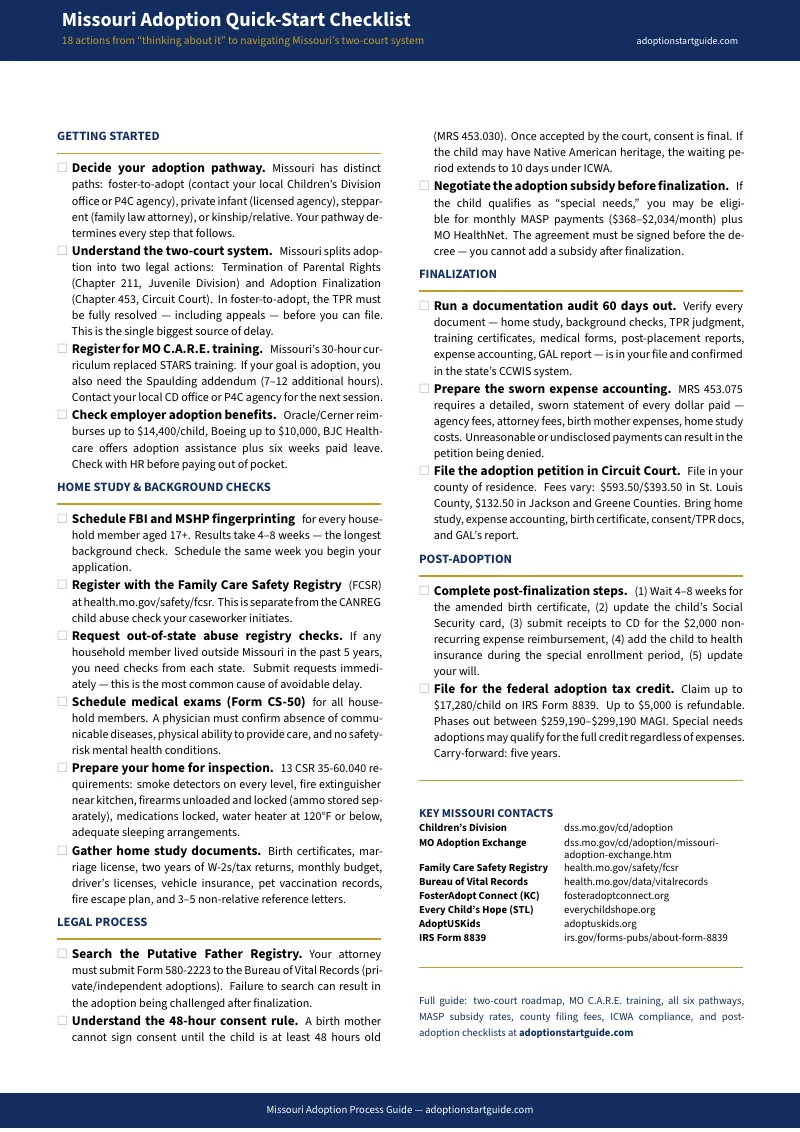
Download the Missouri Adoption Quick-Start Checklist for a one-page overview of the adoption process, from identifying your P4C agency through Circuit Court finalization. Free, no commitment. It includes the two-court transition summary and the four-pathway decision — the two items that cause the most confusion in the Missouri system. If you want the full guide with the FACES-to-CCWIS audit template, subsidy negotiation strategy, county court procedures, training transition tracker, and printable worksheets, click the button in the sidebar.
— less than ten minutes with a Missouri adoption attorney
Missouri adoption attorneys charge $250 to $400 per hour. Private infant agency fees start at $15,000 and can exceed $40,000. A failed placement with a national consultant who doesn't understand Missouri's Putative Father Registry can cost tens of thousands in lost fees and months of lost time. This guide puts the entire Missouri two-court adoption system — the Juvenile-to-Circuit transition, the training requirements, the documentation audit, the subsidy rates, the county court procedures, and the financial planning framework — in your hands for less than the cost of a single phone consultation. Families who understand the system before they enter it move through it faster, negotiate stronger subsidy agreements, and avoid the months of confusion that come from waiting for an overworked caseworker to explain what the next step is.
If the guide doesn't deliver, reply to your download email at any time for a full refund. No forms. No justification required.