You want to adopt in Montana. Then you discovered that MCA Title 42, the DPHHS website, the Putative Father Registry, and the District Court each assume you already understand the other three.
Montana is not like other states. The state maintains a Putative Father Registry that can protect or derail your adoption depending on whether a 10-day notice requirement was properly served. The Indian Child Welfare Act applies here with extra force -- Montana's own MICWA statute extends protections to children connected to any of the state's 7 federally recognized tribes, and "active efforts" means something specific and documented. Birth mother consent cannot be signed until 72 hours after birth, and once it's signed before a judge or authorized officer, it's generally irrevocable -- but families routinely confuse these two facts and plan around the wrong one. After placement, Montana requires a 6-month post-placement supervisory period before the court will issue a Final Decree. And 33% of the state lives in frontier areas where finding a licensed home study provider means driving hours across open country.
You've already done the research. You've been on the DPHHS website, where adoption information is scattered across CFSD pages, PDF publications, and links that send you to the Montana Code Annotated without explaining what you're reading. You contacted an agency like Sacred Portion or Nightlight, where the orientation covered their process but not the three other pathways you might be better suited for. You found the Gallatin County adoption packet, which gives you forms but no guidance on how to fill them. You found Reddit threads where someone from Florida explained Montana's consent rules incorrectly in the same comment where they confused the Putative Father Registry with a system that doesn't exist here. And you found that adoption attorneys in Billings and Missoula bill $250 or more per hour.
The information exists. It's scattered across DPHHS publications, MCA Title 42 chapters, CFSD foster care pages, MICWA court guidelines, District Court filing requirements, and agency orientation packets. Piece it together yourself and you'll burn weeks reading statutes that explain the law but never show you how the pieces connect into a family's actual experience.
The Big Sky Adoption Navigator
This is a complete, Montana-specific adoption guide built around the problem every family in this state hits: navigating a system where DPHHS, private agencies, independent attorneys, the District Courts, and 7 tribal authorities each own a piece of the process but none of them explain how the pieces connect. Not a national overview. Not an agency brochure designed to funnel you into one program. Every chapter, every checklist, every cost figure is grounded in MCA Title 42, current CFSD policies, DPHHS home study requirements, ICWA/MICWA compliance standards, and the real-world experience of families who have adopted in the Big Sky State.
What's inside
- Four-pathway comparison table -- CFSD foster-to-adopt, private agency (Sacred Portion, Nightlight, Youth Homes), independent (attorney-facilitated) adoption, and stepparent/relative adoption mapped side by side. Costs, timelines, eligibility, and the realistic wait for each pathway so you choose the right one before investing months in the wrong direction. Foster-to-adopt runs $0 to $2,500. Private agency fees range from $20,000 to $50,000. Independent adoption costs $8,000 to $40,000. Stepparent adoption runs $1,500 to $5,000. That decision deserves more than a caseworker's one-sentence summary.
- The Putative Father Registry explained -- Montana maintains a centralized registry through DPHHS Vital Records. This chapter explains how to request a search, the 10-day notice requirement for registered fathers, what happens when no father has registered, and the affidavit process that protects your adoption from a late-stage paternity challenge. The registry is your legal shield -- but only if you use it correctly and on time.
- ICWA and MICWA compliance guide for Montana's 7 tribes -- Montana's 2023 MICWA act extends protections beyond the federal ICWA baseline for Indian children connected to the Blackfeet, Crow, Northern Cheyenne, Confederated Salish and Kootenai, Fort Belknap, Fort Peck, and Chippewa Cree nations. "Active efforts" means documented, concerted steps to engage the family and collaborate with the tribe -- a higher standard than "reasonable efforts." If a court later finds those efforts were not made or not documented, the adoption can be vacated. This chapter covers the "reason to know" trigger, the tribal inquiry process, the placement preference hierarchy, the qualified expert witness requirement, and how to document compliance so your adoption is permanent.
- Home study preparation with Montana-specific focus -- In Montana, firearm storage is the single most common issue that delays home study approval. Every firearm must be in a locked cabinet or equipped with a trigger lock, and ammunition must be stored separately. This chapter includes a Montana safety pre-check: firearm storage verification, wood stove and heating safety (critical in rural properties), well water testing for homes not on municipal systems, fencing and livestock safety for ranch properties, and the standard poison/cleaning supply lock requirements. No national guide covers these because most states don't have this combination of issues.
- The 72-hour consent rule and irrevocability -- Birth mother consent cannot be signed until 72 hours after the child's birth. This is not a "revocation window" -- it's a waiting period before consent can be given. Once consent is signed before a judge or authorized officer, it is generally irrevocable in Montana. This chapter clarifies the timing, explains what happens in the hospital during those 72 hours, and covers the difference between voluntary relinquishment and involuntary termination of parental rights.
- The 6-month post-placement period explained -- Montana requires six months of post-placement supervision before the District Court will issue a Final Decree. Families fear this as a window where the child can be "taken back." This chapter clarifies what the period actually is, what the post-placement reporter evaluates, what triggers removal versus what doesn't, and how to prepare for the supervisory visits. Includes guidance on how county practices differ between larger courts in Billings and Missoula versus rural districts.
- District Court filing guide -- The adoption petition, required exhibits, the $105 filing fee (Gallatin County benchmark), the hearing process, and the procedure for obtaining an amended birth certificate through DPHHS Vital Records. Covers the differences between filing in Yellowstone County, Missoula County, Lewis and Clark County, Cascade County, and smaller rural courts where there are no dedicated adoption staff.
- Cost breakdown and Montana tax credit strategy -- Montana has no state adoption tax credit, so your entire tax benefit depends on the Federal Adoption Tax Credit (up to $17,280 for 2025). For CFSD foster-to-adopt placements, the "special needs" designation means you can claim the full credit even with zero out-of-pocket expenses. This chapter covers which birth parent expenses are legal in Montana (medical, travel) and which are prohibited, CFSD adoption subsidies and monthly care payments, expense timing and carry-forward strategy, and the federal phase-out thresholds.
- ICPC guide for interstate placements -- If you're adopting a child born in another state or placing through an out-of-state agency, the Interstate Compact on the Placement of Children adds weeks to your timeline. This chapter covers the ICPC process from Montana's side, what the "waiting in a hotel" period actually looks like, and how to plan for it financially and logistically.
- Frontier access solutions -- How to find home study providers, attorneys, and court resources when you live in Valley County, Custer County, or any of Montana's frontier regions where the nearest licensed agency is hours away. Includes guidance on virtual home study components, travel reimbursement through CFSD, and which agencies serve the entire state regardless of your location.
Printable standalone worksheets included
The guide comes with printable standalone PDFs designed for real-world use:
- Pathway Comparison Card -- Four pathways side by side on one page. CFSD foster-to-adopt, private agency, independent, and stepparent/relative adoption. Costs, timelines, and the first steps for each route. Print it, sit down with your partner, and make the decision that shapes everything else.
- ICWA/MICWA Compliance Tracker -- Fillable tracker for documenting tribal inquiries, notice dates, active efforts, and tribal responses for Montana's 7 federally recognized tribes. Designed so your documentation meets the standard the District Court requires if compliance is ever challenged.
- Home Study Document Checklist -- Every document your home study provider will request, organized by category. Financial records, medical clearances, reference letters, background check requirements, firearm storage verification, and the Montana safety pre-check items. Nothing missing when the social worker arrives.
- Post-Finalization Action Plan -- Amended birth certificate through DPHHS Vital Records, Social Security update, insurance enrollment, the federal tax credit filing, and the CFSD subsidy continuation claim. Every administrative step after the decree, in order, with contacts and processing timelines.
Who this guide is for
- Foster-to-adopt families working with CFSD -- You've attended a CFSD orientation, started the licensing process, and realized that the state's information covers foster care licensing but barely explains the transition from foster placement to permanent adoption. 47% of Montana children in foster care are placed with relatives -- whether you're a kinship caregiver or a non-relative foster parent, this guide covers the legal pathway from placement to Final Decree.
- Kinship caregivers and relative adopters -- You've been raising a grandchild, niece, or nephew after a family crisis. You may not have legal custody. This guide covers the relative adoption pathway, the TPR process when a parent has abandoned the child, and the CFSD subsidies most kinship families don't know they qualify for. Montana's 47% kinship placement rate means you're not alone -- but the legal process still requires the same court filings as any other adoption.
- Stepparents adopting a spouse's child -- The absent biological parent hasn't been involved in years. MCA Title 42 governs the conditions for consent or involuntary termination. This guide walks you through the Putative Father Registry search, the consent or TPR process, and the District Court filing -- without paying $3,000 for an attorney to explain the basics.
- Private infant adoption families -- You're working with Sacred Portion, Nightlight, or another licensed agency and facing a $20,000 to $50,000 process with timelines you can't predict. This guide covers what the agency won't: the legal mechanics of consent, the Putative Father Registry, ICWA/MICWA obligations, and the District Court finalization process.
- Families navigating ICWA/MICWA -- If there is any possibility of Native heritage in the child's background, ICWA/MICWA applies. Montana is home to 7 federally recognized tribes and 8.5% of the child population has Native American heritage. This guide covers the tribal inquiry process, the active efforts documentation, and the qualified expert witness requirement so your adoption is compliant and permanent.
- Rural and frontier families -- You live in eastern Montana, the Hi-Line, or another area where the nearest adoption agency is a three-hour drive. This guide covers how to access home study providers, attorneys, and court resources from anywhere in the state, including virtual options and CFSD travel support.
- LGBTQ+ and single parents -- Montana law permits any adult to petition for adoption. Whether you're a same-sex couple, a single adopter, or pursuing second-parent adoption, the legal requirements are the same. This guide covers them without assuming a two-parent heteronormative household.
Why the free resources aren't enough
The DPHHS website covers the foster-to-adopt pathway through CFSD. It explains orientations, licensing, and waiting child listings. But it provides minimal guidance on private, independent, or relative adoption. If you're not fostering first, DPHHS has little for you. And even within foster-to-adopt, the information is scattered across multiple CFSD pages, PDF publications, and links to the Montana Code Annotated with no unified sequence.
Agencies like Sacred Portion and Nightlight provide orientation sessions and emotional support, but their materials are agency-specific. They cover their program, their fees, their matching process. They don't explain the Putative Father Registry, the District Court filing requirements, or how to claim the federal tax credit. They are focused on placement, not navigation.
National adoption guides discuss "state adoption laws" without explaining that Montana has a Putative Father Registry with a 10-day notice window, that MICWA extends protections beyond federal ICWA for 7 tribes, or that the 6-month post-placement period is longer than most states. They mention home studies without covering firearm storage requirements. They reference "consent revocation" using rules from states where consent is revocable -- in Montana, it generally is not.
Reddit and Facebook groups give you emotional support and personal stories. They also confuse Montana law with neighboring states' statutes in the same thread, treat ICWA as something that only applies on reservations, and offer advice based on timelines that don't match Montana's 72-hour consent rule or 6-month post-placement requirement. In a state where 7 tribes have jurisdiction and the Putative Father Registry creates specific legal obligations, that confusion has consequences.
Montana adoption attorneys bill $250 or more per hour. A single consultation costs $300 to $500. Families routinely spend their first billable hour covering foundational questions this guide answers in Chapter 1.
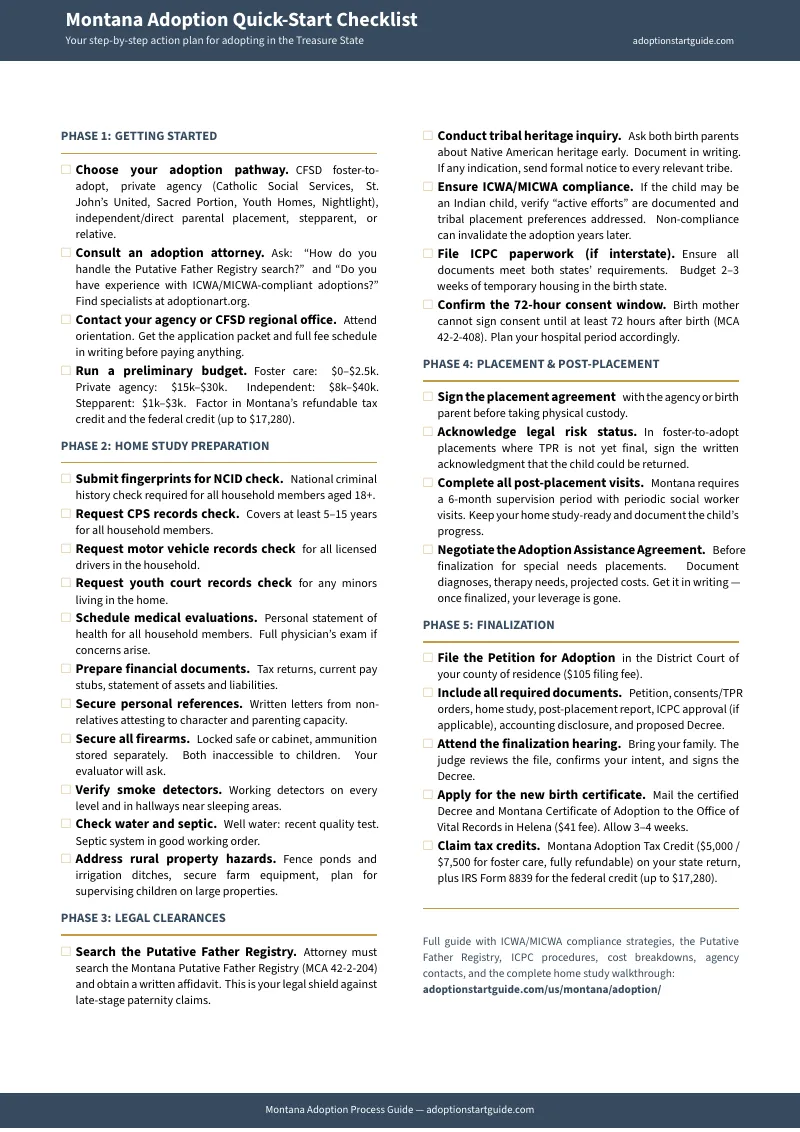
The free Quick-Start Checklist
Download the Montana Adoption Quick-Start Checklist for a one-page overview of the key steps from first inquiry to finalization. Free, no commitment. If you want the full guide with the four-pathway comparison, the Putative Father Registry explained, the ICWA/MICWA compliance guide, the Montana home study preparation, and all the printable worksheets, click the button in the sidebar.
-- less than one minute of a Montana adoption attorney's time
The average adoption attorney in Montana bills $250 or more per hour. A single consultation runs $300 to $500. Families routinely spend their first billable hour covering foundational questions this guide answers in Chapter 1. The Big Sky Adoption Navigator doesn't replace your attorney. It makes sure you don't pay your attorney to teach you the basics of Montana adoption law.