
You want to foster a child in Montana. Then you discovered that your water heater might disqualify your home, that background checks require every state you've lived in for the past five years, that PRIDE training cohorts fill up months in advance in rural regions, that your well water needs to be tested during specific seasonal windows, and that the state's own website buries the actual licensing steps inside 40-page legal PDFs.
You called the CFSD hotline. You got a friendly voice that told you to "attend an orientation" and wait for the next training cohort -- which might be four months away in Great Falls, or six months if you're in a frontier county where sessions run once a year. You checked the DPHHS website and found legal language from ARM Title 37 that explains what the state requires but never tells you what to do first, what can run in parallel, or what actually stalls applications for months. You found Reddit threads where foster parents in other states confidently explain requirements that don't apply in Montana. And you found national guides that have never heard of ARM 37.51.901 or the CFSD six-region structure.
The information exists. It's scattered across the Montana Code Annotated (Title 41, Chapter 3), the Administrative Rules of Montana (ARM Title 37), six different regional CFSD office websites, DPHHS orientation packets, Child Bridge newsletters, MFAPA forum archives, and IdentoGO fingerprinting portals. Piece it together yourself and you'll burn months reading legal language, calling the wrong office, and discovering requirements out of sequence -- which is exactly why the number of licensed foster homes in Montana dropped from 1,674 to 1,200 while 2,400 children still needed placement.
The Parallel Processing Roadmap
This guide exists because the licensing process is not actually as long as most applicants experience it. The six-month timeline that families report on forums is what happens when you follow the steps in the order the state presents them -- linearly, one after another. Background checks sit idle while you wait for training. Training sits idle while you wait for a home inspection. References go cold while you wait for fingerprint results. The Parallel Processing Roadmap shows you which requirements can run simultaneously, which ones have hidden dependencies, and exactly when to start each step so nothing sits on a desk while something else sits on a calendar.
What's inside
- The CFSD system map -- How Montana's six administrative regions work, which Regional Administrator handles your area, how to find your assigned Family Resource Specialist, and why building that relationship early shaves weeks off your timeline. Includes the full regional office directory with direct contacts.
- Eligibility decoded -- The actual requirements from ARM 37.51.301: minimum age 18, the 24-month cohabitation rule for couples, income documentation, the health statement (Form DPHHS-CFS-021), and the non-discrimination protections that apply regardless of marital status, sexual orientation, or religious background. No guessing about whether you qualify -- the specific standards are here.
- Background check sequencing -- FBI fingerprints through IdentoGO, Montana DOJ checks, CPS registry searches for every state you've lived in, and the critical step most applicants miss: submitting Authorization for Background Checks (Form CFS-LIC-018) on day one, not after training. Processing times, costs ($30 DOJ plus $15-20 rolling fee), and the "disclose everything" principle that prevents undisclosed history from killing your application.
- Home inspection checklist -- What the Family Resource Specialist actually looks for during the walk-through: bedroom window egress (20 inches wide by 24 inches high minimum), bed width (30 inches minimum, no upper bunks under age 8), water temperature at every tap (110-120 degrees F), smoke detectors in every bedroom and hallway, carbon monoxide detectors for fuel-burning appliances, locked medication and chemical storage, secured firearms with ammunition stored separately, and the well water testing windows (April-June or September-October) that rural families need to plan around.
- Training navigator -- Keeping Children Safe (KCS) is 18 hours delivered over 3 full days or 6 evening sessions. Core-KCS adds 10 more hours, many available as self-paced e-learning. If your region's cohort is full or three hours away, the guide covers how to attend in a neighboring region, access hybrid modules, and avoid the winter scheduling gap that catches rural families off guard.
- The home study decoded -- What the 3-5 interviews with your Family Resource Specialist actually cover: your childhood, your parenting philosophy, your relationship dynamics, your discipline approach, your understanding of trauma, and how your household handles stress. This chapter tells you what to prepare, not what to memorize.
- Financial support mapped -- Daily reimbursement rates ($14-25+ depending on the child's needs level), Medicaid coverage, clothing and school supply allowances, the Adoption Assistance Program for foster-to-adopt transitions, and the federal adoption tax credit. Every dollar Montana provides, organized by placement type.
- The foster-to-adopt pathway -- How Termination of Parental Rights works in Montana (MCA 41-3-607), what "concurrent planning" means for your family, the Adoption Assistance Agreement you must negotiate before finalization, and the post-adoption subsidies that continue after the legal process ends.
- ICWA and tribal considerations -- Montana is home to seven tribal nations, and the Indian Child Welfare Act creates specific requirements for cases involving Native children. Active efforts, qualified expert witnesses, placement preferences, and how ICWA intersects with state foster care licensing -- covered with the respect and specificity this subject demands.
- Reference letter framework -- One of the most common reasons for licensing delays is that personal references don't know what to write or take too long to respond. The guide includes a framework you can share with your 3-5 references so they understand what CFSD is looking for and respond promptly.
Who this guide is for
- Families who've been thinking about it for months -- You've followed Child Bridge on Facebook, read the MFAPA newsletter, and discussed it at the kitchen table more times than you can count. The heart is ready. The paperwork is overwhelming. This guide turns the 18-month research spiral into a structured action plan.
- Kinship caregivers in crisis -- A niece, nephew, or grandchild just entered CFSD custody, and you got the call. You need to get licensed fast to qualify for the daily reimbursement and Medicaid coverage. You don't have 18 months to research -- you need the step-by-step process tonight. The Parallel Processing Roadmap was built for exactly this situation.
- Rural and frontier families -- Your nearest CFSD office is a three-hour drive. The next training cohort is months away. Your home is on well water. This guide covers the rural-specific realities that national resources ignore: remote training options, well water testing schedules, and how to coordinate inspections when your Family Resource Specialist covers five counties.
- Healthcare workers with complicated schedules -- You work 12-hour shifts at a hospital in Billings or a clinic in Miles City. You understand trauma. You have the temperament. But the rigid training calendar and weekday inspection slots feel impossible. The guide maps out scheduling strategies for shift workers, including evening and hybrid training options.
- Faith-based families responding to a calling -- Organizations like Child Bridge and Promise 686 brought you to this point. The spiritual motivation is real. The state bureaucracy is real too. This guide is the technical companion to your community's support -- it handles the ARM citations, form numbers, and inspection requirements so your energy goes toward the child, not the paperwork.
- Foster-to-adopt families -- You want permanency for the child in your care. The guide covers the Termination of Parental Rights process, Adoption Assistance negotiations, and the court process from petition to Final Decree -- specific to Montana law.
Why the free resources aren't enough
The DPHHS website lists the requirements. It does not explain the sequence. It does not tell you that submitting background checks before starting training saves two months. It does not mention that well water testing has seasonal windows that can stall your application if you miss them. It does not warn you that references who don't respond within two weeks can push your home study back by a month. The state gives you the ingredients -- the guide gives you the recipe, in the right order, with the timing that turns a six-month process into something significantly shorter.
National foster care books provide emotional support and general encouragement. They don't cite ARM 37.51.816 (bedroom standards), ARM 37.51.901 (environmental safety), or ARM 37.51.1401 (training requirements). They don't know that Montana uses "Keeping Children Safe" instead of the PRIDE acronym used in most other states. They don't list your regional CFSD office or explain Montana's specific reimbursement rate structure. In a process where one missed requirement can stall your application for months, guidance from the wrong state is worse than no guidance at all.
8 PDFs — the guide plus 6 printable standalone tools
The guide comes with 6 standalone printable tools designed to go on your fridge, in your folder, and into your references' hands:
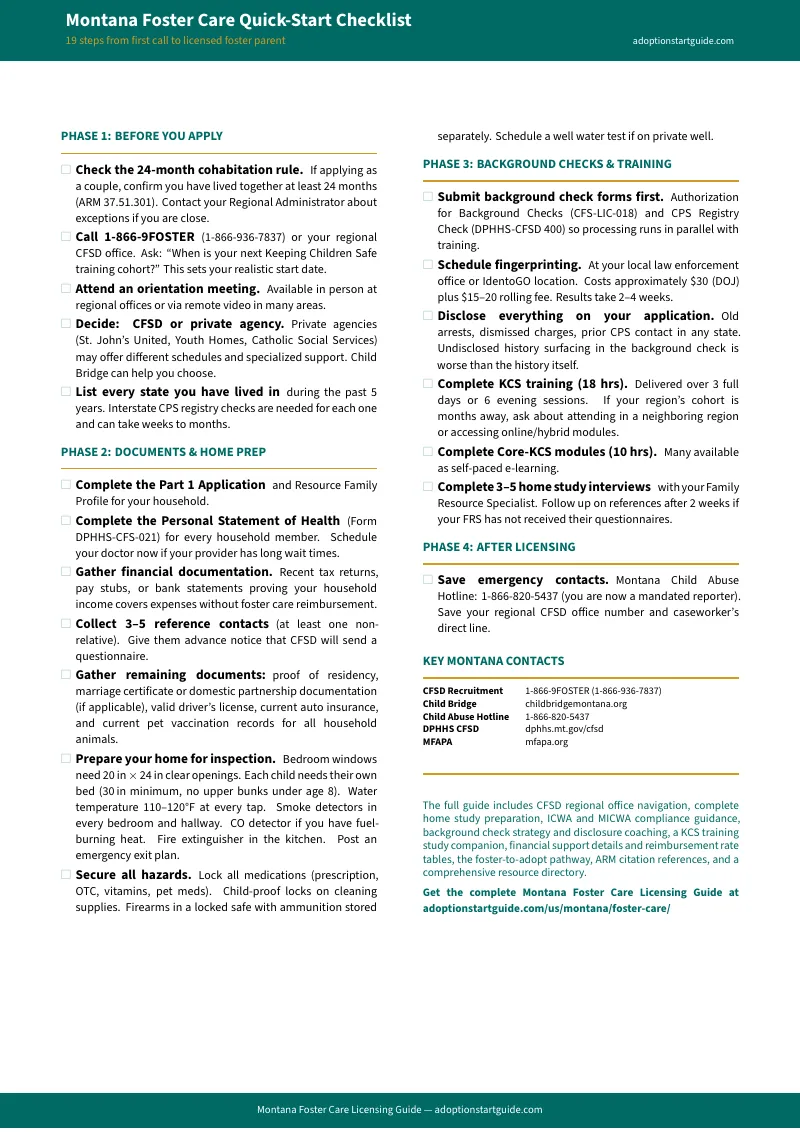
- Quick-Start Checklist — 19 critical action items across five phases, from first phone call to first placement
- Parallel Processing Timeline — a visual wall chart showing which licensing steps run simultaneously, week by week
- Home Safety Inspection Checklist — room-by-room walkthrough of every ARM 37.51.901 requirement your inspector checks
- Background Check Tracker — fillable tracker for all four check types plus interstate checks, with dates, costs, and status columns
- Regional Directory — all six CFSD offices, key phone lines, and online resources on one page
- Financial Reference Card — daily rates, clothing allowances, Medicaid, respite, and tax benefits at a glance
- Reference Letter Guide — a handout you give to your 3-5 references so they know what CFSD will ask
The free Quick-Start Checklist
Download the Montana Foster Care Quick-Start Checklist for a one-page overview of the key steps from first phone call to first placement. Free, no commitment. If you want the full guide with the Parallel Processing Roadmap, the home inspection checklist, the reference letter framework, the training navigator, and the complete regional directory, click the button in the sidebar.
-- less than a single hour of a Montana family law attorney's time
Family law attorneys in Montana charge $200 to $350 per hour. A 30-minute phone call to ask "what are the bedroom requirements?" costs more than this entire guide. A single fingerprint processing fee costs $30. A missed well water test means waiting until the next seasonal window -- potentially four months. An application that stalls because references weren't contacted early enough means another month of a child waiting for a home. The Parallel Processing Roadmap doesn't replace your caseworker -- it makes sure you don't spend months learning the process by trial and error while children wait. If the guide doesn't deliver what you need, you're covered by a refund guarantee, no time limit -- no questions, no risk.