
You visited dhhs.ne.gov, opened NAC Title 391, and drowned in 400 pages of regulations that never once tell you whether to license through DHHS or a private child-placing agency.
Nebraska runs foster care through the Department of Health and Human Services Division of Children and Family Services, five separate service areas with different operational cultures, and a network of private child-placing agencies like KVC, Christian Heritage, Cedars, Jenda, and South Central Behavioral that each present themselves as the obvious choice. DHHS publishes the regulations. The agencies run the orientations. Nobody compares them side by side because every stakeholder is incentivized to hide the alternatives. The state won't tell you an agency might offer faster support. The agency won't tell you that licensing directly with the state is even an option.
The background check process is where Nebraska families stall out and quit. The Adam Walsh Act requires FBI fingerprinting, the Central Registry check screens for prior CPS involvement, and DHHS adds its own adult protective services and sex offender registry checks on top. Every adult in your household needs clearance. Submit one form to the wrong office, and your application enters what foster parent forums call the "black hole" — weeks of silence with no tracking number, no status updates, and no clear person to contact when your Resource Development worker has moved on to a new caseload. In a state where 23.2% of children in care have had five or more caseworkers, your application is competing for attention against an overwhelmed system.
Meanwhile, your home has to pass an inspection you can't fully prepare for using the state website. NAC Title 391 requires 35 square feet of bedroom space per child, but the regulation doesn't include a measurement guide. Firearms must be stored unloaded in a locked container with ammunition locked separately — and in a state where gun ownership is the norm, this requirement trips up families who've safely stored weapons for decades but don't meet the specific administrative code standard. Cleaning supplies locked. Medications locked. Water heater at 120 degrees. Pool or pond fenced. And the inspector checks every item against a form you've never seen because DHHS doesn't publish the walkthrough version of what they're actually looking for.
The Nebraska Licensing Navigator
This guide is built for Nebraska's CFS system and nothing else. Every chapter, every checklist, every contact number is grounded in current NAC Title 391 and Title 474 regulations, DHHS Division of Children and Family Services policy, and the real differences between how the Eastern Service Area in Omaha operates versus the state-run offices in Kearney, North Platte, and Alliance. Not a national foster care overview. Not an agency recruitment pitch. The independent navigation layer between what the state publishes online and what you actually need to know to move from first orientation to approved license — under current conditions, on current timelines, in your specific part of Nebraska.
What's inside
- CPA vs. DHHS direct-licensing decision matrix — This is the comparison Nebraska's system is designed not to provide. DHHS won't recommend an agency. Agencies won't mention the state-direct option. This chapter compares licensing through a private child-placing agency (KVC, Christian Heritage, Cedars, Jenda, South Central Behavioral, Embracing Heart) versus licensing directly with DHHS by caseload ratios, on-call support availability, matching philosophy, training format flexibility, reimbursement speed, and geographic coverage across all five service areas. Includes which CPAs serve which counties so you choose based on your location and family's situation — not based on who had the most persuasive orientation.
- Service area regional guide — Nebraska's five CFS service areas operate as functionally different systems. The Eastern Service Area around Omaha uses privatized case management with contracted agencies. The Western and Central areas are state-run with different communication channels, smaller staff, and quarterly orientation schedules instead of monthly. This chapter maps each area's office locations, direct phone numbers for Resource Development workers in Alliance, North Platte, Grand Island, Norfolk, Lincoln, and Omaha, training session availability, and the practical differences that affect your timeline depending on whether you live in Douglas County or Cherry County.
- Room-by-room home audit based on NAC Title 391 — The DHHS home inspection checks your home against the administrative code, and the pass/fail line is more specific than "safe and clean." This chapter gives you the complete walkthrough: the 35-square-foot bedroom minimum with a measurement worksheet, firearm storage requirements (unloaded, locked container, ammunition locked separately), medication lockbox standards for prescription and over-the-counter drugs, water heater temperature maximum (120 degrees), smoke detector and carbon monoxide detector placement, cleaning supply storage, window and door safety, and outdoor hazard assessment for pools, ponds, and agricultural equipment. Handle every item before the inspector arrives.
- Background check and fingerprinting tracker — The Adam Walsh Act FBI fingerprinting, Central Registry check, adult protective services registry, sex offender registry, and Nebraska criminal history check run simultaneously through different offices with different processing times. This chapter maps each check to its processing office, explains what triggers a delay, provides the specific criteria for case-by-case review of prior offenses (including decade-old misdemeanors and DUIs that forums say are automatic disqualifiers but often are not), and includes follow-up email templates for when your results enter the black hole. The templates are the "squeaky wheel" strategy that experienced Nebraska foster parents say is the only way to keep a stalled clearance moving.
- TIPS-MAPP vs. Deciding Together training comparison — Nebraska uses two pre-service training tracks, and nobody tells you that you have options. TIPS-MAPP (Trauma Informed Partnering for Safety and Permanence) runs 10 to 11 weekly three-hour evening sessions, totaling 27 to 30 hours. Deciding Together condenses the curriculum into 7 sessions. For rural families driving an hour or more to the nearest training site, this difference is the difference between completing training and dropping out. This chapter compares both tracks by schedule, format, content coverage, availability by service area, and which agencies offer which option — plus online and weekend-intensive alternatives where they exist.
- Reference and medical form preparation templates — Nebraska requires three favorable references and a health report signed by a medical practitioner using state-approved language. The reference template coaches your references on what the Resource Development worker is actually evaluating — not "is this person nice" but specific parenting competencies and support network indicators. The medical form preparation sheet tells your doctor exactly what DHHS needs documented and in what format, preventing the common rejection where a physician signs off using their own language instead of the state's required phrasing.
- Reimbursement and NCR optimization guide — Nebraska's daily foster parent reimbursement rates are determined by the Nebraska Caregiver Responsibility (NCR) assessment tool, which evaluates the level of care a child requires. Higher NCR scores mean higher daily rates, but the tool is opaque and many foster parents are undercompensated because they don't understand how to document the care they're providing. This chapter explains the NCR tiers, the documentation that supports accurate level-of-care assessment, and the reimbursement timeline so you know exactly when payments arrive and what to do when they don't. For kinship families, this chapter covers the bi-monthly reimbursement equivalent to licensed non-relative homes — a recent policy shift that many relative caregivers don't know they're eligible for.
- ICWA compliance section — Nebraska is home to the Omaha, Winnebago, Santee Sioux, and Ponca Tribes. If a child placed in your home is a member of or eligible for membership in a federally recognized tribe, the Indian Child Welfare Act establishes placement preferences and procedural protections that override standard DHHS procedures. This chapter explains what "active efforts" means in practice, the placement preference hierarchy, how to contact tribal social services, and how to support a child's cultural and tribal connections.
Printable standalone worksheets included
- Licensing Timeline Tracker — Every milestone from first orientation through approved license, with fill-in date fields and the realistic processing windows for each step. Print it, update it after every caseworker interaction, and always know where you stand in the four-to-twelve-month process.
- 35 Sq Ft Floor Plan Worksheet — A grid for mapping your bedrooms against the NAC Title 391 minimum space requirement. Measure and document before the inspector arrives so you know exactly which rooms qualify and which need adjustment.
- Firearm Compliance Log — Storage location, lock type, ammunition storage, and verification dates for every firearm in your household. Nebraska has one of the highest gun ownership rates in the country. This worksheet documents your compliance in the format the inspector expects.
- Home Safety Inspection Checklist — Room-by-room walkthrough of every NAC Title 391 requirement. Walk your home with this before the DHHS inspector arrives.
Who this guide is for
- Omaha, Lincoln, and Sarpy County families navigating agency overload — You live in the metro area where most of Nebraska's foster children are concentrated. You've attended an orientation at KVC, considered Christian Heritage, looked at Cedars, and realized every presentation was a recruitment pitch, not preparation. This guide gives you the CPA comparison matrix that the system is designed not to provide — so you choose the agency that fits your family, not the one with the best marketing.
- Rural families in Grand Island, Kearney, North Platte, and beyond — You're an hour or more from the nearest training site. The 10-week evening TIPS-MAPP schedule is a logistical impossibility with your work and family commitments. This guide maps the Deciding Together alternative, online training options, and how your service area's state-run office operates differently from the privatized Eastern Service Area that most resources assume you're part of.
- Kinship caregivers who need answers in 72 hours — A grandchild, niece, or nephew has been placed with you or is about to be. You need to understand the emergency placement protocol, the condensed 5-hour online training module for relative foster homes, and how to access the bi-monthly reimbursement you may be entitled to. Over 55% of Nebraska's foster placements go to kinship families. This guide has a dedicated pathway for your situation.
- Foster-to-adopt families — You're entering the system hoping to provide a permanent home. Nebraska's median time from foster care entry to adoption finalization is 965 to 987 days. This guide explains how concurrent planning works in practice, what the reunification timeline looks like, and how the transition from foster license to adoption proceeds when termination of parental rights occurs.
- Faith-based families answering the call — You're connected through CarePortal, your church's foster care ministry, or a faith-based CPA like Christian Heritage. The calling is clear. The NAC Title 391 inspection standards, the Adam Walsh Act fingerprinting process, and the DHHS administrative code are not. This guide maps the licensing process so the bureaucracy doesn't derail your mission.
- Single applicants and renters — Nebraska law allows single adults 21 and older to foster, and homeownership is not required. But the application process doesn't make this obvious, and many prospective parents assume they'll be disqualified before they start. This guide addresses your specific situation — proving financial stability solo, meeting space requirements in a rental, and demonstrating your support network to the home study evaluator.
Why the free resources aren't enough
The DHHS website is a regulation repository, not a guide. It publishes NAC Title 391 licensing standards and a basic FAQ. The information is written in administrative code language, links are frequently broken or circular, and the site assumes you already understand the difference between the five service areas, the CPA network, and the state-direct licensing path. Finding what you need on dhhs.ne.gov is a research project, not a quick read.
Agency orientation sessions are recruitment events. KVC, Christian Heritage, Cedars, and every other CPA will tell you about the 4,100 children in Nebraska who need homes. They will not tell you the cons of licensing with their agency, the fact that a different CPA might serve your county better, or that you can license directly through DHHS and skip the private agency entirely. Each stakeholder in the system is incentivized to present only their piece of the puzzle.
NFAPA, Facebook groups, and Reddit threads provide emotional support and contradictory advice. A family whose CPA handled everything in Omaha gives different guidance than a kinship caregiver in Scottsbluff navigating a state-run service area without a caseworker who returns calls. Crowdsourced guidance is well-intentioned and situationally unreliable. An answer that worked for one agency may be wrong for yours.
National foster care resources describe a generic licensing process that doesn't account for Nebraska's five service areas, the CPA vs. DHHS direct-licensing choice, the TIPS-MAPP vs. Deciding Together training options, the NCR reimbursement tool, or the 23.2% caseworker turnover rate that means your application may change hands multiple times before approval. A guide written for Arizona or Ohio won't help you in Nebraska.
The free Quick-Start Checklist
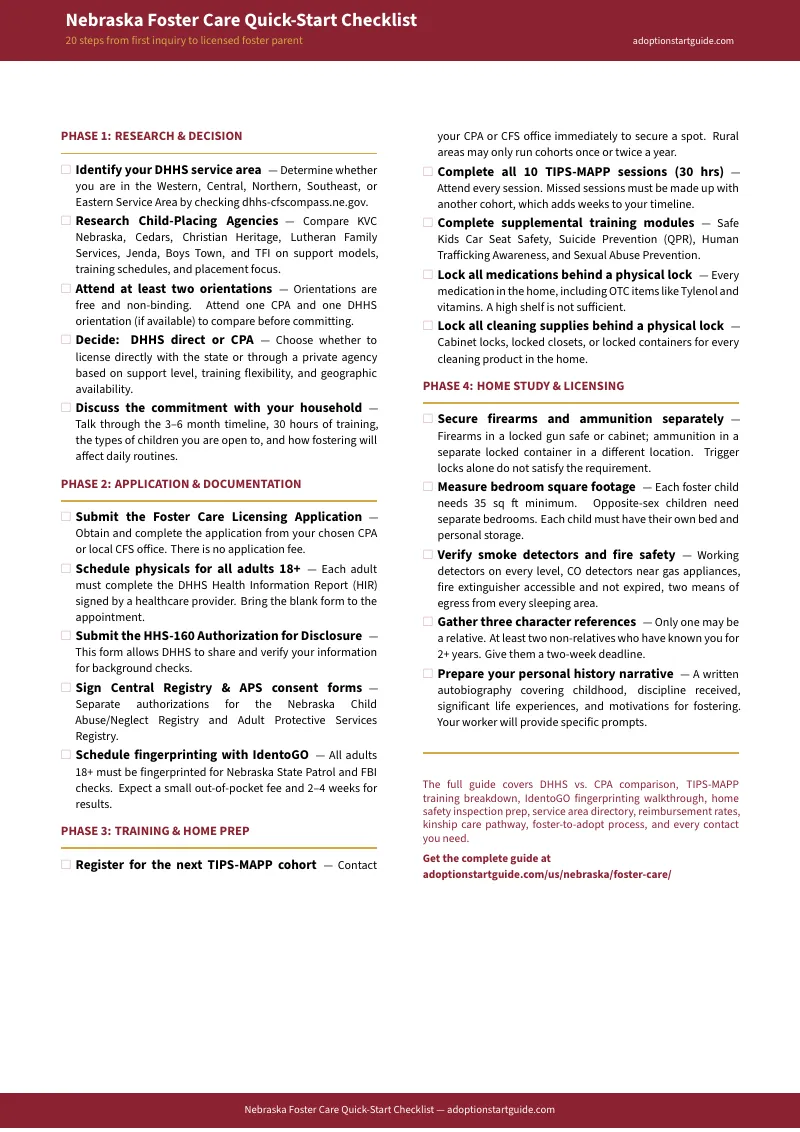
Download the Nebraska Foster Care Quick-Start Checklist for a one-page overview of the licensing process, from first orientation through approved license. Free, no commitment. If you want the full guide with the CPA decision matrix, service area regional guide, room-by-room home audit, background check tracker, training comparison, reference and medical templates, reimbursement optimization, ICWA section, and all the printable worksheets, click the button in the sidebar.
— less than one background check processing fee
The Adam Walsh Act fingerprinting costs $30 to $50 per adult. A medical physical for your household runs several hundred dollars if you're uninsured. And every week your licensing is delayed by a stalled background check, a failed home inspection, or a rejected medical form is a week you're not receiving the daily reimbursement rate. This guide costs less than the cheapest fingerprinting fee you're already going to pay — and it prevents the mistakes that turn a four-month process into a twelve-month ordeal.
If the guide doesn't deliver, reply to your download email at any time for a full refund. No forms. No justification required.