You live in Nevada. You want to adopt. And you cannot figure out which office to call first.
You searched "how to adopt in Nevada" and landed on three completely different websites run by three completely different agencies — Clark County Department of Family Services if you live in Las Vegas, Washoe County Human Services Agency if you live in Reno, and the state Division of Child and Family Services if you live anywhere else. Each one has its own application, its own training requirements, and its own caseworkers. None of them acknowledge the other two exist. You don't know whether you're supposed to call the county office on West Owens or the state office on Belrose. You filled out an inquiry form three weeks ago and nobody called you back. You're not even sure you contacted the right agency for the type of adoption you want — because the Clark County DFS website only talks about adopting children from foster care, and your situation might be private adoption, or stepparent adoption, or your sister's kids who have been living with you since February.
Maybe you did reach someone. Maybe a caseworker explained the home study and the background checks and the training hours — and then that caseworker left. Nevada child welfare agencies lose 36% of new staff within 18 months. Your file got reassigned to someone who doesn't know your name, let alone your case history. You called to ask about the timeline and got a voicemail that was never returned. You tried to look up the statute yourself — NRS Chapter 127 — and discovered that entire sections were repealed and moved to Chapters 127C and 127F in the 2025 legislative session. The forms your neighbor used two years ago might cite statutes that no longer exist. The Reddit threads you found mix Nevada law with California law, and one poster confidently told someone that Nevada has a putative father registry. It doesn't. Nevada is one of the few states with no father registry at all, which means the court requires a "diligent search" for any potential biological father before it will grant a petition — and nobody on Reddit mentioned that a failed diligent search can stall your adoption for months.
The free resources are not built for your question. Clark County DFS tells you how to adopt their foster children — it says nothing about private agency adoption, independent adoption, or how to formalize the kinship arrangement you've had going since your brother went to prison. The state DCFS guide is written in bureaucratic language for caseworkers, not families. Foster Kinship is excellent for grandparents and relatives who need support services, but they don't walk you through the legal petition process. Private agency websites like Loving Hearts and Adoption Choices of Nevada tell you about their services — they won't tell you that adopting through the county is free, or that certain relative adoptions allow the court to waive the home study entirely under NRS 127.120. Everyone is selling their piece of the system. Nobody is showing you the whole board.
The Nevada Route Map: Your Complete Guide to Adoption in the Silver State
This guide exists because Nevada runs three separate child welfare systems inside one state border, and no single agency, website, or attorney has any reason to explain all three to you. The Nevada Route Map gives you the entire adoption landscape — Clark County DFS, Washoe County HSA, and DCFS Rural Region — in one document. It covers every legal pathway recognized under NRS Chapters 127, 127C, and 127F: foster-to-adopt, private agency, independent, stepparent, relative, and adult adoption. It is written for families in Las Vegas, Reno, Henderson, Sparks, Carson City, Elko, Pahrump, and every rural county in between. It is written for the system Nevada families actually navigate — the one where your zip code determines your agency, your caseworker might leave before your case is done, and a statute you looked up last month might have been moved to a different chapter this year.
What's inside
- Three-Agency Routing System — The decision framework that tells you exactly which agency handles your adoption based on your county of residence and the type of child you want to adopt. Clark County DFS manages Las Vegas, Henderson, North Las Vegas, and Boulder City. Washoe County HSA manages Reno and Sparks. DCFS Rural Region manages the remaining fifteen counties from Elko to Nye. Each agency has different training hour requirements, different application processes, and different caseload timelines. This chapter maps all three so you contact the right office on day one — not after three weeks of unreturned voicemails to the wrong agency.
- Six-Pathway Comparison Matrix — A side-by-side breakdown of every adoption pathway available in Nevada: foster-to-adopt through your regional agency, licensed private agency placement (Loving Hearts, Adoption Choices, A Path of Light), independent adoption through an attorney without an agency, stepparent adoption under NRS 127.120, relative and kinship adoption with the home study waiver provision, and adult adoption under NRS 127.190. Each pathway mapped with realistic timelines, cost ranges, consent requirements, and the specific situations where one pathway is clearly better than the others. Includes the legal threshold for when a stepparent or relative can petition without the full DCFS home study — because that waiver saves months and thousands of dollars, and most families don't know it exists.
- Putative Father Search Protocol — Nevada has no putative father registry. The court requires the petitioner to conduct a "diligent search" for any potential biological father before it will finalize an adoption — and if the search is deemed insufficient, the judge sends you back to start over. This chapter gives you the legal standard the court applies, the types of evidence that satisfy it, the difference between "unknown father" and "unnamed father" under Nevada case law, and template language for the diligent inquiry affidavit. This is the single biggest source of delay in Nevada adoption petitions, and no free resource explains how to handle it correctly.
- NRS 127 Legal Framework Decoder — The complete Nevada adoption statute translated into plain English. The 2025 legislative session moved key provisions from NRS 127 into new Chapters 127C (child welfare placements) and 127F (foster care). If you're working from older guides, attorney checklists, or court forms that cite the original NRS 127 sections, your petition could be flagged for citing repealed statutes. This chapter maps the old section numbers to the new ones and explains every provision that affects your case: the 10-year age gap requirement under NRS 127.020 (and how stepparents get waivers), the six-month residency rule for finalization, consent requirements, revocation timelines, and grounds for dispensing with consent when a parent has abandoned the child.
- ICWA and Tribal Coordination Guide — Nevada has 27 federally recognized tribes, including the Pyramid Lake Paiute, Walker River Paiute, Washoe Tribe, Western Shoshone, and Te-Moak Tribe. If the child you are adopting has or may have tribal membership or eligibility, the Indian Child Welfare Act applies — and ICWA requires a different evidentiary standard ("beyond a reasonable doubt" versus "clear and convincing evidence"), mandatory tribal notification, and a 10-day post-consent withdrawal period for birth parents. The Clark County DFS FAQ does not mention ICWA. This chapter does, because a failure to comply with ICWA notice requirements is grounds for overturning a finalized adoption years later.
- Home Study Preparation Guide — What the home study evaluator assesses during in-home visits, the documents you need assembled before the first appointment, and the Nevada-specific requirements that trip families up. The 200-square-foot per person living space guideline. The pool fence and gate requirements that apply to nearly every home in Clark County. The mandatory Nevada child abuse and neglect registry check, FBI fingerprinting, and sex offender registry verification for every adult in the household. The medical exam and TB testing requirements. Training hours — Clark County DFS requires 24 hours of pre-service training for foster-to-adopt families, while requirements vary for private and relative adoptions. This chapter covers what the evaluator is actually looking for, what raises flags, and how to prepare your home and your household members before the visit is scheduled.
- Financial Planning Framework — Realistic cost breakdown by pathway. Foster-to-adopt through Clark County DFS, Washoe HSA, or DCFS is essentially free — the agency covers the home study, and families receive non-recurring adoption expense reimbursement up to $2,000 per child. Private agency adoption ranges from $15,000 to $40,000 depending on the agency and birth mother expenses. Independent adoption through an attorney runs $8,000 to $20,000. Stepparent adoption costs $500 to $3,000 depending on whether it's contested. This chapter also maps the Nevada adoption subsidy program under NRS 127.186 — monthly maintenance payments for children adopted from foster care, Medicaid continuation, and the $500 attorney fee reimbursement that most families never claim because nobody tells them it exists. Includes the federal adoption tax credit (up to $16,810 per child) and a fill-in budget worksheet.
- Court Filing Navigator — Nevada adoption petitions are filed in the District Court of the county where the petitioner resides or where the child resides. In Clark County, that means the Family Court on North Pecos Road in Las Vegas. In Washoe County, the Second Judicial District Court in downtown Reno. In rural counties, the local District Court — which may sit only a few days per month. This chapter covers the petition requirements, the hearing process, what happens at the final adoption hearing, and the specific documents the judge needs to see. Includes the timeline from filing to finalization — typically six to twelve months after placement, depending on the pathway and the court's calendar. Addresses the crowded Clark County docket specifically, because Las Vegas families face longer waits than Reno or rural families due to volume.
- Agency and Attorney Directory — Licensed child-placing agencies operating in Nevada: Loving Hearts Adoption Services (Las Vegas, domestic infant), Adoption Choices of Nevada (Las Vegas, open adoption focus), A Path of Light Adoption Services (Reno-based, domestic and interstate), and the regional public agencies. Attorney referral guidance organized by pathway and region, with what to ask in a first consultation, typical fee structures for contested versus uncontested cases, and the flat-fee versus hourly billing question that matters when you're comparing a $2,500 stepparent adoption to a $15,000 contested TPR case. Includes the Clark County Legal Aid Center of Southern Nevada for families who qualify for free or low-cost representation.
- Post-Adoption Roadmap — What happens after the judge signs the decree. New birth certificate application through the Nevada Division of Public and Behavioral Health. Medicaid continuation for children adopted from foster care. Post-adoption support services through Foster Kinship and the DCFS Post-Adoption Services Unit. The process for accessing sealed adoption records under NRS 127.171 if medical history or ancestry documentation is needed later. Social Security number and name change procedures.
Printable standalone worksheets included
- Adoption Timeline Tracker — Every milestone from first agency contact through court finalization, with fill-in date fields organized by pathway. Print it, update it after every meeting and court date, and always know exactly where your case stands in the Nevada system.
- Home Study Document Checklist — Nevada child abuse registry check, FBI fingerprint clearance, sex offender registry verification, medical exams, TB tests, financial records, reference letters, and home safety items including the Clark County pool fence requirements — organized in the order the evaluator expects them.
- Financial Planning Worksheet — Costs by pathway, adoption subsidy calculation, federal tax credit eligibility, non-recurring expense reimbursement, and attorney fee reimbursement tracking in one printable sheet.
- Court Filing Checklist — The specific forms and documents required for your District Court — petition, consent forms, home study report, background clearance results, and the diligent search affidavit — with checkboxes so nothing gets left out of your filing.
Who this guide is for
- Las Vegas families starting the adoption process — You live in Clark County and you've been trying to figure out whether to go through DFS, a private agency, or an attorney. The Three-Agency Routing System and Six-Pathway Comparison Matrix give you the decision framework in one sitting, so you stop bouncing between websites that each only tell you about their own services.
- Stepparent adopters — Your spouse's child calls you Mom or Dad. You want the legal relationship to match the real one. You need to know whether the absent biological parent's consent is required, how the six-month abandonment presumption works under Nevada law, whether the court will waive the home study for your situation, and what the uncontested process actually costs — because the $5,000 quotes you're seeing online may be twice what a straightforward case requires.
- Kinship and relative caregivers — You are a grandparent, aunt, uncle, or sibling who stepped in when a parent couldn't. Maybe you have a guardianship. Maybe you have nothing but a verbal agreement and a child who has been sleeping in your spare room for two years. You need to move from informal arrangement to legal permanency, and you need to understand the home study waiver, the TPR process for an absent parent, and the kinship adoption subsidy that helps offset costs on a fixed income.
- Foster-to-adopt families — You are licensed through Clark County DFS, Washoe HSA, or DCFS Rural Region, and the case plan for your foster child has changed from reunification to adoption. You need to understand the TPR timeline, the adoption subsidy negotiation that must happen before the decree is signed, and the paperwork transition from foster care to permanent adoption — because your caseworker's 36% chance of leaving means you may need to advocate for your own case.
- LGBTQ+ couples and single adopters — Nevada is one of the most adoption-friendly states for same-sex couples and single parents. Registered domestic partners can petition jointly. Single adults face no legal barriers. But agency attitudes vary, and the home study process for non-traditional families sometimes surfaces questions that married heterosexual couples never get asked. The guide covers your legal rights and the practical realities.
- Rural Nevada families — You live outside Clark and Washoe Counties, which means your adoption goes through DCFS Rural Region. Court calendars in rural districts sit less frequently. The Deputy AG assigned to your county may be the only one handling child welfare cases — and if they leave, your case stops moving. The guide covers the rural-specific realities that Las Vegas families never encounter.
Why free resources fall short
The Clark County DFS website tells you how to adopt children from the county foster care system. It does not address private adoption, independent adoption, stepparent adoption, or the process for families who live in Henderson but want to adopt an infant through a licensed agency. The state DCFS guide is written in the language of case management — "case plan goals," "permanency hearings," "reasonable efforts findings" — not in the language of a family trying to understand what they need to do next. Foster Kinship is the best resource in Nevada for grandparents and relative caregivers, but their mission is support services and training, not step-by-step legal process guidance.
National adoption guides describe a version of adoption that exists on paper but not in Nevada. They don't mention the three-agency split. They don't explain that Clark County's training requirements differ from the state agency's. They don't address the putative father diligent search requirement that stalls Nevada petitions because no one warned the family it was coming. They don't flag the NRS 127 reorganization that moved key provisions to new chapter numbers in 2025. And they certainly won't tell you that certain relative adoptions in Nevada allow the court to waive the home study requirement entirely — because that information doesn't generate a $30,000 agency placement fee.
Las Vegas family law attorneys charge $250 to $400 per hour. A full contested adoption case can run $10,000 to $20,000 in legal fees. An initial consultation costs $150 to $300. Every question you ask your attorney about "how does the Nevada system work" is a question that costs you money — and the answer is in this guide. Families who understand the system before they hire an attorney spend their legal budget on legal strategy, not on education they could have gotten for the cost of lunch at a Henderson drive-through.
The free Quick-Start Checklist
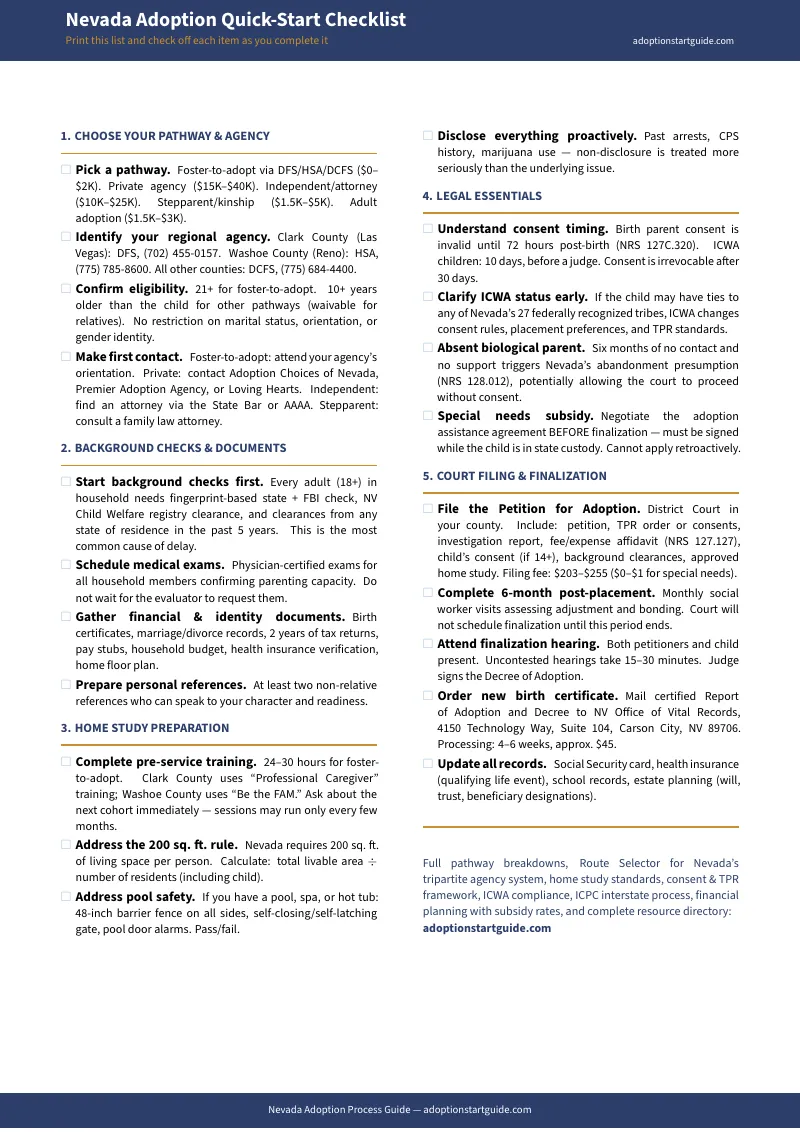
Download the Nevada Adoption Quick-Start Checklist for a structured overview of the adoption process — from identifying your pathway and your regional agency through court finalization. Free, no commitment. It includes the Three-Agency Routing System and the Six-Pathway Comparison Matrix summary, which are the two decision points that cause the most confusion in the Nevada system. If you want the full guide with the Putative Father Search Protocol, the NRS 127 Legal Framework Decoder, the ICWA Tribal Coordination Guide, the financial planning worksheets, and the court filing checklists, click the button in the sidebar.
— less than one hour with a Las Vegas family law attorney
Las Vegas adoption attorneys charge $250 to $400 per hour. Private agency fees start at $15,000. A contested TPR case can run $10,000 to $20,000 in legal costs. This guide puts the entire Nevada adoption system — the three-agency routing map, the six legal pathways compared side by side, the putative father search protocol, the ICWA tribal requirements, the financial assistance programs, and the agency and attorney directory — in your hands for less than the cost of parking at a Strip resort for the day. Families who understand the process before they enter it file cleaner petitions, avoid the wrong-agency runaround, claim subsidies they didn't know existed, and spend their attorney hours on legal advocacy instead of basic orientation.
If the guide doesn't deliver, reply to your download email at any time for a full refund. No forms. No justification required.