You want to become a foster parent in New Jersey. The system that's supposed to help you can't even keep its caseworkers long enough to return your call.
You called your local CP&P office. You were told to attend an orientation. You asked when the next one was. The person who answered didn't know because the caseworker who schedules them transferred to another office last month. They said someone would call you back. That was three weeks ago. Nobody called.
So you went to nj.gov/dcf and tried to find out what you actually need to do. You found the Resource Family Care page. It mentioned PRIDE training, a home study, background checks, and an Office of Licensing inspection. It linked to Title 9, to N.J.A.C. 3A:51, to the CARI registry, and to a PDF about the Resource Family Care Agreement. You read all of it. You still don't know whether your bedroom is big enough, whether your dog disqualifies you, whether you should go through CP&P directly or call one of the private agencies you found on Google, or how long any of this actually takes.
Then you tried the private agencies. Bethany Christian Services told you to attend their orientation. Catholic Charities told you to attend theirs. Embrella's website had great FAQs but was designed for families who are already licensed. A woman in a Facebook group said she went through CP&P directly in Morris County and it took four months. Another said she went through an RFA in Camden County and it took eleven. Nobody could explain why. Both said their caseworker left halfway through.
Meanwhile, you learned that New Jersey requires 27 hours of PRIDE pre-service training. You work full time. Your partner works full time. The training sessions are on weekday evenings and weekend mornings. You have two kids already. Nobody has published a schedule you can plan around. You're supposed to just show up when your agency tells you to, and if you miss a session, you wait for the next cycle.
Then someone on Reddit mentioned lead paint. Your house was built in 1968. You looked up P.L. 2021, c. 182 and realized that New Jersey updated its lead-safe requirements and that pre-1978 homes face specific testing and certification rules that most foster care websites haven't caught up with. You don't know if your house passes. You don't know who to call to find out. You don't know whether to fix it before you apply or wait until the OOL inspector tells you what's wrong. And you're starting to wonder whether this whole process is designed to weed people out rather than welcome them in.
The Garden State Licensing Blueprint: Your Complete New Jersey Foster Care Guide
This guide is built for how New Jersey's foster care licensing process actually works in 2026 -- not the version on government websites, not the version agencies use to recruit, but the operational reality of becoming a licensed resource family parent through a system that spans 46 local CP&P offices across 21 counties, requires navigation of both the Division of Child Protection and Permanency and the Office of Licensing, and runs on a PRIDE training curriculum that most families can't schedule around until they understand how the calendar actually works. Every chapter reflects current New Jersey administrative code (N.J.A.C. 3A:51), the 2024 lead paint law updates, CP&P's county-level operational differences, and the private RFA landscape as it exists today -- not as it existed when the state's own website was last updated.
What's inside
- CP&P vs. Private RFA Decision Framework -- New Jersey lets you license directly through the Division of Child Protection and Permanency or through a private Resource Family Agency. Each path has different caseworker ratios, training schedules, placement priorities, and support structures. The guide identifies the major private RFAs operating in New Jersey, explains which counties they serve, how their support compares to the CP&P direct route, and what each path means for your timeline and placement experience -- so you don't commit to an agency based on which one had the best Google ad and then discover six months later that the direct route would have been faster for your county.
- OOL Home Inspection Pre-Audit Checklist -- The Office of Licensing conducts "Life-Safety" inspections that go far beyond a general safety check. They measure bedroom capacity by square footage, verify window egress dimensions, check carbon monoxide detector placement adjacent to every sleeping area, inspect pool barriers and outdoor hazards, and enforce standards from N.J.A.C. 3A:51 that are written in regulatory language no parent is expected to parse. The guide translates every OOL standard into a room-by-room walkthrough you can do before the inspector arrives -- because a failed first inspection doesn't just mean fixing a smoke detector. It means rescheduling around the OOL's calendar, which can add two to three months to your timeline.
- Lead-Safe Blueprint for Pre-1978 Homes -- New Jersey's P.L. 2021, c. 182 changed the lead testing and certification requirements for older homes. If your house was built before 1978, you face specific lead-safe certification obligations that most foster care resources don't mention because most foster care resources aren't written for New Jersey. The guide explains exactly what the law requires, how it intersects with OOL licensing standards, and what steps to take before your home inspection so lead paint doesn't become a months-long roadblock.
- 27-Hour PRIDE Training Strategy -- PRIDE (Parents Resource Information Development Education) is the mandatory pre-service curriculum in New Jersey. Twenty-seven hours across multiple sessions, scheduled on evenings and weekends that may or may not align with your work schedule, your childcare arrangements, or your commute. The guide maps how PRIDE sessions are scheduled through CP&P offices and private RFAs, explains the makeup session policy, and provides a scheduling strategy so you can complete the training without losing six months of weekends -- the "commuter-friendly" approach for families who can't treat the licensing process like a full-time job.
- Background Check and CARI Registry Walkthrough -- Every adult in your household needs a Criminal History Record Information (CHRI) check, a Child Abuse Record Information (CARI) check, and a sex offender registry check. If you've lived outside New Jersey in the past five years, you need clearances from those states too. The guide walks through the entire sequence -- FBI fingerprinting, state police checks, CARI submissions, out-of-state registry requests -- and explains the order that prevents delays from clearances expiring before others arrive.
- Board Rate Tables and Financial Reality -- New Jersey's board rates vary by child age and level of care. The guide includes current payment structures, the clothing allowance, the initial placement package, NJ FamilyCare health coverage for foster children, and a clear explanation of what these payments actually cover -- because board rates are reimbursements for the cost of care, not income, and your household must demonstrate financial stability independent of these funds.
- Kinship Emergency Placement Path -- If CP&P just placed a relative's child in your home, you're operating on a different timeline than prospective foster parents who are planning ahead. The guide covers presumptive eligibility, the emergency placement window, what you need to do in the first 48 to 72 hours to maintain placement, and the path from emergency kinship caregiver to fully licensed resource family parent -- including the financial support available during the interim period.
- County-Level Navigation -- New Jersey has 21 counties, 46 local CP&P offices, and no two of them process applications at the same speed. Bergen County suburban professionals face different logistics than Camden County families navigating a higher-volume office. The guide addresses the county-level operational differences that determine your actual timeline -- because the state publishes a process, but the county runs it.
6 standalone printable tools included
In addition to the full guide and quick-start checklist, your download includes 6 standalone tools you can print independently and use right now:
- OOL Home Inspection Pre-Audit Checklist -- Room-by-room walkthrough of every Life-Safety standard. Print it, grab a pen, and check off each item as you walk through your house.
- Lead-Safe Blueprint for Pre-1978 Homes -- The certification pathway on a single page: Lead-Safe vs. Lead-Free distinction, the 4-step process, county risk levels, and timeline impact.
- Board Rate Reference Card -- Landscape one-pager with all current monthly rates, clothing allowances, respite rates, and NJ FamilyCare medical coverage details.
- Kinship Emergency Placement Guide -- If CP&P just placed a relative's child with you, this is your first 72 hours action sheet. Presumptive eligibility rules, immediate steps, and financial support.
- CP&P vs. Private RFA Decision Worksheet -- Side-by-side comparison with all major agencies listed by county, decision criteria, and the 6 questions to ask before you commit.
- Background Check Sequence & Tracker -- Fillable tracker for all four required clearances for every household member 18+, plus the out-of-state CARI log that prevents the most common multi-month delays.
Who this guide is for
- Working families in the suburbs -- You're in Bergen, Morris, Middlesex, or Monmouth County. You commute into Manhattan or Newark. Your household income is solid but your time is not. You need a licensing path that works around commuter schedules and a PRIDE training strategy that doesn't require quitting your job or abandoning your existing children every weekend for three months.
- Urban families in Newark, Jersey City, Trenton, or Camden -- You want to keep neighborhood kids in the neighborhood. You may live in an older building or a rental. You need straight answers about square footage requirements, lead paint rules for pre-1978 housing, and whether your landlord can block you from becoming a foster parent.
- Kinship caregivers who just got the call -- CP&P placed your grandchild, your niece, or a family friend's child with you. You have 48 to 72 hours to figure out what happens next. You need to know the emergency placement rules, what financial support kicks in immediately, and what licensing steps you can defer versus what you must do right now.
- Faith-motivated families -- Your church or congregation brought in a speaker from The Forgotten Initiative or a similar ministry. You're ready to move from "we should do this someday" to "we're starting this week." You need to know whether to go through CP&P directly or through a faith-based RFA, and what the practical difference is beyond the brochure.
- Single professionals considering foster parenthood -- New Jersey doesn't require you to be married. It doesn't require you to own a home. But the licensing process was designed by people who assumed you had a stay-at-home partner to handle the paperwork and attend daytime appointments. The guide addresses the single-applicant reality: managing the process solo, handling caseworker responsiveness when you're the only point of contact, and scheduling around a single income and a single schedule.
- Foster-to-adopt families -- If your goal is adoption through the foster care system, the guide covers concurrent planning, how New Jersey handles the transition from foster care to termination of parental rights, and the financial reality of adoption through CP&P -- including the fact that foster care adoption costs essentially nothing compared to the $25,000 to $50,000 private domestic adoption route.
Why the free resources fall short
The NJ.gov/DCF website publishes every statute, every regulation, every form. It is organized like a legal repository -- because that's what it is. A parent trying to find "bedroom requirements" has to navigate N.J.A.C. 3A:51, cross-reference Title 9, and interpret administrative code language written for attorneys and compliance officers. The information is technically available. It is practically unusable.
Embrella (formerly NJ Foster and Adoptive Family Services) provides excellent support for licensed foster families -- training, advocacy, peer connections. But their materials assume you're already in the system. They're designed for parents who have a caseworker, not parents who can't get one to call them back.
Private agencies like Bethany Christian Services and Catholic Charities run polished orientations. They're also recruiting for their own pipeline. They won't tell you that the CP&P direct route might be faster for your county, or that another agency has better caseworker ratios, or that you don't need an agency at all. That's not a criticism -- it's their business model. But it means the advice you get from an agency orientation is about that agency, not about you.
National foster care books describe a generalized process that doesn't account for New Jersey's OOL Life-Safety inspection standards, the CARI registry check, the 27-hour PRIDE curriculum, the 2024 lead paint law updates, the CP&P vs. RFA decision, or the county-level differences in application processing. A book written for Texas or Ohio won't tell you that your Morris County orientation runs on a different schedule than your Bergen County neighbor's, or that the OOL inspector measures your window egress dimensions, not just whether you have windows.
Reddit and Facebook groups are where the real questions get asked. They're also where someone's experience in 2019 gets shared as current policy in 2026, where "DYFS" gets used interchangeably with "CP&P" as if the system didn't fundamentally restructure, and where board rate figures from a decade ago circulate as fact. The community support is genuine. The technical accuracy is unreliable.
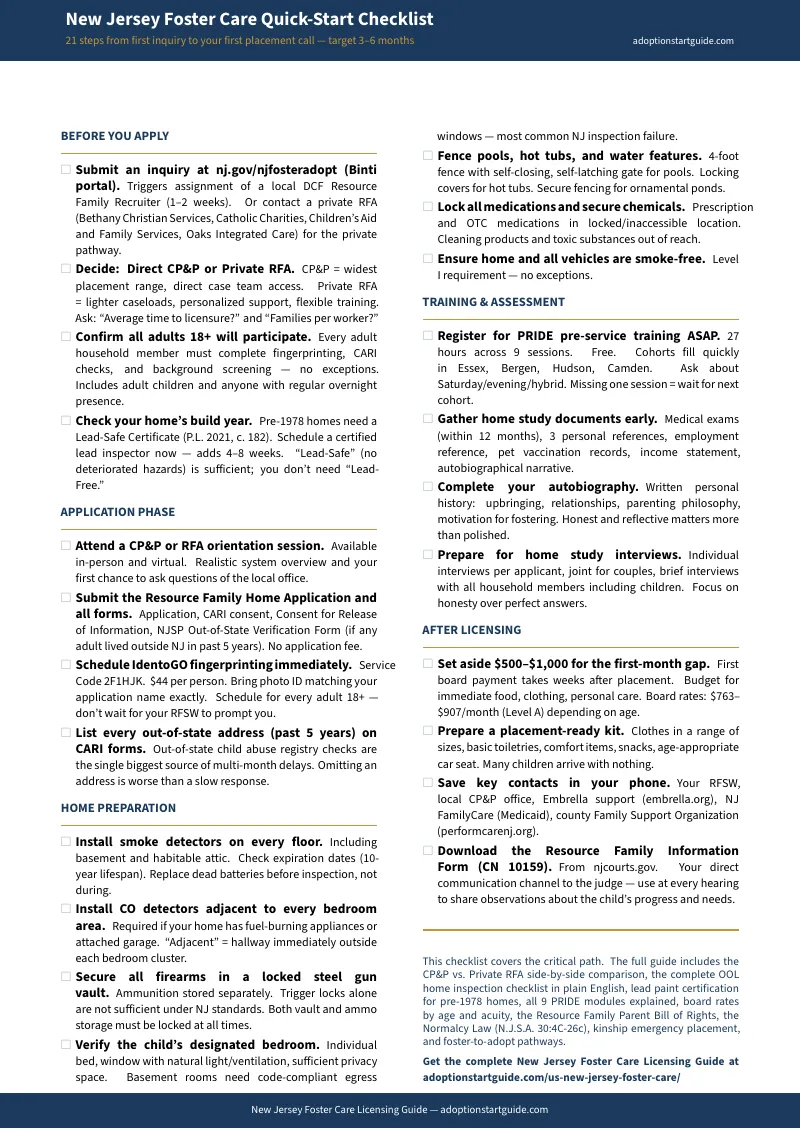
The free Quick-Start Checklist
Download the New Jersey Foster Care Quick-Start Checklist for the essential actions that move you from first inquiry through the CP&P system -- including the home safety items and document requirements that cause the most delays in the Garden State. Free, instant download, no commitment. If you want the full guide with the CP&P vs. RFA decision framework, the OOL pre-audit checklist, the lead-safe blueprint, the PRIDE training strategy, the background check walkthrough, the board rate tables, the kinship emergency path, and the county-level navigation, click the button in the sidebar.
-- less than the cost of one PRIDE training makeup session you won't need
One failed OOL inspection because nobody told you about the carbon monoxide detector placement rule adds two to three months to your timeline. One wrong background check sequence means clearances expire before others arrive and you start over. One missed PRIDE session because you didn't know it was the only evening slot this cycle means waiting for the next training round while your application sits idle. This guide puts the entire New Jersey foster care licensing process in your hands for less than what most families spend on gas driving to a CP&P office that never returns their call. Families who understand the system before they enter it pass the OOL inspection on the first visit, complete PRIDE without losing six months, and walk into their first placement prepared -- not overwhelmed.
If the guide doesn't deliver, reply to your download email at any time for a full refund. No forms. No justification required.