North Carolina has 100 county DSS offices, a seven-day consent window that most online forums get wrong, and a brand-new digital case management system that your agency's handbook hasn't been updated for.
You started on the NC DHHS website looking for a clear path to adoption. What you found was a compliance archive. Dense administrative language written for county caseworkers and agency auditors. Links to NCGS Chapter 48 sections with no explanation of what they mean for your kitchen table conversation about becoming a family. A list of licensed child-placing agencies with no guidance on how their fees compare, how their wait times differ, or whether you even need an agency for your situation. You expected a roadmap. You got a regulatory filing cabinet.
So you tried your county DSS website. Mecklenburg County's adoption page points you to Children's Home Society. Wake County's page links to a general foster care orientation. Durham County's page hasn't been updated since before the Fostering Care in NC Act shifted oversight to the state level. You checked three counties and found three completely different starting points. Nobody told you that the county you live in affects your wait time, your caseworker availability, and your timeline to finalization -- and that a family in Buncombe County might finalize in two months while a family in Mecklenburg waits six.
Then you turned to the internet. A national adoption guide told you that birth mother consent is irrevocable once signed. That is not North Carolina law. Under NCGS 48-3-608, the birth parent has exactly seven days to revoke consent in writing -- and if the seventh day falls on a weekend or holiday, the window extends. Someone on Reddit said you need a private agency for any domestic infant adoption. That is not true either -- North Carolina permits independent adoption through an attorney with a licensed social worker conducting the home study. A Facebook group member told you the preplacement assessment is just a house tour. The preplacement assessment is a comprehensive evaluation of your finances, your marriage, your childhood history, your emotional readiness, and your home safety -- conducted by a licensed entity whose recommendation determines whether the Clerk of Superior Court will sign your decree.
Meanwhile, the agency websites are warm and encouraging. Children's Home Society wants you in their program. Baptist Children's Homes wants you in theirs. Christian Adoption Services wants you in theirs. They will not explain that you can pursue an independent adoption for $15,000 less than their agency fee. They will not tell you that the PATH NC digital system is changing how their caseworkers track your file. They will not mention the SB 248 vital records change that lets you get your child's birth certificate from the local Register of Deeds in days instead of waiting months at the state office in Raleigh. They are marketing to you. They are not guiding you.
The 100-County Adoption Navigator: Your Operational Guide to Adopting in North Carolina
This guide is built for North Carolina's county-administered adoption system -- the real one, not the simplified version on the state website. Every chapter addresses the specific statutes under NCGS Chapter 48, the operational differences across the 100 county DSS offices, and the 2026 legal changes that most resources have not caught up with. It is not a repurposed handbook from another state. It is the layer between what NC DHHS publishes for professionals and what you actually need to know to adopt -- in your county, under the rules that apply right now, updated for the PATH NC digital transition, the SB 248 birth certificate reform, and the current Fostering Care in NC Act restructuring.
What's inside
- 100-County DSS Routing Strategy -- North Carolina is a county-administered state, which means the pace, availability, and responsiveness of your adoption process depends on which of the 100 county DSS offices you're working with. Mecklenburg County has the highest caseload in the state and budgets three to six months from filing to finalization. Buncombe County in the west can finalize uncontested cases in two months. Cumberland County near Fort Liberty handles a high volume of military adoptions and knows the ICPC complications that come with PCS orders. This chapter maps the major county offices -- contacts, typical timelines, local procedures -- so you make informed decisions about where and how to file instead of discovering the differences after you've already started.
- Seven-Day Consent Revocation Decoded (NCGS 48-3-608) -- This is the legal provision that keeps adoptive families awake at night, and the one that online forums get wrong most often. In North Carolina, a birth parent who signs consent has exactly seven days to revoke it in writing. The day of signing is excluded from the count. Weekends and holidays extend the deadline. After the seven days expire, consent is irrevocable except for proven fraud or duress -- an extremely high legal bar. This chapter explains the precise calculation, the difference between a "consent" in independent adoption and a "relinquishment" to an agency, and includes the Seven-Day Survival Plan: a framework for managing the most emotionally intense week of the adoption process with communication guidelines, documentation practices, and a day-by-day protocol.
- Five Pathways Compared -- Public DSS, Private Agency, Independent, Stepparent, and Relative/Kinship -- North Carolina allows five distinct adoption pathways, and most families do not realize they have a choice until they are already committed to one. Foster-to-adopt through your county DSS costs $0 to minimal out of pocket but requires foster licensing and involves a termination of parental rights process that can take 12 to 24 months. Private agency adoption through CHSNC, BCH, or Bethany runs $20,000 to $40,000. Independent adoption with an attorney and a licensed social worker costs $15,000 to $30,000 and can be faster. Stepparent adoption is $1,500 to $2,500 and often waives the home study. Relative and kinship adoption is $1,500 to $5,000 and is surging in western NC's mountain counties. One chapter, five paths, zero agency marketing.
- Preplacement Assessment Room-by-Room Preparation -- The home study is the gatekeeping mechanism in North Carolina adoption law. No adoption of a minor can be finalized without a current, favorable preplacement assessment. This chapter walks you through every dimension the social worker evaluates: the physical home inspection (smoke detectors, carbon monoxide detectors, firearm storage, medication lockup, pool fencing), the financial assessment, the medical evaluation, the personal interviews about your childhood, your motivations, and your relationship stability, and the references. It includes the room-by-room preparation guide so you can walk your own home with the same checklist the social worker will use -- and fix everything before the first visit, not after a re-inspection delay.
- Military Family Adoption Roadmap -- North Carolina is home to Fort Liberty (Army, Fayetteville) and Camp Lejeune (Marines, Jacksonville) -- two of the largest military installations in the country. Thousands of military families adopt each year, and they face challenges that civilian guides do not address: deployments that interrupt the home study, PCS orders that trigger ICPC requirements mid-process, home study validity across state lines, and the question of whether BAH counts as income during the financial assessment (it does). This chapter includes the complete DD Form 2675 reimbursement process for the $2,000-per-child DFAS adoption expense reimbursement, the military legal assistance contacts at Fort Liberty and Camp Lejeune, and deployment-proofing strategies so a reassignment does not unravel your adoption.
- ICWA and Eastern Band of Cherokee Compliance -- North Carolina is home to the Qualla Boundary, the tribal lands of the Eastern Band of Cherokee Indians. The Indian Child Welfare Act is not a theoretical issue here -- it is a practical requirement that families and attorneys encounter regularly. If there is any reason to believe a child may have Native American heritage, the court must send notice to the relevant tribe and the Bureau of Indian Affairs. Failure to do this can result in the adoption being set aside years after finalization. This chapter covers the ICWA placement preferences, the "active efforts" standard, the specific contacts at the EBCI Family Safety office, and the NC Division of American Indian Affairs Indian Child Welfare Program.
- PATH NC Digital System Navigation -- The state is in the middle of a significant technology transition. The PATH NC digital case management system is changing how caseworkers track and manage adoption cases across all 100 counties. The Fostering Care in NC Act has shifted North Carolina toward greater state-level oversight of the county DSS agencies. These changes are still rolling out, and many agency handbooks and free resources have not caught up. This chapter explains what PATH NC means for your adoption timeline, how to work with caseworkers who are learning a new system, and what the centralization trend means for families currently in the pipeline.
- SB 248 Vital Records Modernization -- Until January 2026, getting a new birth certificate after adoption meant submitting a request to the state Office of Vital Records in Raleigh and waiting weeks or months in a backlog. Senate Bill 248 changed that. Adoptive families can now obtain certified copies of the new birth certificate directly from their local Register of Deeds office -- a process that takes days instead of months. Most adoption resources still point families to the old Raleigh process. This chapter walks you through the new local process step by step: confirming the Clerk filed DSS-1815, allowing processing time, visiting the Register of Deeds with your decree and ID, and requesting the five certified copies you'll need for Social Security, school enrollment, insurance, and passport applications.
- Complete DSS Form Checklist -- Every form required to file an adoption petition in North Carolina, in the order the Clerk of Superior Court expects to see them: DSS-1800 (petition), DSS-1801/1802 (consent or relinquishment), DSS-1808 (report to the court), DSS-1809 (affidavit of parentage), DSS-5191 (affidavit of fees), DSS-1815 (report to vital records), the preplacement assessment, and the ICPC 100A for interstate placements. The chapter explains what each form does, who completes it, and the specific requirements that trigger rejection if missed.
- Financial Planning and Adoption Assistance -- North Carolina covers nearly all costs for families adopting from foster care, including monthly adoption assistance subsidies of $702 to $810 per month depending on the child's age, with supplemental payments up to $1,600 for high medical needs. Medicaid eligibility continues until age 18 or 21 regardless of the adoptive family's income. The federal adoption tax credit provides up to approximately $16,810 per child. Major employers in the RTP and Charlotte often offer $5,000 to $10,000 in adoption reimbursement benefits. This chapter consolidates every financial resource available to North Carolina families and includes the critical rule that the Adoption Assistance Agreement must be signed before finalization -- once the decree is entered, the state has no obligation to negotiate.
Printable standalone worksheets included
- Adoption Timeline Tracker -- Every milestone from your first agency or attorney contact through the final decree hearing, with fill-in date fields. Print it, update it after every court filing and caseworker visit, and always know where you stand in the process.
- Document Checklist -- DSS-1800, DSS-1801/1802, DSS-1808, DSS-1809, DSS-5191, DSS-1815, background check clearances, medical statements, financial disclosures, reference letters, and the preplacement assessment -- every document you need, in filing order, with checkboxes.
- Financial Planning Worksheet -- Agency fees, attorney fees, home study costs, court filing fee, birth parent expenses, adoption assistance subsidies, employer benefits, the federal tax credit, and the military DFAS reimbursement -- all in one printable sheet for your household budget conversation.
- Home Safety Preparation Sheet -- Room-by-room walkthrough of every preplacement assessment physical requirement: smoke detectors, CO detectors, firearm storage, medication lockup, pool and pond fencing, emergency numbers posted, and hazardous materials. Walk your home with this before the social worker arrives.
Who this guide is for
- Research Triangle families pursuing private or independent adoption -- You're in Raleigh, Durham, or Cary. You work in tech, biotech, or higher ed. You've researched agencies online and you know the process costs between $15,000 and $40,000. What you don't know is how Wake County's timeline compares to Durham County's, whether hiring your own attorney for an independent adoption would be faster and cheaper than committing to an agency, or how the seven-day revocation period actually works under North Carolina law versus what you read in a national forum. This guide turns a multi-year research spiral into a single weekend read.
- Charlotte metro families navigating the agency landscape -- You're comparing Children's Home Society, Bethany Christian Services, Baptist Children's Homes, and Catholic Charities. Each agency's website is encouraging but none of them compare their fees to a competitor's, explain the independent adoption alternative, or tell you that Mecklenburg County's caseload means longer wait times than smaller surrounding counties. This guide provides the neutral comparison that no agency has an incentive to give you.
- Military families at Fort Liberty and Camp Lejeune -- You're active duty or a military spouse. You need to know whether a deployment will derail your home study, whether PCS orders trigger ICPC requirements, whether your BAH qualifies as income, and how to claim the $2,000 DFAS reimbursement after finalization. National adoption guides treat military families as an afterthought. This guide gives you a dedicated chapter.
- Stepparents formalizing an existing family -- The child already lives with you. You already do the parenting. You need the legal certainty -- inheritance rights, medical decision-making authority, the security of a final decree from the Clerk of Superior Court. You need to understand whether the absent biological parent will consent, whether parental rights can be terminated based on abandonment or failure to pay support, and whether you qualify for a home study waiver. This guide maps the stepparent pathway from consent through finalization.
- Western NC kinship caregivers and grandparents -- A grandchild, niece, or nephew was placed with you because a parent could not provide safe care. The opioid crisis has driven a surge in kinship placements across the mountain counties. You may not have planned to adopt, but you need to understand the kinship adoption pathway, the adoption assistance subsidies that continue after finalization, and how to navigate the Clerk of Superior Court process on a fixed budget. This guide costs less than a single hour of attorney time and covers what that consultation would.
- Faith-motivated families answering a call -- Your church's adoption ministry, an Orphan Sunday event, or a campaign by Baptist Children's Homes or 127 Worldwide brought you to this moment. Your heart is ready. This guide makes sure the paperwork matches the calling -- because spiritual readiness and legal compliance are both required to bring a child home in North Carolina.
Why the free resources aren't enough
The NC DHHS website publishes the rules. It lists the NCGS Chapter 48 sections, the NC Kids adoption network, and the county DSS directory. What it does not do is tell you which counties finalize in two months and which ones take six. It does not explain the strategic difference between an agency relinquishment and an independent consent, or how that difference affects your seven-day revocation timeline. It does not walk you through the new SB 248 birth certificate process at the Register of Deeds. It is a compliance resource for caseworkers, not a planning tool for families.
Children's Home Society, Baptist Children's Homes, and Christian Adoption Services provide polished content designed to bring you into their programs. They will not compare their fees to a competitor's. They will not tell you that an independent adoption with your own attorney might be faster and $15,000 cheaper. They will not explain that the open adoption agreement they helped you draft is generally not legally enforceable in North Carolina after the decree is signed. They are selling a service, not providing neutral guidance.
National adoption books on Amazon cost more than this guide and do not know that North Carolina uses the Clerk of Superior Court instead of a family court judge, that the seven-day revocation window has weekend and holiday extensions, that the Eastern Band of Cherokee Indians makes ICWA compliance a routine concern rather than a theoretical one, or that SB 248 changed the birth certificate process three months ago. A book written for all 50 states cannot tell you that your county's timeline is twice as long as the county next door.
The free Quick-Start Checklist
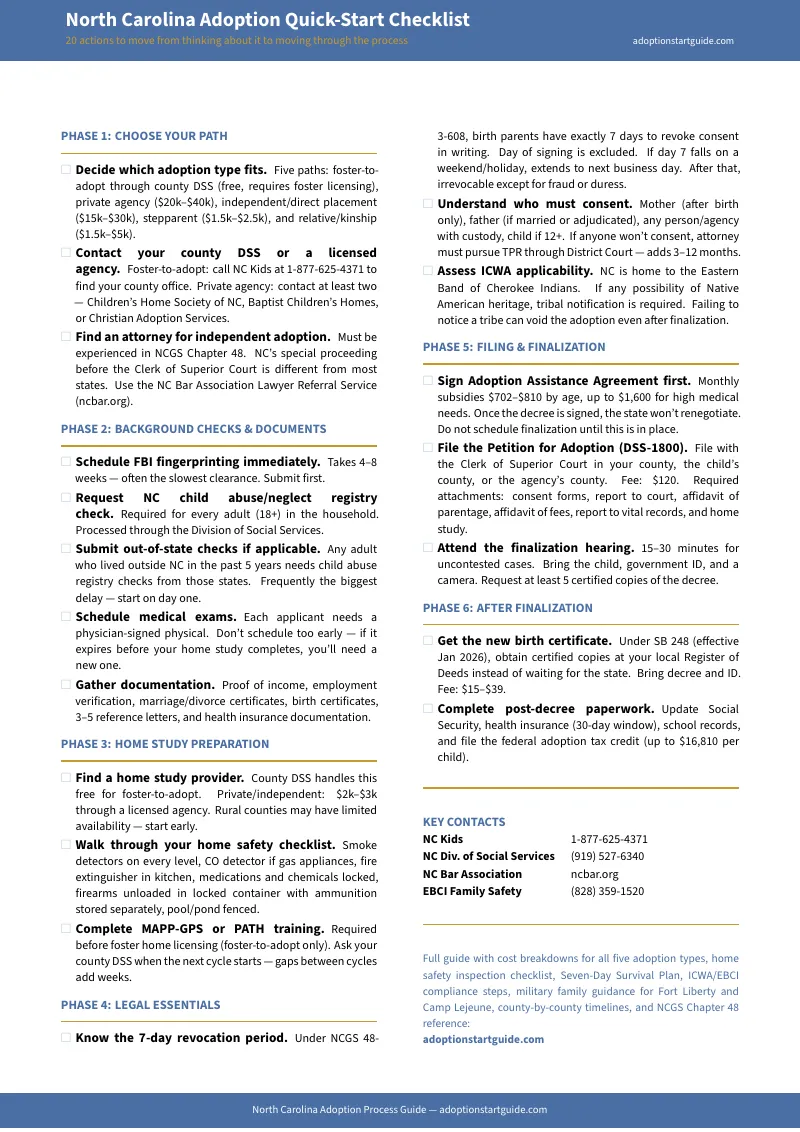
Download the North Carolina Adoption Quick-Start Checklist for a one-page overview of the adoption process, from choosing your pathway through your final decree hearing. Free, no commitment. If you want the full guide with the 100-county routing strategy, the Seven-Day Survival Plan, the military family roadmap, the ICWA compliance chapter, the room-by-room home study preparation, and the printable worksheets, click the button in the sidebar.
-- less than one hour of attorney time to navigate a 100-county system
The typical North Carolina adoption takes six to eighteen months of research before a family makes their first formal contact with an agency or attorney. During that time, they are piecing together the process from fragments scattered across 100 county DSS websites, a state portal designed for caseworkers, and online forums where other states' consent laws are cited as North Carolina fact. This guide distills the most critical decisions into a single weekend read. A wrong assumption about the seven-day revocation period creates emotional devastation that could have been prevented with one clear explanation. A missed ICWA notification requirement can unravel an adoption years after finalization. A family that does not know about the SB 248 Register of Deeds process waits months for a birth certificate that could be in their hands in days. An unplanned PCS order without ICPC preparation can derail a military family's adoption mid-process.
If the guide does not deliver, reply to your download email at any time for a full refund. No forms. No justification required.