
You want to foster a child in North Carolina. Then you discovered that 100 county DSS offices each run their own process, MAPP training fills up months in advance, and nobody can tell you whether your house will pass inspection until after you've already invested weeks of paperwork.
North Carolina's foster care system is state-supervised but county-administered — meaning every single one of the 100 county departments of social services has its own caseworkers, its own training schedules, its own interpretation of the fire inspection rules, and its own waitlist for home studies. The NCDHHS website gives you the text of 10A NCAC 70E in compliance language but never maps the steps in the order a family actually completes them. The fosteringnc.org site offers orientation videos and encouraging messaging but doesn't explain why Mecklenburg County's timeline looks nothing like Surry County's. Baptist Children's Homes and 127 Worldwide provide excellent faith-based recruitment but steer you toward their agency model without explaining the county DSS alternative. And the Facebook groups mix Wake County's process with Buncombe County's in the same thread.
Meanwhile, the details that determine whether you get licensed in four months or twelve are scattered across state administrative code, county-specific orientation packets, training provider calendars, and word-of-mouth from foster parents in your specific county. How long does SBI/FBI fingerprinting take in your county? When is the next MAPP or GPS training cohort, and what happens if you miss registration and wait four months? What does the home study worker actually ask your children during the interview? If you're stationed at Fort Liberty, does base housing meet 10A NCAC 70E fire requirements? If your grandmother just placed a nephew with you, what's the difference between staying unlicensed at $0/month and getting licensed for $702-$810/month?
Forty-five percent of people who begin researching foster care in North Carolina never complete the licensing process. Not because they weren't qualified. Because the patchwork system gave them no coherent path from "I'm interested" to "I'm licensed" — and after weeks of conflicting information, they quietly gave up.
The NC Licensing Roadmap
This is a complete, North Carolina-specific foster care licensing guide built around the central problem every family in this state hits: navigating a county-administered system where 100 different DSS offices, multiple pre-service training curricula, background check timelines, and home inspection standards each own a piece of the process but none of them explain how the pieces connect. Not a national overview. Not a government code book designed for social workers. Every chapter, every checklist, every board rate figure is grounded in current NCDHHS policies, 10A NCAC 70E administrative rules, and the real-world experience of families who have been licensed in this state.
What's inside
- 100-County Navigation Guide — North Carolina's biggest licensing variable isn't the rules — it's which county you live in. Caseworker caseloads vary from manageable to 20% above national averages. Training cohorts run monthly in Wake County and quarterly in rural Piedmont counties. This chapter gives you the framework for evaluating your county DSS: questions to ask at first contact, how to assess their current waitlist, what caseworker turnover rates mean for your timeline, and when a licensed child-placing agency is the better route. Because calling your county DSS blind is how families end up waiting six months just for an orientation date.
- Home Study Preparation System — The official application asks for references, financial documentation, and medical forms. The actual home study evaluates your marriage, your childhood, your discipline philosophy, and how your five-year-old answers open-ended questions from a stranger. This chapter covers the "hidden" checklist — the questions caseworkers are trained to explore, the household dynamics they're assessing, how to prepare your references so they don't accidentally raise red flags, and the room-by-room environmental standards that fail families who thought they were ready. Includes the specific fire inspection items, water temperature requirements, firearm storage rules, and medication lock-up standards from 10A NCAC 70E.
- MAPP/GPS Training Roadmap — North Carolina requires 30 hours of pre-service training through either the MAPP (Model Approach to Partnerships in Parenting) or GPS (Group Preparation and Selection) curriculum. This chapter maps the full training arc: what each session covers, the autobiographical exercises that feel invasive but are actually mutual assessments, the "Shared Parenting" module that intimidates most new families, makeup policy if you miss a session, and how to find the next available cohort when your county's schedule is full. Missing one registration window can delay your license by four months.
- Background Check Timeline Manager — Every adult in your household needs SBI state criminal checks, FBI fingerprinting, the NC Responsible Individuals List check, out-of-state Adam Walsh Act checks, and a DMV records review. SBI/FBI processing runs 2 to 4 weeks but can extend further. This chapter gives you the exact sequencing so all results arrive within the same validity window — because medical exams, TB tests, and background checks all expire, and one delayed result means re-testing everything else at your expense.
- Shared Parenting Communication Scripts — North Carolina mandates that foster parents work directly with birth parents toward reunification. Most prospective parents find this requirement terrifying in theory and manageable in practice — but only if they know what to expect. This chapter provides communication scripts for the first meeting with a birth parent, boundary-setting language for visitation logistics, and strategies for the emotional complexity of caring for a child while supporting the plan to return them home.
- Financial Reality Blueprint — Monthly board rates of $702 to $810 by age group, Medicaid coverage for all foster children, clothing allowances, child care subsidies, mileage reimbursement for case plan travel, and the tax treatment of foster care payments. This chapter also covers what the board rate does and doesn't cover, the expenses that catch families off guard, and how to plan financially so the reimbursement supports the child without straining your household budget.
- Military Family Supplement — Families at Fort Liberty and Camp Lejeune face unique intersections between DoD housing standards and North Carolina's 10A NCAC 70E fire safety requirements. Base housing layouts, installation fire marshals vs. county inspectors, how PCS orders affect an active license, and the support resources available through Military OneSource and installation Family Readiness Groups that don't appear in standard DSS materials.
- Kinship Fast-Track Guide — When a relative's child is removed and placed with you overnight, you don't have months to research. This chapter covers the emergency placement process, licensed vs. unlicensed kinship care (and the financial difference between $0/month and the full $702-$810/month board rate), the 15-hour NTDC kinship training alternative to the full 30-hour MAPP curriculum, the Mutual Home Assessment, and the path from temporary emergency placement to fully licensed kinship home.
- Licensing Countdown Tracker — Medical exams, TB tests, fire inspections, and background checks all expire on different timelines within a 180-day documentation window. One delayed component means re-doing earlier steps at $100+ per medical re-test. The tracker puts every deadline on one timeline so you never lose progress to an expired document.
Printable templates and checklists included
- Required Documents Checklist — Every document your county DSS requires during the application, organized in completion order with 180-day expiration tracking. DSS-5016 application, medical exams, background check authorizations, fire inspection request, reference contacts, financial disclosure, pet vaccination records, auto insurance, and MAPP/GPS training certificate.
- Home Safety Self-Inspection Checklist — Walk your home room by room before the caseworker arrives. Fire safety, water temperature (120 degrees max), firearms in locked storage with ammunition separate, medication lockup, bedroom requirements, pool fencing, smoke and CO detectors, and the North Carolina-specific items — wood stove clearances, well water testing, and fire extinguisher ratings — that trip up rural families.
- Placement Call Decision Sheet — When the phone rings with a potential placement, 14 questions to ask before you say yes or no. Child's age, behavioral history, medical needs, sibling status, visitation schedule, school arrangements, and the assigned caseworker's direct line.
- Monthly Expense and Reimbursement Tracker — Board rate income, clothing allowance claims, mileage logs for case plan travel, child care costs, and out-of-pocket expenses in one printable sheet formatted for North Carolina's submission requirements.
- Licensing Countdown Tracker — The 180-day documentation timeline on one page. Medical exams, TB tests, fire inspections, fingerprinting, and interstate checks mapped against their expiration dates so nothing expires before your license is issued.
- MAPP/GPS Session Tracker — Track all 12 training sessions across 30 hours with dates, topics, and completion status. Includes the kinship 15-hour NTDC track.
- Medication Administration Record — Daily medication log required by NC DSS for every child in your care. Child info, prescribing physician, dosage, time given, and initials.
- Monthly Caseworker Visit Log — Document every caseworker visit with topics discussed, concerns raised, next court dates, and worker name. Protects you during caseworker turnover.
- Key Contact Information Sheet — All essential contacts in one place: county DSS, licensing worker, caseworker, school, pediatrician, therapist, respite provider, plus statewide numbers and key legal references.
Who this guide is for
- Couples and individuals beginning the foster care process — You've watched the NCDHHS orientation video and called your county DSS, but you can't tell whether to schedule fingerprinting, register for MAPP training, or complete your medical exam first. This guide puts the steps in sequence so you stop researching in circles and start making measurable progress toward licensure.
- Rural families concerned about the home inspection — Your home has a wood stove, a private well, or a septic system. You don't have a fire hydrant within 1,000 feet. This guide tells you exactly what 10A NCAC 70E requires for each situation so your property doesn't derail an application that's otherwise ready to go.
- Military families at Fort Liberty or Camp Lejeune — You're ready to foster but you're not sure how base housing inspections, PCS orders, and deployment cycles interact with North Carolina's county-administered licensing requirements. The military supplement bridges the gap between DoD family support and state foster care regulations.
- Kinship caregivers acting in an emergency — A grandchild, niece, or cousin's child was placed with you this week. You need to understand your options immediately: unlicensed placement at no financial support, or the path to full licensure with $702-$810/month in board payments. This chapter exists because you don't have months to figure it out.
- Faith-community families answering the call — Your church hosted a foster care awareness event through BCH or 127 Worldwide and you feel called to serve the 11,000+ children currently in North Carolina's system. This guide translates that calling into concrete, county-specific action steps so your good intention doesn't stall in bureaucratic confusion.
Why the free resources aren't enough
The NCDHHS website covers the licensing process across dozens of pages written for departmental compliance, not for a family at their kitchen table trying to figure out where to start. It's organized by division — child welfare policy in one section, administrative code in another, training provider lists somewhere else — rather than by the sequence a family actually follows. A prospective parent in Davidson County has to navigate statewide reports, cross-reference county-specific contacts, and decode regulatory language just to determine their next concrete step.
FosteringNC.org provides encouragement and a general overview but doesn't address the 100-county variance that makes every family's path different. Baptist Children's Homes and other faith-based agencies offer excellent recruitment and support — for families who choose their specific agency pathway. They rarely explain the pros and cons of county DSS licensing versus private agency licensing, because they have a stake in the answer. Military OneSource covers fostering at a national level but lacks the North Carolina-specific knowledge of how 10A NCAC 70E intersects with on-base housing fire codes.
Reddit threads and Facebook groups give you peer support and secondhand experience. They also mix Mecklenburg County's urban process with Watauga County's rural requirements in the same conversation, recommend skipping steps that aren't skippable, and offer advice based on policies that changed two years ago. In a system where one missed training cohort costs you four months and one expired background check means re-fingerprinting at your own expense, secondhand advice from the wrong county is worse than no advice at all.
The free Quick-Start Checklist
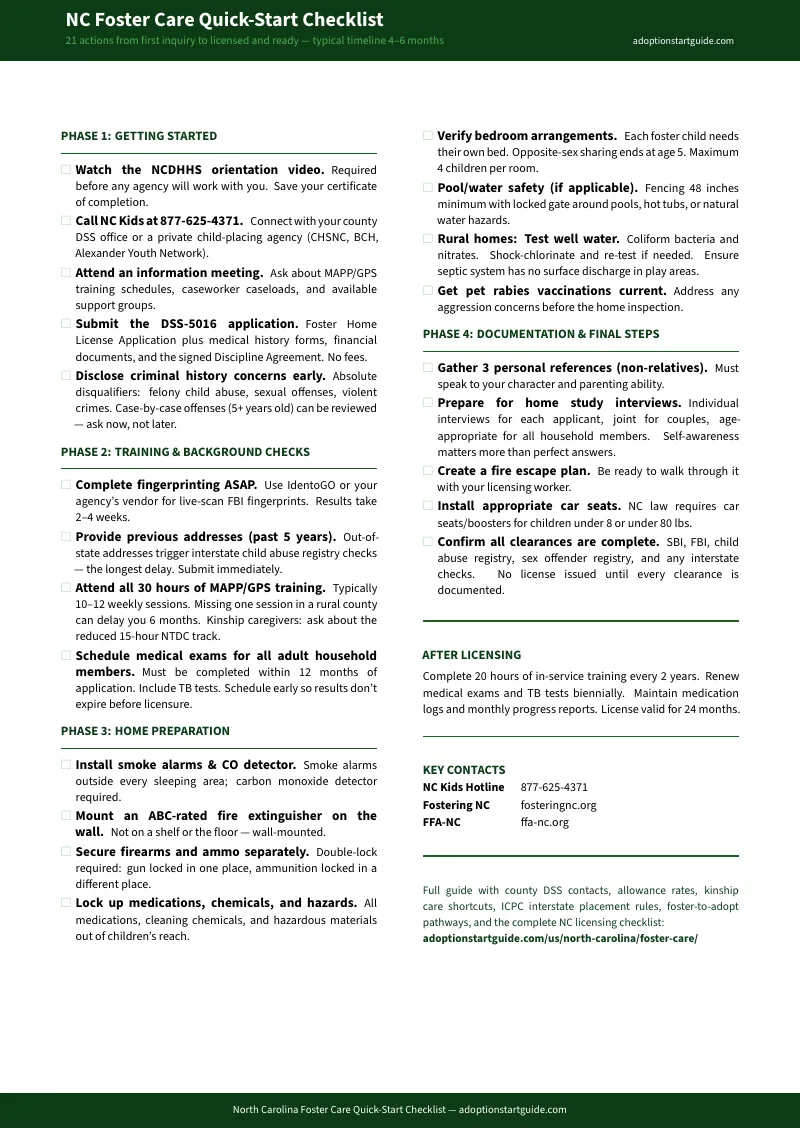
Download the North Carolina Foster Care Quick-Start Checklist for a one-page overview of the key licensing steps from first inquiry to approved license. Free, no commitment. If you want the full guide with the 100-county navigation framework, the home study preparation system, the shared parenting scripts, the military family supplement, the kinship fast-track pathway, and all the printable templates, click the button in the sidebar.
— less than one medical re-test
A single medical exam costs $100 or more. An expired TB test means paying again. A missed MAPP cohort delays your license by four months — and for kinship caregivers, every month without full licensure is a month at zero financial support instead of the $702-$810/month board rate you're entitled to. The NC Licensing Roadmap doesn't replace your county caseworker. It makes sure you don't waste their limited time asking questions the guide already answers, and it makes sure you don't learn about the training bottleneck, the background check sequence, or the 180-day documentation window after it's already cost you time and money you won't get back.