You want to adopt in North Dakota. You just didn't expect that the agency your parents used closed, the state redesigned the entire case management system, and nobody can tell you whether to call a Human Service Zone or a private agency first.
Lutheran Social Services of North Dakota facilitated adoptions in this state for 102 years. Then it closed its doors in 2021, and the institutional anchor for thousands of North Dakota families disappeared overnight. Catholic Charities absorbed some functions. Christian Adoption Services picked up others. But no single organization stepped into the gap, and the families still searching for "LSSND adoption" are landing on dead links and outdated phone trees.
Then in February 2024, the state redesigned its entire case management process. Assessment timelines shortened by 23 days. Background check fees for foster-to-adopt families were eliminated. Public agency adoptions surged 33.9% in a single year. But most of the advice circulating online — in forums, in national guides, in the pamphlets sitting in your agency's waiting room — predates the redesign. Families are following 2022 instructions through a 2024 system and wondering why nothing lines up.
And then there is the routing problem. In North Dakota, you cannot walk into your county office and start an adoption. Human Service Zones handle child protection — investigations, emergency removals, foster care case management. They do not handle adoptions directly. For home studies, licensing, and matching, you work with a private child-placing agency. For foster-to-adopt, the AASK program coordinates between the state and those private agencies. For stepparent adoption, the state provides no forms at all — you draft your own Summons and Petition from scratch or pay an attorney $325 to $1,500 to do it. Most families call the wrong office first and lose weeks before anyone redirects them.
Meanwhile, North Dakota is home to five federally recognized tribal nations — the Mandan, Hidatsa, and Arikara Nation, the Spirit Lake Tribe, the Standing Rock Sioux Tribe, the Turtle Mountain Band of Chippewa, and the Sisseton Wahpeton Oyate. Native American children represent 44% of children in foster care but only 9% of the state's total child population. The Indian Child Welfare Act applies to any child who is a member of or eligible for membership in a federally recognized tribe, and North Dakota's own HB 1564 now prioritizes tribal placement preferences as the top priority in those cases. Families who don't understand how ICWA works in this state — the "active efforts" standard, the "qualified expert witness" requirement, the 10-day post-birth consent rule for ICWA cases versus the "anytime after birth" rule for non-ICWA cases — risk having their adoption challenged or invalidated.
And if you live west of the Missouri — Williston, Minot, Dickinson, Watford City — you already know the geography problem. Most adoption resources, agencies, and attorneys are concentrated in Fargo and Bismarck. Finding a home study provider, a support group, or even a social worker who returns your calls from the western oil patch requires a different strategy than the one that works on the eastern side of the state.
Nobody in the system is working against you. But the system was not designed to explain itself. The HHS website gives you statutes. The court system gives you a research guide with no forms. The agencies give you their own process, not the full picture. And the families who came before you learned the hard way that adopting in North Dakota means assembling a roadmap from a dozen contradictory sources — or hiring a $250-to-$500-per-hour attorney to explain what this guide covers on page one.
The Post-Redesign Roadmap
This is a complete, North Dakota-specific adoption guide written for the state's current legal and institutional landscape: the 2024 Case Management Redesign, the NDCC Title 14 framework, the five-tribal ICWA requirements, and the post-LSSND provider reality. Not a national overview with the state's name swapped in. Every chapter, every checklist, every provider directory is grounded in how adoption actually works in North Dakota right now — from the Fargo metro to McKenzie County, from a private infant placement to a stepparent petition you are drafting at your kitchen table.
What's inside
- Five-pathway breakdown with 2024 Redesign updates — Foster-to-adopt through AASK, private licensed agency, independent attorney-facilitated, identified adoption under NDCC 14-15.1, and stepparent/relative/adult adoption. Each pathway explained with current costs, timelines, legal requirements, and the specific agencies and contacts that handle each one. The 2024 Redesign cut 23 days from assessment timelines and eliminated background check fees for AASK families — this guide tells you exactly how to take advantage of those changes instead of following outdated advice.
- ICWA compliance for all five tribal nations — A plain-language breakdown of how the Indian Child Welfare Act applies in North Dakota, including the "active efforts" standard that goes beyond the "reasonable efforts" required in non-ICWA cases, the qualified expert witness requirement, the specific placement preferences for each tribal nation, and the consent timing differences that trip up even experienced attorneys. This chapter reframes ICWA from a source of anxiety into a procedural framework you can follow with confidence — tribal partner adoptions increased 53.2% after the redesign because cooperation is working.
- The routing map — who to call and when — The single most confusing aspect of North Dakota adoption is knowing which entity handles what. Human Service Zones, Regional Human Service Centers, private child-placing agencies, the AASK program, and District Courts all play different roles at different stages. The guide maps the entire routing system so you contact the right office on your first call, not your fourth.
- Consent and revocation explained in plain language — When a birth mother can sign consent (anytime after birth in non-ICWA cases, no earlier than 10 days after birth in ICWA cases), what happens during the revocation window, and why NDCC 14-15-14 makes the final decree permanent and irrevocable. This is the chapter that answers the question keeping you up at night: "Can the adoption be reversed after it's final?" The answer under North Dakota law is no.
- Stepparent adoption without official forms — North Dakota is one of the states that provides no court forms for adoption. The guide walks you through the Summons, Petition, Verification, and proposed Decree that you need to draft, the $160 filing fee, the 21-day response period, and how to handle a non-cooperating biological parent. Whether you hire an attorney or prepare the documents yourself, you will know exactly what the court expects.
- Home study preparation for North Dakota realities — What social workers actually assess during the home study, from the firearms storage requirement to water temperature checks to the autobiographical narrative. The guide covers PRIDE training for foster-to-adopt families, the medical report, background check processing, and character references. If you live in a modular home in the oil patch, your home qualifies — permanence and commitment matter, not square footage.
- Post-LSSND provider directory — Where services went after Lutheran Social Services closed. Catholic Charities North Dakota (Fargo, Bismarck, Minot), Christian Adoption Services (Bismarck, West Fargo), All About U Adoptions (Burlington), Building Forever Families (Watford City), and the AASK program. Plus Regional Human Service Centers for post-adoption clinical support, the Post-Adopt Network for ongoing family services, and adoption attorneys across the state — including western ND practitioners that Fargo-centric resources never mention.
- Cost breakdown by pathway — From nearly free (AASK foster-to-adopt with eliminated background check fees) to $25,000+ (private agency infant adoption), every cost itemized: home study fees, agency fees, legal fees, court filing, birth certificate updates, and the adoption assistance subsidy that must be negotiated before finalization. The guide explains the federal Adoption Tax Credit, the $2,000 non-recurring expense reimbursement for special needs adoptions, and how to manage birth parent expenses legally under NDCC 14-15-10.
Printable standalone worksheets included
The guide comes with printable standalone PDFs designed for real-world use:
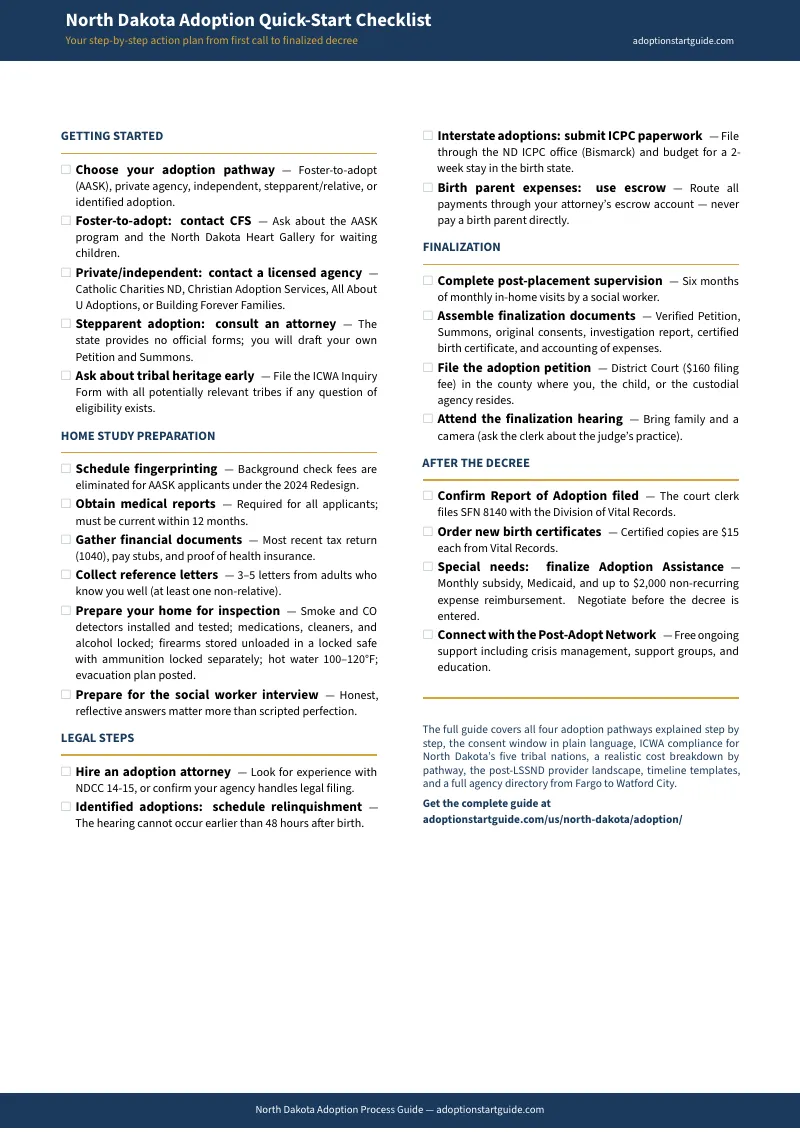
- Quick-Start Checklist — Every major action item from pathway selection through finalization and post-decree tasks, organized in the order the system expects you to complete them. Print it, check items off, and know exactly where you stand at every stage.
- Pathway Comparison Card — All five adoption pathways compared side by side on one page. Costs, timelines, eligibility, and legal requirements at a glance. Sit down with your family and make the decision that shapes everything else.
- Home Study Preparation Worksheet — The safety inspection checklist, document gathering list, and interview preparation guide on one printable sheet. Know what the social worker will look for before they walk through your door.
- ICWA Inquiry Checklist — A step-by-step guide for determining whether ICWA applies to your adoption, with the five tribal nations listed and the specific procedural requirements for each stage. File the inquiry early and avoid the most common compliance error in North Dakota adoption.
Who this guide is for
- Families exploring adoption for the first time — You have been thinking about this for months, maybe years. You have Googled "how to adopt in North Dakota" and found a dozen different starting points that all seem to contradict each other. This guide gives you the single, current, step-by-step roadmap that the state does not provide, organized by the pathway that fits your situation.
- Foster parents considering permanency through AASK — The child in your home has a permanency goal of adoption. You want to give them a legal family, not another temporary placement. The guide explains the AASK process, the 2024 Redesign efficiencies that apply specifically to you, the adoption assistance subsidy that must be locked in before finalization, and the transition from foster care per diems to permanent support.
- Stepparents and relatives formalizing an existing relationship — You have been raising this child. You want the birth certificate, the inheritance rights, and the legal permanency that comes with adoption. But the state provides no forms, and you are not sure whether you need an attorney or can handle the petition yourself. The guide gives you the document requirements, the filing process, and the cost comparison so you can make an informed decision.
- Families navigating ICWA requirements — You are adopting a child with tribal heritage, or you think the child might have tribal heritage, and the legal complexity has you paralyzed. This guide explains exactly what ICWA requires in North Dakota, what "active efforts" means in practice, and how to work with tribal social workers rather than around them. Families who understand the framework move through the process. Families who avoid it get blindsided.
- Western North Dakota families — You live in Williston, Minot, Dickinson, or a rural community hours from the nearest agency office. Most adoption resources assume you are in Fargo. This guide includes western ND providers, explains how to work with agencies remotely, and addresses the specific challenges of adopting in a region where "the nearest social worker" might be a three-hour drive.
Why the free resources aren't enough
The North Dakota HHS website provides the raw statutes — NDCC 14-15, NDCC 14-15.1, NDCC 27-20.3 — written in the dense, technical language of the Century Code. It tells you what the law says. It does not tell you how to prepare your kitchen for a home study, how to handle a birth father who will not sign consent, or whether your modular home in the Bakken disqualifies you. (It does not.)
The ND Courts website provides a research guide for adoption that explicitly states it offers no forms. In a state where every adoption petition must be drafted from scratch, that research guide tells you what documents exist without showing you what they look like or how to prepare them.
Adults Adopting Special Kids (AASK) is an excellent resource for foster-to-adopt — but it covers only that single pathway. If you are pursuing a private infant adoption, an independent placement, or a stepparent petition, AASK has nothing for you.
National guides from Adoption.com and American Adoptions rank well for North Dakota searches, but they are written for a generic American adoption process. They do not mention the 2024 Case Management Redesign. They do not name the five tribal nations or explain how North Dakota's own HB 1564 strengthens ICWA placement preferences. They do not address the LSSND closure or tell you which agencies absorbed which services. Using a national guide to adopt in North Dakota is like using a map of "The Midwest" to navigate from Fargo to Watford City — the general direction might be right, but you will miss every turn.
Reddit and Facebook groups provide lived experience and emotional solidarity, which matters. But they also provide conflicting legal advice, outdated agency recommendations, and the kind of ICWA anxiety that comes from secondhand stories rather than statutory understanding. This guide gives you the law, the process, and the providers — verified, current, and specific to North Dakota.
The free Quick-Start Checklist
Download the North Dakota Adoption Quick-Start Checklist for a one-page overview of the key steps from pathway selection through home study, legal filing, finalization, and post-decree tasks. Free, no commitment. If you want the full roadmap with five-pathway breakdown, ICWA compliance framework, routing map, provider directory, cost analysis, timeline templates, and printable worksheets, click the button in the sidebar.
— less than fifteen minutes with a Fargo adoption attorney
A single consultation with a North Dakota adoption attorney runs $250 to $500 per hour. Families routinely spend that first billable hour covering foundational questions this guide answers on page one — which pathway fits their situation, which agency to call first, whether ICWA applies, and what the home study actually involves. The Post-Redesign Roadmap does not replace your attorney. It makes sure you do not pay your attorney to explain the difference between a Human Service Zone and a child-placing agency, or to describe the consent timeline you could have understood before you walked in. You arrive at that first consultation — if you need one at all — ready to discuss strategy, not basics. For stepparent and relative adoptions, this guide may be the only resource you need.