
North Dakota reorganized its entire foster care system. The old county offices are gone. The state website still reads like administrative code. You're stuck between wanting to help and not knowing where to start.
You decided to become a foster parent in North Dakota. You went to nd.gov expecting a clear path. What you found was a system mid-transformation. Senate Bill 2086 dissolved the old county-administered model and replaced it with 48 Human Service Zones reporting to the centralized CFS Licensing Unit in Bismarck. The website still references "regional human service centers" in some places and "zones" in others. National foster care guides still tell you to "contact your county social services office" — an office that no longer exists.
You found NDAC 75-03-14 and tried to read it. The Minimum Physical Standards for family foster homes are written in regulatory language designed for licensing specialists, not for a family in Fargo trying to figure out whether their bedroom window meets the 24-by-20-inch egress requirement, or a couple in Williston wondering if their manufactured home on a lease qualifies as a "full-time residence." You learned about the 27-hour PRIDE training and couldn't find anyone who would tell you what to expect before you commit nearly four full days of your life to it.
Meanwhile, the landscape that used to guide North Dakota families has fractured. Lutheran Social Services of North Dakota — the organization that supported foster families for 102 years — closed in 2021. Catholic Charities remains strong, but their focus is adoption through AASK, not the nuts and bolts of getting a foster care license. The Facebook groups mix Minnesota rules with North Dakota rules on everything from firearm storage to bed-sharing. And if you live on a working farm or ranch, nothing you've read online addresses whether your outbuildings, livestock areas, and Quonset huts will trigger inspection concerns that a suburban home never would.
The information exists. It's buried across nd.gov policy manuals, the UND Children and Family Services Training Center calendar, NDAC regulatory text, and scattered peer advice that may or may not reflect the post-SB 2086 reality. You can spend six to twelve months assembling this picture yourself — that's the North Dakota average. Or you can read the guide.
The Licensing Navigation System: Your North Dakota Foster Care Guide
This guide is built for North Dakota's reorganized child welfare system and nobody else's. Every chapter, every checklist, every recommendation is grounded in NDAC 75-03-14, the current CFS Licensing Unit framework, the Human Service Zone structure, and the practical realities of getting licensed in a state where the nearest training site might be a three-hour drive across the prairie. It covers the gap between what nd.gov publishes and what you actually need to know to get from "interested" to "licensed" without the regulatory confusion, the failed inspections, or the months of research paralysis that the system redesign has created.
What's inside
- NDAC 75-03-14 in Plain English — Every Minimum Physical Standard for family foster homes translated from regulatory language into clear, actionable requirements. Bedroom dimensions, egress windows, water temperature limits, smoke detector placement, firearm storage rules, medication lockup, and the specific standards that differ from what you'll find in generic national guides. If you've been trying to read the administrative code yourself and getting lost in cross-references, this chapter does the translation for you.
- Zone vs. Unit Navigation Map — How the 48 Human Service Zones interact with the CFS Licensing Unit in Bismarck — who handles what, who you call when, and why the zone that manages the child in your care is a different entity from the unit that manages your license. This is the structural confusion that stalls most North Dakota applicants in their first month, and no national guide even acknowledges it exists.
- Agricultural and Rural Property Guide — A dedicated chapter for families fostering on working farms and ranches. Outbuilding inspections, livestock area safety perimeters, Quonset hut and barn access restrictions, fencing requirements, the "full-time residence" standard for homes on agricultural land, and the specific fixes — most under $50 — that turn a flagged rural property into a passing one. Written for the reality that most North Dakota foster homes are not suburban three-bedrooms with fenced backyards.
- PRIDE Training Survival Guide — The 27-hour Parents Resource for Information Development and Education pre-service training broken down session by session. What each module covers, what your trainers are evaluating, how the "Loss and Attachment" sessions work, how to find cohort schedules through the UND CFSTC, and practical strategies for completing the training when you're balancing shift work, farm operations, or a three-hour drive to the nearest training site. Includes guidance on the abbreviated 3-hour PRIDE for qualified relative placements.
- Background Check and Clearance Strategy — FBI fingerprint processing timelines, BCI criminal history checks, Child Abuse and Neglect Index screening, sex offender registry checks, health examinations for every household member, and the "12-month stability period" that applies if your medical history includes certain conditions. Starting the slowest clearances first is the single biggest factor in whether your licensing takes 90 days or 9 months.
- Home Study Preparation — What the licensing specialist actually evaluates during interviews, the questions they ask about discipline philosophy and personal history, what causes real denials in North Dakota versus the myths that circulate online, and how to prepare your household honestly. The home study is not a judgment of your lifestyle — it's a Safety Framework assessment. This chapter explains exactly what that means.
- Bakken Energy-Sector Stability Strategies — Specific guidance for oil field workers, pipeline contractors, and energy-sector families in Western North Dakota. How to document income stability when your pay fluctuates with rig counts, how to demonstrate residential permanence in Williston's high-turnover housing market, and how to structure your application around a 14-day shift rotation schedule. The licensing unit has seen every version of this — this chapter shows you how other Bakken families have addressed it successfully.
- 2023 State ICWA Guidance — Nearly 40% of North Dakota's foster children are Native American. House Bill 1536 codified the Indian Child Welfare Act into state law, creating specific requirements for "active efforts" and tribal notification that apply whether you're fostering through the state system or through one of the four tribal nations that license their own homes. A respectful, practical guide to what ICWA means for your foster care journey — including what it requires of non-Native families who may care for Native children.
- Kinship and Relative Licensing Path — If a grandchild, niece, nephew, or family friend's child has been placed with you, you may already be providing care without a license. North Dakota's "30-Day Rule" means any non-relative providing foster care beyond 30 days needs a license. This chapter covers the Licensed-Relative pathway, the financial difference between licensed and unlicensed kinship care, relative waivers for non-safety standards, and how to turn a crisis placement into stable, supported caregiving with access to the daily foster care rate.
- Financial Reality — North Dakota's daily foster care rates broken down by age and level of care, clothing allowances, supplemental support, Medicaid coverage for foster children, and an honest assessment of what the stipend covers versus what you'll spend out of pocket. Includes the kinship rate comparison that shows exactly how much more a licensed relative receives than an unlicensed one.
Printable tools and worksheets included
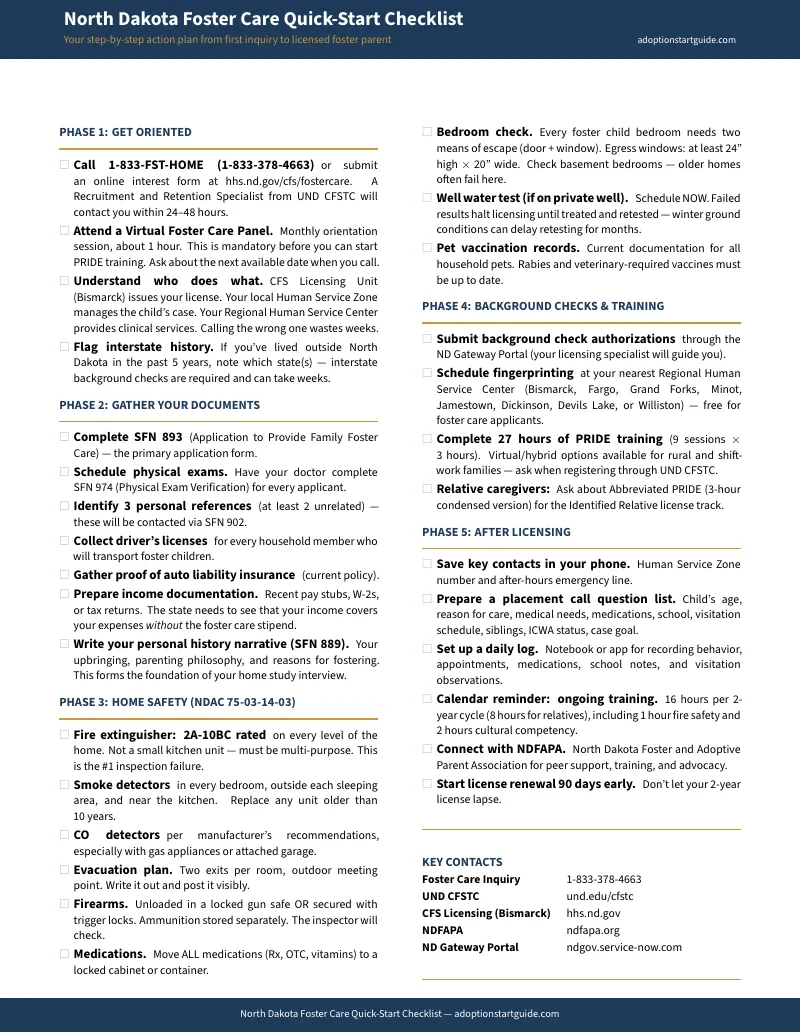
- Quick-Start Checklist — Every critical action from confirming eligibility through post-licensing obligations, organized into clear phases. Print it, check items off, and always know exactly where you stand.
- Application Document Tracker — Every required document with date-obtained columns and processing time estimates so nothing falls through the cracks during the clearance process.
- Home Safety Inspection Checklist — Room-by-room and property-wide walkthrough matching what the licensing specialist evaluates, with ND-specific requirements for rural properties, firearm storage, and outbuilding access.
- Reference Letter Prompt Sheet — A tool to give your 3-5 required personal references so they highlight the PRIDE competencies the state is actually looking for, instead of writing a generic character reference.
- Fire Safety Self-Assessment — Pre-inspection tool modeled on State Fire Marshal requirements so you can identify and fix issues before the licensing specialist visits.
- First Placement Quick Reference — What to discuss on the placement call, what to do when the child arrives, first 24-hour priorities, and first-week action items.
Who this guide is for
- First-time prospective foster parents — You've been on nd.gov for weeks. You've read fragments of NDAC 75-03-14, browsed the HHS foster care pages, maybe called 1-833-FST-HOME and still don't feel like you understand the full picture. You need someone to lay out the process in the order you'll actually encounter it, written for North Dakota's current system — not the county-based model that no longer exists.
- Rural and agricultural families — You live on a working farm or ranch. You have outbuildings, livestock, and property features that no generic foster care guide addresses. You've been assuming your property won't qualify, or you've been unable to find anyone who can tell you what the licensing specialist will actually look for when they drive out to your place. This guide was written for your property, not a suburb.
- Energy-sector families in the Bakken — You work in oil, gas, or pipeline. Your income is strong but your schedule is unconventional and your housing situation may be non-traditional. You've heard the licensing unit is skeptical of "transient" applicants. This guide shows you how to present your stability in a way that addresses those concerns head-on.
- Kinship caregivers — A child in your family was placed with you. You didn't plan for this. The child is already here. Now you need to understand the licensing process, the financial support available, and why getting formally licensed changes everything from your daily rate to your caseworker support.
- Families interested in tribal foster care — You want to understand how the state ICWA works, what "active efforts" means in practice, and how fostering a Native American child involves coordination between state and tribal systems. This guide treats tribal sovereignty with the respect it requires while giving you the practical information you need.
Why the free resources fall short
The nd.gov website publishes NDAC 75-03-14, the CFS Licensing Unit contact information, and the PRIDE training calendar. These materials are technically available and technically accurate. They are also written in regulatory language for compliance professionals, organized by administrative code section rather than by the order a family actually encounters the process, and scattered across multiple HHS subpages that don't link to each other in any logical sequence.
The UND Children and Family Services Training Center provides PRIDE scheduling but doesn't explain the pre-licensing steps. Families register for the 27-hour training before they understand the background check requirements, then discover mid-course that a medical history issue requires a 12-month stability period they could have started months ago.
Catholic Charities North Dakota provides strong support through the AASK program — for adoption. If you want regular foster care licensing or short-term respite certification, their resources are adoption-centric and won't walk you through the licensing-specific process.
National foster care guides refer to "county social services" — an entity that North Dakota replaced with Human Service Zones years ago. They describe a county-administered model that no longer exists here. And the Facebook groups mix North Dakota rules with Minnesota rules on firearms, sleeping arrangements, and inspection standards, because half the members in "North Dakota foster care" groups live in the Fargo-Moorhead metro and confuse the two states' requirements.
After Lutheran Social Services of North Dakota closed in 2021, the trusted community institution that had guided foster families for over a century was gone. Nothing has fully replaced it. This guide fills that gap — not as an agency, but as the structured, ND-specific resource that families lost when LSSND closed its doors.
The free Quick-Start Checklist
Download the North Dakota Foster Care Quick-Start Checklist for a phased overview of the licensing process: eligibility confirmation, zone and licensing unit contacts, background checks and clearances, PRIDE training, home study preparation, and post-licensing obligations. Free, no commitment. If you want the full guide with the NDAC 75-03-14 translation, agricultural property chapter, Bakken stability strategies, ICWA guidance, PRIDE survival guide, and the complete set of printable tools, click the button in the sidebar.
— less than one tank of gas to drive to training in Bismarck
The typical North Dakota applicant researches for six to twelve months before calling 1-833-FST-HOME. The confusion between zones and units, the regulatory language of NDAC 75-03-14, the uncertainty about rural property standards, and the gap left by LSSND's closure all contribute to a research phase that drags on far longer than the actual licensing process needs to take. A missed clearance requirement can add months. An outbuilding issue you could have fixed for $50 can turn a passed inspection into a failed one. A medical history question you didn't know about can trigger a 12-month wait that started running the day you discovered it, not the day you applied.
If the guide doesn't deliver, reply to your download email at any time for a full refund. No forms. No justification required.