
Ohio has 88 county Probate Courts that finalize adoptions, and no two of them charge the same filing fee or follow the same timeline.
You started on the ODJFS website looking for a clear path to adoption. What you found was a regulatory archive. Dense administrative language written for caseworkers and agency compliance officers. Links to ORC Chapter 3107 sections with no explanation of what they mean for your family. A list of certified assessors with no guidance on how to choose one. You expected a roadmap. You got a law library.
So you tried the county Probate Court website. Wayne County lists a $1,000 filing fee. Pike County charges $150 but requires an attorney. Fairfield County offers self-representation forms. Greene County bundles the assessor fee into a $750 filing. You checked four counties and found four completely different processes. Nobody told you that the county you file in could change your total cost by $850 before you even start.
Then you turned to the internet. A national adoption guide told you that birth mothers have a 30-day revocation period after signing consent. That's not Ohio law. In Ohio, once the birth parent signs consent before the Probate Court after the 72-hour wait, it is effectively irrevocable. Someone on Reddit said you need an agency for every type of adoption. That's not true either — Ohio allows independent adoptions with a certified assessor and an attorney. A Facebook group member told you the Ohio Adoption Grant covers up to $10,000. The actual program pays up to $20,000 for special needs adoptions, with no income limit. But the application goes through the OHID portal, and nobody in that thread could explain how to use it without getting rejected.
Meanwhile, the agency websites are polished and encouraging. They want you to sign with them. They won't explain that you can hire your own private assessor to speed up the home study. They won't tell you that your county's filing fee is five times higher than the next county over. They won't mention the Putative Father Registry and the 15-day deadline that protects your adoption from legal challenges — or the fact that missing it can unravel everything. They are marketing to you. They are not guiding you.
The 88-County Adoption Roadmap: Your Operational Guide to Adopting in Ohio
This guide is built for Ohio's county-administered adoption system — the real one, not the simplified version on the state website. Every chapter addresses the specific statutes under ORC Chapter 3107, the operational differences between the 88 Probate Courts, and the financial realities that national guides have no framework for. It's not a repurposed handbook from another state. It's the layer between what ODJFS publishes for professionals and what you actually need to know to adopt — in your county, under the rules that apply right now, updated for the 2025 Ohio Adoption Grant Program and the current NAS landscape.
What's inside
- 88-County Probate Court Fee Comparison — This is the information that saves you real money before you file a single document. Wayne County charges $1,000. Pike County charges $150. Greene County includes the assessor fee in a $750 filing. The county you choose affects your total adoption cost by hundreds or thousands of dollars — and most families never compare because no single resource puts it all in one place. This chapter does. Stop guessing what your county charges and start making informed decisions about where and how to file.
- Ohio Adoption Grant Application Walk-Through — The Ohio Adoption Grant pays $10,000 for standard adoptions, $15,000 for foster-to-adopt placements, and $20,000 for special needs adoptions. There are no income limits. But the application goes through the OHID portal, the required documentation is specific, and the most common rejection reasons are avoidable if you know what they are. This chapter walks you through the grant from eligibility verification through the MyOhio submission, including the certified adoption decree and W-9 requirements that trip families up. A $10,000 grant is worth getting right on the first try.
- Six Pathways Compared — Private, Agency, Foster-to-Adopt, Stepparent, Relative, and Independent — Ohio allows six distinct adoption pathways, and most families don't realize they have a choice until they're already locked into one. This chapter explains how each pathway works under Ohio law, what it costs, how long it takes, and who it's best suited for. The stepparent adopter legalizing an existing relationship needs a different process than the couple pursuing a private domestic infant placement. The grandparent taking custody of a grandchild born in the opioid crisis needs a different financial support structure than the family working with a licensed agency in Columbus. One chapter, six paths, zero agency marketing.
- The 72-Hour Consent Rule and Putative Father Registry Protection — Under ORC 3107.08, a birth mother cannot sign consent until 72 hours after the child is born. Once she appears before the Probate Court and signs, that consent is generally irrevocable — there is no 30-day revocation window like other states. But the Putative Father Registry has its own deadline: the search must be requested no later than 15 days after birth. Miss it and the adoption faces a legal vulnerability that could have been eliminated with a single filing. This chapter covers both timelines, the hospital protocol during the 72-hour wait, and the exact steps to protect your adoption from challenges that surface months later.
- Home Study Preparation and Assessor Selection Strategy — Ohio requires that only a certified adoption assessor listed on the ODJFS registry can conduct your home study. Most families accept whoever their agency assigns. This chapter explains why you should actively choose your assessor — including the fact that private assessors can often complete the JFS 1673 home study assessment faster than agency-assigned ones, and that the "file transfer" fee for moving your study between providers is a known cost you can plan for. It covers every section of the home study, the JFS 1691 application for placement, and the documentation you should have organized before the first interview, not during it.
- Adopting Children with NAS: A Trauma-Informed Chapter for Ohio Families — Ohio had 1,156 hospitalizations for Neonatal Abstinence Syndrome in 2023. For families considering adoption from the foster care system, the fear of NAS is real and usually based on incomplete information. This chapter provides the clinical data — average hospital stay of 14.9 days, 87.6% Medicaid coverage — alongside the practical reality of raising a child with prenatal substance exposure. It covers the Help Me Grow early intervention program, the Title IV-E Adoption Assistance subsidies, and the long-term developmental research that most agency brochures leave out. Fear should not be the reason a child waits longer for a family.
- Open Adoption Agreements — What ORC 3107.65 Actually Means — Many Ohio families believe their open adoption agreement is a binding contract. It is not. Under ORC 3107.65, post-adoption contact agreements are not enforceable by the court after the final decree. This chapter explains what that means in practice: how to build a sustainable open adoption relationship based on mutual commitment rather than legal obligation, what happens when one party stops participating, and why understanding this before finalization protects both your family and the birth family from unrealistic expectations.
- Birth Certificate Access and the 2015 Records Law — Ohio's 2015 law restored adopted adults' access to their original birth certificates. This chapter covers who qualifies, the request process, medical history access, and how adoptive families can prepare for the conversations that will arise as their children grow. For families whose children will eventually seek biological connections, understanding the legal framework now prevents surprises later.
Printable standalone worksheets included
- Adoption Timeline Tracker — Every milestone from your first assessor inquiry through the final decree hearing, with fill-in date fields. Print it, update it after every court filing and agency contact, and always know where you stand in the process.
- Document Checklist — JFS 1673, JFS 1691, birth certificates, marriage certificates, background check clearances, medical statements, financial disclosures, reference letters, assessor reports — every document you need, in the order you need it, with checkboxes.
- Financial Planning Worksheet — Agency fees, court filing costs, assessor fees, attorney fees, birth mother living expenses (capped at $3,000 under ORC 3107.055), and the Ohio Adoption Grant offset — all in one printable sheet for your household budget conversation.
- Home Safety Preparation Sheet — Room-by-room walkthrough of every home study physical requirement: smoke detectors, carbon monoxide detectors, firearm storage, medication storage, pool safety, and hazardous materials. Walk your home with this before the assessor arrives, not after.
Who this guide is for
- Families pursuing private domestic infant adoption — You're in Columbus, Cleveland, or Cincinnati. You've researched agencies online and you know the process costs between $10,000 and $35,000. What you don't know is how the 88-county fee structure affects your filing costs, how to choose a certified assessor who can move faster than your agency's default, or how to secure the Ohio Adoption Grant that could reimburse $10,000 to $20,000 of those fees with no income limit. This guide turns a five-figure process into a navigable sequence.
- Stepparents and relatives formalizing an existing relationship — The child already lives with you. You already do the parenting. What you need is the legal certainty — inheritance rights, medical decision-making, the security of a final decree. You need to understand ORC 3107.07's "consent unnecessary" provisions, the one-year absence test for a biological parent who has stopped supporting or communicating, and whether your county requires an attorney or allows self-representation. This guide maps the stepparent and relative adoption pathway county by county.
- Kinship caregivers in Appalachian and rural Ohio — A grandchild or a niece or nephew was placed with you because a parent couldn't provide safe care. You may not have planned to adopt. But you need to understand the kinship-to-adoption pathway, the Title IV-E subsidies that continue after finalization, and how the Ohio Adoption Grant applies to your situation. You're on a fixed income and a $300-an-hour attorney consultation isn't in the budget. This guide costs less than a tank of gas and covers what that consultation would.
- Families considering foster-to-adopt through a PCSA — You want to adopt a child from Ohio's foster care system. The county Public Children Services Agency has information about foster care licensing, but the transition from foster parent to adoptive parent involves a different legal process — Probate Court finalization, the termination of parental rights, and the adoption subsidy negotiation. This guide covers the bridge between the foster care chapter and the courthouse steps.
- Families concerned about adopting children with prenatal substance exposure — The opioid crisis has reshaped Ohio's child welfare landscape. Over 16,000 children are in foster care, and NAS affects a significant number of infants entering the system. You want to help but you're scared of what you don't understand. This guide provides the medical data, the early intervention resources, the subsidy programs, and the developmental research — without minimizing the challenges or overselling the outcomes.
Why the free resources aren't enough
The ODJFS website publishes the rules. It lists the ORC Chapter 3107 sections, the certified assessor registry, and the application forms. What it doesn't do is tell you which county Probate Court charges $150 and which one charges $1,000 for the same filing. It doesn't explain the strategic difference between hiring a private assessor and accepting your agency's default. It doesn't walk you through the OHID grant portal. It's a compliance resource for professionals, not a planning tool for families.
The county PCSA websites focus on foster care, not adoption. They're excellent for understanding how to become a foster parent in Franklin County or Hamilton County. They do not explain the private infant adoption pathway, the stepparent process, or the independent adoption option. If your path doesn't start with a foster placement, these sites have almost nothing for you.
Private agency websites — American Adoptions, Adoption Circle, Catholic Charities — provide polished content designed to bring you into their program. They won't compare their fees to a competitor's. They won't tell you that an independent adoption with your own assessor might be faster and cheaper. They won't explain that the open adoption agreement they helped you draft is not enforceable under Ohio law. They're selling a service, not providing neutral guidance.
National adoption books on Amazon cost more than this guide and don't know that Ohio's consent is irrevocable after the court hearing, that there's no 30-day revocation period, or that the Putative Father Registry has a 15-day deadline. A $20 book written for all 50 states cannot tell you that your county's filing fee is six times higher than the next county over.
The free Quick-Start Checklist
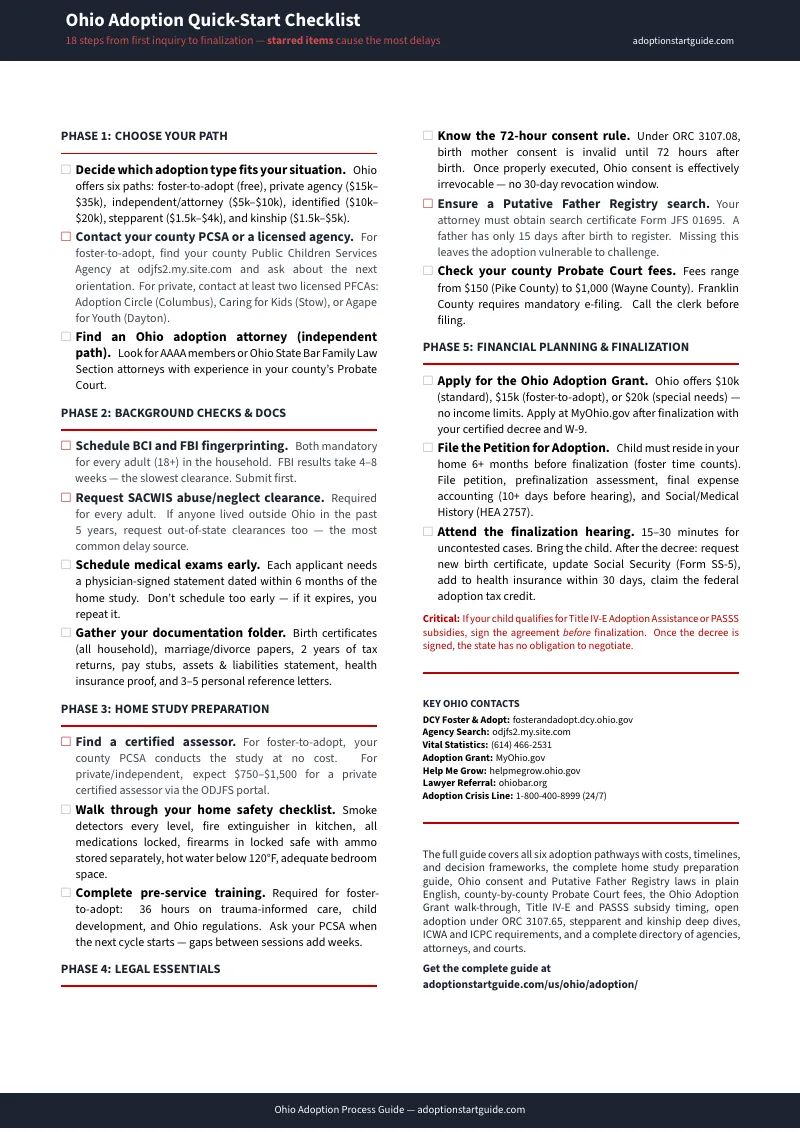
Download the Ohio Adoption Quick-Start Checklist for a one-page overview of the adoption process, from choosing your pathway through your final decree hearing. Free, no commitment. If you want the full guide with the 88-county fee comparison, grant application walk-through, assessor selection strategy, NAS chapter, and printable worksheets, click the button in the sidebar.
— less than one hour of attorney time to save weeks of research
The typical Ohio adoption takes six to twelve months of research before a family makes their first formal contact with an agency or assessor. During that time, they're piecing together the process from fragments scattered across 88 county websites, a state portal designed for caseworkers, and online forums where other states' laws are cited as Ohio fact. This guide distills the most critical decisions into a single weekend read. A wrong county filing costs you $850 in avoidable fees. One comparison chart prevents that. A missed Putative Father Registry deadline creates a legal vulnerability that could surface months after placement. One timeline prevents that. A rejected grant application delays $10,000 to $20,000 in reimbursement that has no income limit. One walk-through prevents that.
If the guide doesn't deliver, reply to your download email at any time for a full refund. No forms. No justification required.