
Ohio has 88 counties, 88 Public Children Services Agencies, and 88 different ways to answer the same question: "How do I become a foster parent?"
You decided to foster. Maybe the opioid crisis hit your neighborhood and you watched a family disintegrate across the street. Maybe your church ran a foster care awareness night and the numbers stopped being abstract — 15,000 children in Ohio's system at any given point, more than 24,000 cycling through each year. Maybe a niece or grandchild showed up at your door with a caseworker and a garbage bag and you realized you're already doing this — you just don't have the certificate yet.
So you went to fosterandadopt.dcy.ohio.gov looking for a clear starting point. What you found was a state portal built for administrators, not families. You discovered that Ohio is state-supervised but county-administered — meaning your experience in Franklin County (Columbus) will be structurally different from one in Meigs County (southeastern Appalachia), even though the governing rules are the same statewide. You found references to the Ohio Administrative Code — OAC 5101:2-5, OAC 5101:2-7 — that read like they were written for compliance attorneys. You found a "How to Become a Foster Parent in Ohio" page that told you to "contact your local PCSA or a private agency" without explaining what a PCSA is, how it differs from a PCPA or PNA, or why that choice might be the most consequential decision you make in the entire process.
Then you turned to Facebook. "Ohio Foster Parents." "Columbus Foster Care Support." "Northeast Ohio Fostering." You posted your question and got the answer that defines this system: "It depends on your county — call your local agency." But which agency? Your county PCSA? One of the private agencies that recruits across multiple counties? Nobody told you that a private PCPA might offer 24/7 crisis support and higher per diems while your county PCSA might hold quarterly orientations and take six months to return a voicemail. Nobody explained the tradeoff, because every free resource you found was either a government rulebook or a recruitment pitch from an agency trying to sign you up.
The state website publishes every rule in the Ohio Administrative Code. That's 400-plus pages of regulatory language. It publishes "Transmittal Letters" that update the rules — documents so dense that county caseworkers themselves need training to interpret them. Meanwhile, a grandparent in Scioto County raising her daughter's children on $12.40 a day through the Kinship Support Program has no idea that becoming fully certified would increase her daily rate to $25-$80+ and unlock clothing allowances, respite care, mileage reimbursement, and a $15/hour training stipend she's never heard of.
The 88-County Navigator
This guide is built for Ohio's county-administered foster care system and nobody else's. Every chapter, every checklist, every form reference is grounded in the Ohio Administrative Code (OAC 5101:2-5 and 5101:2-7), the Ohio Revised Code (ORC Chapter 5103), and the operational realities of a state where each of the 88 counties runs its own show under one set of statewide rules. It covers the gap between what the state posts online and what you actually need to know to get from "interested" to "certified" without wasted trips to the Sheriff's office, failed fire inspections, or months of silence from an agency that never explained the next step.
What's inside
- Ohio's System Explained — ODJFS, DCY, PCSAs, PCPAs, and PNAs — Ohio recently split child welfare oversight between ODJFS and the newer Department of Children and Youth (DCY). On the ground, 88 county PCSAs operate independently alongside private agencies (PCPAs and PNAs) that recruit and train foster families across county lines. This chapter maps the full organizational landscape — who sets the rules, who issues the certificates, who holds custody, and who you actually call — so you stop wasting time contacting the wrong office. You'll also get a neutral PCSA vs. private agency comparison framework with seven questions to ask each agency before committing, because no free resource will tell you when choosing a private PCPA over your county PCSA makes sense.
- Step-by-Step Certification Process — Ohio's certification journey has five stages, from initial inquiry through state certificate issuance. This guide walks you through each one in order: what happens, what your agency expects from you, which forms to submit and when (JFS 01673, JFS 01681, JFS 01653, JFS 01348), and how to avoid the common stalls that stretch a 6-to-9-month process to 18. You'll know what's coming before your caseworker tells you — and you'll know which steps to run in parallel instead of sequentially.
- The WebCheck Tactical Map — The BCI&I and FBI fingerprint-based background checks are the single step that causes the most avoidable delays in Ohio. You need to show up at an authorized WebCheck location with reason code ORC 2151.86 plus your agency's specific identifier code. If you give the wrong reason code, your results go to the wrong office, you've wasted $30-$70 in fees, and you're starting over. This chapter gives you the exact codes, explains where to go, what it costs, what the processing timeline looks like, and the "run your own first" strategy that catches surprises before the agency does.
- CORE Training Walkthrough — Ohio's 24-hour CORE (Comprehensive Overview and Review of Education) curriculum covers trauma, birth family partnership, behavior management, cultural diversity, and the Reasonable and Prudent Parent Standard. This chapter breaks down what each module covers, explains that 100% of pre-service training can now be completed through live virtual sessions, and reveals the OCWTP Regional Training Center strategy — if your rural county offers CORE training once a quarter, you can often attend at a regional center in a neighboring county to avoid waiting months.
- The Training Stipend Nobody Volunteers — Under OAC 5180:2-5-38, DCY pays private agencies $20 per training hour, and the agency is required to pass $15/hour through to the caregiver. For 24 hours of standard CORE training, that's $360. For 36 hours including additional modules, that's $540. The training itself is free — no tuition, no registration fee. The stipend also applies to continuing education after certification. Some agencies promote it. Others don't mention it unless you ask. This guide tells you to ask.
- Home Safety Audit — Pass the First Time — Derived directly from OAC 5101:2-7-12 and the JFS 01348 Safety Audit form. Smoke alarms on every level, carbon monoxide detectors (separate requirement), fire extinguisher rated 2A:10BC, firearms locked inoperative with ammunition locked separately, all medications locked (including vitamins and cough syrup), hot water at 120 degrees or below at the tap, well water tested by the county health department if applicable, no peeling paint, pool fencing. This chapter gives you the room-by-room walkthrough so you fix the five most common failure points before the inspector arrives — not after.
- The Type A/Type B Clarification — A persistent source of confusion in Ohio: local zoning boards, neighbors, and sometimes government employees confuse foster homes with "Type A" or "Type B" child care homes. A Type A home is a licensed daycare for 7-12 children. A foster home is governed by OAC 5101:2-7, a completely separate regulatory chapter. If someone tells you that you need a commercial kitchen or a separate entrance to foster, they're wrong. This chapter gives you the specific OAC citations to set the record straight.
- Certificate Types and the Matching Process — Ohio issues Family Foster Home certificates (standard), Treatment Foster Home certificates (for children with significant behavioral or medical needs — requires 365 days of experience or 60 hours of specialized training), and Medically Fragile Home certificates (for children requiring daily nursing-level care). With NAS infants from the opioid crisis driving demand for specialized placements, understanding which certificate matches your capacity — and how the per diem rates differ dramatically between tiers — shapes your entire fostering experience.
- Financial Reality Breakdown — Ohio's per diem rates vary by county and care level. Standard foster care typically pays $20-$80/day depending on the county and child's age. Treatment-level care pays more. The state maximum ceilings run from $300/day for standard care up to $1,000/day for intensive/medically fragile cases. Beyond the per diem: initial clothing allowance (typically $350 within 60 days), full Medicaid for every foster child, the $15/hour training stipend, mileage reimbursement, and state-subsidized childcare for working foster parents. The 88-county variation means two families 30 miles apart may receive very different rates for identical placements — which is why comparing agencies on specific dollar amounts, not state maximums, is critical.
- Kinship Care — The Financial Bridge — If you're a grandparent, aunt, uncle, or fictive kin raising a relative's child, you may be on the Kinship Support Program at $12.40/day for up to six months. Full certification bumps that to $25-$80+/day permanently, plus clothing allowances, training stipends, full respite care, and agency support. The certification process is the same — background checks, CORE training, home study, safety audit — but many agencies offer expedited timelines for kinship families because the child is already placed. This chapter maps the financial logic so you can see exactly how much you're leaving on the table.
- Foster-to-Adopt Pathway — Ohio law gives foster parents who have cared for a child for six months or more preference in adoption when reunification doesn't succeed. This chapter explains concurrent planning, how Permanent Custody works under ORC 2151.414, the separate adoption assessment, adoption subsidies that continue until the child turns 18 (or 21), and ongoing Medicaid eligibility for adopted children. It also addresses the hardest emotional truth: reunification with the birth family is the legal priority, and you must genuinely support that even when your heart wants a different outcome.
- Your Rights and Responsibilities — Ohio's Resource Family Bill of Rights gives you the right to all known information about a child before placement, the right to attend court hearings, the right to decline any placement, and the right to file a grievance. The Reasonable and Prudent Parent Standard (RPPS) means you can make normal parenting decisions — field trips, sleepovers, sports, haircuts — without caseworker approval for every activity. This chapter covers both sides: what protections you have and what documentation you're responsible for (medication logs, mileage logs, monthly reports, fire drill records).
- County-Specific Resources — Profiles of the major PCSAs (Franklin County/Columbus, Cuyahoga County/Cleveland, Hamilton County/Cincinnati, Lucas County/Toledo, Summit County/Akron, Montgomery County/Dayton) plus guidance for rural and Appalachian counties where training is less frequent, agency options are fewer, and transportation to appointments can be a barrier. Statewide resource directory including DCY, OCWTP, OFCA, OFCAA, and the Ohio child abuse hotline.
Printable standalone worksheets included
- Complete Document Checklist — Every form and supporting document organized by phase: application documents (JFS 01673, JFS 01681, JFS 01653), background check documents (reason codes, agency codes, five-year address history), home safety audit items (smoke alarms, CO detectors, firearms, medications, water temperature), and ongoing record-keeping requirements. Print it, keep it in your binder, check items off as you go.
- Certification Timeline Template — Week-by-week planner from initial inquiry through certificate issuance and placement readiness. Covers the realistic 6-to-9-month timeline with built-in parallel tracking so you're running background checks, gathering documents, and registering for training simultaneously instead of sequentially.
- Background Check Tracking Log — Track the status of BCI&I, FBI, SACWIS, sex offender registry, and interstate checks for every adult in your household. Submission dates, clearance dates, and status at a glance — print one per household member.
- Ohio Terms Glossary — PCSA, PCPA, PNA, ODJFS, DCY, OAC, ORC, CORE, OCWTP, SACWIS, BCI&I, WebCheck, KSP, OWF, RPPS, NAS, ICWA, and every other acronym Ohio's system throws at you — defined in plain language on one printable page.
- Key Forms Reference Sheet — One-page quick reference for JFS 01673, JFS 01691, JFS 01681, JFS 01653, and JFS 01348 — what each form is, who completes it, and when to submit it.
- Medication Administration Record — The daily medication log Ohio requires foster parents to maintain for every child in care. Child's name, Medicaid number, medication, prescribing physician, dosage, time given — print one per child per month.
- Monthly Drill and Progress Log — Fire and weather drill documentation plus monthly progress notes on health, school, and behaviors. Print one per month and keep in your binder for caseworker reviews.
- Key Contact Information Sheet — Your agency, assessor, caseworker, after-hours crisis line, child's school, pediatrician, respite provider, plus statewide numbers (child abuse hotline, poison control, DCY, OCWTP) — all on one printable page posted near your phone.
Who this guide is for
- First-time prospective foster parents — You've been thinking about this for months. You went to the DCY website and found an administrative archive where you expected a roadmap. You don't know the difference between a PCSA and a PCPA, whether to license through your county or a private agency, or what "ORC 2151.86" means. You need someone to translate Ohio's 88-county system into plain language and tell you what to do this week.
- Kinship caregivers — A grandchild, niece, nephew, or family friend's child was placed with you after a PCSA removal. The child is already in your home. You didn't plan for this. You may be receiving $12.40/day through the Kinship Support Program and not know that full certification could triple your daily support while unlocking clothing allowances, training stipends, and respite care. This guide maps the financial bridge from KSP to full licensure.
- Appalachian and rural Ohio families — You live in one of the 32 Appalachian counties where the opioid crisis has driven foster care entries above the state average, broadband access is limited, and your county PCSA may hold orientations quarterly instead of monthly. This guide is a downloadable PDF you can read offline, and it includes the OCWTP Regional Training Center strategy for accessing CORE training outside your home county.
- Healthcare and social service professionals — You're a nurse, therapist, social worker, or first responder who has seen the system's impact firsthand. You don't need a guide that tells you "children need love" — you need one that tells you the exact BCI reason code, the training stipend rule number, and the OAC citation for bedroom window requirements. This guide is written for people who want specifics.
- Faith-motivated families — The Forgotten Initiative, Hope Bridge, CarePortal, or your own church's foster care ministry brought you here. The calling is the engine. This guide is the map — it handles the regulatory navigation so your mission doesn't stall in a maze of county acronyms and form numbers.
- Foster-to-adopt families — You're entering the system hoping to eventually provide a permanent home. You need to understand how Ohio handles concurrent planning, Permanent Custody under ORC 2151.414, and the foster parent preference in adoption — and why the certification step is the prerequisite for everything that follows.
Why the free resources fall short
The state website publishes everything in the Ohio Administrative Code. That's comprehensive — and completely unusable for a family trying to figure out if their basement bedroom qualifies or whether a 20-year-old DUI disqualifies them. The OAC is written for administrators and compliance officers. "Transmittal Letters" that update the rules are even denser. You can find the answer to almost any foster care question in the OAC the same way you can find the answer to any tax question on the IRS website. But you still use TurboTax.
County PCSA websites vary wildly. Lucas County (Toledo) has one of the better sites — training calendars, stipend details, clear contacts. Many rural county sites are essentially non-functional. Franklin County offers virtual orientations. Your county might hold them quarterly. No county website will tell you: "You might want to license through a private agency instead of us because our caseworker-to-family ratio is 1:40 and a private PCPA in your area is 1:15." That assessment is exactly what an independent guide can offer.
Reddit and Facebook groups are valuable for community. The constant refrain is "call your county" — which assumes you know which county office handles foster care, who to ask for, and what questions to bring. The Ohio Foster Care and Adoption Association provides advocacy and legislative news but not a step-by-step licensing walkthrough. Every free resource either assumes you've already chosen an agency or is trying to recruit you into one. None of them meet you where you actually are: before your first call, trying to make sense of a system that has 88 independent entry points.
The free Quick-Start Checklist
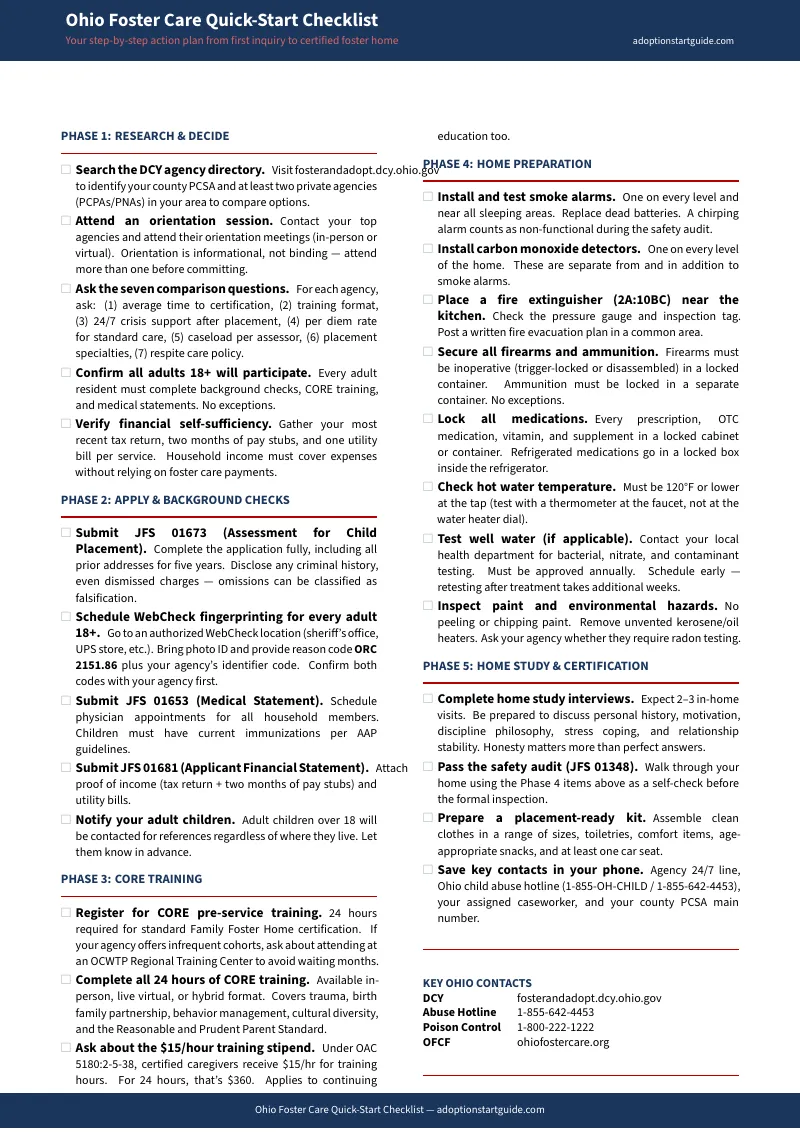
Download the Ohio Foster Care Quick-Start Checklist for a five-phase action plan covering the entire certification process — from searching the DCY agency directory through passing the safety audit and saving your key contacts. Free, no commitment. If you want the full guide with the PCSA vs. private agency comparison, WebCheck tactical walkthrough, CORE training breakdown, training stipend details, home safety audit preparation, kinship financial bridge, foster-to-adopt pathway, county-specific resources, and all eight printable worksheets, click the button in the sidebar.
— less than the cost of one BCI background check
A single BCI&I WebCheck fingerprinting appointment costs $30-$70 per person. Walking in with the wrong reason code — the single most common mistake Ohio applicants make — means you've wasted that fee and need to go back. One failed fire inspection because you forgot that carbon monoxide detectors are a separate requirement from smoke alarms delays your certification by weeks. One month of waiting on the Kinship Support Program at $12.40/day when you could be receiving $25-$80+/day as a certified foster parent is hundreds of dollars left on the table. One chapter of this guide prevents each of those problems.
If the guide doesn't deliver, reply to your download email at any time for a full refund. No forms. No justification required.