Oklahoma has 39 tribal nations, a Putative Father Registry most attorneys outside the state have never heard of, and a consent process that requires a district court judge. You searched "how to adopt in Oklahoma" and got none of that.
You found the OKDHS website. It covered the foster-to-adopt pathway in bureaucratic detail but said nothing about private agency or independent adoption. You found agency brochures from Deaconess and Nightlight and Catholic Charities, each describing their own process as if it were the only option, each steering you toward a $600 application fee before explaining what you were actually signing up for. You may have found the Oklahoma Bar Association's pro se handbooks, written for attorneys in statutory language that assumes you already know the difference between Title 10 and Title 10A. And you almost certainly found Reddit threads and Facebook groups where someone mentioned "Baby Veronica" and tribal intervention, and nobody in the comments could tell you whether that case actually applies to your situation or what Oklahoma law says about it now.
Here is what none of those sources told you. Oklahoma requires birth mother consent to be executed before a district court judge -- not notarized, not witnessed by a social worker, but certified by a sitting judge who confirms the mother understands the consequences and is acting voluntarily. That consent cannot happen until at least 72 hours after birth. Once executed, it is irrevocable under 10 O.S. section 7503-2.4, except for a fraud or duress challenge filed within 30 days. After the final decree, it cannot be challenged for any reason. That three-layer finality framework is one of the strongest in the country, and most families pursuing adoption in Oklahoma have never heard of it.
The Putative Father Registry -- the Centralized Paternity Registry at 10 O.S. section 7506-1.1 -- is the mechanism that prevents an unknown biological father from appearing months after placement and undoing your family. If a man has not registered with the CPR and has not maintained a "substantial and positive relationship" with the child, the court can proceed without his consent. That single statute eliminates the nightmare scenario that keeps prospective parents awake at night, but the DHS website does not explain how it works, agency brochures mention it in passing, and the Facebook groups treat it as a rumor.
And then there is ICWA. Oklahoma has the largest concentration of tribal nations in the country. Every adoption in this state must account for the Indian Child Welfare Act and the Oklahoma Indian Child Welfare Act, whether the child has confirmed tribal heritage or not. The standard is "reason to know" -- if anyone in the proceeding suggests Native ancestry, the child must be treated as an Indian child until the tribe confirms otherwise. The Baby Veronica case did not make ICWA a threat. It made compliance non-negotiable. A misspelled name on a tribal notification form cascaded into years of Supreme Court litigation. The lesson is not fear. The lesson is precision.
The 39-Tribe Navigator: Your Oklahoma-Specific Adoption Roadmap
This guide is built for the legal and procedural reality that Oklahoma families actually face -- the three distinct pathways, the DHS contracted agency system under the Pinnacle Plan, the 39-tribe ICWA landscape, and the statutory framework that governs consent, termination, and finalization in this state specifically. Every chapter cites the Oklahoma Adoption Code (Title 10, sections 7501-1.1 through 7511-1.1). Every procedural step reflects the current DHS contractor assignments, the current ICWA notice requirements, and the current district court finalization process. This is not a national adoption overview with Oklahoma mentioned in a footnote. It is the operational layer between what DHS posts online and what you actually need to know to adopt in Oklahoma -- through your pathway, under current law, in your county.
What's inside
- Three-Pathway Comparison -- DHS foster-to-adopt, private licensed agency (Deaconess, Nightlight, Catholic Charities, Adoption Choices, Oklahoma Baptist Homes), and independent attorney-facilitated adoption compared side by side. Costs, timelines, level of control, matching process, and the specific trade-offs of each route. The DHS pathway can cost zero dollars. Private agency runs $20,000 to $45,000. Independent runs $15,000 to $50,000+. This chapter maps each pathway so you can choose based on your budget, flexibility, and how much control you want over the matching process -- not based on which agency brochure you happened to pick up first.
- Consent and the 72-Hour Rule Decoded -- How Oklahoma's judicial consent process actually works: the 72-hour statutory floor after birth, the requirement for execution before a district court judge, irrevocability under section 7503-2.4, the 30-day fraud/duress challenge window, the absolute bar after the final decree, and the extrajudicial consent alternative under section 7503-2.6. This is the chapter that eliminates the "what if she changes her mind" fear with the actual statutory framework, not reassuring generalities.
- Putative Father Registry Explained -- The Centralized Paternity Registry (10 O.S. section 7506-1.1): what it is, how your attorney searches it, what happens if a father has registered versus has not, the "substantial and positive relationship" standard, and why the registry is a protection for adoptive families rather than a threat. This chapter covers the specific timelines that bar a late-appearing father from disrupting a finalized placement.
- ICWA Compliance Guide for Oklahoma's 39 Tribes -- Not a warning. A compliance checklist. How to determine whether ICWA applies (the "reason to know" standard), the mandatory tribal notification process (registered mail, return receipt requested, with specific required content), the tribe's right to intervene and petition for transfer to tribal court, the "active efforts" standard versus "reasonable efforts," ICWA placement preferences, the "good cause" exception, and how the Baby Veronica case actually changed practice in Oklahoma. Includes key tribal ICWA contact information for the Cherokee Nation, Choctaw Nation, Chickasaw Nation, Muscogee (Creek) Nation, Osage Nation, and Seminole Nation.
- Home Study Preparation Guide -- The Resource Family Assessment in detail: the 27-hour pre-service training requirement (DHS pathway), OSBI and FBI fingerprint-based background checks, OKDHS child welfare database search, medical clearance for all household members, financial verification standards, home safety requirements (firearms storage, pool fencing, smoke detectors, medication storage), interview preparation, reference selection, and the most common delays -- especially out-of-state background checks for families who have moved to Oklahoma recently. Timeline: 60 days to six months depending on preparation.
- DHS and Pinnacle Plan Navigator -- How the public foster-to-adopt system actually works in Oklahoma. The Pinnacle Plan consent decree and its impact on how DHS operates. Why you may be working with a contracted private agency (Deaconess, DCCM, TFI Family Services) instead of a DHS caseworker. The concurrent planning model. Eligibility, training, and what to expect during the reunification phase before a child becomes legally free for adoption.
- Stepparent, Relative, and Kinship Adoption -- The simplified procedures available when the adoptive parent already has an existing relationship with the child. The six-month residency requirement. The home study waiver for stepparents when the child has lived in the home for at least one year. Grounds for involuntary termination of the non-custodial parent's rights: abandonment (six months), failure to support (12 of 14 months), and unfitness. Kinship adoption pathways and subsidy eligibility for children previously in DHS custody.
- Financial Planning -- Cost breakdown by pathway. The federal adoption tax credit (up to $16,810). Oklahoma's state income tax deduction (up to $20,000 in non-recurring adoption expenses). Oklahoma Adoption Assistance subsidies for special needs children ($531 to $678+ per month). SoonerCare (Medicaid) eligibility for adopted children regardless of family income. Non-recurring expense reimbursement up to $1,200 per child. Oklahoma Promise tuition coverage for children adopted from DHS or tribal custody. Birth parent expense rules and the Affidavit of Expenditures requirement.
- Finalization and Post-Adoption -- The six-month post-placement supervision period, the petition filing process, the district court finalization hearing (20 to 60 minutes, closed courtroom), obtaining the amended birth certificate from OSDH Vital Records, the three-month "collateral attack" limit that makes your decree essentially unchallengeable, open adoption and post-adoption contact agreements under section 7505-1.5, the Interstate Compact on the Placement of Children (ICPC) for interstate cases, and post-adoption support resources including OKDHS post-adoption services, counseling referrals, and support groups.
- Oklahoma Agency, Attorney, and Resource Directory -- Licensed child-placing agencies (Catholic Charities OKC, Nightlight Christian Adoptions Tulsa, Deaconess OKC, Adoption Choices Oklahoma, Oklahoma Baptist Homes), attorney referral sources (Oklahoma Bar Association Family Law Section, AAAA), tribal ICWA contacts for major Oklahoma nations, the OKDHS ICPC office, and OSDH Vital Records.
Printable standalone worksheets included
- Adoption Timeline Tracker -- Every milestone from first contact through court finalization, with fill-in date fields. Print it, update it after every meeting, and always know exactly where you stand in the process.
- Home Study Document Checklist -- Background clearances, medical exams, financial records, references, and home safety items organized in the order the evaluator expects them. Nothing missing when they arrive.
- Pathway Comparison Card -- DHS foster-to-adopt, private agency, and independent adoption compared on one printable page: costs, timelines, eligibility, matching process, and trade-offs.
- Financial Planning Worksheet -- Costs by pathway, tax credit calculation, subsidy eligibility, SoonerCare coverage, and reimbursement tracking in one printable sheet for your household budget conversation.
Who this guide is for
- OKC and Tulsa metro families starting the adoption conversation -- You have been researching for weeks or months. You have a dozen browser tabs open. You know adoption in Oklahoma is possible, but you cannot figure out which pathway fits your family, what it actually costs, or what happens first. You need the full picture before you commit $600 to an agency application fee or $300 to an attorney consultation.
- Faith-driven families answering the call -- Your church, your ministry group, or your own reading of James 1:27 has brought you to this point. You are spiritually ready. Now you need the practical roadmap -- the legal steps, the financial reality, the timeline -- that turns conviction into action. This guide bridges the gap between calling and compliance.
- Military families at Tinker AFB or Fort Sill -- You have reached a point in your career where you are stable enough to pass a home study. But you have also lived in multiple states in the past five years, which means out-of-state background checks, potential ICPC complications, and the constant question of whether a PCS order will disrupt your placement. This guide addresses the military-specific complications head on.
- Foster parents whose case goal just changed to adoption -- Your contractor or DHS caseworker told you the child in your care is becoming "legally free." The goal has shifted from reunification to permanency. But nobody explained the TPR timeline, the subsidy negotiation process, or how the Pinnacle Plan contractor system handles the transition from foster care to adoption. You need the roadmap from foster parent to legal parent.
- Stepparents and kinship families formalizing an existing bond -- The child is already in your home. You are already the parent in every way that matters. Now you need to make it legal, and you need to understand whether the home study waiver applies, how to handle the non-custodial parent's rights, and what it costs when you do it right the first time.
- Families navigating ICWA and tribal sovereignty -- The child in your adoption has confirmed or possible Native American heritage. You need to understand the tribal notification requirements, the placement preferences, the "active efforts" standard, and the tribal court transfer process. You need a guide that treats tribal sovereignty as a procedural reality to comply with, not a vague warning to worry about.
Why the free resources fall short
The OKDHS website covers the foster-to-adopt pathway for children in state custody. It says nothing about private agency or independent adoption. It does not explain the Putative Father Registry, the 72-hour consent rule, or how ICWA compliance works when you are the one doing the adopting rather than the state. It is written for the system's needs, not yours.
Agency websites -- Nightlight, Catholic Charities, Deaconess -- describe their own programs as if each were the only option. They are recruiting you as a client, not helping you compare. None of them will tell you that the DHS pathway costs zero dollars, that independent adoption gives you more control over matching, or that their $600 application fee is non-refundable if the match falls through.
The Oklahoma Bar Association's pro se handbooks are written in Title 30 statutory language. They define "guardianship" with precision but give no guidance on the emotional, logistical, or financial realities of the adoption process. They are reference material for attorneys, not roadmaps for families.
Reddit and Facebook groups are where the misinformation lives. Someone mentions "Baby Veronica" and suddenly every prospective parent in the thread believes ICWA means their adoption will be overturned. Nobody in the comments can cite the actual statute, explain the three-month collateral attack limit, or describe what proper ICWA compliance looks like. The fear is real. The information behind it is not.
Oklahoma adoption attorneys charge $200 to $400 per hour. A one-hour consultation gives you general advice about your specific situation -- not a full comparison of all three pathways, not ICWA compliance checklists, not a directory of every agency and attorney in the state, and not the Putative Father Registry explained in language you can actually understand. This guide puts the entire Oklahoma adoption system in your hands for a fraction of what a single legal hour costs.
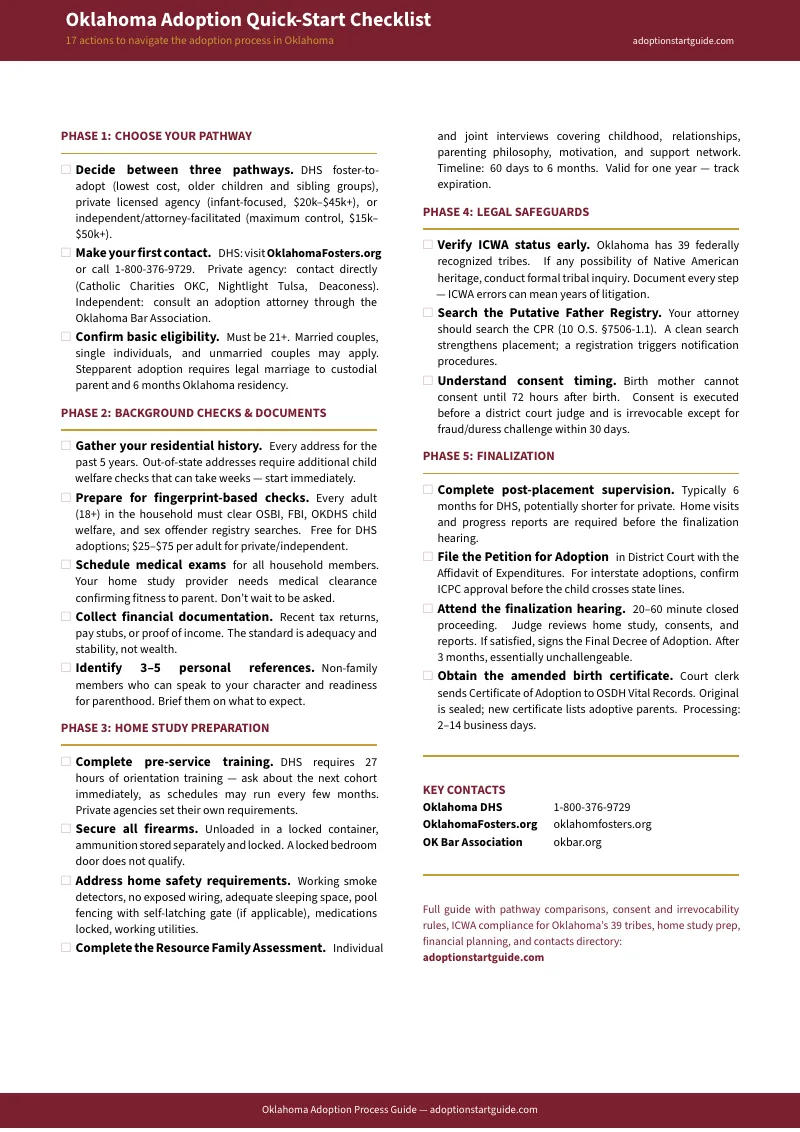
The free Quick-Start Checklist
Download the Oklahoma Adoption Quick-Start Checklist for a one-page overview of the adoption process, from choosing your pathway through court finalization. Free, no commitment. It includes the three-pathway decision framework and the five-phase milestone sequence -- the two items that cause the most confusion for Oklahoma families just starting out. If you want the full guide with the ICWA compliance checklist, the Putative Father Registry explanation, the consent law decoder, the home study preparation guide, the financial planning framework, and the printable worksheets, click the button in the sidebar.
-- less than one hour with an Oklahoma adoption attorney
Oklahoma adoption attorneys charge $200 to $400 per hour. Agency application fees start at $600. A failed independent placement can cost $15,000 to $25,000. This guide puts the entire Oklahoma adoption system -- 39-tribe ICWA navigation, the Putative Father Registry, consent finality under Title 10, all three pathways compared, financial planning with tax credits and subsidies, and a vetted agency and attorney directory -- in your hands for less than what most families spend on a single phone consultation. Families who understand the system before they enter it choose the right pathway, prepare for the home study without delays, and move through the legal process knowing exactly what comes next instead of waiting for an overworked caseworker or an agency recruiter to tell them.
If the guide doesn't deliver, reply to your download email at any time for a full refund. No forms. No justification required.