
You Want to Foster a Child in Oregon. The State Gave You a Website and Wished You Luck.
Oregon needs foster parents desperately. The fentanyl crisis is now driving roughly 40% of new cases. Children are waiting longer for placement. ODHS is under a $34 million federal settlement for systemic failures. And yet the people who want to help — people like you — are left navigating a system that wasn't designed to be navigated.
Here's what you find when you start looking into it:
- Every Child Oregon handles 80% of initial inquiries, but they hand you off to one of 16 ODHS district offices — and which district you land in dramatically affects your experience
- RAFT training replaced PRIDE, but the 27-hour, 9-session schedule varies by region and fills up fast
- OAR 413-200 safety requirements change depending on whether you're in the Willamette Valley, the coast, or Eastern Oregon — earthquake anchoring, wildfire evacuation plans, well water testing — and nobody tells you which ones apply to your property
- The SAFE home study evaluation feels like a black box, and your certifier may or may not explain what they're actually assessing
- Oregon's Indian Child Welfare Act (ORICWA) is stricter than the federal law, and if you don't understand it, a placement could be disrupted months in
The free resources give you regulations and phone numbers. They don't give you the operational knowledge to move through a system that's stretched thin across a state the size of the United Kingdom.
The Beaver State Licensing System — Your District-by-District Guide to Getting Certified
This guide was built for Oregon's specific foster care landscape — the 16-district variation, the geography-specific safety requirements, and the ODHS bureaucracy that prospective parents have to navigate. It takes every stage of the certification process and translates it from OAR administrative rules into clear, practical instructions with the details the state's website leaves out.
What's Inside
The ODHS District Map — 16 Districts, 16 Different Experiences
Oregon's foster care system is state-administered but district-operated, and the difference between districts is enormous. The guide maps all 16 districts with direct contacts, typical response times, and capacity status. You'll know which districts are overwhelmed, which are responsive, and how to advocate for yourself when your certifier goes silent. This alone prevents the most common frustration: calling a general number, getting transferred twice, and ending up on a list nobody checks.
RAFT Training — 27 Hours That Determine Your Timeline
RAFT (Resources for Adoptive and Foster Training) replaced PRIDE as Oregon's mandatory pre-service training. It runs 9 sessions over 27 hours, and cohorts fill months in advance in the Portland metro area while some rural districts only offer them twice a year. The guide covers enrollment timing, virtual vs. in-person availability by region, what the curriculum actually covers, and the proactive script to call your district and lock in your seat before the next cohort is full.
OAR 413-200 Home Inspection — Geography-Specific Safety Prep
Oregon's administrative rules require different safety measures depending on where you live. Western Oregon homes need earthquake-anchored water heaters and furniture. Eastern and Southern Oregon properties need documented wildfire evacuation plans. Rural homes on well water need bacteriological testing. Coastal homes face additional storm preparedness requirements. The guide gives you the specific checklist for your region so you're not scrambling to bolt a bookshelf to the wall the day before your inspection.
Background Checks — CBES, FBI, LEDS, and CARIS Decoded
Oregon runs four overlapping background check systems: CBES (Child and Background Enforcement System), FBI fingerprint checks through IdentoGO, LEDS (Law Enforcement Data System), and CARIS (Client Assessment and Reporting Information System). Each has its own timeline, fee, and failure points. The guide walks you through all four in the order they're processed, with the common issues that cause delays — name variations, out-of-state history, old addresses — and how to resolve them before they stall your application.
The SAFE Home Study — What Your Certifier Is Actually Evaluating
The Structured Analysis Family Evaluation is Oregon's standardized home study tool. It feels invasive because it is — it's designed to be comprehensive. But the scoring is transparent if you know the framework. The guide breaks down each SAFE domain: family history, relationship dynamics, parenting approach, support systems, motivation, and environmental safety. You'll understand what your certifier is looking for at each interview, what a strong response looks like, and how couples can prepare together so you're not blindsided by the personal questions.
ORICWA — Oregon's Stricter Indian Child Welfare Act
Oregon's ICWA implementation (ORS 419B.600-419B.665) goes beyond the federal law. If you're fostering a child who is or may be a member of a federally recognized tribe, ORICWA governs placement preferences, notice requirements, and active efforts to prevent family separation. Misunderstanding ORICWA can lead to a placement disruption months into your fostering relationship. The guide explains what ORICWA means for non-Native foster parents in practical terms: the notification process, the placement hierarchy, the tribal coordination your certifier will handle, and what it means for your timeline.
Kinship Care — Oregon's Fastest-Growing Placement Path
Kinship placements now account for 36.1% of all Oregon foster care placements, and the number is climbing. If you're a grandparent, aunt, uncle, or family friend who received that call from a caseworker, your certification path is different from general applicants. The guide covers the relative and kinship care licensing process, the expedited timeline, financial support differences, and the critical decision of whether to pursue formal certification or remain an informal placement — and the consequences of each choice.
LGBTQ+ Families — Oregon's Non-Discrimination Protections and Youth Affirmation
Oregon explicitly prohibits discrimination against prospective foster parents based on sexual orientation or gender identity under ORS 418.648. Beyond non-discrimination, Oregon mandates affirmation of LGBTQ+ youth in foster care — meaning foster parents are expected to support, not merely tolerate, a child's identity. The guide covers your legal protections as an LGBTQ+ applicant, the affirmation expectations the state holds for all foster parents, and how this shows up in the SAFE evaluation and RAFT training.
Financial Reality — Monthly Rates, Enhanced Rates, and What's Not Covered
Oregon's monthly foster care maintenance rates run $958 for children 0-5, $963 for ages 6-12, and $1,022 for teens 13-20. Enhanced rates through the CANS (Child and Adolescent Needs and Strengths) assessment can increase payments for children with higher needs. The guide covers the base rates, the CANS enhanced rate tiers, Medicaid for every foster child, child care assistance, and an honest accounting of the out-of-pocket costs the state doesn't reimburse — gas for visits, home modifications for inspection, training time off work, respite care coordination.
Foster-to-Adopt — Oregon's Concurrent Planning Model
If your goal is adoption, Oregon's concurrent planning approach means the state works toward reunification and an alternative permanent plan simultaneously. The guide covers how concurrent planning works in practice, the ASFA timelines that govern when DHS must pursue permanency, the Termination of Parental Rights process under Oregon law, adoption finalization, and the ongoing adoption assistance payments. You'll understand the realistic timeline from certification to adoption — and why it's almost never as fast as the brochure suggests.
Plus: Printable Standalone Worksheets
Your purchase includes standalone printable PDFs you can use independently: the OAR 413-200 Home Inspection Self-Audit Checklist (walk your home room by room with geography-specific items for your region), the Document Tracker (fillable three-phase checklist for every form and certificate), and the Communication Log (structured ODHS contact tracking for caseworker transitions). Plus your legal rights under ORS 418.648, the complete 16-district ODHS contact directory, and Every Child Oregon contact protocols.
Who This Guide Is For
- First-time prospective foster parents who want a clear path through ODHS certification before their first call to Every Child Oregon — especially if you're unsure which of the 16 districts handles your county
- Kinship caregivers who received a call about a relative's child and need to understand the expedited licensing path and financial support options
- Rural and Eastern Oregon families whose properties face wildfire evacuation requirements, well water testing, or long drives to the nearest RAFT training cohort
- LGBTQ+ applicants who want to understand Oregon's specific non-discrimination protections and the youth affirmation expectations before starting the process
- Anyone whose application stalled — your certifier left, your district stopped responding, or you missed a RAFT cohort and don't know how to get back on track
- Foster-to-adopt families who want to understand how concurrent planning, ASFA timelines, and TPR work in Oregon before they commit to the process
- Families considering infant placements in a state where the fentanyl crisis is driving a significant portion of new foster care cases
Why This Exists When There Are Free Resources
Every Child Oregon and ODHS provide essential recruitment materials and the basic regulatory framework. But they leave five critical gaps:
- District-level variation. Free resources give you a statewide phone number. They don't tell you that your experience will vary dramatically based on which of the 16 districts handles your county — or how to navigate a district that's overwhelmed and unresponsive.
- Geography-specific home safety. Free guides say "meet OAR 413-200 standards." They don't explain that earthquake anchoring applies in the valley, wildfire plans apply east of the Cascades, and well water testing applies in rural areas — or give you the checklist specific to your property type.
- SAFE home study preparation. The state tells you there's a home study. It doesn't break down the SAFE evaluation domains, the scoring framework, or how to prepare for the personal interviews as a couple or individual.
- ORICWA implications for non-Native families. Free resources mention ICWA. They don't explain Oregon's stricter implementation, what it means for placement stability, or how it affects your timeline and expectations.
- RAFT enrollment logistics. Free resources say training is required. They don't tell you that Portland metro cohorts fill weeks in advance, that rural districts may only offer two sessions per year, or give you the proactive enrollment approach that prevents a months-long delay.
This guide fills those gaps with the operational detail that turns a willing family into a certified, prepared foster parent.
Your Investment
For , you get 5 PDFs — the complete Oregon Foster Care Licensing Guide (83 pages), the Quick-Start Checklist, the printable OAR 413-200 Home Inspection Checklist, the Document Tracker, and the Communication Log. Everything you need from first inquiry to first placement.
A missed RAFT cohort delays your certification by months. An unprepared home inspection means rescheduling and re-inspection. A single unanswered call to the wrong district office wastes weeks you could have spent getting certified. The guide pays for itself the first time it saves you from one of these setbacks.
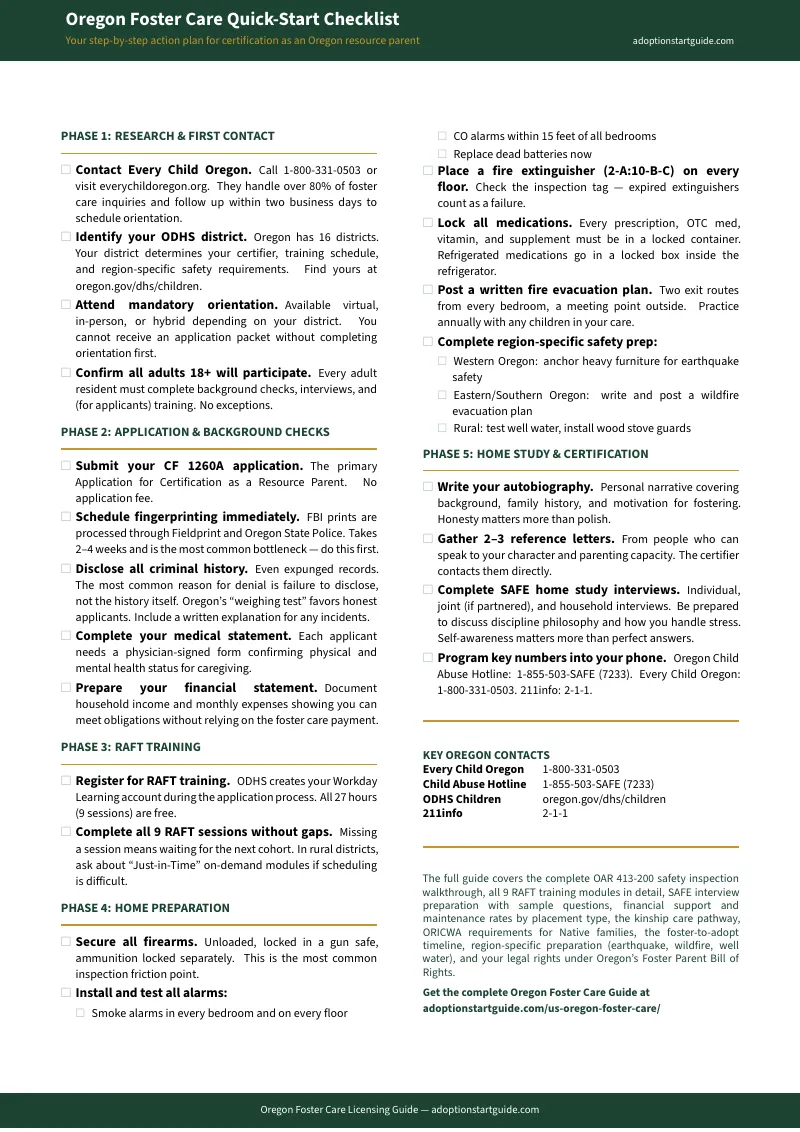
Start with the free checklist — actionable items organized across five phases of the certification process. If you want the complete system with SAFE home study preparation, the 16-district contact directory, geography-specific inspection checklists, and all the templates, get the full guide.