You're ready to adopt in Pennsylvania. Then you discovered that the Orphans' Court, DHS, SWAN, and the private agencies each assume you already understand the other three.
Pennsylvania is not like most states. Adoption petitions don't go to family court -- they go to the Orphans' Court Division of the Court of Common Pleas, an equity court dating to the 17th century with its own procedural rules that differ from county to county. Philadelphia's First Judicial District has dedicated Orphans' Court judges. Carbon County's Orphans' Court shares a docket with civil and family divisions. The filing fee in Philadelphia is $349. In Carbon County it's $95. Neither court's website tells you this upfront, and your agency won't volunteer the comparison because they only work with one county.
You've already done the research. You found the DHS website, which covers foster-to-adopt through SWAN but says almost nothing about private agency or independent adoption. You found SWAN's toolkit -- 47 bulletins, Act references, and regulatory citations written for caseworkers, not parents. You found Adoptions From The Heart's orientation page, which requires you to "request info" before it reveals fee schedules. You found Reddit threads where well-meaning strangers confuse Pennsylvania's 30-day revocation period with New Jersey's irrevocable consent rules in the same comment. And you found adoption attorneys in Philadelphia and Pittsburgh who bill $250 to $450 per hour but won't tell you over the phone whether you even need an attorney for your pathway.
The information exists. It's scattered across 23 Pa.C.S. Sections 2101 through 2938, SWAN bulletins, OCYF licensing regulations in 55 Pa. Code, county-specific Orphans' Court local rules, and agency orientation packets designed to recruit you, not educate you. Piece it together yourself and you'll burn weeks reading documents that explain the rules but never tell you the order of operations as a parent.
The Orphans' Court Decision Map
This is a complete, Pennsylvania-specific adoption guide built around the problem every family in this Commonwealth hits: navigating a system where the Orphans' Court, DHS, SWAN, private agencies, and independent intermediaries each own a piece of the process but none of them explain how the pieces connect. Not a national overview. Not an agency brochure designed to funnel you into one program. Every chapter, every checklist, every cost figure is grounded in the Pennsylvania Adoption Act (23 Pa.C.S.), current DHS policies, Orphans' Court procedural rules, and the real-world experience of families who have adopted in Pennsylvania.
What's inside
- Four-pathway comparison table -- SWAN foster-to-adopt, private licensed agency, independent (intermediary) adoption, and kinship/stepparent adoption, mapped side by side. Costs, timelines, eligibility, and the realistic wait for each pathway so you choose the right one before investing months in the wrong direction. SWAN foster-to-adopt runs $0 to $500. Private agency adoption costs $30,000 to $45,000. Independent adoption through an attorney runs $15,000 to $25,000. Stepparent adoption costs $1,500 to $3,500. That decision deserves more than an agency orientation's one-sentence summary.
- The 72-hour and 30-day consent decoder -- Pennsylvania's consent rules are two-layered and families routinely conflate them. Birth parents cannot sign consent until 72 hours after birth under Section 2711. After signing, they have 30 days to revoke. But consent signed before a judge is irrevocable immediately. This chapter maps the three consent scenarios -- voluntary relinquishment to an agency, consent in independent adoption, and involuntary termination -- so you understand exactly when your adoption becomes legally secure and what the risk window looks like for each pathway.
- County-by-county Orphans' Court navigator -- Philadelphia's dedicated Orphans' Court division operates differently from Allegheny County's, which operates differently from rural counties where Orphans' Court shares a docket with family law. This chapter covers filing fees, local rules, typical timelines from petition to finalization hearing, and how to find your county's specific Orphans' Court clerk. Because discovering that your county charges $349 to file while the next county charges $95 shouldn't happen after you've already hired a lawyer in the wrong jurisdiction.
- The "no living expenses" rule explained -- Pennsylvania is one of the strictest states on adoption-related payments. Under 23 Pa.C.S. Section 2533, you cannot pay a birth parent's rent, food, or living expenses. The intermediary report filed with the court must itemize every dollar spent. This chapter explains what you can legally pay (medical, counseling, legal fees), what you cannot, and how the court scrutinizes the Section 2533 report -- because a single improper payment can be flagged as illegal consideration and jeopardize your finalization.
- Three mandatory clearances navigator -- Every household member over 18 needs PATCH (Pennsylvania Access to Criminal History), FBI fingerprint clearance, and Child Abuse History certification. Each has a different processing time, and if you file them in the wrong order, the first expires before the last arrives. This chapter gives you the exact sequencing so all three clearances land within the same validity window, plus the five non-family reference letters your home study requires and what the social worker is actually evaluating in each one.
- ICPC interstate adoption survival guide -- If you're adopting a child born in another state, the Interstate Compact on the Placement of Children requires approval from both states before you can bring your child home. In practice, this means 7 to 14 days in a hotel near the birth hospital, at your own expense, waiting for paperwork to clear. This chapter covers the ICPC timeline, what to pack for an extended out-of-state stay, how to expedite the process, and what families wish they'd known before booking a one-way flight.
- AAP subsidy negotiation guide -- Pennsylvania's Adoption Assistance Program provides monthly subsidies, medical assistance, and nonrecurring expense reimbursement for children adopted from foster care. The critical rule: the Adoption Assistance Agreement must be signed before finalization or you lose eligibility permanently. This chapter covers eligibility criteria, how to negotiate the subsidy amount with your county, Title IV-E federal funding, and the post-finalization support services available through SWAN that most families never learn about.
- Act 101 and post-adoption transparency -- Pennsylvania's Act 101 established a voluntary registry for birth parents and adoptees to exchange identifying information. This chapter covers the Confidential Intermediary Program, how to petition for birth records, the amended birth certificate process through the Division of Vital Records, and what "open adoption" actually means in Pennsylvania -- because agency promises of ongoing contact have no legal enforcement mechanism unless they're filed with the Orphans' Court.
- Stepparent and kinship fast tracks -- You've been raising your grandchild, niece, or stepchild for months or years. The absent parent hasn't been involved. Under 23 Pa.C.S. Section 2511, parental rights can be involuntarily terminated for abandonment, failure to perform parental duties, or incapacity. Stepparent adoptions are generally exempt from the full home study requirement, but clearances are still mandatory for every household member. This chapter maps both pathways so the legal process doesn't cost you more time and money than it should.
Who this guide is for
- Families transitioning from infertility treatment to adoption -- You've spent $20,000 to $60,000 on IVF. You're emotionally exhausted. You need legal certainty, not another open-ended process. This guide maps every pathway with real cost ranges and realistic timelines so you can make the decision that shapes your family's future with clear eyes, not agency sales pitches.
- Foster families ready to adopt -- The child in your care just had reunification ruled out. You've been told to "start the adoption paperwork," but the transition from foster license to adoption petition involves different documents, a mandatory post-placement supervision period, and an Adoption Assistance Agreement that must be executed before the judge signs the decree. This guide maps that transition step by step.
- Kinship caregivers who need legal standing -- You've been raising your grandchild, niece, or nephew for months or years. You lack legal custody. The child's parent has abandoned them or is involved with CYS. This guide covers the kinship adoption pathway through the Orphans' Court, the involuntary termination process, and the subsidies you're entitled to but may not know exist.
- Stepparents adopting a spouse's child -- The absent parent hasn't been involved in years. Section 2511 governs the conditions under which consent can be waived through involuntary termination. This guide walks you through the simplified process, the clearance requirements, and the Orphans' Court hearing so one missed filing doesn't cost you months of delay.
- Families adopting from out of state -- You matched with a birth mother in Ohio or Florida. Now you're learning about the ICPC for the first time, and nobody told you about the hotel stay. This guide covers the interstate process, the dual-state approval timeline, and how to plan for 7 to 14 days away from home with a newborn.
Why the free resources aren't enough
The DHS website covers the public foster-to-adopt pathway through SWAN. It explains orientations, the eight-step process, and county contacts. But it provides minimal guidance on private agency, independent, or kinship adoption. If you're not adopting from foster care, DHS has almost nothing for you.
The SWAN toolkit is comprehensive -- for professionals. It lists dozens of Act references, regulatory bulletins, and procedural citations that assume you already understand the Orphans' Court system. It's a reference manual for caseworkers, not a decision guide for parents weighing four different pathways.
Agency orientations are sales pitches. Adoptions From The Heart, Bethany Christian Services, and Catholic Social Services each explain their own program. None of them compare their fees to the competition. None of them explain when you don't need an agency at all. They are recruitment events with an information veneer.
Adoption attorneys in Philadelphia and Pittsburgh bill $250 to $450 per hour. A single consultation runs $300 to $500. Families routinely spend their first billable hour covering foundational questions this guide answers in Chapter 1. The attorney you need is the one who handles the Orphans' Court filing. But you need to understand the system before you can evaluate whether your attorney actually knows Orphans' Court procedure or is a generalist family lawyer who looked it up last week.
Reddit and Facebook groups give you emotional support and anecdotal experience. They also mix Pennsylvania law with neighboring states' rules in the same thread, confuse the 72-hour waiting period with the 30-day revocation window, assume SWAN covers private adoption when it doesn't, and offer advice based on Philadelphia procedures that don't apply in Lehigh or Westmoreland counties. In Pennsylvania, where 67 counties run 67 variations of the same system, that distinction matters.
Printable standalone worksheets included
The guide comes with printable standalone PDFs designed for real-world use:
- Pathway Comparison Card -- Four pathways side by side on one page. SWAN foster-to-adopt, private agency, independent, and kinship/stepparent. Costs, timelines, and the first steps for each route. Print it, sit down with your partner, and make the decision that shapes everything else.
- Three-Clearance Sequencing Tracker -- PATCH, FBI fingerprint, and Child Abuse History with submit dates, expected return dates, and the validity window that prevents your first clearance from expiring before your last one arrives.
- Orphans' Court Filing Checklist -- Every document required for the Pennsylvania adoption petition, organized by pathway. Give it to your attorney and save yourself a billable hour of foundational questions.
- Post-Finalization Action Plan -- Amended birth certificate through the Division of Vital Records, Social Security update, insurance enrollment, tax credit filing, and the SWAN post-permanency services most families never claim. Every administrative step after the decree, in order, with contacts and processing timelines.
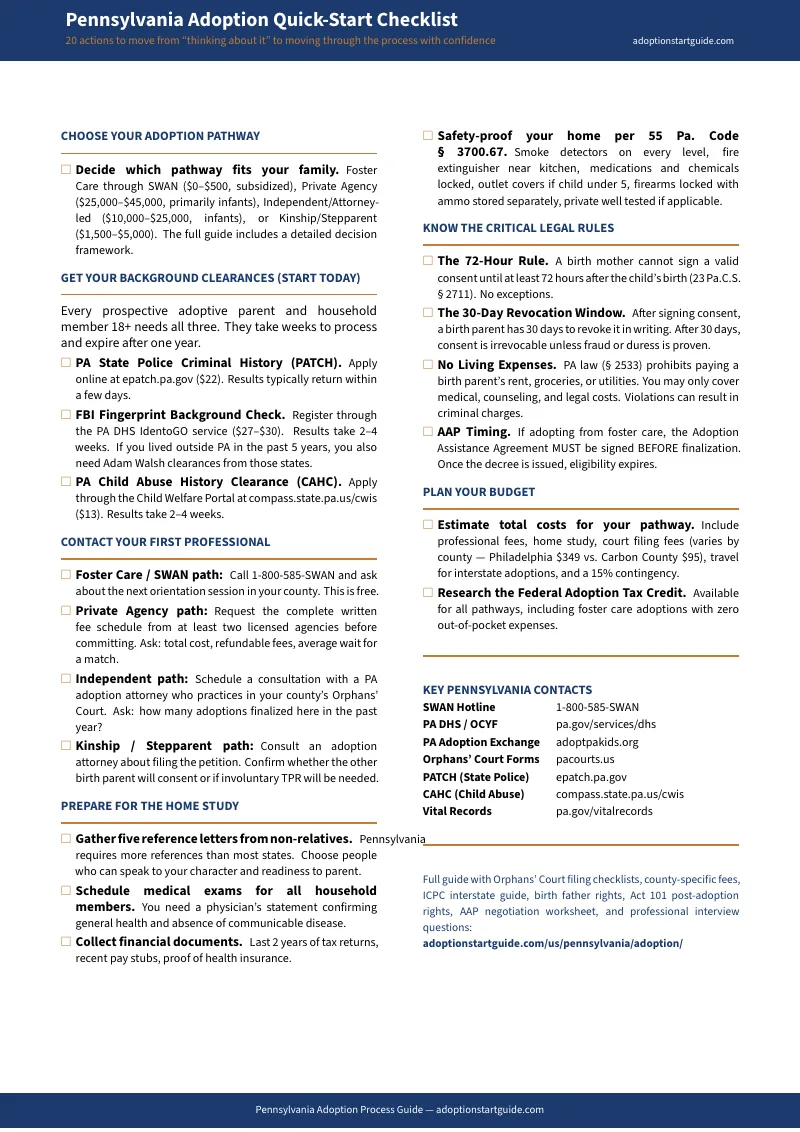
The free Quick-Start Checklist
Download the Pennsylvania Adoption Quick-Start Checklist for a one-page overview of the key steps from first inquiry to finalization. Free, no commitment. If you want the full guide with the four-pathway comparison, the consent decoder, the county-by-county Orphans' Court navigator, the ICPC survival guide, and all the printable worksheets, click the button in the sidebar.
-- less than ten minutes of a Pennsylvania adoption attorney's time
The average adoption attorney in Pennsylvania bills $250 to $450 per hour. Philadelphia partners charge $350 to $500. Families routinely spend their first billable hour covering foundational questions this guide answers in Chapter 1. The Orphans' Court Decision Map doesn't replace your attorney. It makes sure you don't pay your attorney to teach you the basics of the Pennsylvania Adoption Act.