Rhode Island is the smallest state in the country. Its adoption system acts like it — limited agencies, fragmented guidance, and a DCYF website that expects you to piece together the process from policy manuals written for caseworkers.
You started searching. "How to adopt in Rhode Island." You found the DCYF website and a list of requirements — be at least 21, pass a background check, complete TIPS-MAPP training. Then you clicked around looking for the next step and hit a wall. The site told you what the rules are. It did not tell you how to actually move through the system. You found Adoption Rhode Island and learned about foster-to-adopt orientations and photolistings of waiting children. But you are considering private infant adoption, or you are a stepparent, or a grandmother who needs to formalize kinship custody — and Adoption RI's entire mission is foster care recruitment. Their materials end where your questions begin.
So you searched wider. You found American Adoptions quoting $40,000 or more for a domestic infant placement. You found regional consultants charging $250 to $975 in application fees before any real work starts. You found Rhode Island family law attorneys billing $200 to $500 per hour. You may have found the Reddit threads where every procedural question gets the same answer: "Get a lawyer." Useful advice if you have $400 an hour and a specific legal question. Not useful when you do not yet know which of Rhode Island's adoption pathways fits your situation, what the home study actually evaluates, or whether the birth parent consent timeline under RIGL 15-7 protects you or terrifies you.
Rhode Island has roughly 1.1 million people and a handful of licensed child-placing agencies. That small-state bottleneck means demand for domestic infant adoption far outstrips local supply. Families who do not understand their options — DCYF foster-to-adopt, private agency, independent attorney-facilitated, kinship, stepparent — waste months waiting on a pathway that does not match their situation. Families who do not understand ICPC find themselves stranded in another state for 60 to 90 days after an out-of-state placement because nobody explained the interstate compact before they traveled. And families who walk into One Dorrance Plaza for their Family Court hearing without preparation discover that the "happiest day in court" feels a lot less happy when you are unsure whether your paperwork is complete.
The Small-State Adoption Navigator: Your Tactical Guide to Adopting in Rhode Island
This guide is built for Rhode Island's adoption system and nobody else's. Every chapter, every checklist, every legal reference is grounded in Rhode Island General Law Title 15 Chapter 7, the DCYF licensing regulations, the Family Court's adoption procedures at One Dorrance Plaza, and the operational realities of adopting in a state where everyone in the system knows everyone else — and where a misstep at one of the few local agencies can close doors you did not know existed. It is not a repurposed national handbook. It is the layer between what DCYF publishes online and what you actually need to know to move from "thinking about adoption" to standing in front of a Family Court judge with a complete file and a clear path to finalization.
What's inside
- Five-Pathway Decision Framework — DCYF foster-to-adopt (free to low cost), private agency ($20,000 to $50,000), independent attorney-facilitated ($5,000 to $40,000), stepparent ($3,500 to $6,000), and kinship adoption. Each pathway mapped with realistic costs, timelines, training requirements, and the specific RIGL citations that govern it. Most Rhode Island families default to whichever pathway they hear about first. This chapter lays all five side by side so you choose the one that matches your budget, your timeline, and the child you hope to parent.
- The 15-Day Consent Rule Explained — Under RIGL 15-7-5, a birth parent cannot sign consent to adoption until 15 days after the child's birth. Once signed, that consent can be challenged within 180 days on grounds of fraud, duress, or undue influence — but the legal standard for overturning it is extremely high. This chapter maps the exact timeline, explains what happens during those 15 days, how the 180-day challenge window works in practice, and what adoptive families should have in place before consent is signed so the adoption is legally unshakeable.
- DCYF and Binti Portal Navigation — DCYF manages all public foster care and adoption licensing through the Binti portal. This chapter walks you through the application process, the 10-week TIPS-MAPP pre-service training, what DCYF caseworkers evaluate during the home study, how foster maintenance payments work ($24 to $28 per day for standard care, up to $65 per day for intensive needs), and the adoption subsidy negotiation process — including what is negotiable and the critical rule about finalizing your adoption assistance agreement before the decree is signed.
- Home Study Preparation Guide — The home study is where most anxiety lives and most delays start. This chapter separates the real disqualifiers from the myths. You do not need to own your home. You do not need a spare bedroom for every child. You do need a clean background check, stable income documentation, medical clearances, and a home that passes the safety inspection. The chapter includes a printable document checklist organized in the order the social worker expects to see everything — so you are not scrambling for tax returns at 10 PM the night before your first visit.
- Family Court Finalization Walkthrough — The Rhode Island Family Court at One Dorrance Plaza in Providence handles all adoption finalizations. This chapter explains the six-month trial period of residence required before the court will issue the final decree, what documents the petition must include, what happens at the hearing itself, who needs to be present, and the post-decree steps: updating Social Security records and obtaining the new birth certificate from the Center for Vital Records in Cranston.
- ICPC Interstate Placement Guide — Rhode Island's small-state bottleneck means many families look out of state for infant placements. The Interstate Compact on the Placement of Children requires approval from both the sending and receiving state before a child can cross state lines — a process that typically takes 60 to 90 days and can trap you in the birth state if you are not prepared. This chapter explains the ICPC timeline, the paperwork both states require, common delay points, and how to plan so you are not living in a hotel for two months with a newborn.
- Financial Planning Framework — Cost breakdown by pathway. Foster-to-adopt through DCYF: $0 to $2,000 in legal fees, with monthly subsidy and Medicaid for the child. Private agency: $20,000 to $50,000. Independent: $5,000 to $40,000 depending on birth parent expenses. Stepparent: $3,500 to $6,000. This chapter maps the federal adoption tax credit (up to $16,810 per child), Rhode Island-specific financial assistance, the $2,000 non-recurring expense reimbursement for foster care adoptions, and the birth parent expense rules — which in Rhode Island are governed by judicial oversight rather than a statutory cap, meaning you need to understand what judges typically approve.
- Adoptee Rights and Records Access — Rhode Island now allows adult adoptees (18+) unrestricted access to their original birth certificates. This chapter explains the current law, how to request records from the Center for Vital Records in Cranston, the process for accessing sealed court files, and what the shift in Rhode Island's openness policy means for adoptive families building relationships with birth families.
Printable standalone worksheets included
- Adoption Timeline Tracker — Every milestone from initial pathway selection through court finalization, with fill-in date fields and RI-specific deadlines (15-day consent, 180-day challenge window, 6-month residence period). Print it, update it after every meeting, and always know where your case stands.
- Home Study Document Checklist — Background clearances, medical exams, financial records, references, and home safety items organized in the order your social worker expects them.
- Financial Planning Worksheet — Costs by pathway, tax credit calculation, subsidy rates, grant eligibility, and expense tracking in one printable sheet for your household budget conversation.
- Attorney Consultation Prep Sheet — The questions to ask in your first meeting, organized by pathway, so you get maximum value from every billable hour instead of paying $400 to hear the basics.
Who this guide is for
- Families pursuing foster-to-adopt through DCYF — You attended the Adoption Rhode Island orientation. You registered on the Binti portal. Now you are staring at the TIPS-MAPP training schedule and a stack of background check forms, and nobody has explained the full timeline from licensing through placement through TPR through finalization — or how the subsidy negotiation works and why you must complete it before the judge signs the decree.
- Families pursuing private infant adoption — Rhode Island's small-state reality means there are very few local infant placements. You are considering an out-of-state agency or an independent match through an attorney, and you need to understand the ICPC process, the 15-day consent timeline, what birth parent expenses Rhode Island judges approve, and how to budget realistically for a process that national agencies routinely underquote by $10,000 or more.
- Stepparents who want legal recognition — You have been parenting this child for years. You need the legal status to match — for school enrollment, medical decisions, inheritance, and the permanency that comes with a new birth certificate. You need to know whether consent from the absent biological parent is required, what the court considers when consent is contested, and whether you can navigate the Family Court process without paying $6,000 to an attorney for a petition you can largely prepare yourself.
- Kinship caregivers — grandparents, aunts, uncles — A DCYF removal or a family crisis placed this child in your home. You need to understand the difference between guardianship and adoption, how kinship foster care subsidies work, and what legal standing Rhode Island grants to a relative who has had physical custody for two years or more. You want permanency, not just another temporary arrangement that leaves you scrambling every time the school asks for documentation.
Why the free resources fall short
The DCYF website publishes regulations and policy documents written for caseworkers and attorneys. It tells you that consent cannot be signed before 15 days after birth. It does not tell you what happens during those 15 days, what paperwork should already be in place, or how the 180-day challenge window affects your planning. The site lists the requirements for a home study but does not explain what the social worker is actually looking for or how to prepare your home and your documentation so the process moves forward without delays.
Adoption Rhode Island is an excellent organization — for foster care recruitment. Their photolistings, virtual orientations, and "Extreme Family Finding" programs serve children in state custody. But if you are pursuing private infant adoption, stepparent adoption, or an out-of-state placement through ICPC, Adoption RI's resources do not cover your pathway. Their mission ends at the foster care system's boundary.
Children's Friend and Family Service of Rhode Island provide foster care licensing and social services. Their adoption pages are a contact form for "centralized intake" — not a walkthrough of the process, the costs, or the legal framework. You can call them and start an application. You cannot learn from their website whether their pathway is the right one for your family.
Rhode Island adoption attorneys charge $200 to $500 per hour. A one-hour consultation buys you general advice about your specific pathway — not a complete walkthrough of all five options, not a home study prep checklist, not a subsidy negotiation strategy, not an ICPC planning guide, and not a printable timeline tracker you can update as your case progresses. The guide puts the entire Rhode Island adoption system in your hands for a fraction of what a single legal consultation costs — and makes your first attorney meeting dramatically more productive because you arrive knowing which pathway you are on, what questions to ask, and what documents you need.
The free Quick-Start Checklist
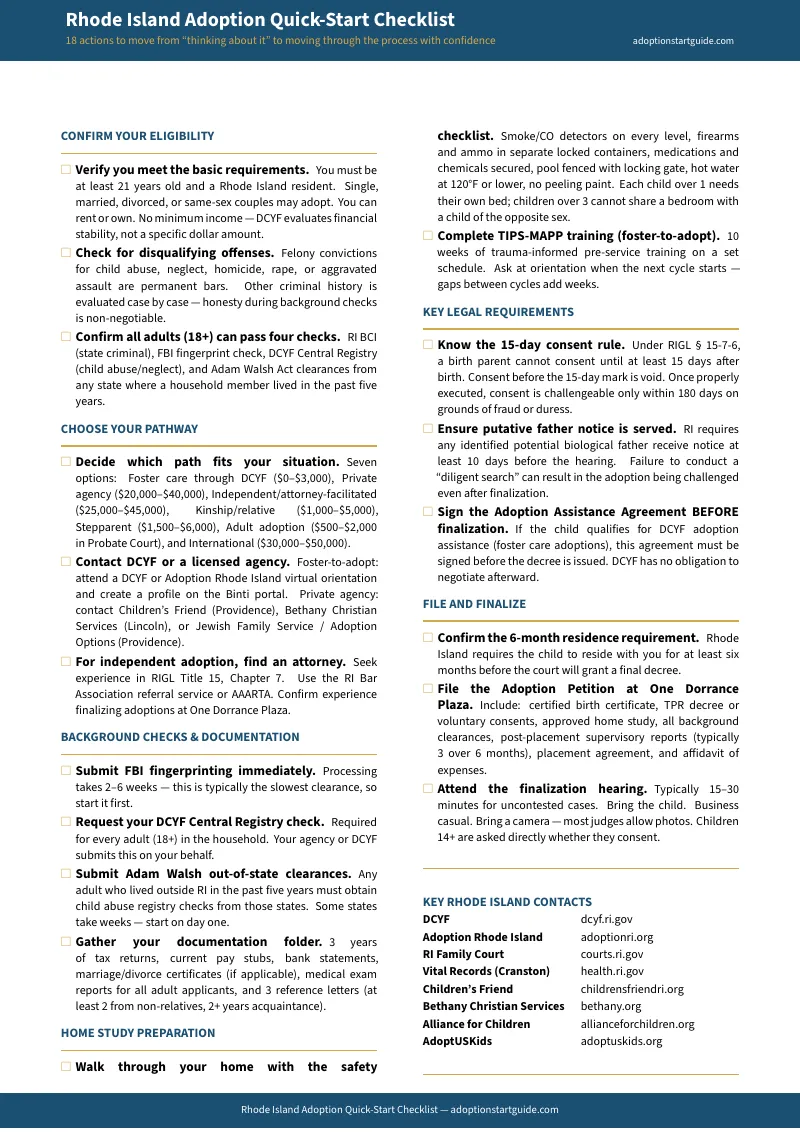
Download the Rhode Island Adoption Quick-Start Checklist for a one-page overview of the adoption process — the five pathways, the eligibility requirements, and the first steps for each. Free, no commitment. It includes the pathway comparison and the RI eligibility test — the two starting points that cause the most confusion. If you want the full guide with the consent timeline decoder, home study preparation, ICPC navigation, Family Court walkthrough, financial planning framework, and printable worksheets, click the button in the sidebar.
— less than fifteen minutes of a Rhode Island adoption attorney's time
Rhode Island adoption attorneys charge $200 to $500 per hour. A single missed detail on the consent timeline can create six months of legal uncertainty. A subsidy agreement signed without understanding the negotiation process locks you into a rate that may not cover a child's actual needs. An ICPC placement attempted without proper planning can strand you in another state for months. A home study delayed because your documents were incomplete adds weeks to a process that already feels endless. These are the mistakes that cost thousands. This guide prevents them.
If the guide does not deliver what you need, reply to your download email at any time for a full refund. No forms. No justification required.