
South Dakota has 1,685 children in foster care and a foster care entry rate that's climbing. The DSS website tells you the rules. It doesn't tell you how to navigate a system built around PRIDE training waitlists, ICWA compliance, and rural property standards that no other state shares.
You felt the calling. Maybe it was a "Stronger Families Together" ad during National Foster Care Month. Maybe your pastor mentioned it, or you watched a relative's child enter the system and wondered if you could help. Whatever brought you here, you went to the Department of Social Services website looking for a clear starting point.
What you found was ARSD 67:42:05 --- the Administrative Rules of South Dakota governing family foster homes. A regulatory document written for licensing specialists, not for the family sitting at the kitchen table trying to figure out whether their ranch's well water or outbuildings will pass inspection. You found references to PRIDE training, DCI background checks, FBI fingerprint submissions, Central Registry screenings, and the phrase "contact your regional office" repeated as though the Sioux Falls office, the Rapid City office, and the Aberdeen office all operate the same way. They don't.
What you didn't find was a plain-language answer to the question every South Dakota family asks first: what exactly do I need to do, in what order, and how long will this take where I live?
So you turned to online forums and Facebook groups. You posted your question and got the answer that defines this system: "Call your regional DSS office and ask." But calling a regional office gives you a voicemail and a callback in three to five business days --- if they're not between PRIDE cohorts. You're in the gap between wanting to foster and knowing how to start, and nobody is meeting you there.
National foster care books will prepare your heart. They won't tell you whether your septic system needs certification, how to sequence DCI and FBI checks to avoid expired results, what "Active Efforts" means under ICWA when 75% of children in the state's system are Native American, or why the Rapid City office processes cases differently than Mitchell. AdoptUSKids publishes a South Dakota overview. It covers what every state page covers --- age minimum, training requirement, background check --- and nothing that's specific to the actual experience of licensing in this state.
The Prairie State Licensing System
This guide is built for the South Dakota DSS system and nobody else's. Every chapter, every checklist, every regulation reference is grounded in ARSD 67:42:05, the current PRIDE curriculum, and the operational realities of the six regional DSS offices that serve this state. It covers the gap between what DSS posts online and what you actually need to know to get from "interested" to "licensed" without unnecessary delays, failed inspections, or months of silence from an office that never explained the next step.
What's inside
- Step-by-Step Licensing Process --- South Dakota's licensing process runs through distinct stages, from your initial inquiry call to license approval. This guide walks you through each one in order: what happens, what DSS expects from you, which documents to submit and when, and how to avoid the common stalls that stretch a process into unnecessary months. You'll know what's coming before your licensing specialist tells you --- because in many regions, they won't tell you until you ask.
- PRIDE Training Breakdown --- The mandatory 30-hour PRIDE (Parent Resources for Information, Development, and Education) training is the single biggest time commitment in the process --- and the point where most South Dakota families stall, because sessions may only run quarterly in rural regions. This guide breaks down the six core themes from trauma and brain development through cultural and tribal competence, explains what your trainers are evaluating, and tells you how to find and secure a spot in the next available cohort. If you're in a rural area hours from the nearest training site, the chapter covers online module options through FosterParentCollege.com.
- Home Safety Standards --- Derived directly from ARSD 67:42:05. Smoke detector placement, carbon monoxide detectors, water heater temperature limits, medication storage requirements (child-proof caps are not sufficient --- locked container required), firearm and ammunition storage rules (including pellet guns and BB guns), sleeping arrangements, and bedroom capacity. Walk your house with this chapter before the licensing specialist walks it for you. Catch the fix before it becomes a 30-day delay.
- Rural Property Deep-Dive --- This is where South Dakota's requirements diverge from every other state. Annual well water testing for coliform and nitrate. Abandoned wells capped and plugged per SDCL 46-6-18. Septic system verification. Pesticides, fertilizers, and fuels locked in enclosed storage. Farm machinery secured with keys removed. Livestock handling areas fenced. Grain bins, silage pits, and manure storage secured. If you live on a farm or ranch, this chapter exists because the DSS website doesn't explain how a working agricultural property meets modern foster care safety codes.
- ICWA and Tribal Foster Care --- Approximately 75% of children in South Dakota's foster care system are Native American. The Indian Child Welfare Act shapes placement decisions, court proceedings, and the expectations placed on every foster parent in the state. This chapter explains the ICWA placement preference hierarchy, what "Active Efforts" means for both Native and non-Native families, how the nine federally recognized tribes operate their own Child Protection Programs, and why understanding ICWA is not optional here --- it's foundational. Written in plain language, not legal jargon.
- Background Check Sequencing --- Four separate checks, three different agencies, two possible fingerprinting methods, and a sequencing order that matters. DCI state criminal history ($50 combined with FBI), FBI national fingerprint check, Central Registry child abuse/neglect screening, and out-of-state registry checks for anyone who lived outside South Dakota in the past five years. This chapter gives you the exact order, the costs, and the timeline so nothing expires before your application is complete. Out-of-state checks are the number-one cause of licensing delays --- this chapter shows you how to submit them on day one.
- Regional DSS Office Profiles --- What the Sioux Falls office (highest volume, strong LSS partnership) looks like versus Rapid City (heavy ICWA focus, proximity to Pine Ridge) versus Aberdeen, Watertown, Mitchell, and Pierre. PRIDE training schedules, staffing levels, wait times, and the local nuances that affect your timeline. You'll know what to expect from your specific region before you make the first call.
- Home Study Preparation --- The home study is the most personally intensive part of the process. This chapter explains what the Family Services Specialist is actually evaluating --- motivation, relationship stability, discipline philosophy, trauma-informed capacity, and support systems --- and reframes the visit from an interrogation to what it really is: a process designed to rule families in, not rule them out.
- Financial Reality Breakdown --- Current South Dakota maintenance rates from $22.85 per day for children 0-5 ($685.50/month) to $27.43 per day for teens 13-18+ ($822.90/month), plus automatic Medicaid enrollment covering medical, dental, vision, mental health, and prescriptions at no cost to you. The maintenance payment is not income --- it's a reimbursement for the child's expenses. This chapter covers the full financial picture so you can foster sustainably.
- Kinship and Fictive Kin Care --- If a grandchild, niece, nephew, or family friend's child was placed with you after a DSS removal, you're already parenting. You didn't plan for this. This chapter explains how kinship licensing works, which requirements may be expedited for relative placements, and how to move from emergency caregiver to fully licensed resource parent with access to full maintenance payments and support services.
- Foster-to-Adopt Pathway --- For families entering the system with adoption as their goal. How concurrent planning works in South Dakota, when a foster family receives consideration for adoption, how Termination of Parental Rights (TPR) unfolds, and what adoption assistance is available. This chapter also addresses the hardest truth: reunification is the legal priority, and you must support it even when your heart wants a different outcome.
Standalone printable tools included
- Home Safety Inspection Checklist --- Room-by-room walkthrough of every ARSD 67:42:05 requirement. Print it, walk your house, check every item before the licensing specialist arrives.
- Rural Property Inspection Checklist --- Well water, septic, firearms, farm machinery, outbuildings, livestock, and hazardous chemicals. Built for South Dakota farms and ranches.
- Background Check & Clearance Tracker --- Track DCI, FBI, Central Registry, out-of-state, and tribal court checks for every adult household member. Includes the sequencing strategy that prevents expired results.
- Regional Office Directory --- All six DSS regional offices with phone numbers, addresses, key counties, and space to record your assigned licensing specialist and next PRIDE training date. Post it near your phone.
- Foster Care Financial Worksheet --- Daily rates by age group, monthly budget planner, what's covered versus what needs caseworker approval, Medicaid enrollment details, and tax treatment.
- ICWA Quick Reference Card --- All nine tribal Child Protection Programs, the placement preference hierarchy, Active Efforts requirements, and cultural competency steps on one page.
- PRIDE Training Overview --- All six core sessions summarized, practical tips for attendance, and a checklist of what to complete while waiting for the next cohort.
Who this guide is for
- First-time prospective foster parents --- You've been thinking about this for months. You saw the "Stronger Families Together" campaign, attended a church information night, or felt the calling after learning that South Dakota needs 300 new foster families each year. You went to the DSS website and found regulations where you expected a roadmap. You need someone to lay out the process in plain language and tell you what to do this week.
- Rural and agricultural families --- You have the space, the stability, and the heart to foster, but you live on a working farm or ranch and you're worried about well water testing, outbuilding safety, firearm storage rules, and whether your property will pass inspection. It will --- and this guide shows you exactly what needs to be in place.
- Families navigating ICWA --- Whether you are a tribal member from one of the nine federally recognized tribes pursuing licensure to keep children within the community, or a non-Native family wanting to understand how ICWA placement preferences work in practice, this guide explains the framework without the legal density.
- Kinship caregivers --- A child in your family was placed with you after a removal. The child is already in your home. You didn't plan for this. Now you need to get licensed to access full maintenance payments and support services, and you're navigating a system you never expected to enter on a timeline you didn't choose.
- Foster-to-adopt families --- You're entering the foster care system hoping to eventually provide a permanent home. You need to understand how South Dakota handles the transition from foster placement to TPR and adoption, and why the licensing step is the prerequisite for everything that follows.
Why the free resources fall short
The DSS website publishes the ARSD 67:42:05 administrative rules --- a regulatory framework designed for licensing specialists, not for families trying to figure out if their home qualifies. It tells you what the rules are. It doesn't tell you which rules trip people up, how regional offices differ in practice, or what your licensing specialist is actually evaluating during the home study.
Lutheran Social Services of South Dakota provides strong support for families in their Treatment Foster Care program, but their information is built for families already in the system. If you're pre-licensing --- stuck in the most confusing window of the entire journey --- their resources are several steps ahead of where you are.
Online forums and Reddit offer peer advice, but the information is rarely South Dakota-specific. You'll find outdated wait times from other states, generic training advice that doesn't account for PRIDE scheduling in rural areas, and no guidance on the rural property standards, ICWA compliance requirements, or background check sequencing that define the South Dakota experience. National foster care books describe a generic process that doesn't account for ARSD 67:42:05, the six regional offices, or the fact that 75% of the children in this system are Native American.
The free Quick-Start Checklist
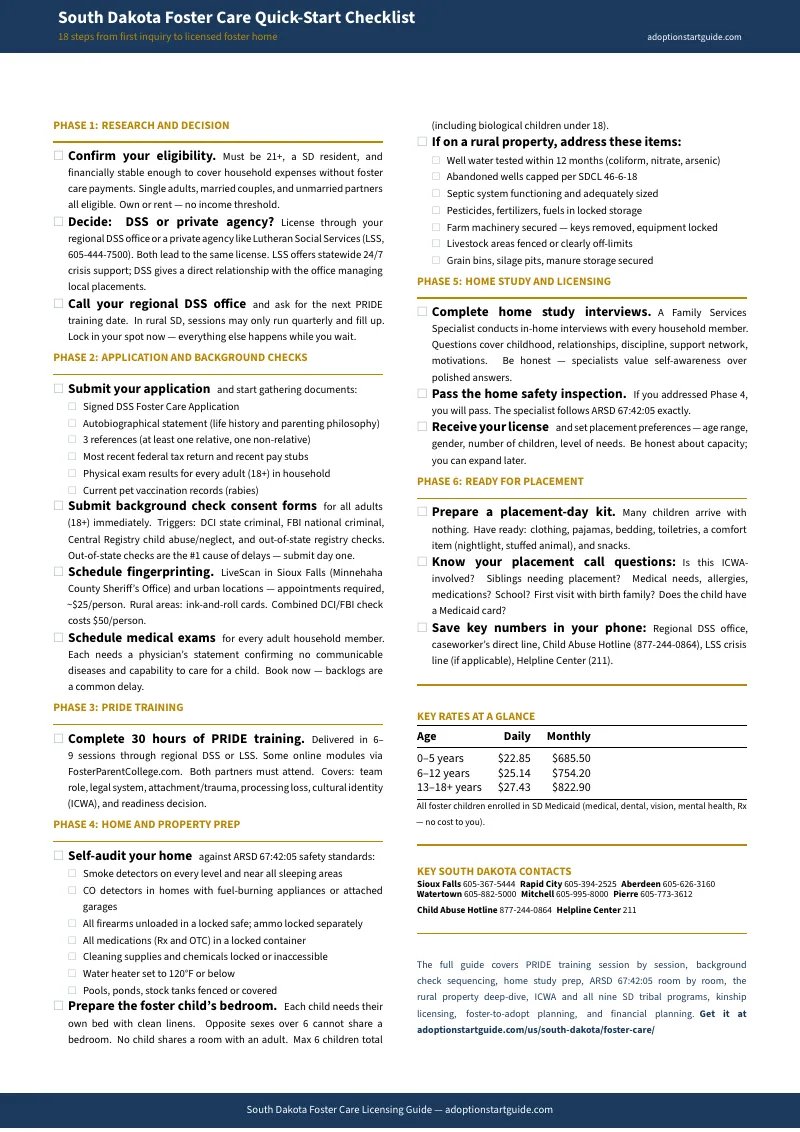
Download the South Dakota Foster Care Quick-Start Checklist for a six-phase overview of the licensing process, from your first DSS inquiry through placement readiness. Free, no commitment. If you want the full guide with the PRIDE training breakdown, rural property deep-dive, ICWA navigation, home study preparation, financial breakdown, kinship pathway, regional office profiles, and background check sequencing strategy, click the button in the sidebar.
--- less than the gas for one round trip to a regional DSS office
A single drive from a rural South Dakota county to the nearest regional DSS office --- only to find out you have the wrong form, your well water test is outdated, or the next PRIDE training doesn't start for three months --- costs more in fuel and lost time than this guide. A one-month delay in licensing because of a misunderstanding about background check sequencing or property standards means a one-month delay in receiving the maintenance payment that supports the child in your care. One chapter on home safety standards prevents the failed inspection. One chapter on ICWA prevents the confusion that makes good families quit before they finish.
If the guide doesn't deliver, reply to your download email at any time for a full refund. No forms. No justification required.