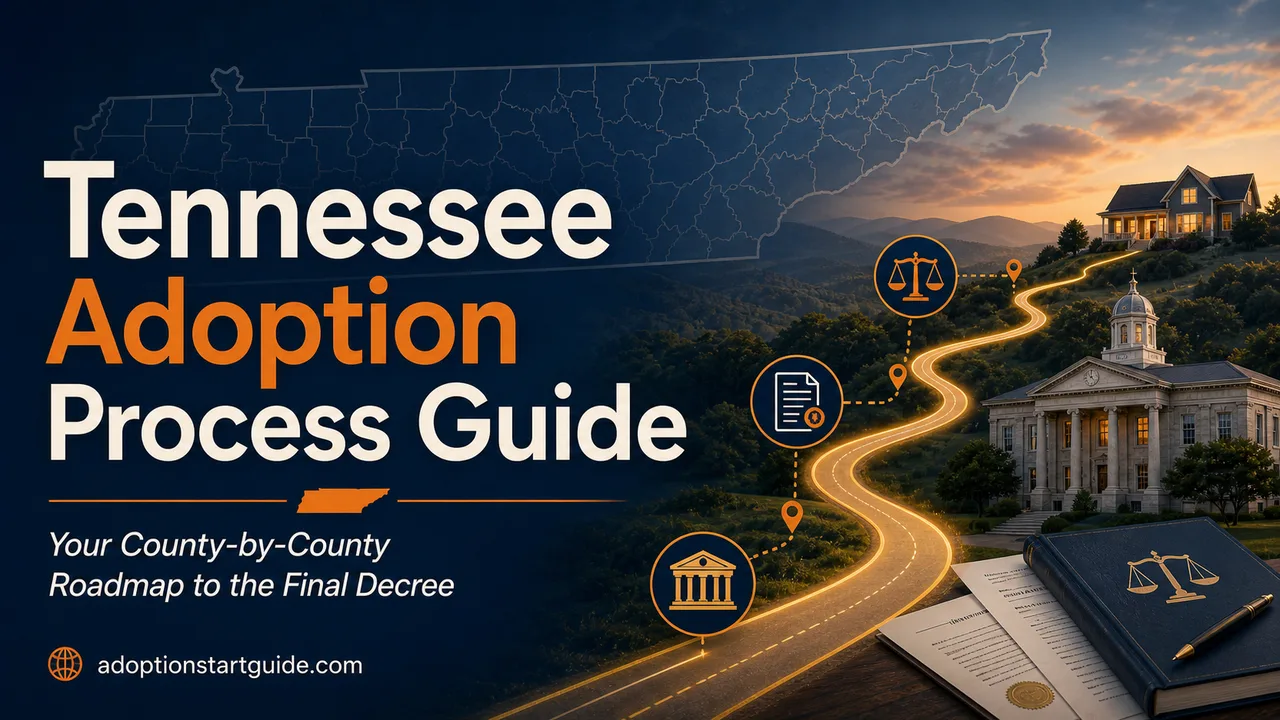
You felt called to adopt in Tennessee. Then you tried to figure out how.
It started with a clear conviction and a Google search. What you found was the DCS website — a maze of foster care policies, licensing forms, and procedural manuals written for caseworkers. You're not looking for foster care. You're looking for adoption. But the state website treats them as one conversation, and the adoption-specific pages assume you already know whether you need Chancery Court or Circuit Court, whether you should file in your county or the child's county, and what an "interlocutory order" means for the next six months of your life.
So you called an agency. The orientation was encouraging. The staff were warm. They told you about home studies and background checks and waiting families. What they didn't tell you is that the agency application fee alone is $250 to $500 — just to start the conversation — and that their total fees run $15,000 to $45,000 depending on the program. They didn't mention that independent adoption in Tennessee is legal and typically costs $7,000 to $13,000. They didn't mention it because they don't want you comparing.
Then you found the Facebook groups. A foster parent in Knoxville told you the birth father can show up "anytime" and take the baby back. That's not how it works — Tennessee's Putative Father Registry sets a 30-day window, and after that, the legal risk drops dramatically. But nobody in the group cited the statute. Someone in Memphis said the interlocutory period is "basically just a formality." It's not. During those six months, you have partial guardianship — enough to make medical decisions, but not enough for a new birth certificate, certain federal benefits, or uncontested international travel. The gap between what people say online and what Tennessee Code Title 36 actually requires is where families lose money, lose time, and lose sleep.
And then there's the question nobody answers clearly: which court handles adoption in your county? Tennessee has 95 counties, and both Chancery and Circuit courts have jurisdiction over adoption petitions. In Davidson County, you file in the Fourth Circuit Court. In Williamson County, local rules mandate Chancery. In Hamilton County, surrenders must be pre-cleared through the Clerk and Master's office. In rural counties, the judge may only hear adoption petitions once a month. Filing in the wrong court doesn't just slow you down — it can mean starting over.
The Tennessee Adoption Roadmap: Every Step from First Inquiry to Final Decree
This guide is built for Tennessee's adoption system as it actually operates — not the simplified version in agency brochures or the caseworker-facing language on tn.gov/dcs. Every chapter addresses the specific requirements under T.C.A. Title 36, Chapter 1, the jurisdictional differences across Tennessee's 95 counties, and the procedural realities that national adoption guides have no framework for. It covers DCS foster adoption, licensed agency adoption, and independent adoption under a single roof, so you can compare the pathways that agencies deliberately keep separate.
What's inside
- County-by-County Court Directory — No free resource in Tennessee tells you which court handles adoption in each of the state's 95 counties. This chapter maps the Chancery vs. Circuit jurisdiction for every county, identifies the local rules that override the general statute, and flags the rural counties where petition hearings happen monthly rather than weekly. File in the right court the first time. In a process that already takes six months minimum, a jurisdictional error is the most expensive mistake you can make for free.
- The Three Waiting Periods Explained — Tennessee adoption has three legally mandated waiting periods that overlap and confuse nearly every prospective parent. The 72-hour post-birth surrender window. The 10-day revocation period (reduced to 3 days in certain placements). The 6-month interlocutory period before the final decree. This chapter breaks down each one — what triggers it, what you can and cannot do during it, and the judicial discretion that can reduce the interlocutory period to three months for newborns. Most agencies quote the longest possible timeline because it manages their liability. This chapter quotes the actual statute and the exceptions.
- Putative Father Registry Search Protocol — The Putative Father Registry is the most misunderstood element of Tennessee adoption law. Existing resources explain how birth fathers register, but not how adoptive parents clear the registry to protect their placement. This chapter walks you through how to request a registry search using Form CS-0435, the 30-day registration deadline that creates a legal safe zone for your family, and the requirement that the search must be conducted at least 10 days before the final hearing. Every adoption attorney in Tennessee knows this. You should know it before you hire one.
- DCS Foster Adoption Pathway — The Zero-Cost Route to a $17,000 Tax Credit — Tennessee has over 8,000 children in state care. Families who adopt through DCS often pay zero out-of-pocket costs, yet qualify for the full federal adoption tax credit — currently $17,280 per child. The reason: children in DCS care are frequently designated "special needs" under the legal definition, which differs from the medical definition. This chapter explains the special needs designation, the adoption assistance agreement, the monthly subsidy that continues post-finalization, and the 2025 tax credit changes that make up to $5,000 of the credit refundable even for families with low federal tax liability. In a state with no income tax, understanding the federal credit is the entire financial strategy.
- Independent Adoption in Tennessee — Legal Framework and Cost Comparison — Tennessee is one of the states that permits independent (non-agency) adoption, where a birth mother places directly with an adoptive family through an attorney. This pathway typically costs $7,000 to $13,000 — a fraction of agency fees. But it carries specific legal requirements: the birth mother must receive independent legal counsel, all expenses paid to the birth mother must be court-approved, and the home study must still be completed by a licensed agency or DCS. This chapter maps the independent pathway step by step, including the allowed and prohibited birth mother expenses under Tennessee law, so you can evaluate this option with the same legal clarity the agencies have.
- Home Study Preparation and Background Check Roadmap — Every adoption in Tennessee requires an approved home study, whether you're going through DCS, an agency, or an independent placement. The home study includes TBI and FBI criminal background checks for every adult in the household, a CPS history review, financial verification, personal references, and a home inspection. This chapter explains what triggers additional review versus what creates a bar, how to prepare documentation before the fingerprinting appointment, and the specific physical requirements for your home — bedroom standards, safety equipment, and the items that cause the most delays. Handle the background check and home preparation before the social worker's first visit, not after they flag something you could have resolved in an afternoon.
- The Interlocutory Operating Manual — Life During the Six-Month Wait — After the court enters the interlocutory order, you're a parent in every practical sense but not a legal parent on paper. This chapter addresses the daily questions that agencies refuse to answer in writing: Can you travel out of state? Enroll the child in school? Add them to your health insurance? What happens if you need emergency medical consent? The interlocutory period is where families feel the most abandoned by the system — the agency's job is done, the attorney is waiting for the final hearing, and you're living with a child whose legal status is still technically "pending." This chapter fills that gap.
- 2025 Financial Planning — Costs, Credits, and the Tennessee Tax Advantage — A side-by-side cost comparison of DCS foster adoption, licensed agency adoption, independent adoption, and premium private placement. Federal adoption tax credit calculation for Tennessee families who pay no state income tax. Employer adoption assistance programs. The refundable $5,000 provision under the 2025 tax law changes. Military adoption reimbursement for families at Fort Campbell or the Memphis naval base. This chapter converts the financial uncertainty into a spreadsheet conversation you can have with your accountant before you commit to a pathway.
Printable standalone worksheets included
- Adoption Timeline Tracker — Every milestone from your first inquiry through the final decree, with fill-in date fields. Print it, update it after every agency contact, attorney meeting, and court date, and always know where you stand in the process.
- Home Study Preparation Checklist — Background check documents, home safety requirements, financial records, personal references, and medical forms — every item you need, in the order you need it, with checkboxes.
- Putative Father Registry Search Checklist — Step-by-step guide to requesting and confirming the registry search, including Form CS-0435, the 30-day window calculation, and the 10-day pre-hearing requirement.
- Financial Comparison Worksheet — DCS, agency, and independent adoption costs side by side, with federal tax credit calculation fields for Tennessee's no-state-income-tax situation.
Who this guide is for
- First-time adoptive parents in Tennessee — You've decided to adopt but every search leads to agency marketing, caseworker manuals, or advice from other states. You need Tennessee-specific guidance that covers all three pathways — DCS, agency, and independent — so you can choose based on your situation, not based on which agency's ad you clicked first.
- Families pursuing independent adoption — You've connected with a birth mother or you're exploring the attorney-facilitated route. You need to understand the legal requirements for independent placement, the court-approved expenses, and the specific risks that this pathway carries compared to agency adoption. This guide covers the independent framework that agencies have no incentive to explain.
- Foster families considering adoption through DCS — You're already fostering a child and reunification is no longer the permanency plan. You need to understand the transition from foster care to adoption, the adoption assistance agreement, the monthly subsidy, and the tax credit that most DCS caseworkers mention but few explain in detail.
- Stepparents and kinship families — You're adopting a stepchild, grandchild, niece, or nephew already living in your home. The process is different from infant adoption — shorter timeline, waived home study in some cases, different consent requirements. This guide covers the kinship and stepparent pathways alongside the standard routes.
- Faith-driven families navigating the legal side — Your church, your community, and your heart brought you to adoption. Now you need the legal and procedural map that your agency orientation didn't provide. This guide respects the calling and delivers the courthouse-level detail that turns conviction into a finalized decree.
Why the free resources aren't enough
The DCS website at tn.gov/dcs is built for foster care, not adoption. The adoption pages link to the same "How to Adopt" overview that hasn't materially changed in years — a high-level flowchart that doesn't address the Putative Father Registry protocol, doesn't map county court jurisdictions, and doesn't distinguish between the three adoption pathways in any operational detail. You can spend hours on the site and come away knowing less than you did when you started, because the information is organized for caseworker compliance, not for families making decisions.
Agency websites — Bethany Christian Services, Agape Nashville, the Bair Foundation — provide polished materials about their own programs. They exist to recruit families into their specific pipeline. They won't compare their $15,000-$45,000 fees to the $7,000-$13,000 independent pathway because the comparison doesn't serve their business model. They won't explain how to clear the Putative Father Registry yourself because they want you to rely on their legal team. The information they provide is accurate. It's also incomplete by design.
Adoption attorney blogs — and Tennessee has several good ones — provide excellent legal analysis. They exist to demonstrate expertise and funnel readers into $200-$400/hour consultations. A blog post about the interlocutory period is valuable. But it won't include the county court directory, the cost comparison across pathways, or the printable worksheets that turn legal knowledge into an actionable plan. And a single consultation costs more than this entire guide.
Reddit and Facebook groups share real experiences. They also share wrong information — birth father myths, outdated revocation rules, and advice from other states presented as Tennessee law. There's no mechanism for accuracy in a comment thread. When the stakes are this high, "I think that's how it works" is not a foundation for your family's future.
The free Quick-Start Checklist
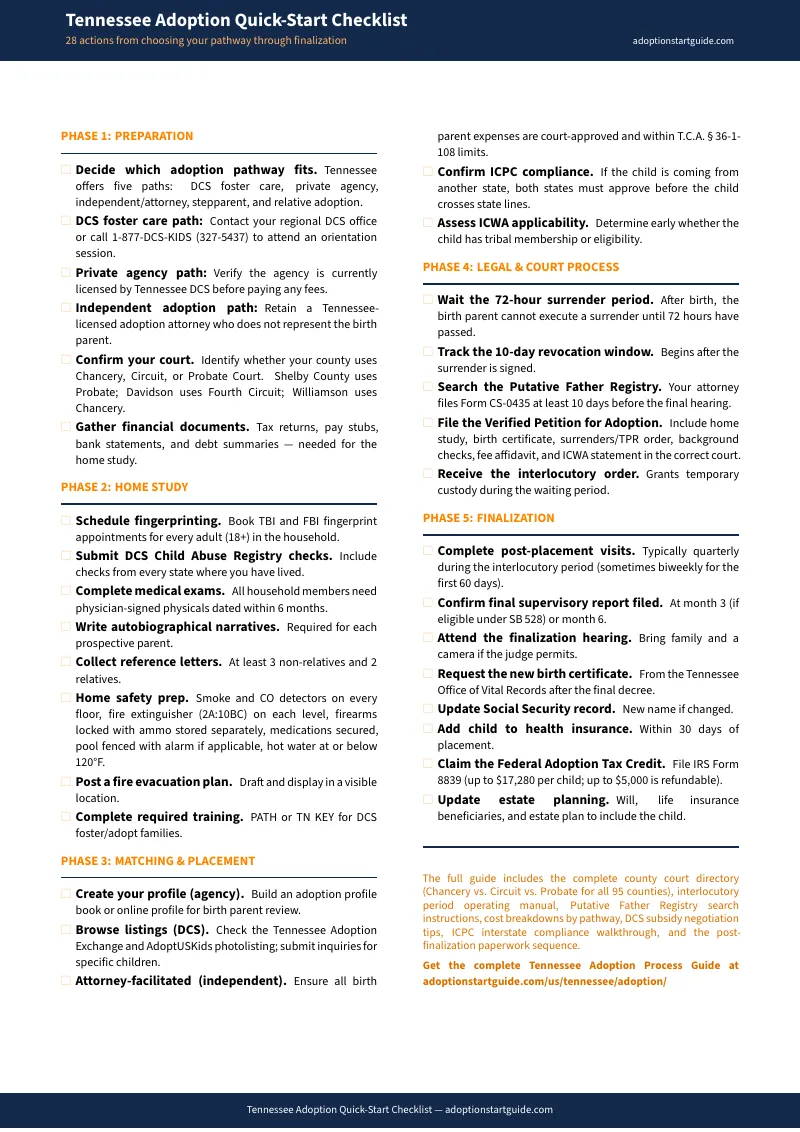
Download the Tennessee Adoption Quick-Start Checklist for a one-page overview of the adoption process — from initial inquiry through the final decree. It covers the key milestones, required documents, and the sequence the Tennessee system expects. Free, no commitment. If you want the full guide with the County Court Directory, Putative Father Registry protocol, financial comparison, interlocutory operating manual, and printable worksheets, click the button in the sidebar.
— less than one hour with a Tennessee adoption attorney
Tennessee adoption attorneys charge $200 to $400 per hour. The typical agency application fee is $250 to $500 just to begin. A wrong-court filing, a missed Putative Father Registry search, or an uninformed pathway choice can add thousands of dollars and months of delay to a process that already takes six months minimum. This guide puts the county court map, the legal timelines, the registry protocol, and the cost comparison in your hands before you write the first check to anyone.
If the guide doesn't deliver, reply to your download email at any time for a full refund. No forms. No justification required.