You want to foster a child in Vermont. Then you discovered that DCF's 12 district offices, mandatory Foundations training offered three times a year, and a home inspection checklist written for suburban houses all assume you already know what you're doing.
Vermont's foster care system is state-administered -- no county agencies, no alternative pathways, just the Department for Children and Families and its Family Services Division standing between you and your license. The DCF website gives you the rules in compliance language but never maps the steps in the order a family actually completes them. The Vermont Foster and Adoptive Family Association lists district representatives for peer support, but half those positions are vacant. The Lund Family Center focuses on adoptive placements and specialized care, not the licensing basics. And the community forums mix Vermont's VCIC fingerprinting process with other states' background check systems in the same thread.
Meanwhile, the details that matter most to Vermont families are nowhere in the standard materials. How do you pass a home inspection when your farmhouse is heated by a wood stove and your water comes from a well? What does DCF actually require for a composting toilet -- and what happens if you don't have the ANR permit? When is the next Foundations training cohort, and what happens if you miss the registration window and wait four months for the next one? Where do you schedule Livescan fingerprinting when your local police department only offers appointments two days a week? If you're a grandparent who just took in a grandchild overnight, what is Policy 221 and how does the streamlined kinship path actually work?
The information exists. It's scattered across DCF licensing rules, Vermont Statutes Annotated, VCIC fingerprinting procedures, the Vermont Child Welfare Training Partnership schedule, Agency of Natural Resources wastewater permits, and proposed legislative rate schedules. Piece it together yourself and you'll spend weeks reading documents that explain the regulations but never tell you what to do first, second, and third as a prospective foster parent in the Green Mountain State.
The Vermont Licensing Roadmap
This is a complete, Vermont-specific foster care licensing guide built around the problem every family in this state hits: navigating a system where DCF district offices, VCIC background checks, Foundations training, and rural home inspections each own a piece of the process but none of them explain how the pieces connect. Not a national overview. Not a government handbook designed for departmental compliance. Every chapter, every checklist, every reimbursement figure is grounded in current DCF policies, Vermont licensing rules, and the real-world experience of families who have been licensed in this state.
What's inside
- The 8-step licensing process mapped start to finish -- From your first call to the district office through application, background checks, Foundations training, home study interviews, home inspection, the final report, and license approval. Each step with specific milestones, documents, and realistic timeframes so the process stops feeling like a bureaucratic black hole and starts feeling like a path with a destination. Typical timeline: 3 to 5 months, but one missed training cohort can add four months overnight.
- Rural Vermont home inspection guide -- Wood stove safety guards (immovable barriers, 36-inch combustible clearance, chimney maintenance records), well water testing for arsenic and uranium (required every six years), composting toilet ANR permit requirements, fire egress in old farmhouses with finished attics, and off-grid property standards. DCF inspectors are your Vermont neighbors -- they know how people live here. But there are specific standards that must be met, and this chapter maps every one of them.
- Foundations training decoder -- The mandatory 8-week pre-service curriculum offered approximately three times per year. The five core pillars (Safety Culture, JEDI, Trauma-Informed Practice, Engagement, Permanency), the 13 required online modules you can start before classroom sessions begin, how to register before cohorts fill up, and why attending a neighboring district's session is sometimes faster than waiting for your own. Missing one registration window means waiting four months.
- VCIC and FBI background check sequence -- The exact order for fingerprinting, the VCIC state criminal check, the FBI national check, the Child Protection Registry screen, out-of-state Adam Walsh Act checks, DMV and court record reviews. Where to schedule Livescan appointments in rural Vermont (limited hours, appointment-only at most police departments), what ID to bring, the $35 fee, and why scheduling this the day you receive your paperwork saves you weeks of avoidable delay. Processing time: 8 to 10 weeks for FBI results alone.
- Policy 221 kinship care roadmap -- The streamlined path for grandparents, aunts, uncles, and fictive kin who need to act fast. How the Suitability Assessment gets a child placed with you before full licensing is complete, how non-safety variances work for sleeping arrangements and bedroom size, the $30/day emergency flat rate during the initial period, and the Reach Up Child Only grant that kinship caregivers often don't know exists.
- Financial support breakdown -- Daily maintenance rates by age group and Level of Care (Level 1 standard through Level 3 specialized, up to $200/day for 24-hour care), the $30/day emergency flat rate, clothing vouchers up to $100, child care subsidies up to $600/month, mileage reimbursement at $0.555/mile for case plan travel, the 6-week submission deadline for expense reports, and supplemental programs including WIC, free school meals, Dr. Dynasaur/Medicaid, and the VFAFA Children's Activity Fund.
- Foster parent rights under DCF Policy 94 -- Your right to pre-placement information, participation in the Child and Family Support Team, court notice for post-disposition hearings, submitting a Foster Parent Report to the Court, and your right to decline any placement. Plus mandatory reporting obligations under 33 V.S.A. Section 4913 and documentation requirements for daily logs, medication administration records, and 24-hour incident reports.
- The foster-to-adopt pathway -- How Termination of Parental Rights works in Family Court, what a "legal risk" placement means, the mandatory six-month trial period, finalization through Probate Court, and how to negotiate Adoption Assistance before the final order so you don't leave support on the table.
Printable templates and checklists included
- Master Document Checklist -- Every document DCF requires during the application, organized in the order you'll need them. Form FSD-200, background check authorizations, medical exams, TB tests, pet vaccination records, well water results, reference contacts, financial documentation, and more.
- Home Safety Self-Inspection Checklist -- Walk your home room by room before the official inspection. Fire safety, water temperature, firearms storage, medication lockup, bedroom standards, pool fencing, and the Vermont-specific items (wood stove guard, well water test, chimney service record) that catch rural families off guard.
- Placement Call Checklist -- When the phone rings with a potential placement, 14 questions to ask before you say yes or no. Child's age and history, medical conditions, behavioral triggers, sibling status, visitation schedule, and the assigned social worker's direct number.
- Daily Log and Mileage Tracking Templates -- Ready-to-print formats for the documentation DCF requires. The daily log covers mood, school, behavior, visitation, medications, and notable events. The mileage tracker maps to Form FS-333B so your reimbursement claims are never late.
Who this guide is for
- Couples and individuals exploring foster care for the first time -- You've been reading the DCF website and you can't tell whether to call your district office, register for Foundations training, or schedule fingerprinting first. This guide puts the steps in order so you stop researching in circles and start moving forward.
- Rural homeowners worried about the inspection -- Your farmhouse has a wood stove, a private well, and a finished attic you wanted to use as the child's bedroom. This guide tells you exactly what DCF requires for each one so your property doesn't derail an application that's otherwise ready.
- Kinship caregivers who need to act fast -- A grandchild, niece, or family friend's child was just placed with you. You need to know about Policy 221, the emergency flat rate, the Reach Up grant, and the path from emergency placement to full licensure. This chapter exists because you don't have weeks to research.
- Single adults ready to open their home -- Vermont welcomes single foster parents. This guide addresses the single-applicant pathway directly, including the financial self-sufficiency standard and how the home study evaluates your support network.
- LGBTQ+ families -- Vermont has actively recruited same-sex couples and LGBTQ+ individuals since before most states acknowledged them. This guide reflects that reality throughout, not as a footnote.
Why the free resources aren't enough
The DCF website covers the licensing process across multiple pages written for regulatory compliance, not for a family sitting at their kitchen table trying to figure out where to start. Key details -- when the next Foundations cohort opens, which Livescan locations have availability, how to handle a well water test failure, what variances are available for kinship homes -- are either buried in policy documents or absent entirely. Families describe the experience as "reading a manual that assumes you already read the other three manuals first."
The Vermont Foster and Adoptive Family Association provides peer support and advocacy, but many district representative positions are currently vacant, leaving families in rural areas without a local mentor during the licensing phase. The Lund Family Center focuses on specialized adoptive placements through Project Family, not the standard licensing basics. The Vermont Child Welfare Training Partnership website has training schedules but doesn't explain how to align your application, background checks, and home study around a training cohort that only runs three times a year.
Facebook groups and Reddit threads give you emotional support and secondhand experience. They also mix Vermont's state-administered VCIC process with county-based systems from other states, recommend skipping steps that aren't skippable, and offer advice based on policies that have changed. In a system where one missed training cohort costs you four months and one improperly stored firearm fails an inspection, secondhand advice from the wrong state is worse than no advice at all.
The free Quick-Start Checklist
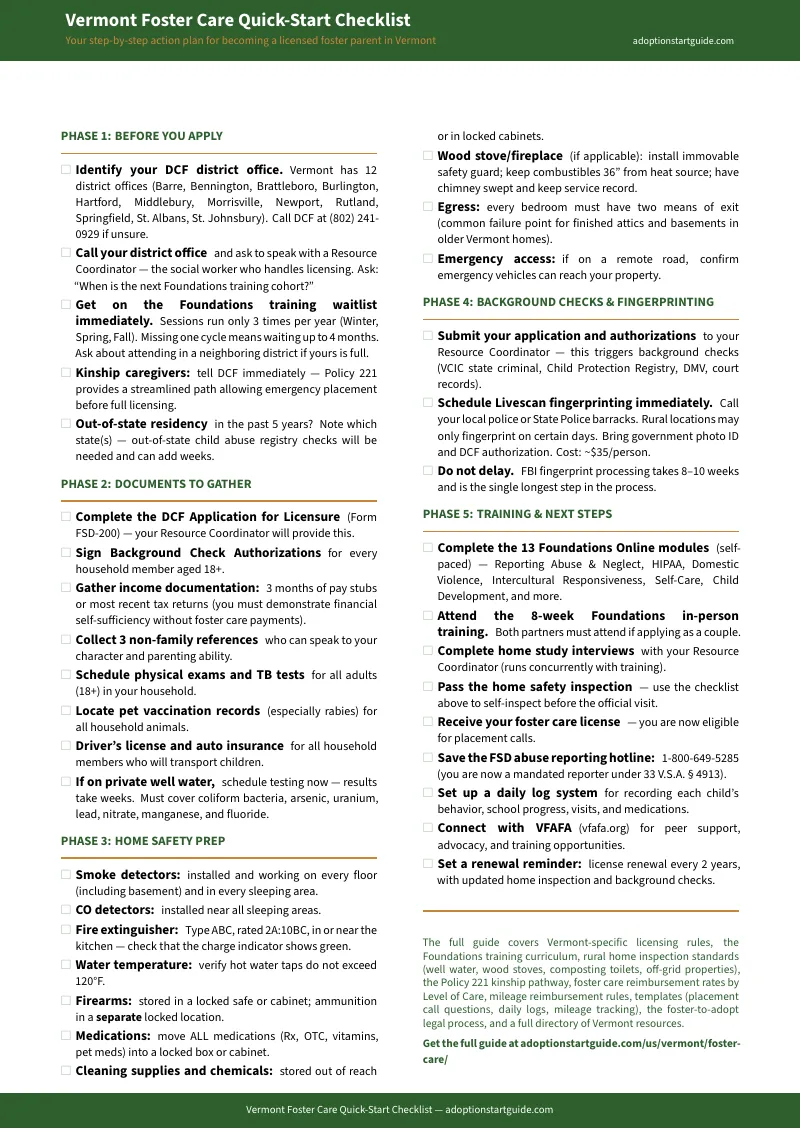
Download the Vermont Foster Care Quick-Start Checklist for a one-page overview of the key steps from first inquiry to license approval. Free, no commitment. If you want the full guide with the rural home inspection walkthrough, the Foundations training decoder, the VCIC background check sequence, the Policy 221 kinship roadmap, and all the printable templates, click the button in the sidebar.
-- less than one Livescan fingerprinting appointment
The FBI fingerprinting fee is $35 per person. A well water chemical panel runs $50 to $200. A single missed Foundations training cohort delays your license by four months -- and for kinship caregivers, that delay means months at the $30/day emergency rate instead of the full Level of Care reimbursement, costing hundreds of dollars in support that should have been yours. The Vermont Licensing Roadmap doesn't replace your Resource Coordinator. It makes sure you don't waste their time asking questions the guide already answers, and it makes sure you don't learn about the training bottleneck, the fingerprinting sequence, or the 6-week mileage submission rule after it's already cost you.