You've decided to adopt in Virginia. Then you discovered that 120 Local Departments of Social Services, 120 Circuit Courts, and the Virginia Code each assume you already understand the other two.
Virginia is not like neighboring states. The Commonwealth runs a "state-supervised, locally administered" system, which means your adoption experience depends entirely on which of the 120 LDSS offices handles your case. Fairfax County has a detailed Practice Manual and specific cover sheet requirements for Circuit Court filings. Prince William County runs a dedicated monthly adoption docket that can shave weeks off finalization. Rural counties in the Shenandoah Valley might only offer the mandatory 30-hour training once a quarter. And the VDSS website covers foster-to-adopt but says almost nothing about private, independent, stepparent, or kinship adoption.
You've already done the research. You found the VDSS website, which covers orientations and the ChildConnect photolisting but provides no clear guidance on how to navigate Circuit Court filings as a private adopter. You found agencies like Bethany Christian Services and Family Life Services, which offer excellent matching programs but are designed to funnel you into their own fee structures. You found Richmond and NoVA attorneys who bill $250 to $380 per hour. And you found Reddit threads where well-meaning strangers mix up Virginia's 7-day consent revocation window with North Carolina's 7-business-day rule and Maryland's 30-day revocation period in the same comment.
The information exists. It's scattered across VDSS guidance manuals, Virginia Code Sections 63.2-1200 through 63.2-1262, Bureau of Vital Records forms, 120 separate Circuit Court clerk offices, and agency orientation packets. Piece it together yourself and you'll burn weeks reading documents that explain the rules but never tell you the order of operations as a parent.
The Virginia Court and LDSS Navigator
This is a complete, Virginia-specific adoption guide built around the problem every family in this Commonwealth hits: navigating a system where 120 Local Departments of Social Services, 120 Circuit Courts, private agencies, and the VDSS each own a piece of the process but none of them explain how the pieces connect. Not a national overview. Not an agency brochure designed to funnel you into one program. Every chapter, every checklist, every cost figure is grounded in Virginia Code Title 63.2, current VDSS policies, Circuit Court filing requirements, and the real-world experience of families who have adopted in the Commonwealth.
What's inside
- Three-pathway comparison table -- Agency adoption, independent (parental placement) adoption, and foster-to-adopt through your LDSS, mapped side by side. Costs, timelines, eligibility, and the realistic wait for each pathway so you choose the right one before investing months in the wrong direction. Foster-to-adopt runs $0 to $1,270 for the home study. Private agency fees range from $25,000 to $40,000. Independent adoption costs $5,000 to $20,000 in attorney and home study fees. That decision deserves more than a caseworker's one-sentence summary.
- The consent and revocation decoder -- Virginia's consent rules are layered and misunderstood. Birth parents cannot sign consent until the child is at least 72 hours old. Once signed, there is a 7-day revocation window where consent can be withdrawn for any reason. But Section 63.2-1234 allows the 7-day period to be waived if the child is at least 10 days old and the birth parent has received independent legal counsel. This chapter explains every scenario: the 72-hour floor, the 7-day window, the 10-day waiver, and what happens when a birth parent attempts revocation after the window closes -- proof of fraud or duress, nothing less. Families from Maryland and D.C. are routinely blindsided because their jurisdictions handle consent differently.
- Circuit Court jurisdiction mapper -- Adoption petitions can be filed where the petitioner resides, where the agency is located, or where consent was executed. With 120 Circuit Courts across 31 judicial circuits, this is not an obvious decision. Circuit 19 (Fairfax) requires specific cover sheets and follows its own Practice Manual. Circuit 31 (Prince William) offers a dedicated monthly adoption docket. Circuit 13 (Richmond) has a streamlined domestic docket with high volume and faster processing. This chapter maps the filing rules for every major jurisdiction so you file in the court that works best for your situation, not just the one closest to your house.
- LDSS navigation guide -- Your Local Department of Social Services controls home study scheduling, training availability, and post-placement supervision. Some departments offer the 30-hour training monthly. Others offer it quarterly. Some complete home studies in 60 days. Others have six-month backlogs. This chapter explains how to assess your LDSS's responsiveness, when to pivot to a private Child-Placing Agency for your home study instead, and how to escalate concerns within the VDSS hierarchy when your local office stalls. The home study is valid for 36 months. Background checks must be updated every 18 months. Timing these correctly prevents expired clearances from derailing your timeline.
- Home study preparation guide -- What the social worker evaluates, the documents you need before the first visit, how to choose between your LDSS and a licensed private CPA, and the cost differences. LDSS home studies can be free for foster-to-adopt families. Private CPA evaluations run $1,750 to $3,000. Organized so nothing is missing when the social worker arrives.
- Post-placement supervision roadmap -- After placement, Virginia requires a minimum of three supervisory visits over six months before finalization. The social worker documents everything from dental care to school adjustment to "what makes the child laugh." Families who are unprepared for this level of scrutiny experience what practitioners call "observation fatigue." This chapter includes a visit preparation checklist so you know exactly what the worker evaluates at each of the three visits and how to document your family's progress between them.
- Military family portability guide -- For families stationed at Naval Station Norfolk, Joint Base Langley-Eustis, Fort Barfoot, or Quantico. How PCS orders affect an in-progress adoption, the Interstate Compact on the Placement of Children when you're transferred out of Virginia mid-process, the $2,000 per child DoD adoption reimbursement, 12 weeks of non-chargeable parental leave, and how to file DD Form 2675 correctly so you don't lose the reimbursement to a paperwork error.
- Stepparent and kinship adoption guide -- You've been raising your stepchild, grandchild, or relative's child. The biological parent agrees. You assume it's simple. It isn't. Even "agreed" adoptions require a home study (unless waived by the court), formal termination of parental rights, and a Circuit Court hearing. Virginia's 2021 legislative changes now allow unmarried partners to adopt as "persons with a legitimate interest," expanding second-parent adoption rights. This chapter covers the consent process, TPR when a parent has abandoned the child, and the specific filing requirements for stepparent and second-parent petitions.
- Financial planning framework -- The federal adoption tax credit reaches $17,280 for 2025 adoptions with a $5,000 refundable portion under the new provisions. Virginia's proposed state credit (HB 1962) would add a $4,000 nonrefundable credit for nonfamily adoptions -- this chapter tracks its legislative status. Title IV-E subsidies for special-needs children adopted from foster care, the DoD $2,000 reimbursement for military families, and the critical rule: the Adoption Assistance Agreement must be signed before finalization or you lose eligibility permanently.
- Post-finalization navigator -- The Circuit Court order is not the last step. Virginia's Bureau of Vital Records requires the VS-21 Report of Adoption form, a $12 processing fee, and a specific sequence for obtaining the amended birth certificate. This chapter covers every administrative step after the decree: Vital Records, Social Security update, insurance enrollment, tax credit filing, and the Virginia-specific forms that most families don't learn about until after finalization.
Who this guide is for
- Northern Virginia professionals navigating a complex system -- You live in Fairfax, Arlington, or Loudoun County. You work in tech, government, or the federal sector. You treat adoption the way you treat every major project: research first, execute efficiently. The $380-per-hour family attorney is your last step, not your first. You want to understand Fairfax Circuit Court's specific cover sheets and the NoVA agency landscape before your first consultation.
- Hampton Roads military families managing deployments and PCS -- You're stationed at Norfolk, Langley-Eustis, or Quantico. Your biggest fear isn't the adoption process itself -- it's a PCS order arriving in the middle of it. This guide covers ICPC portability, the DoD reimbursement, and how to choose an LDSS and attorney who understand the military timeline.
- Central and rural Virginia families with limited local resources -- Your LDSS is the only accessible resource, but it's stretched thin and training sessions are infrequent. Richmond, Charlottesville, and the Shenandoah Valley all have different agency cultures and Circuit Court practices. This guide gives you the escalation paths and alternatives when your local department has a six-month backlog.
- Stepparents and kinship caregivers who need legal standing -- You've been raising a child for months or years. The absent biological parent hasn't been involved. You need legal permanency, not emotional validation. This guide walks you through consent, TPR, and the filing process so one missed step doesn't cost you months in Circuit Court.
- Foster families ready to adopt -- The child in your care has had reunification ruled out. The transition from foster license to adoption petition involves different documents, the mandatory six-month post-placement period, and the Adoption Assistance Agreement that must be executed before the judge signs the decree. This guide maps that transition.
Why the free resources aren't enough
The VDSS website covers the foster-to-adopt pathway. It provides the ChildConnect photolisting, orientation schedules, and general information about how Virginia's "locally administered" system works. But it provides minimal guidance on the Circuit Court filing process, offers no comparison of LDSS responsiveness across regions, and says little about private, independent, or kinship adoption. If you're not entering through the foster care door, VDSS has limited help for you.
Private agencies like Bethany Christian Services, Children's Home Society of Virginia, and Family Life Services provide excellent matching and counseling support. They also charge $25,000 to $40,000 in placement fees and are structurally designed to guide you toward their programs. They don't explain how to file your own petition in Circuit Court, how to choose between LDSS and private CPA home studies, or when to use a different pathway than the one they sell.
National adoption websites discuss "state adoption laws" without explaining that Virginia has 120 separate LDSS offices with different training schedules, that the consent revocation window can be waived under Section 63.2-1234, or that Prince William County has a dedicated adoption docket while rural circuits hear adoption petitions only a few times per year. They reference "home study timelines" without noting that your LDSS's backlog can vary by months depending on which county you live in.
Virginia adoption attorneys charge $250 to $380 per hour. A single consultation costs $300 to $500. Families routinely spend their first billable hour asking foundational questions this guide answers in the first chapter. The Virginia Court and LDSS Navigator doesn't replace your attorney. It makes sure you don't pay your attorney to teach you the basics of Virginia adoption law.
Printable standalone worksheets included
The guide comes with printable standalone PDFs designed for real-world use:
- Pathway Comparison Card -- Three pathways side by side on one page. Agency adoption, independent adoption, and foster-to-adopt. Costs, timelines, and the first steps for each route. Print it, sit down with your partner, and make the decision that shapes everything else.
- Home Study Document Checklist -- Every document your social worker will request, organized by category. Financial records, medical clearances, reference letters, background check forms, and home safety requirements. Nothing missing when the worker arrives.
- Post-Placement Visit Tracker -- All three mandatory supervisory visits with the specific evaluation criteria for each visit. Fillable date fields so you can track progress and prepare for what the social worker assesses at months one, three, and six.
- Post-Finalization Action Plan -- VS-21 Report of Adoption form, amended birth certificate through the Bureau of Vital Records, Social Security update, insurance enrollment, the federal adoption tax credit, and the Virginia-specific forms. Every administrative step after the decree, in order, with contacts and processing timelines.
The free Quick-Start Checklist
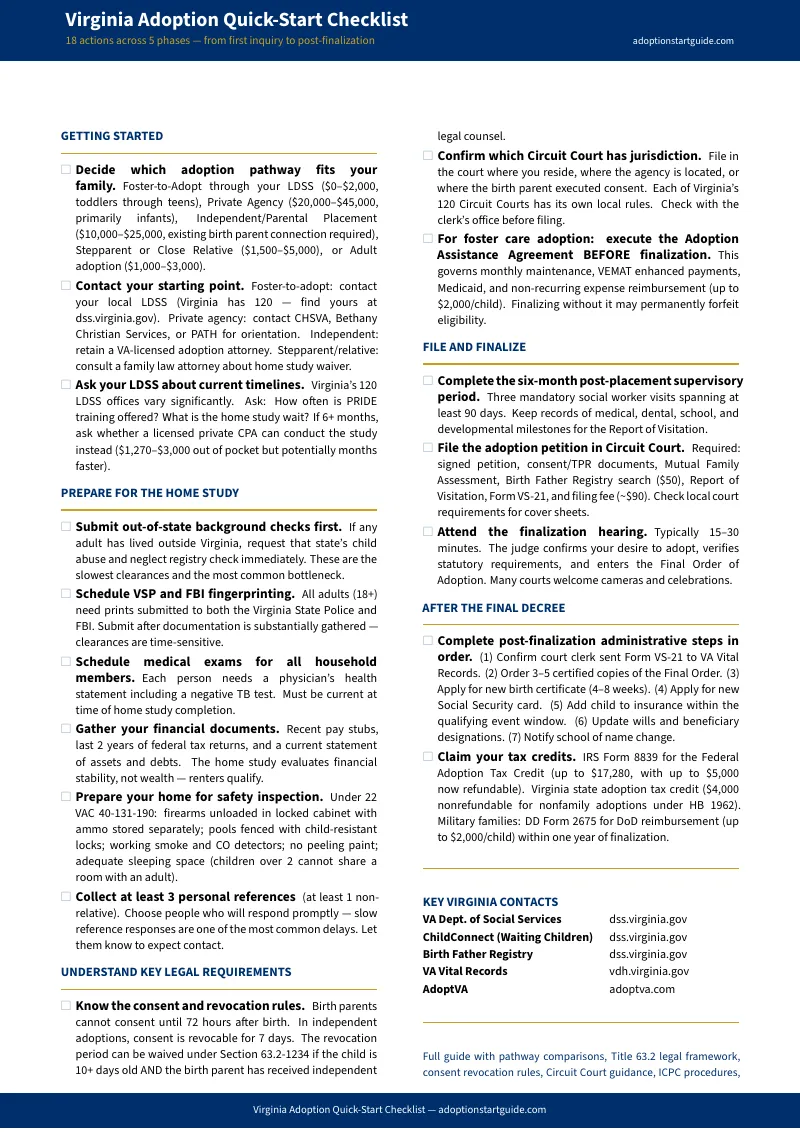
Download the Virginia Adoption Quick-Start Checklist for a one-page overview of the key steps from first inquiry to finalization. Free, no commitment. If you want the full guide with the three-pathway comparison, the consent and revocation decoder, the Circuit Court jurisdiction mapper, the LDSS navigation guide, the military portability section, and all the printable worksheets, click the button in the sidebar.
-- less than one minute of a Virginia adoption attorney's time
The average family law attorney in Virginia bills $250 to $380 per hour. A single orientation consultation runs $300 to $500. Families routinely spend their first billable hour covering foundational questions this guide answers in Chapter 1. The Virginia Court and LDSS Navigator doesn't replace your attorney. It makes sure you don't pay your attorney to teach you the basics, so every minute of their time goes toward the legal work that actually requires a law degree.
Over 600 children are currently waiting for adoptive families in Virginia's ChildConnect system. The process is complex. It doesn't have to be confusing.